Market Summary
Executive Summary and Global Market Analysis
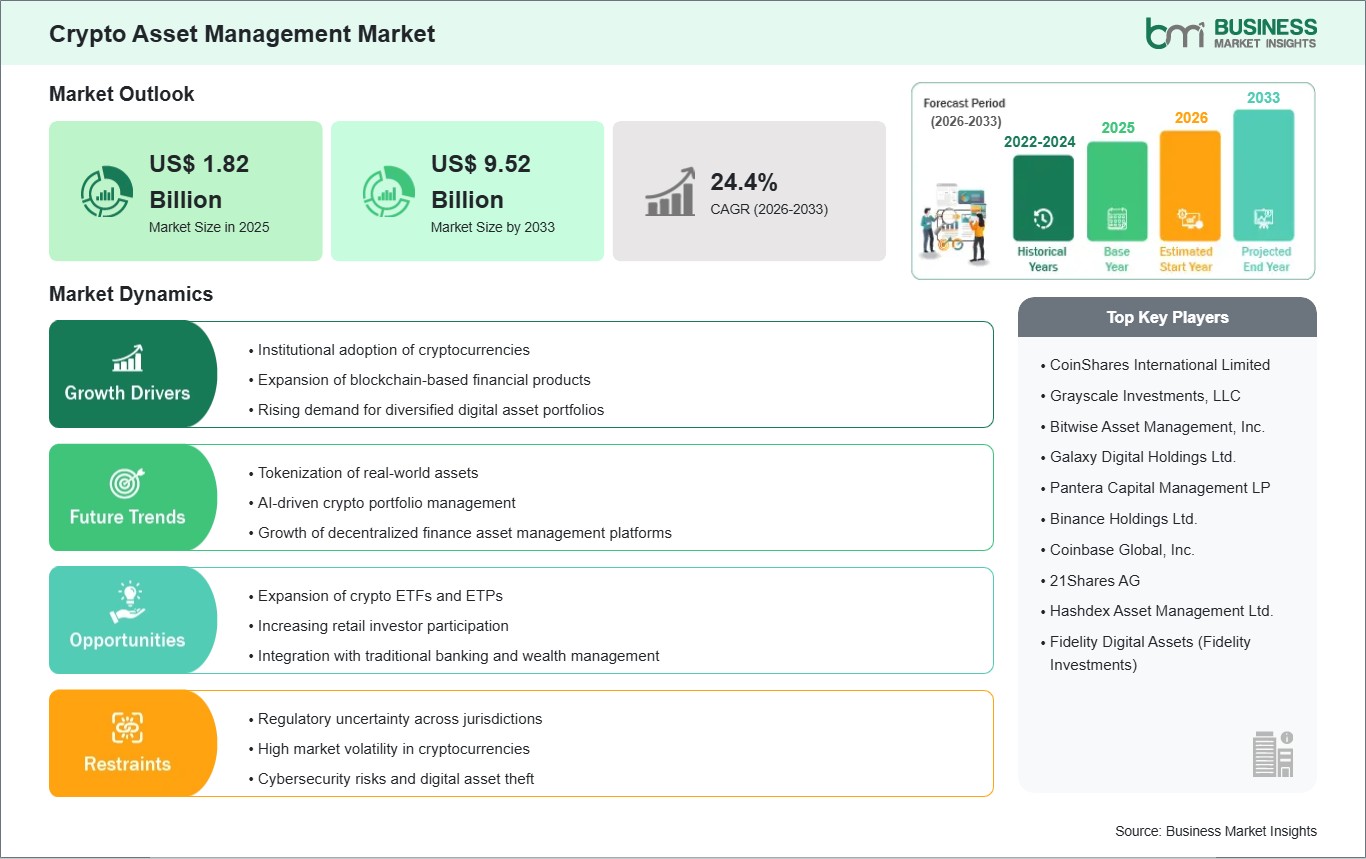
Crypto asset management refers to the integrated application of automated platforms and professional services engineered to facilitate the secure storage, tracking, and optimization of digital currency portfolios. By utilizing a coordinated framework of hardware and software, including institutional-grade cold storage, multi-party computation (MPC) wallets, and real-time portfolio analytics, these systems enable investors to manage diverse assets across multiple blockchain networks from a unified interface. This technology is fundamental to the operational architecture of hedge funds, family offices, and traditional financial institutions seeking to incorporate digital assets into their broader investment strategies. Market expansion is being propelled by the rapid global transition toward the tokenization of real-world assets (RWA), the rising institutional requirement for regulated investment vehicles like spot ETFs, and the increasing integration of decentralized finance (DeFi) protocols with centralized financial (CeFi) platforms.
However, several factors may restrain market progression. The high capital intensity associated with establishing enterprise-grade security infrastructure, encompassing specialized cybersecurity protocols and high-end insurance coverage, remains a primary hurdle for smaller asset managers. The industry also faces persistent technical challenges regarding interoperability, as the lack of standardized communication between different blockchain ecosystems can complicate the seamless transfer and consolidated reporting of assets. Additionally, the proliferation of varied national policies has intensified concerns regarding regulatory fragmentation, as the absence of a centralized global framework slows capital formation and creates compliance risks for cross-border transactions. These hurdles, compounded by high market volatility and a documented shortage of institutional-grade insurance capacity, increase the total cost of ownership and may lengthen the due diligence cycles for traditional fiduciaries.
Despite these hurdles, the market outlook remains highly favorable as the sector transitions toward Institutional Verticalization and On-Chain Infrastructure. Opportunities are emerging through the adoption of Tokenized ETFs; the market is witnessing a surge in blockchain-based representations of exchange-traded funds that enable continuous, 24/7 trading and near-instantaneous settlement. The corporate segment is gaining significant traction, with a rising requirement for Digital Asset Treasury (DAT) solutions as publicly traded companies increasingly hold digital assets as a primary balance-sheet allocation. Furthermore, the growth of AI-Driven Self-Managing Wallets, which utilize autonomous agents to rebalance portfolios and execute trades without human intervention, aligns with global goals for enhanced operational efficiency and data-fortified commerce.
Segment Analysis
Crypto Asset Management Market Segmentation
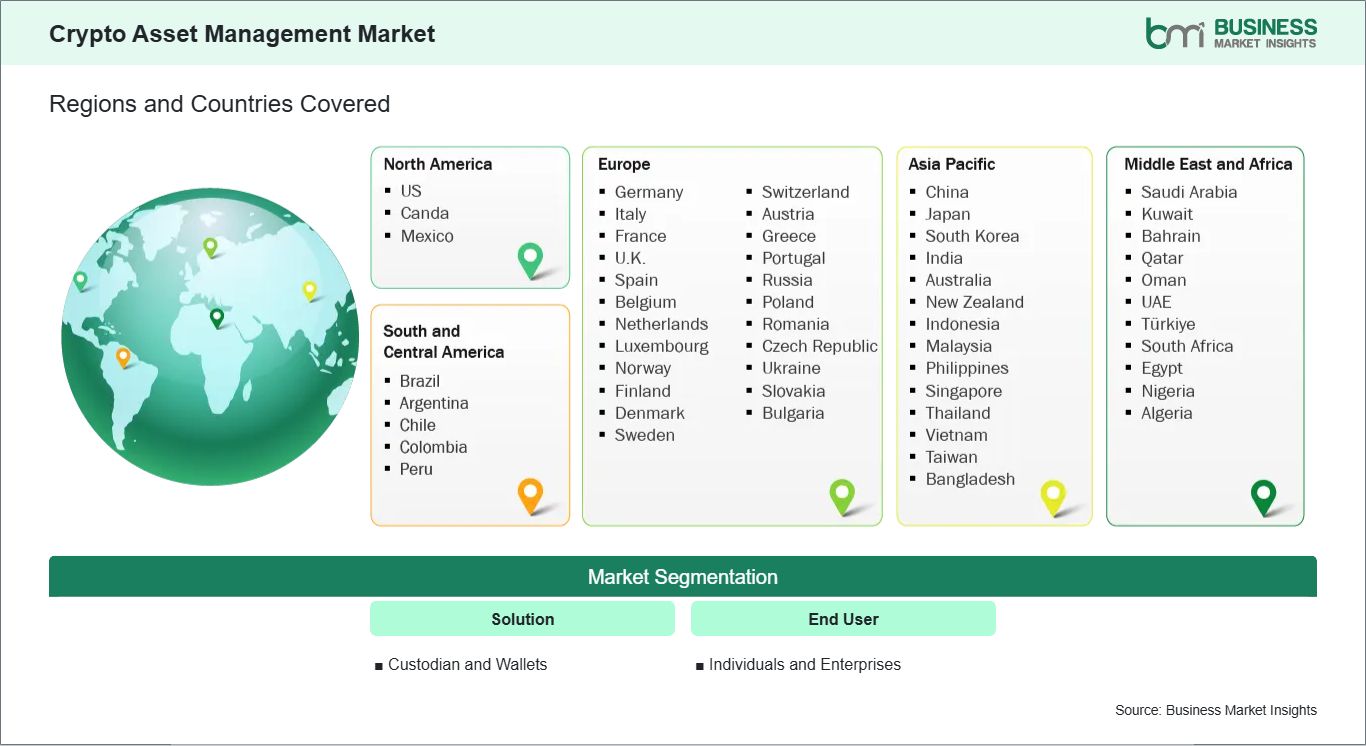
Key segments that contributed to the derivation of the Crypto Asset Management market analysis are solution and end user.
- By Solution, the market is segmented into Custodian and Wallets.
- By End User, the market is categorized into Individuals and Enterprises.
Market Forces
Crypto Asset Management Market Drivers and Opportunities
Rising Demand for Transparency, Security, and Institutional Adoption
The crypto asset management market is being driven by the growing need for transparency, security, and institutional adoption across financial services, fintech, and investment sectors. As cryptocurrencies and digital assets gain mainstream recognition, investors are seeking reliable platforms to manage portfolios, mitigate risks, and ensure compliance with evolving regulations. Institutional participation is amplifying adoption, with hedge funds, banks, and asset managers integrating crypto into diversified investment strategies. Rising demand for secure custody solutions is reinforcing growth, as asset managers prioritize protection against cyber threats and fraud. The expansion of decentralized finance (DeFi) and tokenized assets is also fueling demand for advanced management tools that provide real‑time analytics, liquidity tracking, and automated reporting. Additionally, stricter regulatory frameworks across major economies are propelling investment in compliant, transparent asset management platforms. Collectively, transparency priorities, security requirements, and institutional adoption are sustaining momentum in the global crypto asset management market.
Rising Integration of AI, Blockchain, and Emerging Applications
Opportunities in the crypto asset management market are expanding through the integration of artificial intelligence, blockchain innovations, and emerging cross‑industry applications. AI‑enabled platforms are opening lucrative opportunities by delivering predictive analytics, automated trading strategies, and risk assessment models tailored to volatile crypto markets. Blockchain‑driven solutions are gaining traction, enabling decentralized asset management, smart contract‑based governance, and tokenized fund structures. The growing emphasis on digital transformation is fueling demand for interoperable platforms that integrate seamlessly with traditional financial systems, custodians, and compliance frameworks. Emerging applications in wealth management are driving innovation, as crypto asset management tools support hybrid portfolios combining digital and traditional assets. Retail investors and high‑net‑worth individuals are reinforcing opportunities, where user‑friendly platforms provide personalized insights, tax optimization, and secure custody. Additionally, sustainability trends are encouraging deployment of energy‑efficient blockchain protocols and ESG‑aligned crypto investment strategies. The expansion of central bank digital currencies (CBDCs), cross‑border payments, and decentralized autonomous organizations (DAOs) is creating new pathways for adoption. Vendors who focus on AI‑driven, blockchain‑ready, and regulatory‑compliant asset management solutions are well‑positioned to capture growth. The convergence of AI, blockchain, and institutional finance underscores a transformative trajectory for the global crypto asset management market.
Size and Share Analysis
Crypto Asset Management Market Size and Share Analysis
The Crypto Asset Management market demonstrates steady growth, with size and share analysis revealing evolving trends and competitive positioning among key players. The report examines subsegments categorized within solution and end user, offering insights into their contribution to overall market performance.
Based on Solution, the Custodian subsegment holds a strong presence, as custodial services are indispensable for safeguarding digital assets, ensuring compliance, and providing institutional‑grade security. Custodians are essential for enterprises and large investors who require regulated, secure storage and management of cryptocurrencies. The Wallets subsegment dominates adoption among individuals, offering accessibility, convenience, and control over private keys. Wallets can be hot (online) or cold (offline), catering to different security and usability needs. Together, custodians and wallets highlight the dual nature of crypto asset management solutions, balancing institutional trust with individual empowerment in the digital economy.
Report Coverage
Crypto Asset Management Market Report Coverage and Deliverables
The Crypto Asset Management Market Size and Forecast (2022 & 2033)& report provides a detailed analysis of the market covering below areas:
- Market size and forecast at global, regional, and country levels for all market segments covered under the scope
- Market trends, as well as drivers, restraints, and opportunities
- Market analysis covering key trends, global and regional framework, major players, and recent developments
- Market concentration, heat map analysis, prominent players, and recent developments
- Detailed company profiles, including SWOT analysis
Geographic Insights
Crypto Asset Management Market Geographic Insights
The geographical scope of the Crypto Asset Management market report is divided into five regions: North America, Asia Pacific, Europe, Middle East & Africa, and South & Central America.
North America maintains a preeminent position within the global industry, a status reinforced by a mature financial ecosystem and the early adoption of regulated investment vehicles. The regional landscape is characterized by a significant market share, with the United States serving as the primary hub for institutional capital and technological innovation. This market leadership is supported by a robust presence of technology pioneers, including Coinbase, Inc., Fidelity Digital Assets, Gemini Trust Company, LLC, and BitGo, Inc., who drive the commercialization of enterprise-grade custody and portfolio management platforms.
Industrial and enterprise trends in the region reflect a decisive shift toward Institutional Integration and Spot ETF Proliferation. Organizations are increasingly moving away from speculative retail-driven trading to adopt structured, diversified portfolios managed through regulated vehicles, such as spot exchange-traded funds. Furthermore, the region is witnessing an escalating demand for Tokenized Real-World Assets and Hybrid Custodial Models. This focus on Institutional-Grade Infrastructure allows major banks and hedge funds to utilize blockchain rails for high-value settlements, such as tokenized repo trades, while maintaining the security of multi-party computation and hardware-based safeguarding.
Industry Activity
Recent Developments
The Crypto Asset Management market is evaluated by gathering qualitative and quantitative data post primary and secondary research, which includes important corporate publications, association data, and databases. A few of the key developments in the Crypto Asset Management market are:
- In January 2026, Coincheck Group announced the acquisition of 3iQ, a leading global digital asset manager. The acquisition enhances Coincheck’s institutional-grade crypto investment offerings and expands its international presence. This development underscores the growing consolidation and adoption of regulated digital asset management solutions, highlighting a positive trend in the crypto asset management market.
- In April 2026, Franklin Templeton announced the acquisition of 250 Digital, a cryptocurrency investment management firm spun out of CoinFund, and launched a new division, Franklin Crypto. The move strengthens its active digital asset management capabilities by integrating specialized investment strategies and experienced leadership. This development enhances institutional access to crypto investment solutions and expands its global digital asset platform. It highlights the growing institutionalization of crypto asset management.
Trust & Transparency
Research Methodology
The market analysis combines proprietary research with secondary data from government agencies, company disclosures, regulatory filings, industry databases and expert interviews. Market estimates are validated through data triangulation, cross-market benchmarking and analyst
review.
View Full Research Methodology
Key Sources Referred:
World Bank & Global Trade Indicators World Trade Organization (WTO) International Monetary Fund (IMF) International Trade Administration (ITA) Company Websites Company Annual Reports Company Investor Presentations