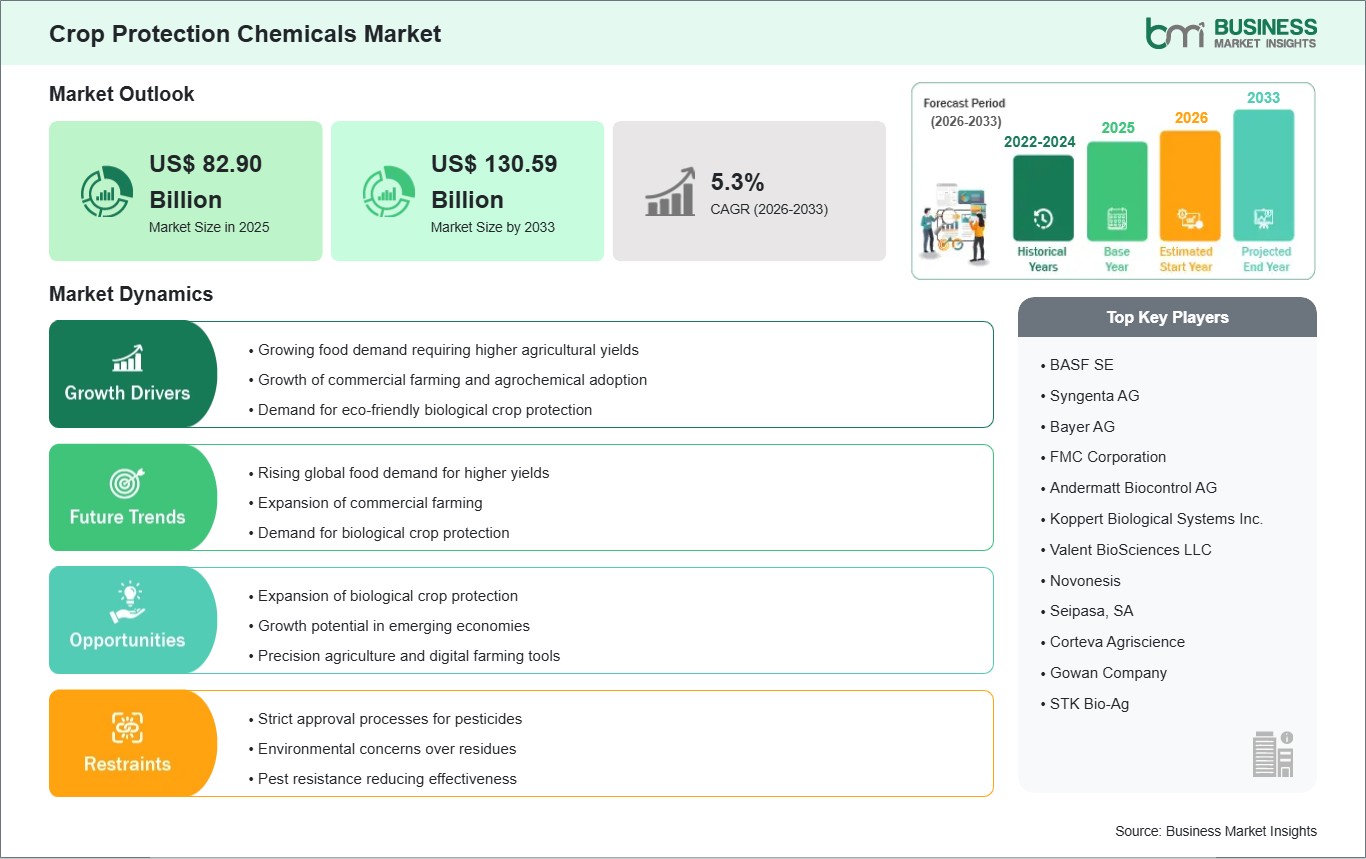
The crop protection chemicals market size is expected to reach US$ 130.59 billion by 2033 from US$ 82.90 billion in 2025. The market is estimated to record a CAGR of 5.3% from 2026 to 2033.
Market growth is fueled by rising global food demand, shrinking farmland, and the use of high-yield crop varieties that need protective inputs. The growth of commercial farming in developing countries, increased awareness of preventing crop loss, and advancements in product formulation and application methods also boost demand. Integrated pest management practices and the creation of more targeted and efficient products are contributing to market growth.
However, strict environmental regulations, concerns about chemical residues, and a rising preference for organic farming practices might limit growth. The costs of meeting regulations and the development of resistance among pests also pose challenges. Nonetheless, ongoing innovation in bio-based and sustainable crop protection solutions supports steady market growth in the coming years.

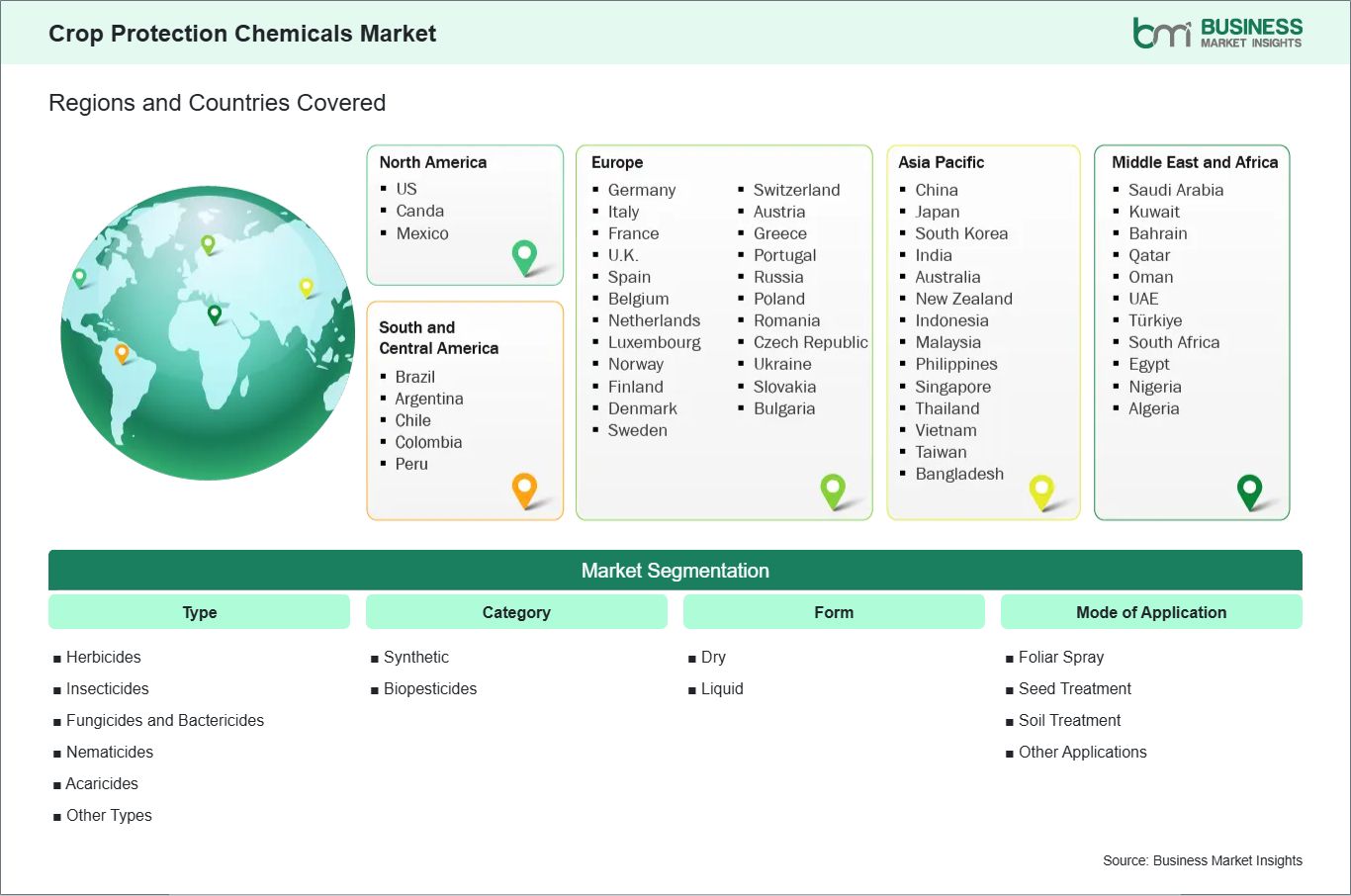
Key segments that contributed to the derivation of the crop protection chemicals market analysis are type, category, form, mode of application, and crop type.
The primary growth factor in the crop protection chemicals market is the increasing global demand for food, driven by population growth, urbanization, and changing diets. The global population is expected to surpass 9 billion by 2050, which means agricultural productivity must rise to ensure food security. Crop protection chemicals, such as herbicides, insecticides, fungicides, and nematicides, are crucial for reducing losses from pests, diseases, and weeds. They help farmers achieve higher yields from limited arable land.
This is especially significant in areas with high population density and restricted cultivable land, like parts of Asia and Africa. The use of high-yield and hybrid crop varieties has also increased the need for crop protection products to maintain plant health and ensure steady output. Furthermore, modern farming methods, such as precision agriculture, integrated pest management, and mechanized cultivation, have improved the effectiveness of crop protection chemicals. These factors make using crop protection solutions vital for meeting global food demand, supporting farm profits, and maintaining agricultural sustainability, which leads to ongoing growth in the market.
There is a significant growth opportunity in the crop protection chemicals market through the development and use of bio-based and sustainable products. Growing awareness of the environment, strict regulations, and consumer demand for safer, residue-free food are pushing manufacturers to innovate beyond traditional synthetic chemicals. Biopesticides, botanical extracts, microbial formulations, and other natural options are becoming popular as eco-friendly solutions that reduce soil and water contamination while still protecting crops.
Research and development in microbial pest control, plant-based active ingredients, and precision application technologies support this shift by improving efficiency and lowering chemical use. Emerging markets, especially in Asia Pacific and South & Central America, present substantial opportunities due to widespread adoption of sustainable agriculture practices and government incentives for organic farming. Furthermore, collaborations between biotech companies, agrochemical firms, and research institutions are speeding up product innovation and market entry. As global regulatory pressure increases, companies that invest in bio-based and sustainable crop protection solutions can meet growing demand while addressing environmental and health issues, making this area a major growth path for the industry.

The crop protection chemicals market demonstrates steady growth, with size and share analysis revealing evolving trends and competitive positioning among key players. The report examines subsegments categorized within type, category, form, mode of application, and crop type, offering insights into their contribution to overall market performance. By type, the herbicides segment holds the largest market share. This dominance comes from its widespread use in controlling weeds in cereals, grains, oilseeds, and pulses, which are major staples in global agriculture. Herbicides are preferred for their effectiveness in improving crop yields and reducing the need for labor-intensive manual weeding. The growth of this segment is fueled by the expansion of large-scale commercial farming, rising demand for high-yield crops, and the adoption of modern farming practices in emerging economies. Ongoing innovations in selective and environmentally friendly herbicides are also promoting wider use. These factors make the herbicides segment a vital part of the crop protection chemicals market, with steady demand expected in the coming years.
| Report Attribute | Details |
|---|---|
| Market size in 2025 | US$ 82.90 Billion |
| Market Size by 2033 | US$ 130.59 Billion |
| Global CAGR (2026 - 2033) | 5.3% |
| Historical Data | 2022-2024 |
| Forecast period | 2026-2033 |
| Segments Covered | By Type
|
|
Regions and Countries Covered
| |
| North America | US, Canada, Mexico |
| Europe | Belgium, Austria, Finland, Denmark, Greece, Poland, Romania, Russia, Ukraine, Czech Republic, Slovakia, Bulgaria, Italy, Luxembourg, Germany, Switzerland, France, Netherlands, Norway, Portugal, Spain, Sweden, United Kingdom |
| Asia-Pacific | Australia, China, India, Japan, South Korea, Indonesia, Malaysia, Philippines, Singapore, Thailand, Vietnam, Bangladesh, New Zealand, Taiwan |
| South and Central America | Brazil, Argentina, Peru, Chile, Colombia |
| Middle East and Africa | Bahrain, Kuwait, Oman, Qatar, Saudi Arabia, United Arab Emirates, Turkiye, South Africa, Egypt, Algeria, Nigeria |
| Market leaders and key company profiles |
|
The " Crop Protection Chemicals Market Size and Forecast (2022–2033)" report provides a detailed analysis of the market covering below areas:
The geographical scope of the crop protection chemicals market report is divided into five regions: North America, Asia Pacific, Europe, the Middle East & Africa, and South & Central America. The Asia Pacific region has led the crop protection chemicals market in recent years. This dominance comes from the region's large agricultural base, high population density, and rising food demand to support growing populations in countries like China, India, and Southeast Asian nations. These countries grow extensive areas of cereals, grains, oilseeds, and fruits and vegetables, all of which need regular protection from pests, weeds, and diseases to stay productive.
Additionally, the quick adoption of modern farming methods, high-yield crop varieties, and mechanized agriculture has increased the need for herbicides, insecticides, and fungicides. Government programs and subsidies that support chemical inputs for farmers also boost consumption. Economic growth, rising disposable incomes, and urbanization have driven demand for higher-quality, safe food. This demand encourages the use of crop protection chemicals to enhance yields and reduce post-harvest losses.

The crop protection chemicals market is evaluated by gathering qualitative and quantitative data post-primary and secondary research, which includes important corporate publications, association data, and databases. A few of the key developments in the crop protection chemicals market are:
The Crop Protection Chemicals Market is valued at US$ 82.90 Billion in 2025, it is projected to reach US$ 130.59 Billion by 2033.
As per our report Crop Protection Chemicals Market, the market size is valued at US$ 82.90 Billion in 2025, projecting it to reach US$ 130.59 Billion by 2033. This translates to a CAGR of approximately 5.3% during the forecast period.
The Crop Protection Chemicals Market report typically cover these key segments-
The historic period, base year, and forecast period can vary slightly depending on the specific market research report. However, for the Crop Protection Chemicals Market report:
The Crop Protection Chemicals Market is populated by several key players, each contributing to its growth and innovation. Some of the major players include:
The Crop Protection Chemicals Market report is valuable for diverse stakeholders, including:
Essentially, anyone involved in or considering involvement in the Crop Protection Chemicals Market value chain can benefit from the information contained in a comprehensive market report.
Please tell us your area of interest
(Market Segments/ Regions and Countries/ Companies)