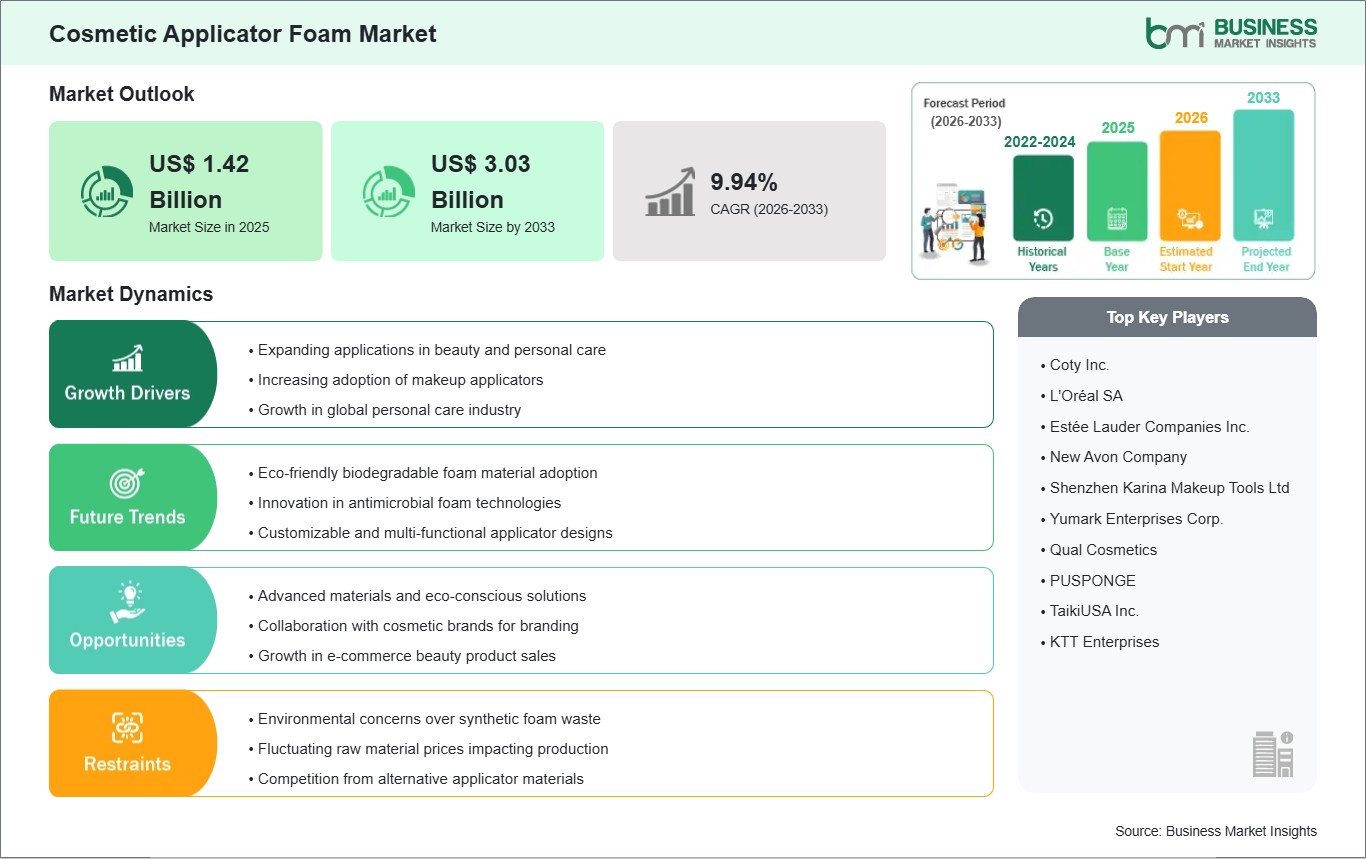
The Cosmetic Applicator Foam Market size is expected to reach US$ 3.03 Billion by 2033 from US$ 1.42 Billion in 2025. The market is estimated to record a CAGR of 9.94% from 2026 to 2033.
Cosmetic applicator foams are currently showing a growth trajectory as the beauty and personal care industry focuses more on precision, hygiene, and a better consumer experience. The applicator foams, including sponge tips, puff applicators, and silicone-infused foams, are commonly used in a range of cosmetic and skincare products, as well as specialized dermatology products. The increase in consumer demand for premium quality, user-friendly, and hygienic applicators, especially for foundations, concealers, powders, and liquid-based cosmetic products, is contributing to the growth of the cosmetic applicator foams industry. The introduction of new and improved features, such as latex-free, anti-bacterial, and eco-friendly foams, is contributing to the differentiation of cosmetic applicator foams, especially for health-conscious and eco-friendly consumer groups. The growth of the premium beauty segment and cosmetic products, as well as the influence of influencer-based cosmetic products, are contributing to the growth of the cosmetic applicator foams industry. The increase in e-commerce usage has also led to a surge in the need for reliable, long-lasting, and travel-friendly applicator foams. Manufacturers are increasingly focusing on integrating design innovation, comfort, and sustainability to remain competitive. Materials engineering, including advanced polyurethane and hydrophilic foam formulations, allows superior product performance, blending efficiency, and structural durability. The market is shaped by both global beauty brands and specialized applicator producers, with partnerships, OEM collaborations, and private-label manufacturing enabling wider product penetration. Regulatory compliance with cosmetic safety standards, such as ISO and FDA guidelines, is critical to maintaining brand credibility. Challenges include cost pressures from raw material fluctuations and consumer expectations for biodegradable and reusable solutions. Nevertheless, rising cosmetic consumption, product innovation, and demand for premium, hygienic, and ergonomic applicators provide sustained growth opportunities, reinforcing the strategic relevance of cosmetic applicator foams within the global beauty ecosystem.

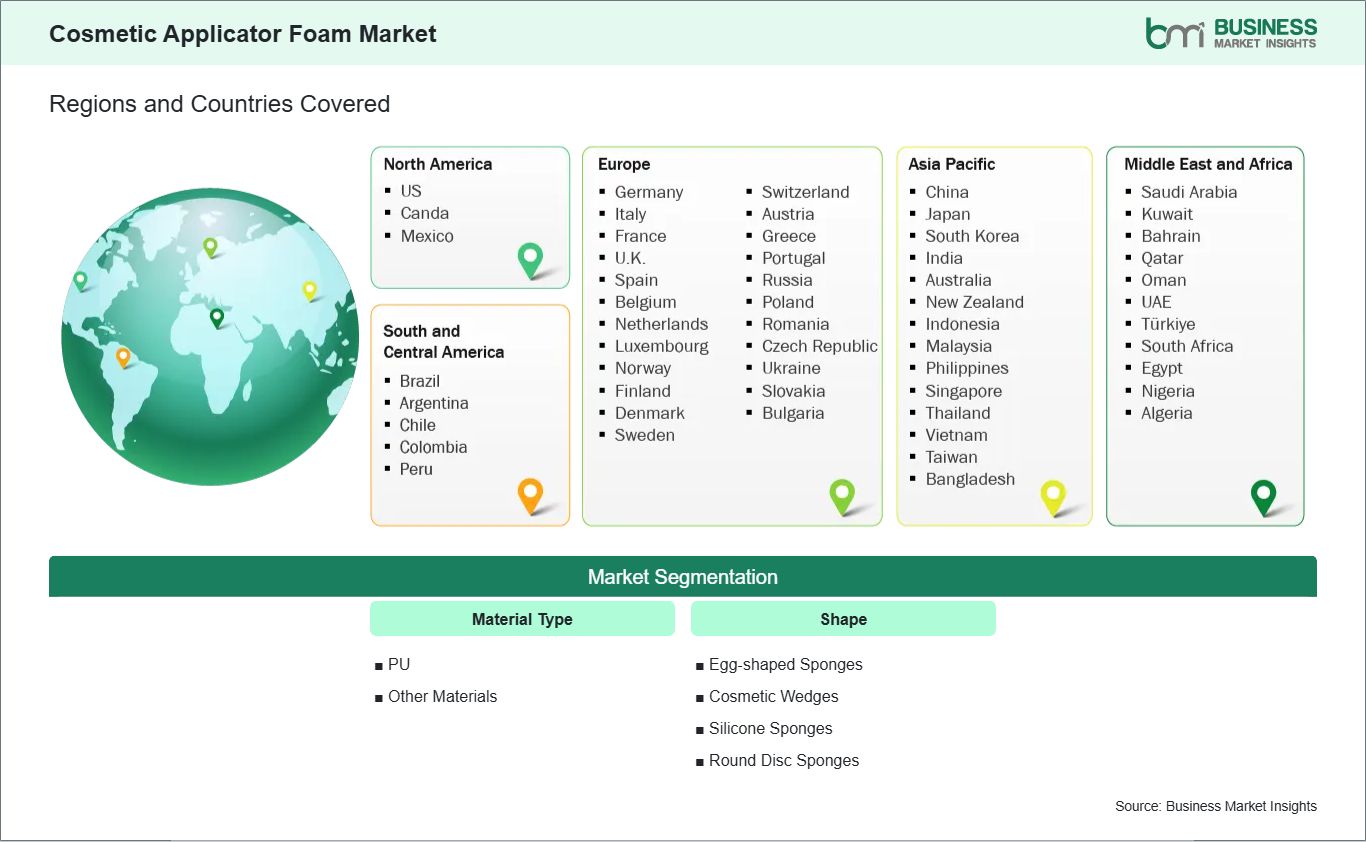
Key segments that contributed to the derivation of the cosmetic applicator foam market analysis are material type and shape.
By Material Type, the cosmetic applicator foam market is segmented into PU and other materials. The PU segment dominated the market in 2025.
On the Basis of Shape, the cosmetic applicator foam market is segmented into egg‑shaped sponges, cosmetic wedges, silicone sponges, and round disc sponges. The egg‑shaped sponges segment dominated the market in 2025.
The global cosmetic applicator foam market is growing, and this growth can be attributed to the increasing demand for cosmetic and personal care products. Cosmetic applicator foams, including sponges, wedges, puffs, and brush pads, are commonly used for the application of foundation, powder, cream, and skincare products. The foams are ideal for ensuring smooth and even application of the products, and this makes them a fundamental part of the beauty and personal care industry.
Cosmetic applicator foams are not only ideal for ensuring smooth and even application of products, but they are also important for ensuring that the products perform optimally. The foams are designed for use with a range of products, from liquid, cream, gel, and powder products. The foams are ideal for ensuring that the products are not wasted, and this makes them a fundamental part of the beauty and personal care industry.
Consumer awareness of personal grooming and the growing popularity of professional makeup techniques continue to drive demand. Additionally, the rise of e-commerce platforms and beauty subscription services has made high-quality cosmetic tools more accessible to a broader audience. Manufacturers are increasingly focused on producing soft, hygienic, and ergonomically designed foams that combine functionality with comfort. These qualities, along with expanding applications in skincare and professional makeup, ensure that cosmetic applicator foams remain integral to the beauty and personal care industry worldwide.
The cosmetic applicator foam industry is experiencing the impact of technological innovations and sustainable materials. Companies are creating innovative cosmetic applicator foams that provide better softness, elasticity, and cosmetic formula compatibility. The new designs are improving the efficacy of the product, preventing product loss, and increasing the comfort of the user. The innovations are responding to the changing needs and wants of the consumer.
The emergence of sustainable and biodegradable cosmetic applicator foams is becoming popular in the industry. The increasing awareness of environmental sustainability is changing the way companies approach the production of cosmetic and personal care products. Companies are working towards creating sustainable and biodegradable cosmetic applicator foams that minimize the impact on the environment. The new approach is responding to the changing needs and wants of the consumer and the demand for sustainable products.
Customization is also a significant driver, with applicator foams designed for specific purposes such as foundation, eyeshadow, or skincare application. Ergonomic shapes and textures enable precise product delivery and improve overall efficiency. As consumers increasingly seek high-performance, hygienic, and eco-conscious beauty tools, innovation in cosmetic applicator foams ensures their continued relevance and widespread adoption in global personal care markets.

The cosmetic applicator foam market demonstrates steady growth, with size and share analysis highlighting evolving trends and competitive dynamics among key players. The report examines subsegments categorized within material type and shape, offering insights into their contribution to overall market performance.
By Material Type, the PU subsegment dominated the market in 2025, driven by its excellent absorption capacity, skin compatibility, and versatility in cosmetic application.
On the Basis of Shape, the egg‑shaped sponges subsegment dominated the market in 2025, owing to its ergonomic design and ability to blend cosmetic products uniformly across facial contours.
| Report Attribute | Details |
|---|---|
| Market size in 2025 | US$ 1.42 Billion |
| Market Size by 2033 | US$ 3.03 Billion |
| Global CAGR (2026 - 2033) | 9.94% |
| Historical Data | 2022-2024 |
| Forecast period | 2026-2033 |
| Segments Covered | By Material Type
|
|
Regions and Countries Covered
| |
| North America | US, Canada, Mexico |
| Europe | Belgium, Austria, Finland, Denmark, Greece, Poland, Romania, Russia, Ukraine, Czech Republic, Slovakia, Bulgaria, Italy, Luxembourg, Germany, Switzerland, France, Netherlands, Norway, Portugal, Spain, Sweden, United Kingdom |
| Asia-Pacific | Australia, China, India, Japan, South Korea, Indonesia, Malaysia, Philippines, Singapore, Thailand, Vietnam, Bangladesh, New Zealand, Taiwan |
| South and Central America | Brazil, Argentina, Peru, Chile, Colombia |
| Middle East and Africa | Bahrain, Kuwait, Oman, Qatar, Saudi Arabia, United Arab Emirates, Turkiye, South Africa, Egypt, Algeria, Nigeria |
| Market leaders and key company profiles |
|
The "Cosmetic Applicator Foam Market Size and Forecast (2022 - 2033)" report provides a detailed analysis of the market covering below areas:
The geographical scope of the Cosmetic Applicator Foam Market report is divided into North America, Asia Pacific, Europe, Middle East & Africa, and South & Central America. North America held the largest share in 2025.
Regional-level dynamics of the cosmetic applicator foam market reflect variations in consumer preferences, retail infrastructure, and cosmetic industry maturity. North America is a dominant market, driven by high cosmetic consumption, sophisticated beauty retail channels, and a focus on hygiene and high-performance applicators. The United States leads adoption, supported by strong e-commerce penetration, premium product demand, and regulatory compliance that promotes safe, high-quality foam applicators.
Europe demonstrates steady growth, led by France, Germany, and the UK, where consumer awareness of sustainability and product safety drives demand for latex-free, biodegradable, and dermatologically tested applicators. High-end beauty products, regulatory enforcement, and eco-conscious purchasing behaviors influence innovation and market adoption in the region. The Asia Pacific region is the fastest-growing market, led by China, India, South Korea, and Japan. Rising disposable incomes, urbanization, and the popularity of K-beauty and J-beauty trends are fueling strong demand. E-commerce, social media influence, and growing middle-class populations are accelerating the adoption of innovative cosmetic applicator foams, including multi-functional and travel-friendly designs. In the Middle East & Africa, demand is emerging, driven by luxury cosmetic consumption in the UAE, Saudi Arabia, and South Africa, while economic disparities limit broad market penetration. South & Central America, particularly Brazil and Mexico, exhibits moderate growth due to expanding urban beauty markets, rising disposable incomes, and increasing adoption of makeup and skincare products, though price sensitivity continues to influence purchasing decisions. These regional dynamics illustrate a balance between mature markets focusing on innovation and emerging markets driving volume growth through expanding cosmetic adoption.

The Cosmetic Applicator Foam Market is evaluated by gathering qualitative and quantitative data post primary and secondary research, which includes important corporate publications, association data, and databases. A few of the key developments in the cosmetic applicator foam market are:
The Cosmetic Applicator Foam Market is valued at US$ 1.42 Billion in 2025, it is projected to reach US$ 3.03 Billion by 2033.
As per our report Cosmetic Applicator Foam Market, the market size is valued at US$ 1.42 Billion in 2025, projecting it to reach US$ 3.03 Billion by 2033. This translates to a CAGR of approximately 9.94% during the forecast period.
The Cosmetic Applicator Foam Market report typically cover these key segments-
The historic period, base year, and forecast period can vary slightly depending on the specific market research report. However, for the Cosmetic Applicator Foam Market report:
The Cosmetic Applicator Foam Market is populated by several key players, each contributing to its growth and innovation. Some of the major players include:
The Cosmetic Applicator Foam Market report is valuable for diverse stakeholders, including:
Essentially, anyone involved in or considering involvement in the Cosmetic Applicator Foam Market value chain can benefit from the information contained in a comprehensive market report.
Please tell us your area of interest
(Market Segments/ Regions and Countries/ Companies)