Market Summary
Executive Summary and Global Market Analysis
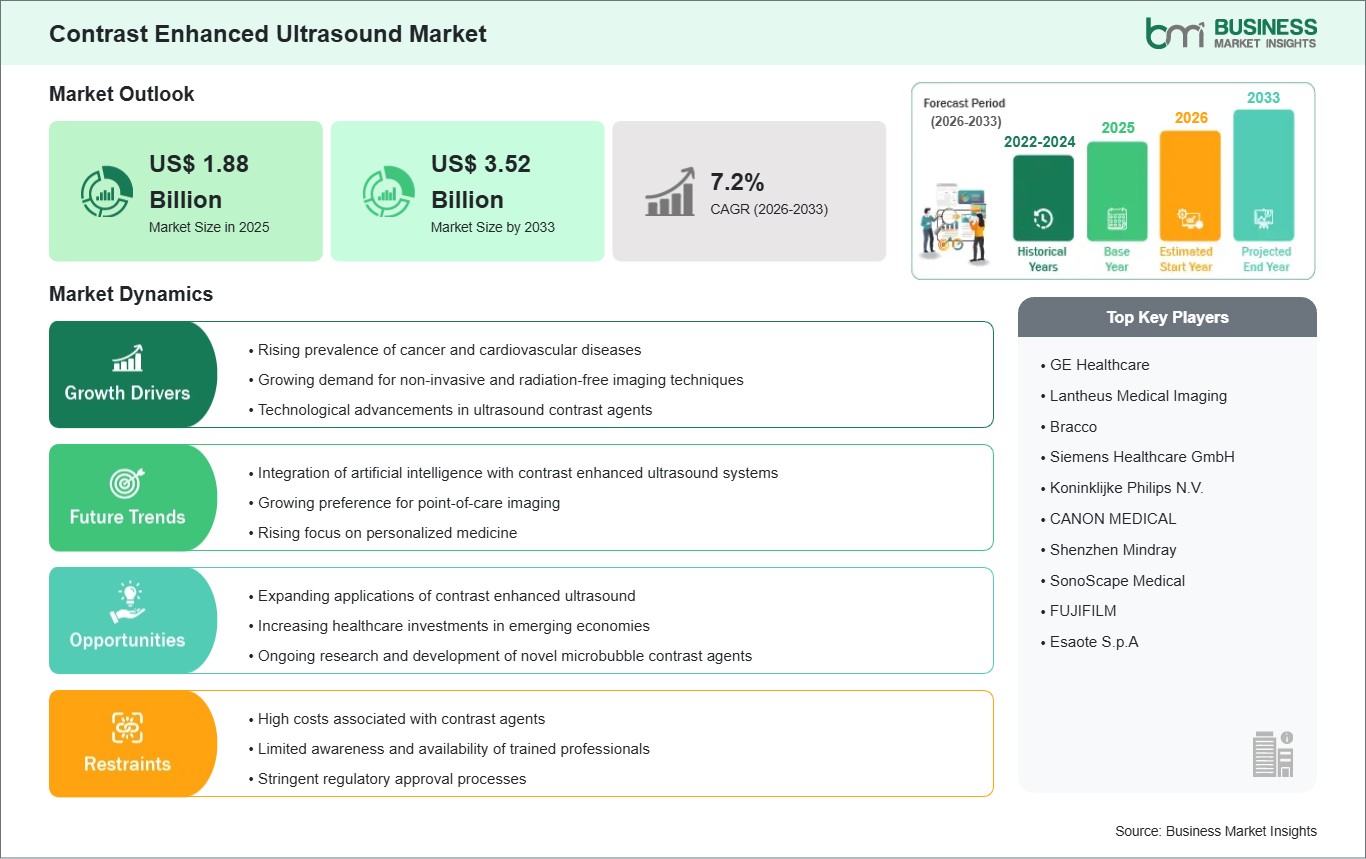
Contrast Enhanced Ultrasound (CEUS) is one of the latest medical imaging techniques where microbubble-based contrast agents, which are injected into the blood stream, are used with regular ultrasound to make blood flow, tissue perfusion, and the structures of the vessels in living bodies very clear through the site of the ultrasound without the use of any ionizing radiation. By the technical strength of the ultrasound imaging created through the reflections of the microbubbles, CEUS not only doubles the diagnostic clarity for the diseases seen in the imaging of the lungs, heart, tumors, and emergency medicine but also makes the treatment process less painful, and risk-free compared to some other traditional methods, as it helps to characterize the lesions, monitor the treatment response and safely and efficiently guide the procedures.
The contrast enhanced ultrasound market is on a steady growth path due to non-invasive imaging's increasing popularity over radiation-based modalities, and the continual technological advancements in ultrasound systems and contrast agents that not only enhance the accuracy but also widen the clinical applications. North America and Europe, the established healthcare markets, lead the way in adoption owing to their rich infrastructure, good reimbursement, and regulatory environments, and the continuous training and experience of medical personnel; on the other hand, Asia-Pacific is a fast-expanding region with increasing health care investments and better access to the medical facilities. The hospitals and diagnostic centers hold the major share of the end-use market with the contrast agents and advanced equipment being the most consumed segments. However, challenges like shortage of trained personnel, fluctuations in reimbursement, and regulatory delays are still there, but the breakthroughs like AI-integration in imaging and mobile CEUS systems continue to enlarge the spectrum of acceptance and clinical utility globally.
Segment Analysis
Contrast Enhanced Ultrasound Market Segmentation
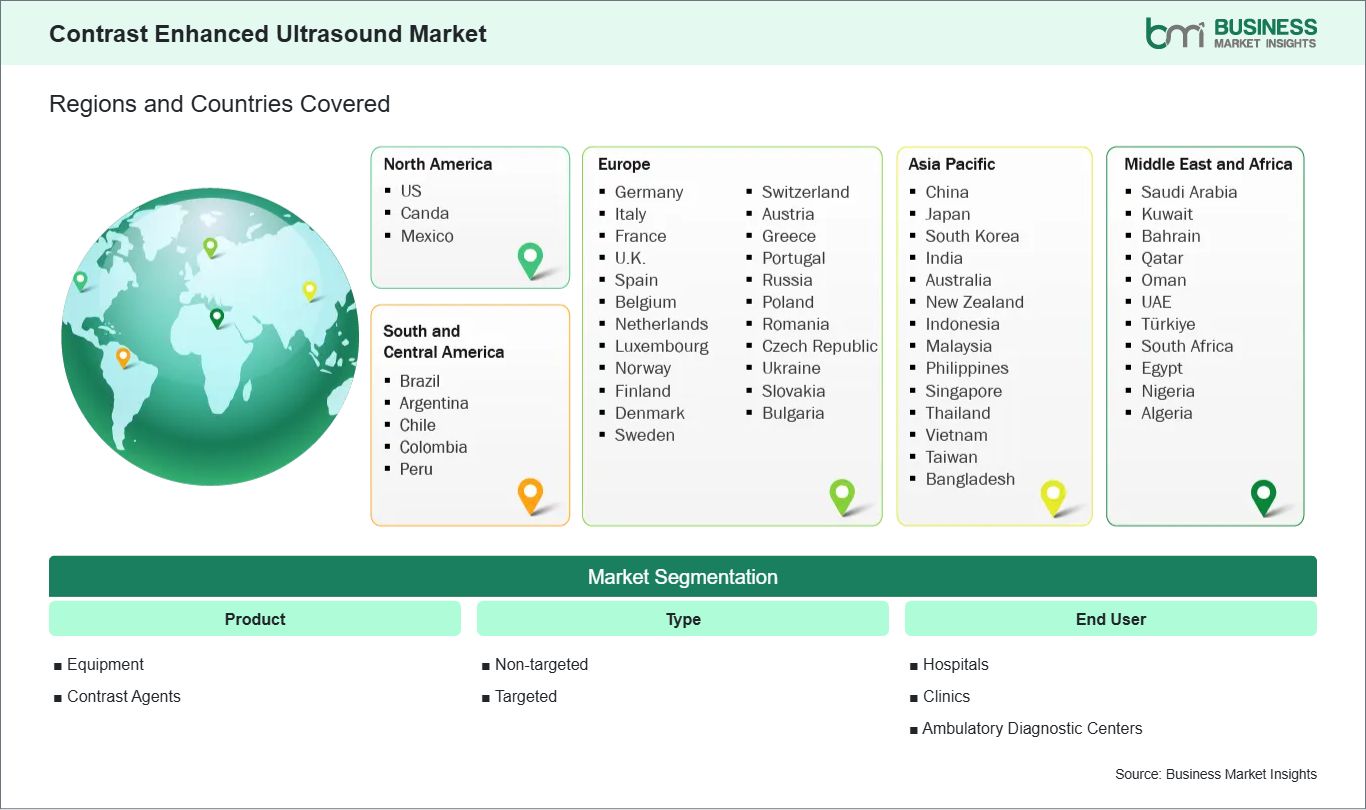
Key segments that contributed to the derivation of the contrast enhanced ultrasound market analysis are product, type, and end user.
- By product, the contrast enhanced ultrasound market is bifurcated into equipment, contrast agents. The equipment segment dominated the market in 2025.
- By type, the market is bifurcated into non-targeted, targeted. The non-targeted segment held a larger share of the market in 2025.
- By end user, the contrast enhanced ultrasound market is segmented into hospitals, clinics, ambulatory diagnostic centers. The hospitals segment dominated the market in 2025.
Market Forces
Contrast Enhanced Ultrasound Market Drivers and Opportunities
Rising Prevalence of Chronic Diseases & Clinical Need for Non-Invasive Imaging
The rising incidence of chronic diseases globally, particularly cardiovascular disorders, liver diseases, and cancers, is one of the principal factors propelling the contrast enhanced ultrasound market. This situation slices up the demand for advanced diagnostic imaging tools into very large pieces as the diseases are still incurring and killing up to 17.9 million people per year worldwide. Along the way, the need for accurate, repeatable diagnostics that come without the risk of radiation exposure is becoming critical. CEUS is safe to use because it does not emit ionizing radiation and at the same time offers real-time visualization of blood flow and tissue perfusion. Therefore, it is accommodative for regular disease monitoring, lesion characterization, and treatment evaluation. Its application is noted in the clinical guidelines for liver cancer diagnostics when CT/MRI are inconclusive, thus further confirming CEUS's involvement in the management of chronic conditions. Adoption is also influenced by the growing demand for radiation-free, cost-effective imaging that improves patient safety and outcomes, hence CEUS is put in the spotlight as a favored modality in contemporary diagnostic pathways.
Integration of AI & Expansion into Emerging Clinical Applications
The contrast enhanced ultrasound market has a technology integration and a wider range of clinical applications as the main factors driving its growth. Among these applications, artificial intelligence (AI) and machine learning are the most promising ones. The latest news indicates that going forward, AI will be incorporated into medical imaging software and ultrasound platforms for diagnosis by means of better accuracy with less human intervention, and on-the-spot support giving, thus, increasing clinical usefulness and streamlining the process. The result is that development is now being done through investment and collaborations, one of the examples being the partnerships between makers of imaging devices and AI researchers to work on the next-gen ultrasonic devices. Besides that, the use of ultrasonic imaging in children, cancer patients, and the emergency room or doctor's office has increased, and CEUS use in such cases is going to be very safe, accurate, and less harmful (compared to CT/MRI), especially because it is targeted at vulnerable groups. The regulators are also opening up to the New and Advanced CEUS technologies more and more in the recent times which is resulting in fast tracking of approvals and thus around for the broader clinical use. The emerging markets in Asia-Pacific, Latin America, and the Middle East & Africa are also putting money into healthcare infrastructure and CEUS adoption, which indicates the growth potential of the said regions as they will be the first ones to have the non-invasive imaging methods.
Size and Share Analysis
Contrast Enhanced Ultrasound Market Size and Share Analysis
By product, the contrast enhanced ultrasound market is bifurcated into equipment, contrast agents. The equipment segment dominated the market in 2025. Equipment dominance is attributed to the widespread adoption of advanced ultrasound systems that support CEUS procedures, broad compatibility across clinical applications, and continual technological enhancements (e.g., improved transducers and nonlinear imaging) that drive demand from major healthcare providers. Its larger installed base and essential role in enabling CEUS provide the foundation for its leading market share.
By type, the market is bifurcated into non-targeted, targeted. The non-targeted segment held a larger share of the market in 2025. Non-targeted segment holds the largest share because non-targeted contrast agents are broadly applicable across most routine imaging tasks—such as vascular, liver, and abdominal scans—are widely approved for clinical use, and are easier to use cost-effectively than more specialized targeted agents. Their versatility and strong clinical adoption sustain leadership.
By end user, the contrast enhanced ultrasound market is segmented into hospitals, clinics, ambulatory diagnostic centers. The hospitals segment dominated the market in 2025. Hospitals conduct the highest volume of CEUS procedures due to extensive diagnostic infrastructure, access to skilled specialists, and high patient throughput, especially for complex conditions requiring contrast imaging. This concentration of resources and demand makes hospitals the primary adopters of CEUS technology.
Report Coverage
Contrast Enhanced Ultrasound Market Report Coverage and Deliverables
The " Contrast Enhanced Ultrasound Market Size and Forecast (2022 - 2033)" report provides a detailed analysis of the market covering below areas:
- Contrast enhanced ultrasound market size and forecast at global, regional, and country levels for all the key market segments covered under the scope
- Contrast enhanced ultrasound market trends, as well as market dynamics such as drivers, restraints, and key opportunities
- Contrast enhanced ultrasound market analysis covering key market trends, global and regional framework, major players, regulations, and recent market developments
- Industry landscape and competition analysis covering market concentration, heat map analysis, prominent players, and recent developments for the contrast enhanced ultrasound market
- Detailed company profiles, including SWOT analysis
Geographic Insights
Contrast Enhanced Ultrasound Market Geographic Insights
The geographical scope of the contrast enhanced ultrasound market report is divided into five regions: North America, Asia Pacific, Europe, Middle East & Africa, and South & Central America. The contrast enhanced ultrasound market in Asia Pacific is expected to grow significantly during the forecast period.
The Asia-Pacific contrast enhanced ultrasound market is segmented into China, Japan, South Korea, India, Australia, New Zealand, Indonesia, Malaysia, the Philippines, Singapore, Thailand, Vietnam, Taiwan, Bangladesh, and the Rest of Asia. The Asia-Pacific contrast enhanced ultrasound market is experiencing robust growth, due to several interconnected factors that are transforming healthcare delivery and diagnostic imaging adoption. The modernization of healthcare infrastructure in major countries such as China, India, and Japan is developing rapidly and is leading to the opening of new doors as far as advanced imaging modalities are concerned with more hospitals and diagnostic centers to incorporate CEUS into daily practice. Continuous increase in chronic disease cases like cancer, liver ailments, and heart diseases calls for very accurate and gentle diagnostic tools, particularly for assessing blood vessels and organs in real-time. The APAC population is getting larger and older, which in turn, is pushing the need for imaging that is done frequently and is safe, and the no-radiation profile of CEUS makes it very appealing. Governments in this area are not only increasing the healthcare budget but also changing the regulations to promote the use of advanced diagnostic technologies, while public-private partnerships and local production are making CEUS systems and contrast agents more accessible and affordable. Furthermore, the growing significance of point-of-care imaging and ultrasound training for clinicians is helping to improve the acceptance and use of the technology in the region thereby contributing to its being the fastest-growing CEUS market in the world.
Industry Activity
Recent Developments
The contrast enhanced ultrasound market is evaluated by gathering qualitative and quantitative data post primary and secondary research, which includes important corporate publications, association data, and databases. A few of the key developments in the contrast enhanced ultrasound market are:
- In September 2023, GE HealthCare announced it received a grant from the Bill & Melinda Gates Foundation for more than US$44 million to create user-friendly, AI-assisted ultrasound imaging auto-assessment tools. The intent of these tools is to assist healthcare providers—also those without the necessary training or experience in ultrasound—by giving them clinical decision support, thereby improving obstetric and lung screening ultrasound scans in maternal and fetal care, as well as in pediatric lung health, with the aim of increasing access to low-and-middle income countries (LMIC) and various care locations.
- In March 2024, at the European Congress of Radiology 2024 (ECR 2024) held in Vienna, Austria in February 2024, Samsung Medison and Bracco Imaging agreed to a Memorandum of Understanding (MoU) that would mark the start of a new path for the diagnostic ultrasound device and contrast agent. This MoU aims to generate synergy in research and development and market exploration through the uniting of the skills and marketing power of Samsung Medison, one of the world's top producers of innovative high-end ultrasound diagnostic machines, and Bracco Imaging, a technology-driven global leader providing end-to-end products and solutions through a wide-ranging portfolio that includes precision diagnostic imaging modalities.
Trust & Transparency
Research Methodology
The market analysis combines proprietary research with secondary data from government agencies, company disclosures, regulatory filings, industry databases and expert interviews. Market estimates are validated through data triangulation, cross-market benchmarking and analyst
review.
View Full Research Methodology
Key Sources Referred:
World Health Organization (WHO)Centers for Disease Control and Prevention (CDC)UNICEF DataNational Cancer InstituteAmerican Heart AssociationCompany websitesCompany annual reportsCompany investor presentations