
Containerboard Market Outlook: Size, Share, Trends, Growth Analysis, Competitive Landscape & Forecast, 2026-2033

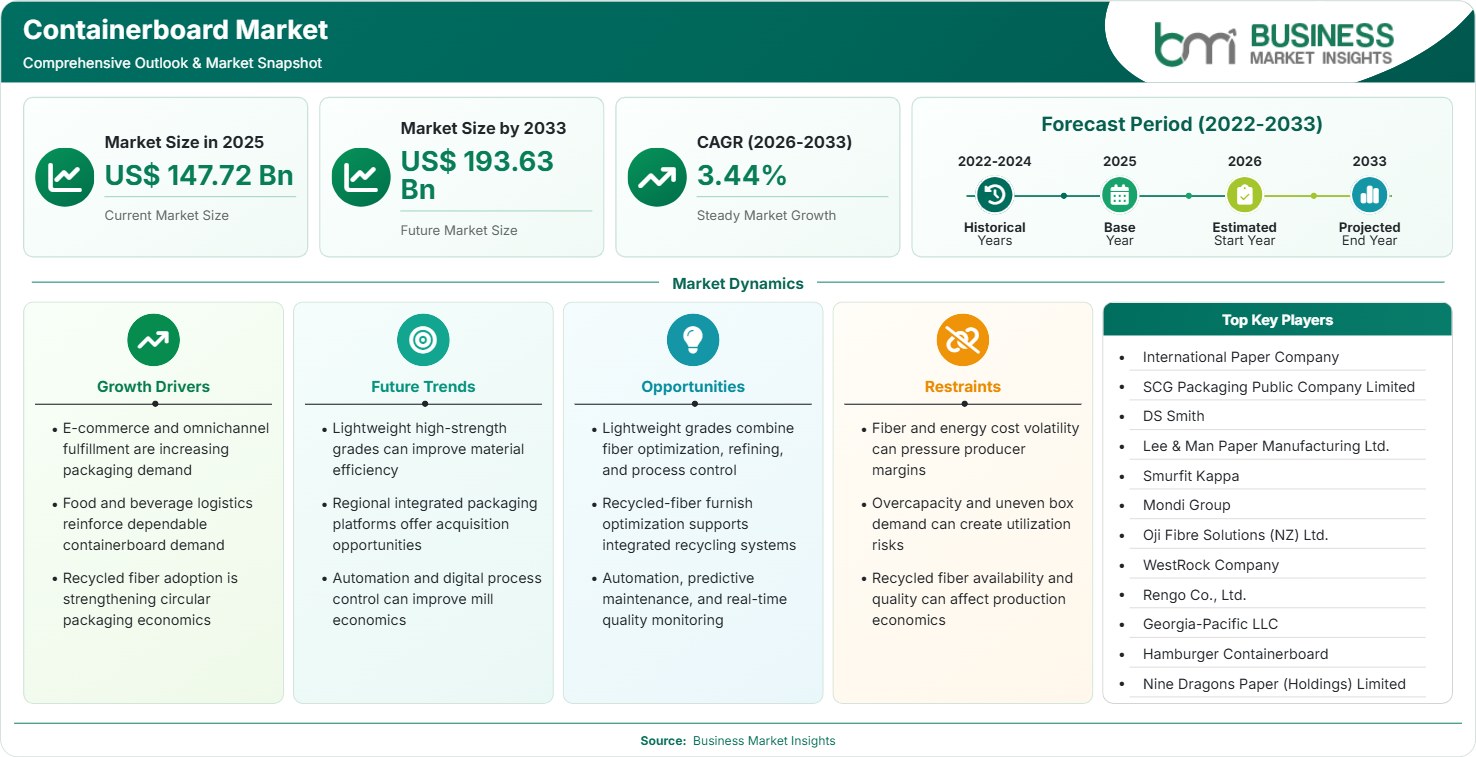
The Containerboard Market size was valued at US$ 147.72 Billion in 2025 and is projected to reach US$ 193.63 Billion by 2033, growing at a CAGR of 3.44% during 2026–2033, driven by e-commerce, sustainable packaging, recycled fibre adoption, light weighting, food delivery, and industrial distribution.

Report Coverage
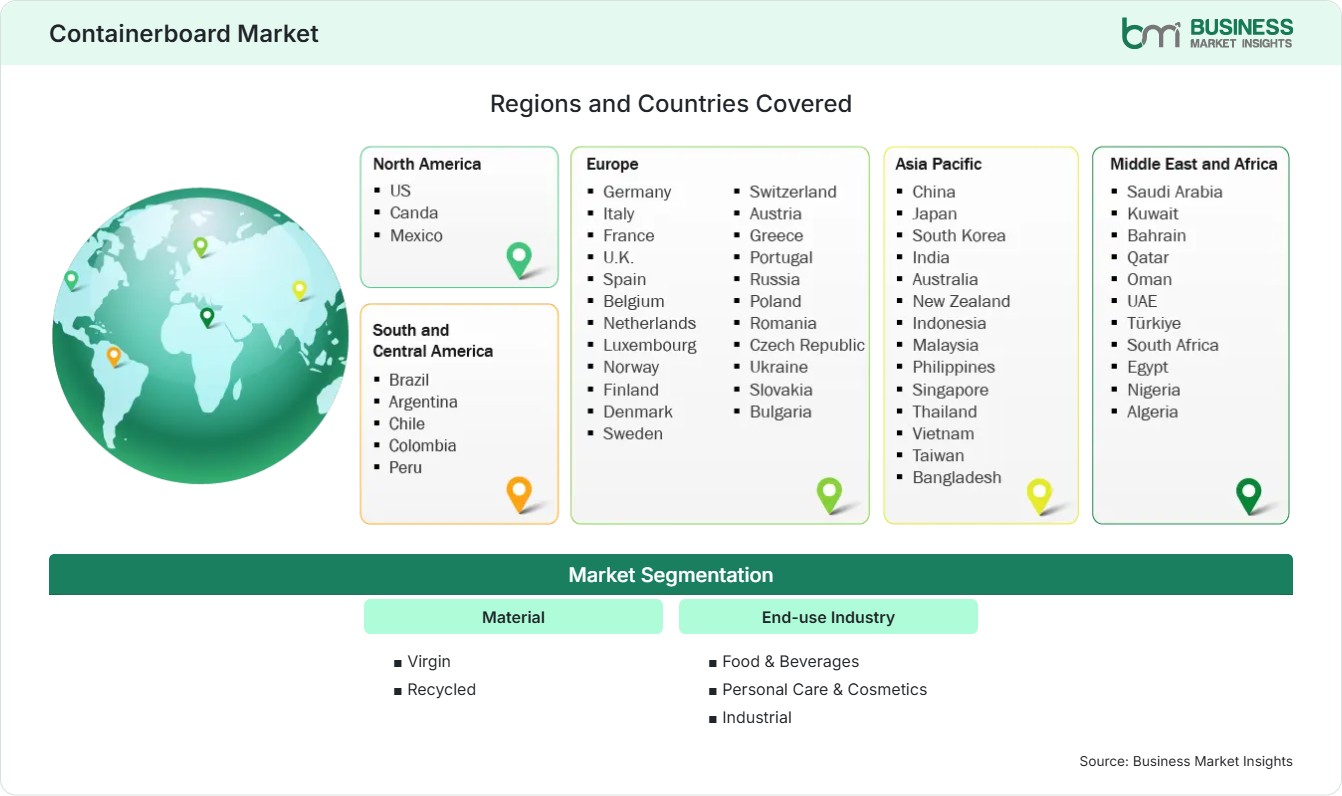
  • Material: Virgin, Recycled
  • End-use Industry: Food & Beverages, Personal Care & Cosmetics, Industrial
US$ 147.72 Bn Market size in 2025
US$ 193.63 Bn Market Size by 2033
3.44% CAGR, 2026 - 2033
2026-2033 Forecast Period

AI Overview

Containerboard Market Summary

  • North America Region: North America holds market share of 27%–30% in 2025, growing with a CAGR of 2.8%–3.3%, influenced by mature corrugated packaging demand, e-commerce fulfillment, food distribution, mill optimization, recycled fibre investment, and lightweight containerboard conversion. The US market remains mature, with 2.7%–3.2% CAGR, supported by packaging optimization, food shipments, recycling infrastructure, and mill consolidation.
  • Fastest Growing Region: Asia Pacific holds market share of 34%–38% in 2025, growing with a CAGR of 4.1%–4.8%, driven by manufacturing expansion, urban consumption, export logistics, e-commerce penetration, rising packaged-food distribution, and investments in integrated paper and packaging capacity.
  • Leading Segment: Recycled material holds market share of 58%–62% in 2025, growing with a CAGR of 3.5%–4.0%, supported by recovered-fiber availability, circular packaging commitments, regulatory pressure, resource efficiency, and converter demand for cost-effective sustainable grades.
  • High Growth Segment: Food & Beverages holds market share of 32%–36% in 2025, growing with a CAGR of 3.8%–4.4%, supported by packaged food distribution, beverage multipacks, cold-chain logistics, foodservice delivery, retail replenishment, and increasing demand for recyclable transport packaging.
  • Key Market Opportunity: Lightweight high-performance grades create attractive opportunities by reducing fiber consumption, freight weight, storage requirements, and packaging costs while maintaining compression strength for automated distribution networks.
  • Major Market Players: International Paper Company; SCG Packaging Public Company Limited; DS Smith; Lee & Man Paper Manufacturing Ltd.; Smurfit Kappa; Mondi Group; Oji Fibre Solutions (NZ) Ltd.; WestRock Company; Rengo Co., Ltd.; Georgia-Pacific LLC; Hamburger Containerboard; Nine Dragons Paper (Holdings) Limited; and Stora Enso.
Strategic Insights

Containerboard Market: Strategic Insights

Containerboard Market Strategic Framework
FREE PDF
Request your free sample
Request free sample
Stakeholder View

Key Takeaways

  • The value chain is increasingly integrated across forestry, recovered fiber collection, pulp and paper production, containerboard manufacturing, corrugating, converting, and recycling. Integrated producers can optimize fiber sourcing and internalize more margin than standalone mills.
  • Food and beverage packaging offers the strongest application upside because corrugated formats combine stacking strength, printability, transport protection, and recyclable fiber content across packaged foods, beverages, foodservice, and cold-chain distribution.
  • Lightweighting is moving from simple basis-weight reduction toward engineered strength. Producers are combining fiber selection, refining, formation control, coating, and structural design to preserve box performance while reducing material consumption.
  • Asia Pacific provides the strongest expansion case because manufacturing relocation, urbanization, packaged-food penetration, and cross-border commerce support incremental box demand while creating opportunities for integrated recycled-fiber infrastructure.
  • Recent corporate actions show portfolio optimization alongside capacity expansion. International Paper agreed to acquire North Pacific Paper Company for US$360 million, adding approximately one million tons of annual containerboard and other paper capacity.
  • Buyers increasingly value supply assurance, grade consistency, recycled content, and regional mill proximity alongside headline paper pricing, strengthening the position of suppliers with diversified assets and integrated recycling networks.
Geographic Outlook

Containerboard Market Regional Highlights

North America Containerboard Market

North America holds a 27%–30% share in 2025 and is projected to expand at a 2.8%–3.3% CAGR from 2026–2033. Containerboard Market share reflects mature corrugated consumption, strong food distribution, established recycling systems, and extensive converting capacity. Demand is moderated by mill closures, inventory discipline, and slower box-volume growth in some channels. Producers are prioritizing efficient assets, lightweight grades, customer proximity, and recycled fiber integration. International Paper’s capacity restructuring and NORPAC transaction illustrate a strategic shift toward competitive mill footprints and higher-performance recycled grades.

  • E-commerce optimization: Packaging suppliers are increasingly engineering right-sized boxes and lighter grades, helping fulfillment operators reduce dimensional weight, material consumption, warehouse requirements, and transportation costs without sacrificing product protection.
  • Recycled fiber expansion: Regional demand for recovered fiber supports recycled containerboard development, while mills increasingly invest in furnish optimization and lightweight products to balance sustainability requirements with strength performance.
  • Food distribution: Food, beverage, protein, and agricultural supply chains maintain dependable corrugated consumption because transportation packaging must withstand stacking, humidity, handling, and repeated distribution cycles.
  • Capacity discipline: Producers are closing inefficient assets and reallocating capital toward competitive facilities, reflecting pressure from weak box volumes, higher operating costs, and changing customer requirements.

US Containerboard Market

The US represents approximately 70%–74% of North America’s 2025 Containerboard Market, with a 2.7%–3.2% CAGR from 2026–2033. US demand benefits from extensive food, beverage, retail, industrial, and parcel distribution networks, but operating economics remain sensitive to box shipments, recovered-paper costs, energy, labor, and mill efficiency. Recent capacity actions demonstrate that suppliers are prioritizing competitive assets rather than maintaining marginal production. International Paper’s 2025 closures and 2026 NORPAC transaction illustrate this restructuring cycle.

  • Mill consolidation: Asset rationalization is concentrating production around facilities with stronger fiber economics, better logistics, modern equipment, and greater flexibility across virgin and recycled containerboard grades.
  • Packaging efficiency: Large retailers and logistics operators increasingly demand lightweight, high-strength board that lowers shipping weight while supporting automated packing, palletization, stacking, and fulfillment processes.
  • Recycling infrastructure: Mature collection systems provide a strong foundation for recovered-fiber utilization, encouraging mills to develop grades with higher recycled content while maintaining compression and converting performance.

Europe Containerboard Market

Europe represents 24%–27% share in 2025, with a 2.9%–3.5% CAGR from 2026–2033. Germany, Italy, France, Poland, and the UK remain leading packaging economies, while Poland and Italy offer stronger growth potential at approximately 3.4%–4.1% CAGR. Containerboard Market growth is increasingly connected with recycled fiber, lightweighting, circularity, and regulatory compliance. Mondi’s Duino investment adds 420,000 tonnes of annual recycled containerboard capacity after full ramp-up, reinforcing regional supply integration.

  • Circular packaging regulation: European packaging policy is accelerating demand for recyclable and resource-efficient fiber formats, influencing grade specifications, recycled content, packaging design, and producer investment priorities.
  • Italian investment: Mondi’s Duino conversion strengthens recycled containerboard supply and demonstrates how existing paper assets can be repurposed to address sustainability-driven demand without relying solely on greenfield capacity.
  • Polish manufacturing: Poland benefits from its position in European manufacturing and logistics, supporting containerboard demand from food, consumer goods, industrial packaging, and export-oriented converters.
  • Lightweighting: European converters are increasingly optimizing box structures and paper specifications to reduce material intensity while preserving stacking strength and automated handling performance.

Asia Pacific Containerboard Market

Asia Pacific accounts for 34%–38% Containerboard Market share in 2025 and is projected to grow at 4.1%–4.8% CAGR from 2026–2033. China, Japan, India, South Korea, and Southeast Asian manufacturing hubs lead consumption, while India, Vietnam, Indonesia, and Thailand provide comparatively higher growth at approximately 4.7%–5.5% CAGR. Strong manufacturing output, export packaging, food processing, urbanization, and e-commerce support demand. Integrated packaging groups are increasing regional footprints through acquisitions, recycling, automation, and production integration.

  • China’s scale: China remains a major production and consumption center, with extensive corrugated converting capacity and demand tied to electronics, consumer goods, industrial shipments, food distribution, and export manufacturing.
  • India’s expansion: Industrialization, organized retail, packaged foods, pharmaceuticals, and e-commerce are widening corrugated packaging applications and creating opportunities for domestic capacity expansion and recycled-fiber systems.
  • Southeast Asian integration: Indonesia, Vietnam, and Thailand are attracting packaging investment as manufacturing supply chains diversify, creating demand for localized paper, corrugated conversion, and recycling infrastructure.
  • Automation: Producers are deploying robotics, cobots, process controls, and automated handling to improve manufacturing efficiency and compensate for labor constraints while increasing consistency. SCGP has highlighted automation and integrated production efficiency in its recent strategy.

Rest of World Containerboard Market

Rest of World holds 9%–12% Containerboard Market share in 2025, with a 3.2%–4.0% CAGR from 2026–2033. South and Central America benefit from agricultural exports, food processing, beverage production, and retail modernization, with Brazil and Mexico leading regional demand. Middle East and Africa markets remain smaller but increasingly attractive as food manufacturing, logistics, consumer goods distribution, and industrial diversification expand. South Africa, Saudi Arabia, and the UAE provide comparatively strong opportunities, with approximately 3.8%–4.6% CAGR.

Latin American converters increasingly require reliable board supplies for produce, beverages, processed foods, and industrial goods. Export-oriented agriculture particularly favors corrugated packaging because it combines stacking performance, ventilation options, printability, and recyclability. Regional producers are also balancing imported paper with local production to reduce freight exposure.

Middle Eastern markets are supported by food imports, retail distribution, and logistics infrastructure, while African markets benefit from urbanization and packaged consumer goods penetration. Investment cases increasingly depend on recovered-fiber availability, energy costs, port access, and proximity to converting customers.

  • Agricultural packaging: Fresh produce and food exports create specialized demand for high-strength corrugated formats capable of handling humidity, stacking pressure, and long-distance logistics.
  • Retail modernization: Organized retail expansion is increasing the use of standardized shipping cartons, shelf-ready formats, and secondary packaging across consumer product distribution networks.
  • Recycling development: Improving collection and sorting systems can expand recycled furnish availability, reducing dependence on virgin fiber and supporting circular packaging strategies.
  • Regional production: Localized paper and converting capacity can lower freight exposure and improve supply reliability, particularly where imported containerboard faces currency, port, or transportation constraints.
Global Market Geography
FREE PDF
Request your free sample
Request free sample
Segment Analysis

Containerboard Market Segmentation

Material

Material demand is led by recycled grades, which represented approximately 58%–62% share in 2025 and are projected to grow at 3.5%–4.0% CAGR from 2026–2034. Containerboard Market scope increasingly emphasizes fiber efficiency, circularity, lightweighting, and consistent strength. Recycled grades benefit from sustainability targets, while virgin grades retain critical applications requiring superior performance and food-contact reliability.

  • Virgin: Virgin fiber supports demanding transport applications requiring high strength, consistent formation, moisture resistance, and print performance. Demand remains anchored in export packaging, food applications, and heavier-duty industrial distribution.
  • Recycled: Recycled grades benefit from circular-economy targets, recovered-fiber availability, lower virgin-resource dependence, and converter demand for sustainable packaging. Improved furnish engineering increasingly narrows performance gaps against virgin grades.

End-use Industry

End-use industries are led by Food & Beverages, representing approximately 32%–36% share in 2025 and growing at 3.8%–4.4% CAGR from 2026–2034. Containerboard Market trends across end uses reflect packaged-food distribution, beverage multipacks, industrial logistics, personal care shipments, and increasingly standardized retail fulfillment. Food and beverage applications benefit from resilient packaging requirements across primary and secondary distribution.

  • Food & Beverages: Food and beverage producers use corrugated packaging for transport, palletization, multipacks, produce, processed foods, and foodservice distribution, with demand supported by retail expansion and supply-chain protection.
  • Personal Care & Cosmetics: Personal care and cosmetics brands require visually consistent, protective shipping cartons for bottles, jars, tubes, and secondary packaging, with e-commerce increasing demand for durable transit formats.
  • Industrial: Industrial applications include machinery components, automotive parts, electrical equipment, chemicals, and durable goods. Strength, stacking resistance, and customization drive grade selection across complex distribution environments.
Market Forces

Containerboard Market Dynamics

Key Market Drivers

E-commerce and omnichannel fulfillment increase corrugated consumption

E-commerce continues to support demand for transport packaging because products move through more individual handling points than conventional store replenishment. The opportunity to grow the market is increasingly focused on boxes of the appropriate size, lighter grades, protective packaging, and packaging designed for automated fulfillment. E-commerce sales of groceries, electronics, household goods, and direct-to-consumer deliveries need the boards that are capable of withstanding compression, vibration, and handling. The Containerboard Market trends would be in favor of those suppliers who can provide strength along with reduced basis weight. In addition, retailers are also demanding less packaging material and greater recyclability, thus preferring fiber-based solutions wherever possible. The need for such demands makes the case for technology differentiation as opposed to bulk commoditization.

Food and beverage logistics reinforce dependable packaging demand

Food and beverage distribution provides a structurally resilient demand base because packaged products require reliable secondary and tertiary packaging throughout processing, warehousing, transportation, and retail replenishment. Protection for beverages, processed food, fresh produce, protein, and food service products is ensured through corrugated packaging. Such packaging should be taken into account due to humidity and cold chain storage. Besides, changing demands are caused by diversification of products and decreasing size of batches. In turn, this causes an increase in packaging complexity. Food packagers, who supply continuous grades of products to food converters, will be able to maintain the constant consumption of their products even when discretionary consumers become weak. Moreover, another driver of this market is the sustainability of fiber-based transport packaging. Thus, food distribution will continue to support stable consumption of containerboards.

Recycled fiber adoption strengthens circular packaging economics

Recovered fiber is becoming strategically important as packaging producers seek to lower dependence on virgin resources and meet corporate circularity commitments. Construction of facilities for collection, sorting, baling, and mill deinking will enable an increase in the use of recycled furnish, though at varying qualities depending on geographic location and collection systems. Mills are therefore working on techniques for conditioning furnishes such that their strength and formation properties remain constant regardless of variations in composition owing to the recycled paper. Recycled containerboard may enhance resource productivity by designing it such that the compression characteristics are achieved using fewer resources. This will be economically viable if the price of recycled furnish, energy, transport, and mill design is low. Companies that operate a system of recycling have a competitive advantage since they control the furnish.

Key Market Opportunities

Lightweight high-strength grades can unlock material efficiency

Lightweighting offers a clear investment pathway because packaging buyers increasingly evaluate fiber consumption, freight, storage, and box performance together. Advanced refining, fiber selection, formation technology, strength additives, and structural engineering can help producers reduce basis weight without proportionally reducing compression performance. This presents possibilities for mills that will be able to reliably produce premium lightweight boards and converters that will be able to redesign boxes based on such requirements. Besides saving money on paper, there are additional commercial advantages since lightening up boxes translates into lower transport costs and less warehouse labor. The most interesting applications for this technology would probably be in the food, beverages, e-commerce, and consumer goods industries, where even a minor savings per box would result in significant amounts when multiplied across millions of boxes.

Regional integrated packaging platforms offer acquisition potential

Integrated platforms combining paper production, recycling, corrugated conversion, and packaging design can create stronger supply assurance and capture value across multiple stages of the packaging chain. Some recent acquisitions highlight this approach. The acquisition of MYPAK by SCGP was successfully concluded in December 2025 and further enhanced the company's presence in the fiber-based packaging market and provided solutions. Also, International Paper's agreement to purchase NORPAC in 2026 enhances its West Coast capabilities and gains about one million tons of containerboard production capacity per year. Such transactions enable reduction of the exposure to freight costs, proximity to customers, better utilization of mills, and increased capacity in recycled grades. Investors can thus focus on the acquisition of companies with state-of-the-art facilities, fiber presence in the region, good converters relationships, and vertical integration opportunities.

Automation and digital process control can improve mill economics

Automation provides an opportunity to improve yield, quality consistency, labor productivity, energy management, and equipment availability. Modern paper machines increasingly rely on advanced process controls to stabilize moisture, basis weight, formation, and strength across variable fiber furnish. Robotic devices and cobotics will help in areas such as palletizing, warehouse management, inspection, and converting activities. According to SCGP, the company has plans to improve efficiency in manufacturing through robotics, cobotics, and automation as part of its 2026 strategy for investments. For investors, automation creates value when deployed alongside equipment modernization and data integration rather than as isolated technology spending. Mills can use predictive maintenance and real-time quality monitoring to reduce downtime, improve customer consistency, and capture more output from constrained assets, supporting stronger returns from existing capacity, supporting Containerboard Market Forecasts.

Market Restraints and Challenges

Fiber and energy cost volatility pressures producer margins

Factor: Containerboard manufacturers will remain vulnerable to changes in recovered paper, wood fiber, pulp, energy, chemical, labor, and transportation costs. The integrated manufacturing plants can minimize this vulnerability to some degree through economies of scale and recycling, but there will still be significant regional variations.

Impact: Price fluctuation might impact margins, especially when the consumer resists price fluctuations, which can be a result of excess capacity or slack box market conditions. In Stora Enso, high wood fiber costs and operating rate remained key problems up until 2025, revealing the link between cost of raw materials and profit margins. Good organization in buying, energy conservation, maintenance planning and flexibility in grades are essential.

Overcapacity and uneven box demand create utilization risks

Factor: Demand for containerboard is closely tied to manufacturing output, retail activity, consumption levels, and shipments, whereas paper mills are characterized by high fixed costs and high capital intensity. In the case of weak box demand, excess capacity may lower operating rates and increase price competition.

Impact: Underutilization is detrimental to mill economics and can lead to shutdowns, closures, restructuring, or deferral of investment. This was illustrated by Stora Enso when they cited weak demand and excess capacity resulting in poor operating rate performance of their fresh-fiber containerboard assets, as well as by International Paper, which closed its facilities in the US due to weak packaging demand.

Company Analysis

Competitive Landscape

Containerboard Market analysis indicates that competition is increasingly shaped by fiber integration, geographic coverage, recycling infrastructure, mill efficiency, product engineering, and converter relationships. Leading suppliers are combining virgin and recycled grades while investing in lightweighting, automation, sustainable packaging, and regional capacity.

Company Name

Overview

Products and Services relevant to this market

International Paper Company

Major fiber-based packaging producer with extensive North American manufacturing, recycling, and distribution capabilities.

Containerboard, corrugated packaging, recycling services, fiber-based packaging solutions, and sustainable packaging materials.

SCG Packaging Public Company Limited

Integrated packaging company with strong Southeast Asian presence and expanding fiber-packaging operations.

Packaging paper, containerboard-related materials, corrugated packaging, recycling, and integrated packaging solutions.

DS Smith

Packaging, paper, and recycling business serving European and international customers with circular packaging expertise.

Containerboard grades, corrugated packaging, recycling services, paper products, and packaging design solutions.

Lee & Man Paper Manufacturing Ltd.

Asian paper producer with integrated pulp and paper manufacturing and strong containerboard exposure.

Kraftliner, recycled containerboard, corrugated medium, packaging paper, pulp, and related paper products.

Smurfit Kappa

Established packaging business with broad corrugated packaging capabilities and global customer coverage.

Containerboard, corrugated cases, packaging systems, paper-based solutions, recycling, and engineered packaging.

Mondi Group

Global packaging and paper producer emphasizing sustainable, recycled, and virgin-fiber packaging solutions.

Recycled and virgin containerboard, corrugated packaging, kraft paper, and sustainable packaging solutions.

Oji Fibre Solutions (NZ) Ltd.

Fiber-products supplier serving packaging and paper markets across Australasia and international supply chains.

Containerboard-related paper products, corrugated packaging materials, pulp, and fiber-based solutions.

WestRock Company

Major corrugated packaging platform with substantial converting and containerboard capabilities.

Containerboard, corrugated boxes, folding cartons, packaging machinery, design, and recycling services.

Rengo Co., Ltd.

Japanese integrated packaging producer with extensive paper and converting capabilities.

Containerboard, corrugated packaging, folding cartons, paperboard, packaging machinery, and related materials.

Georgia-Pacific LLC

Large US paper and packaging producer with integrated fiber and corrugated operations.

Linerboard, corrugated medium, corrugated packaging, paper products, recycling, and packaging solutions.

Hamburger Containerboard

European containerboard specialist within Prinzhorn Group with recovered-paper integration.

Recycled containerboard, corrugated case materials, lightweight grades, and paper products.

Nine Dragons Paper (Holdings) Limited

Large Asian paper manufacturer with significant recycled-fiber and packaging-paper operations.

Containerboard, corrugating medium, recycled packaging paper, pulp, and related paper grades.

Stora Enso

Renewable materials producer with integrated packaging, forest, pulp, paper, and containerboard capabilities.

Containerboard, corrugated packaging solutions, kraftliner, recycled and fresh-fiber packaging materials, and paperboard.

Trust & Transparency

Research Methodology

The market analysis combines proprietary research with secondary data from government agencies, company disclosures, regulatory filings, industry databases and expert interviews. Market estimates are validated through data triangulation, cross-market benchmarking and analyst review.

View Full Research Methodology

Questions Answered

Frequently Asked Questions

How does automation affect containerboard production?

Automation improves consistency, yield, equipment utilization, labor productivity, and maintenance planning. Paper mills increasingly use process controls and digital monitoring, while packaging facilities deploy robotics and automated handling to reduce repetitive work and improve throughput.

Which end-use application offers the strongest growth potential?

Food & Beverages offers a compelling growth profile because packaged foods, beverages, foodservice, agricultural products, and cold-chain distribution require protective secondary packaging. Its recurring logistics requirements provide relatively dependable demand across retail and industrial supply chains.

How are acquisitions changing the competitive environment?

Acquisitions are strengthening vertical integration between paper production, recycling, corrugated conversion, and packaging design. Recent transactions involving International Paper and SCGP demonstrate how companies are seeking regional supply advantages, customer proximity, and stronger control over fiber-based packaging value chains.

Why is light weighting important for containerboard buyers?

Light weighting can reduce paper consumption, transportation weight, storage requirements, and packaging costs. The commercial value is highest when lower basis weight is achieved without sacrificing compression strength, stacking performance, printability, or automated converting efficiency.

What is driving demand for the Containerboard Market?

The Containerboard Market Report highlights that demand for recycled containerboard is being supported by packaging circularity targets, recovered-paper availability, retailer sustainability requirements, and efforts to reduce virgin fiber consumption. Improvements in furnish preparation and paper-machine controls are helping producers maintain strength and consistency while increasing recycled content.

Access the Full Containerboard Market Report

Get segment-level forecasts, regional estimates, competitive benchmarking, company profiles and downloadable Excel datasets.

Access the full Containerboard Market Report
350 pages PDF & Excel | 2026-08-31