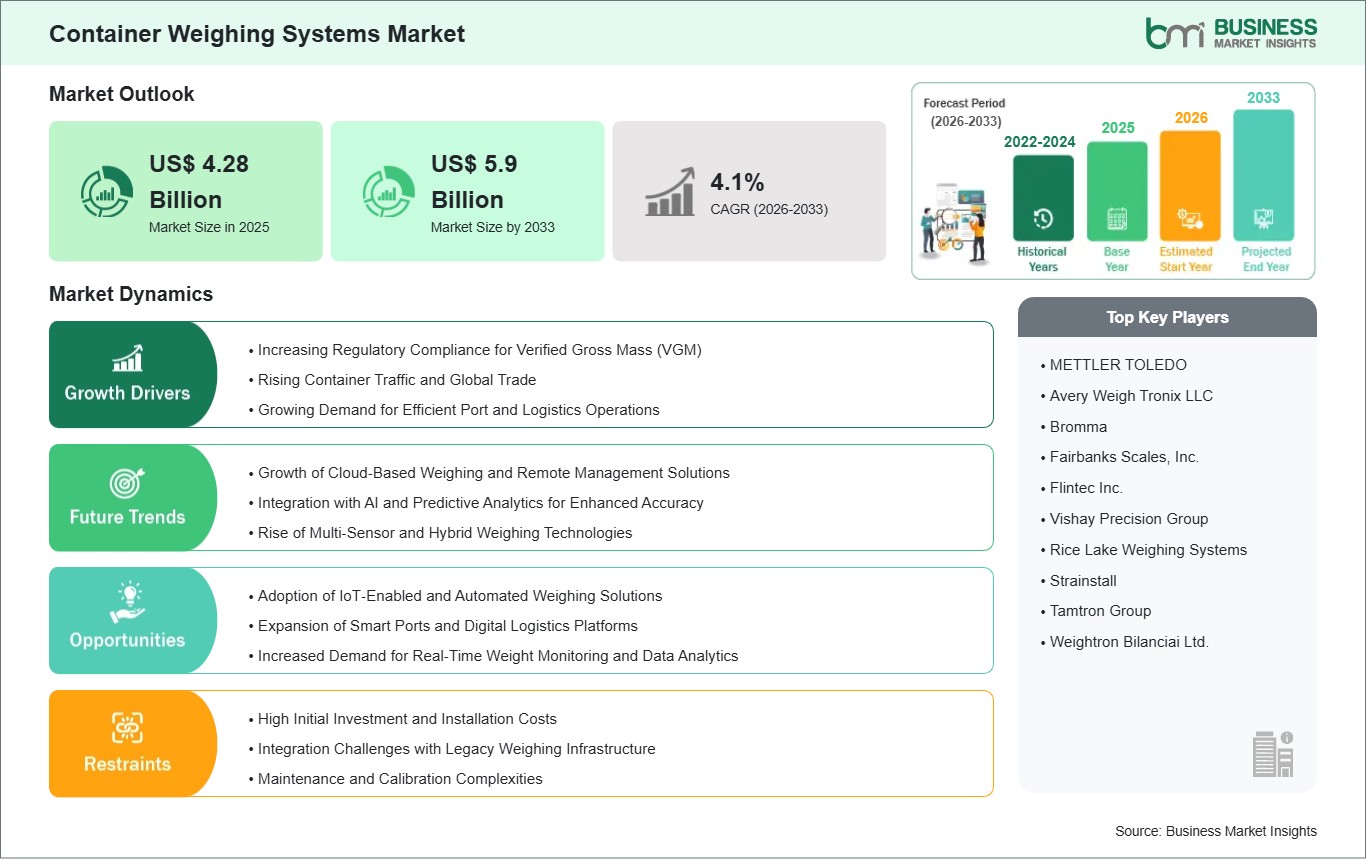
The container weighing systems market size is expected to reach US$ 5.90 billion by 2033 from US$ 4.28 billion in 2025. The market is estimated to record a CAGR of 4.1% from 2025 to 2033.
Container weighing systems have emerged as an essential element in ports, logistics hubs, and transportation networks worldwide for ensuring safety, compliance, and operational efficiency. Container weighing systems, including weighbridges, on-board weighing systems, load cells, and integrated software solutions, are increasingly used across seaports, inland container depots, freight terminals, and logistics centers. These systems have also gained significant adoption among shipping lines, freight forwarders, and road and rail transport operators. Container weighing solutions help organizations achieve several advantages, including accurate cargo weight measurement, improved load distribution, enhanced operational safety, reduced risk of accidents, and compliance with international shipping regulations. The growth of global trade, increasing container traffic, safety concerns, and regulatory mandates such as verified gross mass (VGM) requirements have generated strong focus on implementing container weighing systems.
However, the container weighing systems market faces several challenges that may limit its growth. These include the high cost of system installation and integration, technical complexity, interoperability issues with existing infrastructure, and the need for regular calibration and maintenance. Capital expenditure requirements, along with varying regulatory standards across regions, also influence market adoption. Despite these challenges, the container weighing systems market offers significant growth opportunities, driven by increasing automation in ports and logistics operations, rising demand for efficient freight handling, advancements in digital weighing technologies, and the growing need for accurate, automated, and compliant cargo weight management solutions.

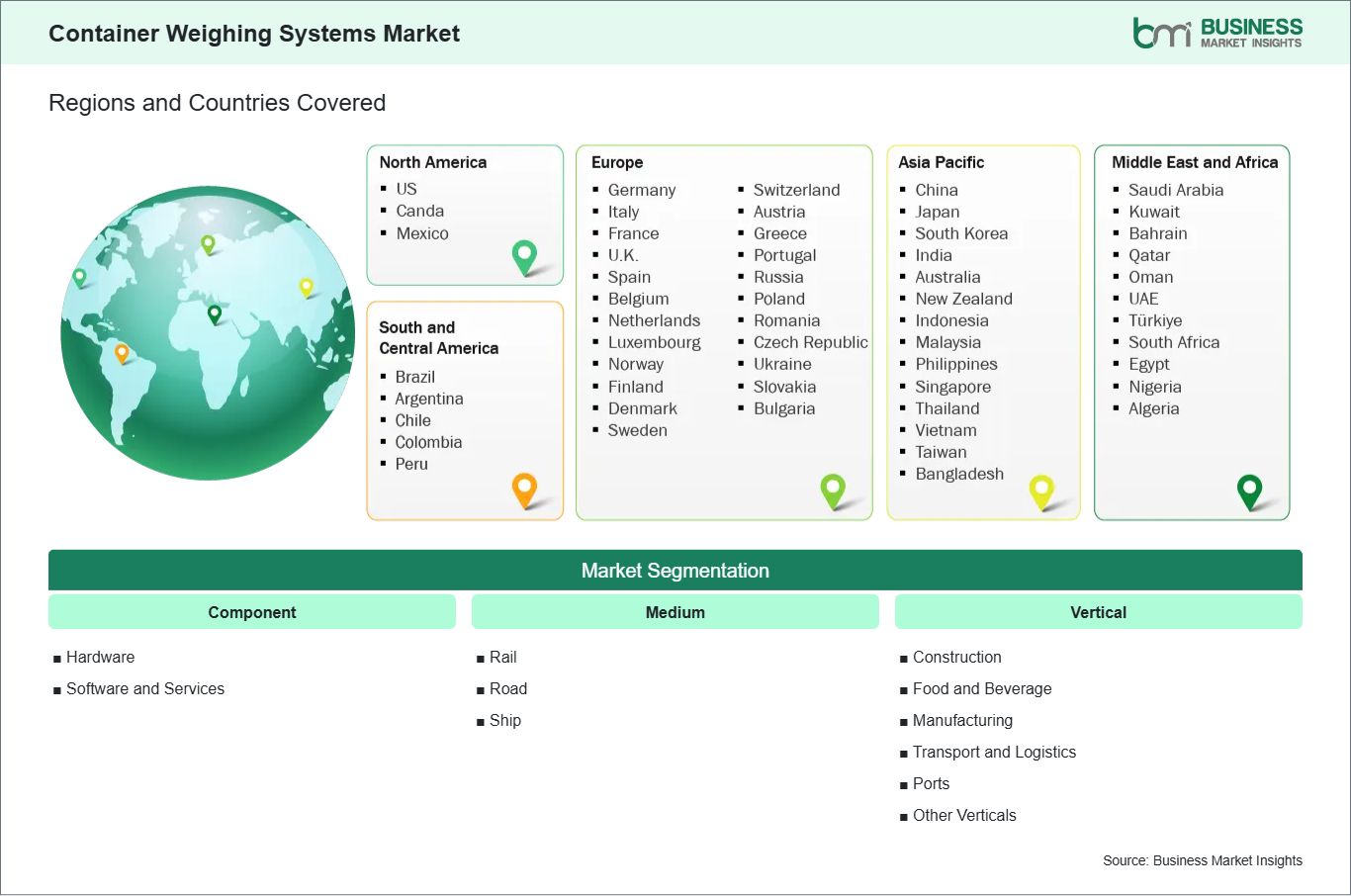
Key segments that contributed to the derivation of the container weighing systems market analysis are component, medium, and vertical.
The container weighing systems market is primarily driven by the growing focus on regulatory compliance and safety standards in the shipping and logistics industry. Initiatives such as the Verified Gross Mass (VGM) regulations by the International Maritime Organization (IMO) require shippers and ports to ensure accurate container weight measurement before loading. This has increased demand for reliable and automated weighing solutions, including weighbridges, on-board systems, and integrated software. Additionally, rising concerns about cargo safety, accident prevention, and operational efficiency in ports and transport networks are further fueling the adoption of container weighing systems globally.
The rapid digital transformation of ports, logistics hubs, and transport operations presents a significant growth opportunity for the container weighing systems market. Automation, IoT-enabled weighbridges, on-board weighing systems, and software integration are enabling real-time weight monitoring, improved operational efficiency, and enhanced compliance with international standards. Growing investments in smart port initiatives, intelligent transportation systems, and connected logistics networks are encouraging adoption. This trend allows technology providers and logistics operators to reduce human error, optimize cargo handling, and offer advanced data analytics services, creating strong opportunities for market expansion.
By component, the container weighing systems market is segmented into hardware, software, and services. Hardware held a significant share in 2025 due to its widespread deployment across ports, transport terminals, logistics hubs, and industrial facilities, driven by strong demand for weighbridges, load cells, on-board weighing devices, and integrated weighing systems.
By medium, the container weighing systems market is segmented into rail, road, and ship. Road held a significant share in 2025 due to the extensive use of trucks for container transportation, rising compliance requirements for cargo weight, and growing adoption of automated road weighing solutions across logistics and freight operations.
By vertical, the container weighing systems market is segmented into construction, food and beverage, manufacturing, transport and logistics, ports, and others. Transport and logistics held a significant share in 2025 owing to increasing container traffic, the need for efficient cargo handling, strict regulatory compliance such as VGM (Verified Gross Mass), and growing investments in automated and digital weighing technologies.
| Report Attribute | Details |
|---|---|
| Market size in 2025 | US$ 4.28 Billion |
| Market Size by 2033 | US$ 5.9 Billion |
| Global CAGR (2026 - 2033) | 4.1% |
| Historical Data | 2022-2024 |
| Forecast period | 2026-2033 |
| Segments Covered | By Component
|
| Regions and Countries Covered | North America
|
| Market leaders and key company profiles |
|
The "Container Weighing Systems Market Size and Forecast (2022–2033)" report provides a detailed analysis of the market covering below areas:
The geographical scope of the container weighing systems market report is divided into five regions: North America, Asia Pacific, Europe, Middle East & Africa, and South & Central America. The container weighing systems market in Asia Pacific is expected to grow significantly during the forecast period.
The Asia-Pacific container weighing systems market is segmented into China, Japan, South Korea, India, Australia, New Zealand, Indonesia, Malaysia, the Philippines, Singapore, Thailand, Vietnam, Taiwan, Bangladesh, and the Rest of Asia. The region is witnessing strong growth, driven by rapid expansion of ports, logistics infrastructure, and industrial facilities, as well as increasing trade and container traffic. Major economies such as China, Japan, and India are leading market growth due to rising demand for accurate and automated weighing solutions across seaports, freight terminals, road transport, and rail networks.
The region is also experiencing growing adoption of advanced container weighing technologies, including automated weighbridges, on-board weighing systems, load cells, and integrated software solutions. Increasing regulatory compliance, such as Verified Gross Mass (VGM) requirements, rising safety and operational efficiency concerns, and government initiatives to modernize transport and logistics infrastructure are further boosting market demand. Additionally, investments in digital solutions, smart port technologies, and technological advancements are positioning Asia-Pacific as a key growth region in the global container weighing systems market.

The container weighing systems market is evaluated by gathering qualitative and quantitative data post primary and secondary research, which includes important corporate publications, association data, and databases. A few of the key developments in the container weighing systems market are:
The Container Weighing Systems Market is valued at US$ 4.28 Billion in 2025, it is projected to reach US$ 5.9 Billion by 2033.
As per our report Container Weighing Systems Market, the market size is valued at US$ 4.28 Billion in 2025, projecting it to reach US$ 5.9 Billion by 2033. This translates to a CAGR of approximately 4.1% during the forecast period.
The Container Weighing Systems Market report typically cover these key segments-
The historic period, base year, and forecast period can vary slightly depending on the specific market research report. However, for the Container Weighing Systems Market report:
The Container Weighing Systems Market is populated by several key players, each contributing to its growth and innovation. Some of the major players include:
The Container Weighing Systems Market report is valuable for diverse stakeholders, including:
Essentially, anyone involved in or considering involvement in the Container Weighing Systems Market value chain can benefit from the information contained in a comprehensive market report.
Please tell us your area of interest
(Market Segments/ Regions and Countries/ Companies)