Market Summary
Executive Summary and Global Market Analysis
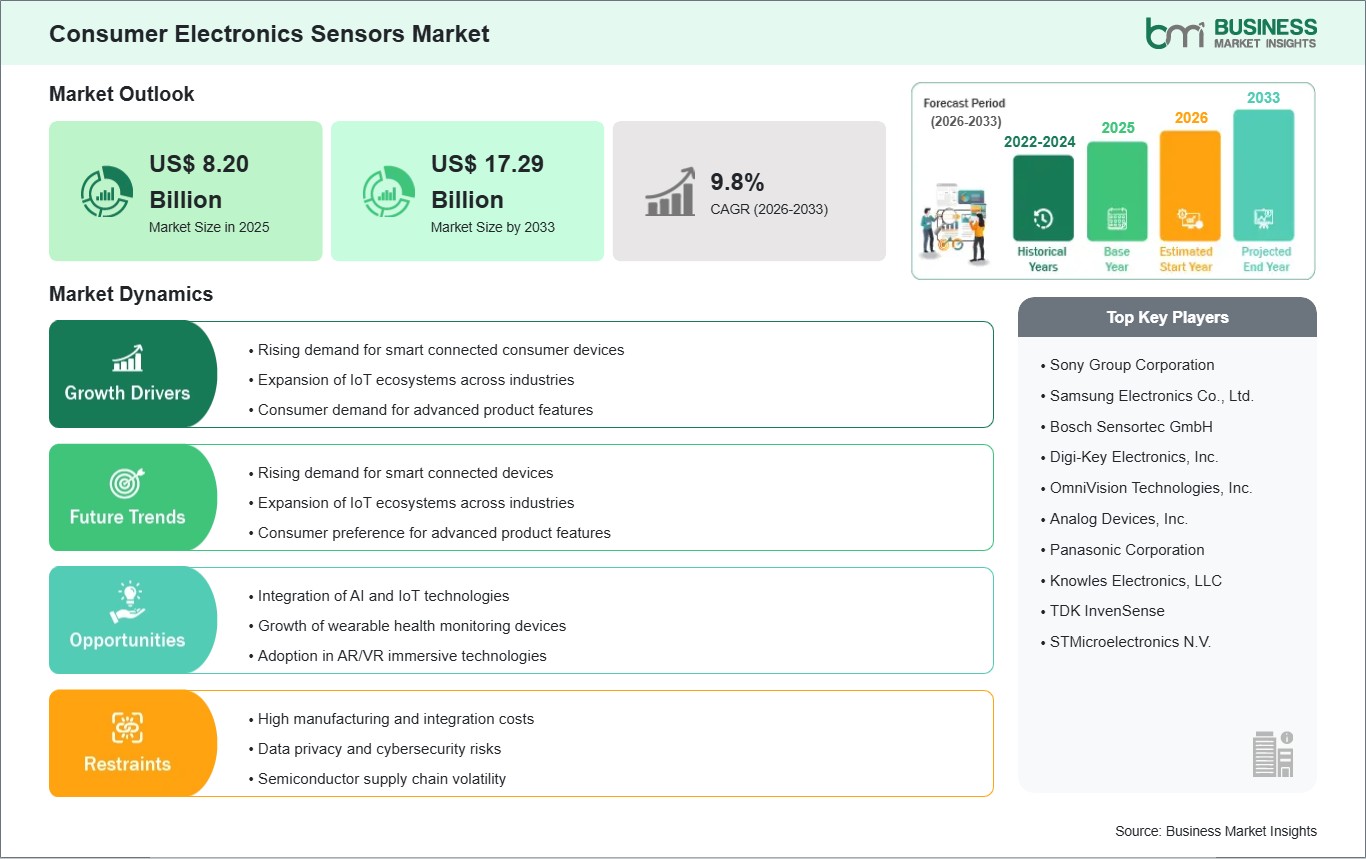
Consumer electronics sensors are devices that detect changes in the environment and convert them into signals for electronic systems to process. They play a crucial role in modern devices such as smartphones, wearables, tablets, and smart home gadgets, enabling features like motion detection, touch recognition, temperature monitoring, and biometric authentication. The usage of these sensors spans multiple applications, including health monitoring, navigation, augmented reality, and energy-efficient automation. The growing demand for consumer electronics sensors is driven by factors such as the increasing adoption of smart devices, advancements in Internet of Things (IoT) technology, rising consumer preference for personalized and convenient experiences, and the trend toward miniaturization and multifunctional devices. Additionally, innovations in sensor accuracy, low power consumption, and integration capabilities are further fueling market growth. As technology evolves, sensors continue to be indispensable in enhancing device intelligence and user experience, making them central to the consumer electronics ecosystem.
Segment Analysis
Consumer Electronics Sensors Market Segmentation
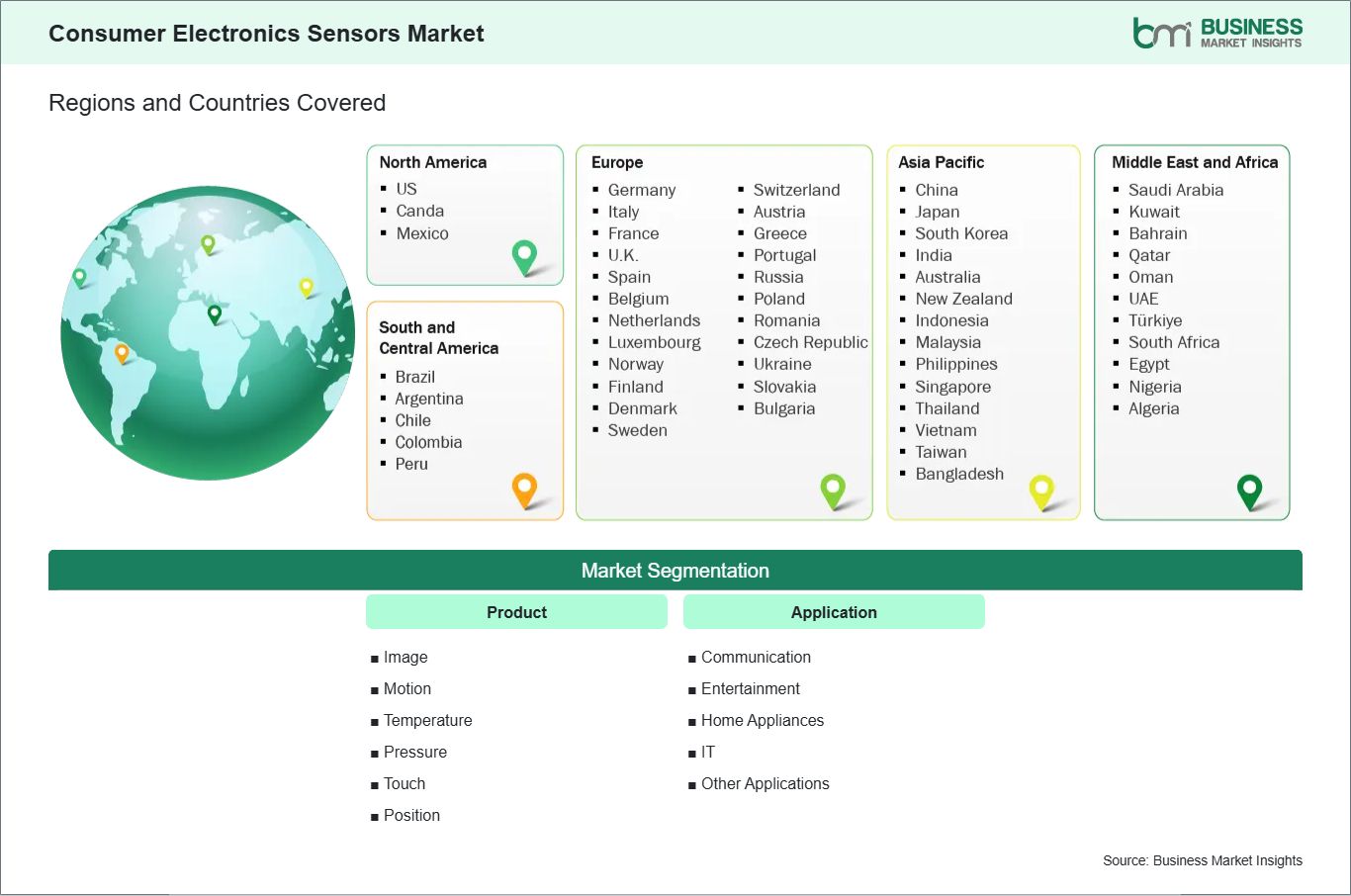
Key segments that contributed to the derivation of the consumer electronics sensors market analysis are product and application.
- By product, the market is segmented into image, motion, temperature, pressure, touch, and position. The image segment held the largest share of the market in 2025.
- By application, the market is segmented into communication, entertainment, home appliances, IT, and others. The communication segment held the largest share of the market in 2025.
Market Forces
Consumer Electronics Sensors Market Drivers and Opportunities
Rising Demand for Smart Devices
The growing adoption of smart devices such as smartphones, wearables, smart home appliances, and IoT gadgets is a major driver of the consumer electronics sensors market. Sensors play a critical role in enabling these devices to function effectively, offering features like motion detection, touch sensitivity, environmental monitoring, and health tracking. For instance, accelerometers, gyroscopes, and proximity sensors are integral to enhancing user experience in smartphones and fitness wearables. Consumers increasingly prefer devices with advanced capabilities that provide convenience, personalization, and improved safety. This surge in demand encourages manufacturers to invest in innovative sensor technologies, boosting production and market expansion. Furthermore, the rising trend of connected devices in homes and workplaces amplifies the need for sensors, fueling continuous growth. The combination of consumer interest and technological advancement makes this driver pivotal in shaping the market trajectory.
Integration of AI and IoT Technologies
The integration of artificial intelligence (AI) and the Internet of Things (IoT) present a significant growth opportunity for the consumer electronics sensors market. By combining AI with sensor technology, devices can process data intelligently, enabling predictive analysis, automation, and real-time decision-making. For example, smart wearables can monitor health metrics and provide personalized recommendations, while smart home systems can optimize energy consumption based on occupancy patterns. IoT ecosystems rely on sensors to collect accurate environmental and operational data, which AI algorithms can then analyze to enhance user experiences and device efficiency. This integration opens avenues for innovative applications in healthcare, smart cities, automotive electronics, and entertainment, creating new revenue streams for manufacturers. Companies investing in AI-powered sensors can differentiate themselves, attract tech-savvy consumers, and expand their market share, making this convergence a critical opportunity for sustainable growth.
Size and Share Analysis
Consumer Electronics Sensors Market Size and Share Analysis
By product, the market is segmented into image, motion, temperature, pressure, touch, and position. The image segment held the largest share of the market in 2025, driven by the growth in smartphone camera enhancements, tech innovation, and demand for compact, low‑power, high‑resolution imaging in consumer electronics.
By application, the market is segmented communication, entertainment, home appliances, IT, and others. The communication segment held the largest share of the market in 2025, due to growing usage as connectivity features and IoT proliferation in consumer devices increase demand for precise, integrated sensors to enhance performance and user experiences.
Report Coverage
Consumer Electronics Sensors Market Report Coverage and Deliverables
The "Consumer Electronics Sensors Market Size and Forecast (2022 - 2033)" report provides a detailed analysis of the market covering below areas:
- Consumer electronics sensors market size and forecast at global, regional, and country levels for all the key market segments covered under the scope
- Consumer electronics sensors market trends, as well as market dynamics such as drivers, restraints, and key opportunities
- Consumer electronics sensors market analysis covering key market trends, global and regional framework, major players, regulations, and recent market developments
- Industry landscape and competition analysis covering market concentration, heat map analysis, prominent players, and recent developments for the air circuit breaker market
- Detailed company profiles, including SWOT analysis
Geographic Insights
Consumer Electronics Sensors Market Geographic Insights
The geographical scope of the consumer electronics sensors market report is divided into five regions: North America, Asia Pacific, Europe, Middle East & Africa, and South & Central America. The consumer electronics sensors market in North America is expected to grow significantly during the forecast period.
The Asia Pacific consumer electronics sensors market is segmented into China, Japan, South Korea, India, Australia, New Zealand, Indonesia, Malaysia, the Philippines, Singapore, Thailand, Vietnam, Taiwan, Bangladesh, and the Rest of Asia Pacific. Rapid urbanization and rising disposable incomes are fueling demand for smart devices, such as smartphones, wearables, and home automation systems, which rely heavily on advanced sensors for enhanced functionality. Technological advancements, including miniaturization, improved energy efficiency, and higher precision of sensors, are making devices more appealing to consumers. Additionally, the growing adoption of the Internet of Things (IoT) in everyday applications—from smart homes to connected vehicles—is creating new opportunities for sensor integration. Government initiatives promoting digitalization and innovation in electronics manufacturing are further supporting market growth. Furthermore, increasing awareness of health and fitness is driving demand for wearable devices equipped with motion, biometric, and environmental sensors. Collectively, these factors contribute to the robust expansion of the consumer electronics sensors market in Asia Pacific.
Industry Activity
Recent Developments
The consumer electronics sensors market is evaluated by gathering qualitative and quantitative data post primary and secondary research, which includes important corporate publications, association data, and databases. A few of the key developments in the consumer electronics sensors market are:
- In January 2026, TDK Corporation announces a suite of InvenSense SmartMotion® custom sensing solutions for more intuitive user experiences with TWS ear buds, AI glasses, augmented reality eyewear, smart watches, fitness bands, and other IoT devices. Combining leading MEMS sensor innovation with sensor fusion software, the three newest IMUs are based on TDK’s latest ultra-low power, high-performance ICM-456xx family that offers edge intelligence for the next generation of consumer technology at the highest motion tracking accuracy.
- In August 2025, Awinic Electronics has successfully developed a new generation of "Hyper-Hall" series Hall sensors based on the "circuit design technology" and "process and packaging technology" honed in the field of mobile devices and consumer electronics. Awinic's "Hyper-Hall" series, with an ultra-small Hall package size of 0.8×0.8mm and ultra-low power consumption of 0.8μA provides the underlying support of "double freedom in space and battery life" for products such as AR smart glasses, foldable phones, smart rings, and medical CGM, promoting consumers into the era of "seamless" experience.
Trust & Transparency
Research Methodology
The market analysis combines proprietary research with secondary data from government agencies, company disclosures, regulatory filings, industry databases and expert interviews. Market estimates are validated through data triangulation, cross-market benchmarking and analyst
review.
View Full Research Methodology
Key Sources Referred:
World Bank - Global Trade IndicatorsWorld Trade Organization (WTO)International Monetary Fund (IMF)International Trade Administration (ITA)Company websiteCompany annual reportsCompany investor presentations