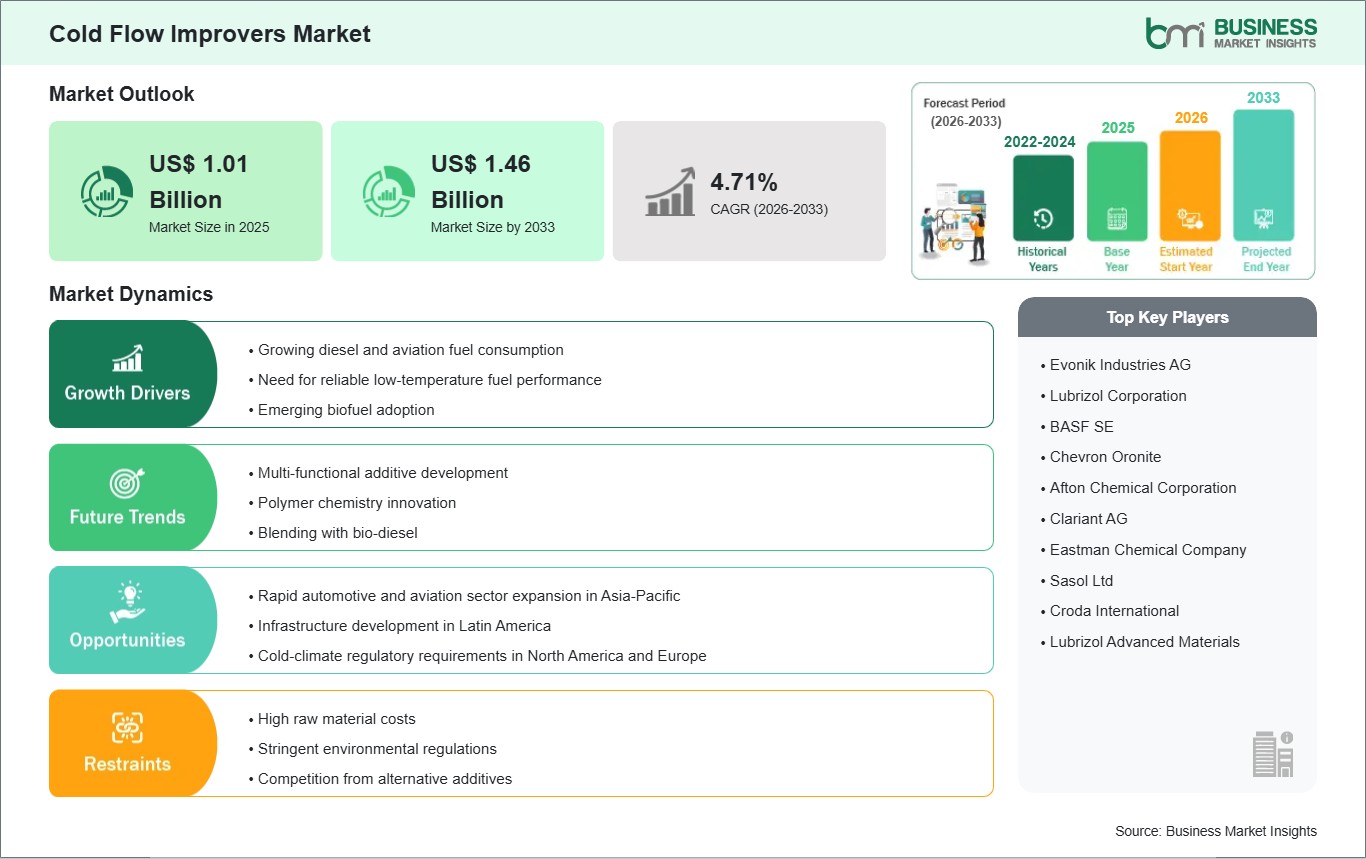
The Cold Flow Improvers Market size is expected to reach US$ 1.46 Billion by 2033 from US$ 1.01 Billion in 2025. The market is estimated to record a CAGR of 4.71% from 2026 to 2033.
The global cold flow improvers market is defined by the critical need to enhance low-temperature performance of fuels and lubricants, particularly in cold climates. Cold flow improvers (CFIs) are chemical additives that prevent wax crystallization in diesel, lubricating oil, and aviation fuels, ensuring smooth flow and optimal performance at sub-zero temperatures.
The market is experiencing growth driven by increasing diesel consumption, expansion of aviation fuel applications, and stringent operational reliability standards in automotive and aerospace industries. CFIs are particularly essential in regions with harsh winters, where fuel gelling can disrupt transportation and industrial operations.
Competitive dynamics are shaped by formulation innovation, performance optimization, and regulatory compliance. Key manufacturers focus on developing multi-functional additives that not only enhance cold flow but also improve cetane number, lubricity, and oxidation stability. The integration of CFIs with biofuels is also gaining traction, driven by sustainability goals and stricter emission regulations.
As industries prioritize operational efficiency, fuel reliability, and low-temperature performance, CFIs are increasingly critical in modern fuel and lubricant formulations globally.

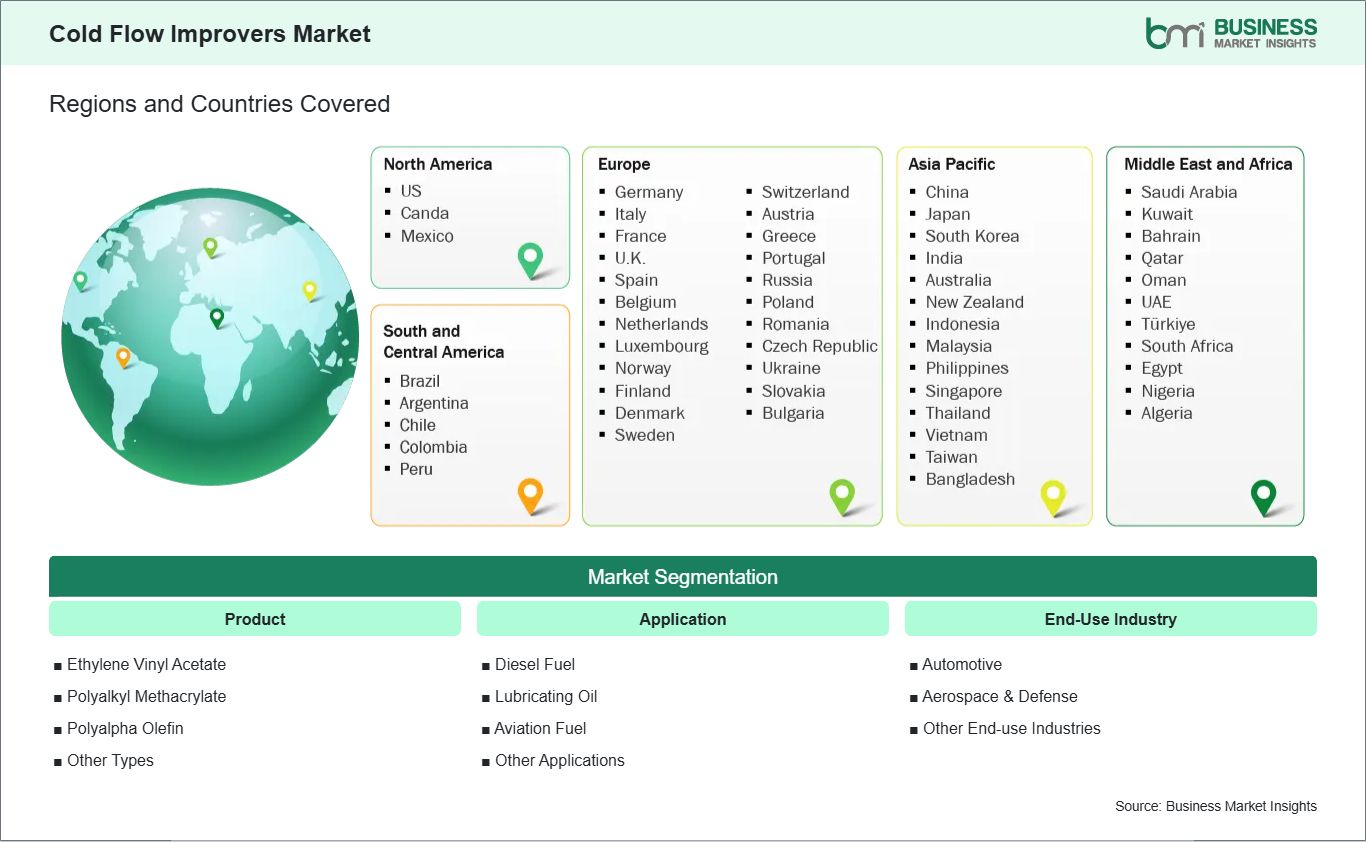
Key segments that contributed to the derivation of the cold flow improvers market analysis are type, application, and end-use industry.
The growing need for diesel and aviation fuels and the demand for cold flow improvers are the major driving forces behind the global cold flow improvers market. Diesel fuel is a major contributor to the overall consumption of transportation and industrial fuels worldwide with Europe, North America and a portion of Asia Pacific's use of diesel fuels counting for a large percentage of global industrial and transportation fuel consumption. Cold flow improvers are necessary for preventing fuel from gelling, crystalizing, and clogging in low temperature conditions, allowing vehicles and machinery to operate without interruption.
Diesel engines make up a large percentage of the commercial vehicle, truck, and bus fleets in the automotive market, particularly in the regions that experience severe winter weather. Cold flow improvers improve the overall reliability of the fuel and reduce maintenance issues, as well as improve the performance of the engine during a cold start condition. Cold flow improvers are also critical in the aviation industry to prevent the jet fuel from freezing at high altitudes, which is essential for flying safely and efficiently.
Emerging markets are beginning to see growth in diesel consumption as a result of infrastructure investment, development, and industrialisation. Cold flow improvers will help to facilitate the transportation and storage of diesel fuels in cold temperatures, which will help them to run their businesses more efficiently and meet operational standards.
Blending cold flow improvers with bio-diesel is also gaining popularity for several reasons, including that bio-fuels tend to crystalize at lower temperatures. This combination of blending with bio-diesel will allow operators to meet their sustainability goals while still maintaining good fuel performance. The global cold flow improvers market is being driven by the growth and increasing demand for diesel fuels.
Due to current technological advances, there are many growth opportunities within the CFI market, including the creation of multi-functional additives, which improve several characteristics of fuels beyond just preventing wax crystallization. Manufacturers are developing new multi-functional CFIs to be more cost-effective and reduce total additive use, thus adding significant value to customers through greater overall performance of the fuels.
One of the growth opportunities is the increasing market acceptance of biofuels. Since bio-diesel has a higher rate of crystallization at lower temperature ranges than petroleum diesel, CFIs will play an important role in maintaining cold weather performance for the bio-diesel market. In addition to providing cold-weather performance benefits, the combination of biofuels with CFIs has environmentally sustainable characteristics.
Polymer chemistry innovation is creating advanced CFIs with superior solubility and lower pour points, as well as improved compatibility across diesel fuel, lubricating oils, and aviation fuels. This innovation allows manufacturers to adjust formulations based on customers' specific end-use requirements (i.e., the customer’s location/climate) and meet regulatory standards.
Reduced reliance on fossil fuels has stimulated the use of renewable energy and created opportunities in emerging economies. As more countries industrialize, develop their automotive sector, and grow their aviation sectors, opportunities to sell CFIs in these growing markets have increased. Many governments in emerging economies are investing heavily in developing transportation and infrastructure systems that require reliable fuel performance.
The CFI market is supported by increasingly demanding regulatory compliance for fuel performance to operate at lower temperatures.

The Cold Flow Improvers Market demonstrates steady growth, with size and share analysis highlighting evolving trends and competitive dynamics among key players. The report examines subsegments categorized within type, application, and end-use industry, offering insights into their contribution to overall market performance.
By type, the polyalkyl methacrylate subsegment dominated the market in 2025, due to its excellent performance in diesel and aviation fuels under low-temperature conditions.
In terms of application, the diesel fuel subsegment dominated the market in 2025, supported by extensive usage in transportation, power generation, and industrial operations.
By end-use industry, the automotive subsegment dominated the market in 2025, driven by the large number of diesel-powered vehicles and increasing fleet sizes globally.
| Report Attribute | Details |
|---|---|
| Market size in 2025 | US$ 1.01 Billion |
| Market Size by 2033 | US$ 1.46 Billion |
| Global CAGR (2026 - 2033) | 4.71% |
| Historical Data | 2022-2024 |
| Forecast period | 2026-2033 |
| Segments Covered | By Product
|
|
Regions and Countries Covered
| |
| North America | US, Canada, Mexico |
| Europe | Belgium, Austria, Finland, Denmark, Greece, Poland, Romania, Russia, Ukraine, Czech Republic, Slovakia, Bulgaria, Italy, Luxembourg, Germany, Switzerland, France, Netherlands, Norway, Portugal, Spain, Sweden, United Kingdom |
| Asia-Pacific | Australia, China, India, Japan, South Korea, Indonesia, Malaysia, Philippines, Singapore, Thailand, Vietnam, Bangladesh, New Zealand, Taiwan |
| South and Central America | Brazil, Argentina, Peru, Chile, Colombia |
| Middle East and Africa | Bahrain, Kuwait, Oman, Qatar, Saudi Arabia, United Arab Emirates, Turkiye, South Africa, Egypt, Algeria, Nigeria |
| Market leaders and key company profiles |
|
The "Cold Flow Improvers Market Size and Forecast (2022 - 2033)" report provides a detailed analysis of the market covering below areas:
The geographical scope of the Cold Flow Improvers Market report is divided into North America, Asia Pacific, Europe, Middle East & Africa, and South & Central America. North America held the largest share in 2025.
North America remains the dominant region, supported by its extensive cold‑climate zones, high diesel consumption, and stringent fuel performance standards. Harsh winters in Canada and northern parts of the United States create a strong need for additives that improve fuel flow and prevent gelling. Moreover, the region’s regulatory environment emphasizes cleaner combustion and reduced emissions, which further drives demand for advanced formulations. The combination of high vehicle ownership, reliance on diesel for freight, and strict environmental policies ensures steady growth and innovation in this market.
Europe follows closely, with its market shaped by the prevalence of diesel‑powered commercial vehicles and strong initiatives to integrate biofuels. European Union regulations encourage the use of additives that enhance fuel efficiency and reduce harmful emissions. Countries such as Germany, France, and the UK have robust transportation networks that rely heavily on diesel, making fuel additives essential for maintaining performance. Additionally, Europe’s commitment to sustainability has accelerated the adoption of eco‑friendly solutions, positioning the region as a leader in green fuel technologies.
Asia Pacific is witnessing rapid growth, driven by expanding automotive and aviation sectors. Infrastructure development in countries like China and India has led to increased demand for transportation fuels, while rising air travel boosts the need for aviation fuel additives. The region’s industrial expansion and growing middle class also contribute to higher consumption, making Asia Pacific a key growth engine for the global market.
Emerging regions such as Latin America and the Middle East & Africa are gradually adopting fuel additives, particularly in industrial diesel and aviation applications. Brazil and Mexico are leading in Latin America due to growing automotive and industrial activity, while Gulf countries are investing in aviation and industrial diversification. Though smaller in scale, these regions represent promising opportunities for future expansion.

The Cold Flow Improvers Market is evaluated by gathering qualitative and quantitative data post primary and secondary research, which includes important corporate publications, association data, and databases. A few of the key developments in the cold flow improvers market are:
The Cold Flow Improvers Market is valued at US$ 1.01 Billion in 2025, it is projected to reach US$ 1.46 Billion by 2033.
As per our report Cold Flow Improvers Market, the market size is valued at US$ 1.01 Billion in 2025, projecting it to reach US$ 1.46 Billion by 2033. This translates to a CAGR of approximately 4.71% during the forecast period.
The Cold Flow Improvers Market report typically cover these key segments-
The historic period, base year, and forecast period can vary slightly depending on the specific market research report. However, for the Cold Flow Improvers Market report:
The Cold Flow Improvers Market is populated by several key players, each contributing to its growth and innovation. Some of the major players include:
The Cold Flow Improvers Market report is valuable for diverse stakeholders, including:
Essentially, anyone involved in or considering involvement in the Cold Flow Improvers Market value chain can benefit from the information contained in a comprehensive market report.
Please tell us your area of interest
(Market Segments/ Regions and Countries/ Companies)