Market Summary
Executive Summary and Global Market Analysis
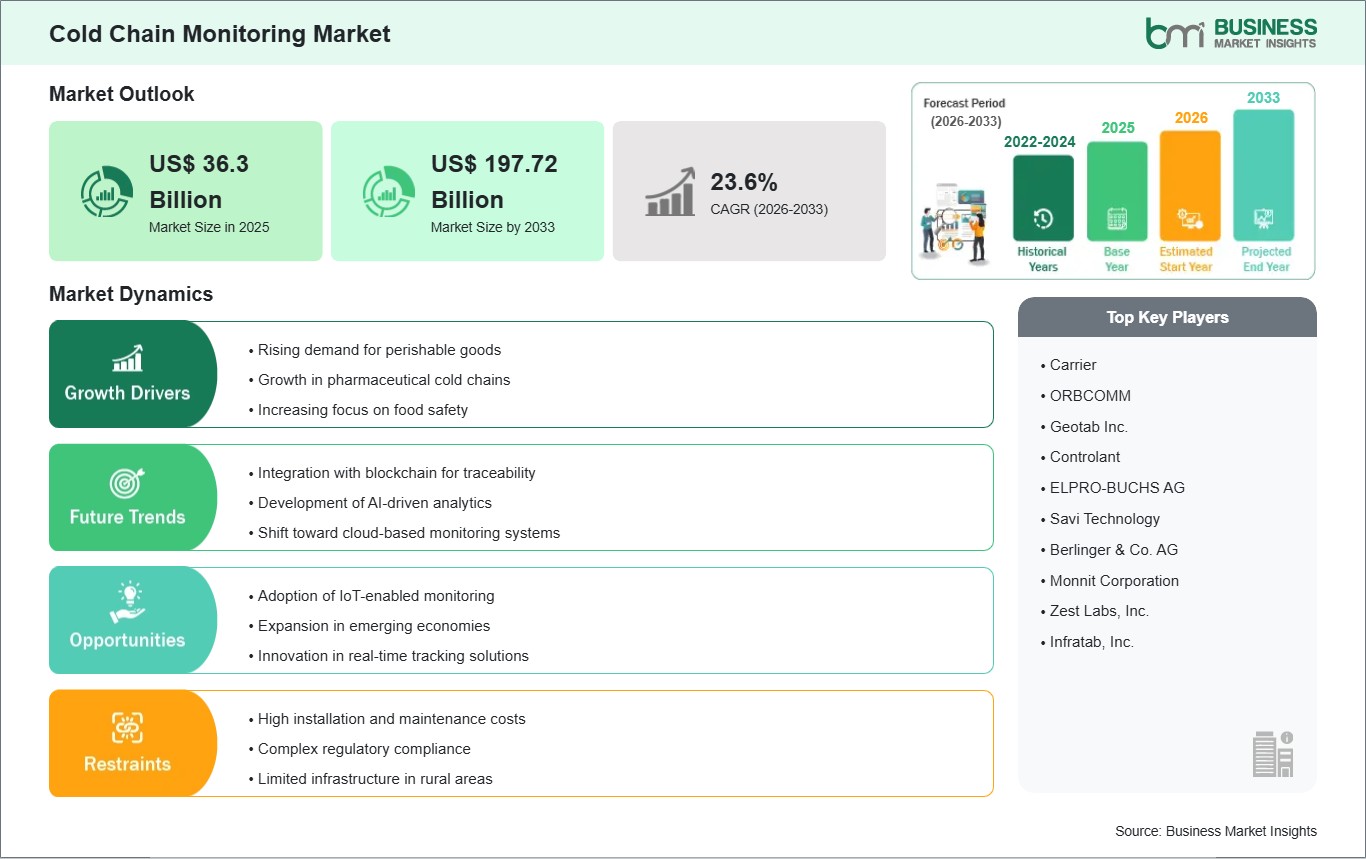
Cold Chain Monitoring involves the continuous, real-time tracking and management of temperature and other environmental conditions (like humidity) for temperature-sensitive products such as pharmaceuticals, vaccines, and perishable foods throughout the supply chain (from storage to transit). The goal is to ensure product integrity, safety, and compliance with strict regulations.
The Cold Chain Monitoring Market is experiencing substantial growth driven by the increased global demand for temperature-sensitive medications and fresh food, coupled with the mandatory requirement for regulatory compliance (e.g., FDA, GDP) that demands comprehensive, documented temperature control. The widespread adoption of IoT sensors, cloud-based software, and predictive analytics is enabling greater visibility and efficiency across logistics operations.
Segment Analysis
Cold Chain Monitoring Market Segmentation
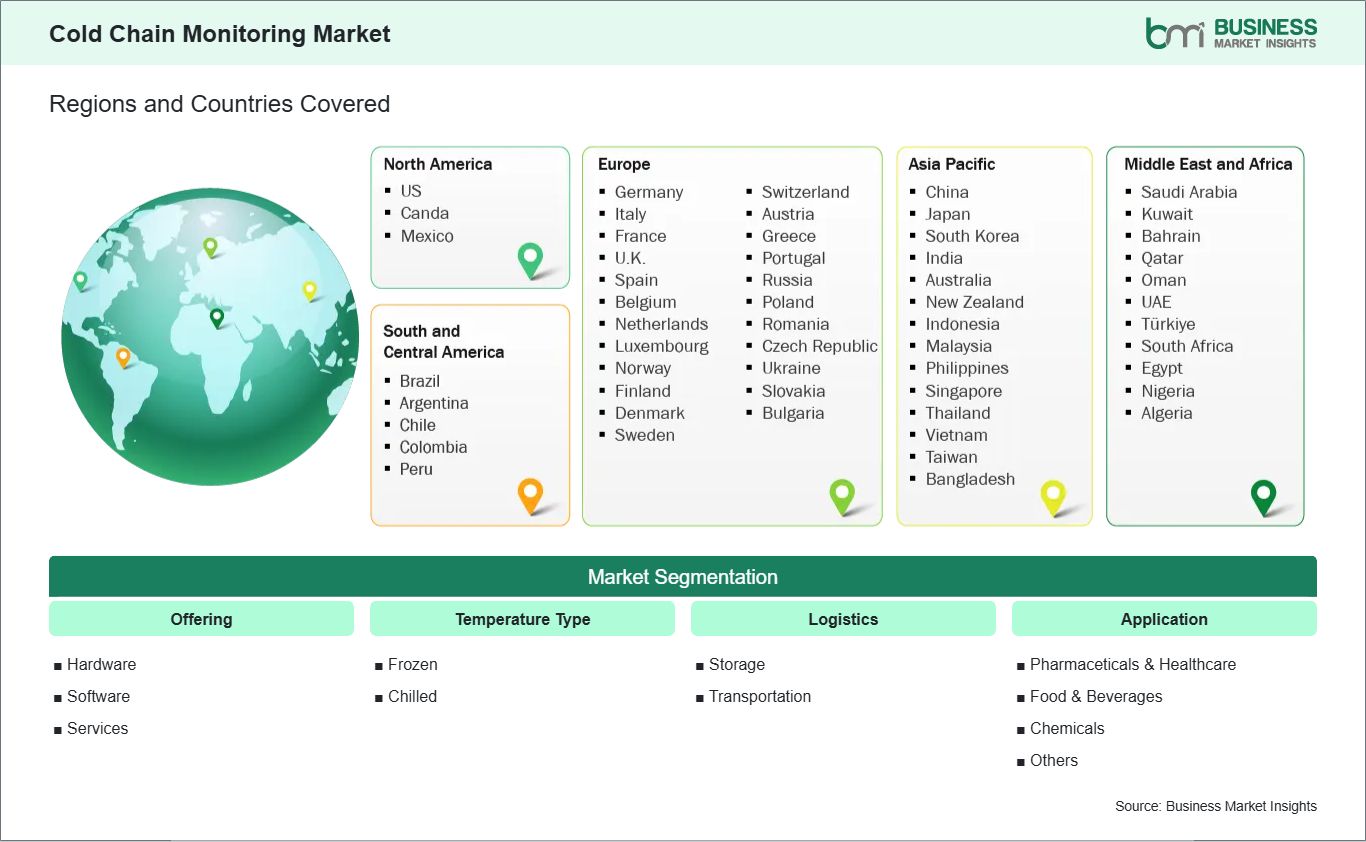
Key segments that contributed to the derivation of the Cold Chain Monitoring Market analysis are offering, temperature type, logistics, and application.
- By Offering, the market is segmented into Hardware (Sensors, RFID Devices, Telematics, Networking Devices, and Others), Software (On-premise and Cloud), and Services.
- By Temperature Type, the market is bifurcated into Frozen and Chilled.
- By Logistics, the market is bifurcated into Storage and Transportation.
- By Application, the market is segmented into Pharmaceticals & Healthcare, Food & Beverages, Chemicals, and Others.
Market Forces
Cold Chain Monitoring Market Drivers and Opportunities
Increasing Global Demand for Temperature-Sensitive Pharmaceuticals and Biologics
The pharmaceutical and healthcare industries are transitioning toward complex biological drugs (biologics, vaccines, gene therapies) that are highly sensitive to temperature fluctuations and require strict, precise temperature control to maintain their efficacy and safety.
The global production and distribution of these products, including routine vaccines and new therapeutic medicines, necessitate a robust, auditable cold chain infrastructure. Regulatory bodies worldwide are continuously tightening Good Distribution Practice (GDP) standards, making advanced monitoring solutions mandatory. Any temperature breach can render a batch of pharmaceuticals ineffective and pose a significant risk to patient safety, driving major pharmaceutical companies and logistics partners to invest heavily in next-generation, real-time monitoring and tracking systems to ensure end-to-end product integrity and regulatory compliance.
Integration of Advanced Technologies like IoT, AI, and Blockchain
The deployment of IoT-enabled sensors and telematics is moving beyond simple data logging to provide real-time, granular visibility into temperature, humidity, and location. This data, when fed into Artificial Intelligence (AI) and Machine Learning (ML) algorithms, enables predictive and prescriptive analytics. This means the system can not only alert stakeholders to a current problem but also predict potential equipment failures or temperature excursions before they occur, allowing for proactive intervention.
Furthermore, Blockchain technology offers an opportunity to create a tamper-proof, transparent ledger of the product's temperature history across all parties in the supply chain, significantly enhancing trust, reducing disputes, and streamlining regulatory audits. This technological synergy creates high-value solutions that reduce waste, improve operational efficiency, and provide an unparalleled level of product security and compliance. The future growth of the cold chain monitoring market is presented by the opportunity to fully integrate next-generation digital technologies.
Size and Share Analysis
Cold Chain Monitoring Market Size and Share Analysis
The Cold Chain Monitoring Market demonstrates consistent growth, with size and share analysis revealing strong positioning for material and product leaders amid customization trends. The report examines subsegments within offering, temperature type, logistics, and application, providing insights into their contribution to overall market performance.
For instance, the hardware subsegment holds a significant share due to the essential nature of physical sensors and telematics. The Food & Beverages subsegment remains a dominant application area, accounting for a significant portion of revenue, while the Pharmaceuticals segment is projected to grow at a faster rate due to high-value cargo requirements.
Report Coverage
Cold Chain Monitoring Market Report Coverage and Deliverables
The "Cold Chain Monitoring Market Size and Forecast (2022 - 2033)" report provides a detailed analysis of the market covering below areas:
- Cold Chain Monitoring Market size and forecast at global, regional, and country levels for all the key market segments covered under the scope
- Cold Chain Monitoring Market trends, as well as market dynamics such as drivers, restraints, and key opportunities
- Cold Chain Monitoring Market analysis covering key market trends, global and regional framework, major players, regulations, and recent market developments
- Industry landscape and competition analysis covering market concentration, heat map analysis, prominent players, and recent developments for the Cold Chain Monitoring Market
- Detailed company profiles, including SWOT analysis
Geographic Insights
Cold Chain Monitoring Market Geographic Insights
The geographical scope of the Cold Chain Monitoring Market report is divided into five regions: North America, Asia Pacific, Europe, Middle East & Africa, and South & Central America.
North America held a significant share in the market, primarily due to well-established cold chain infrastructure, high consumer awareness of food safety, and stringent regulatory environments in the pharmaceutical sector.
Asia Pacific is projected to exhibit the fastest growth during the forecast period, driven by expanding e-commerce for groceries, a growing population, and increasing foreign direct investment in building modern cold storage and logistics capabilities.
Industry Activity
Recent Developments
The Cold Chain Monitoring Market is evaluated by gathering qualitative and quantitative data post-primary and secondary research, which includes important corporate publications, association data, and databases. A few of the key developments in the Cold Chain Monitoring Market are:
- In October 2025, Carrier Global Corporation, a global leader in intelligent climate and energy solutions, announced that Carrier Ventures has made a strategic investment in Net Feasa, a pioneer in wireless IoT connectivity and vessel network technology that enables real-time container visibility at sea.
- In July 2025, Geotab, a global leader in connected vehicle and asset solutions, announced a major upgrade to its Cold Chain solution, introducing new hardware and enhanced software capabilities that provide businesses with greater visibility, control, and compliance assurance for temperature-sensitive shipments. These enhancements aim to support local industries, such as food producers and logistics operators, in maintaining product integrity and reducing waste across the supply chain.
- In October 2024, ORBCOMM joined the move to −15°C coalition to promote cold chain sustainability. ORBCOMM partnered with industry stakeholders to accelerate climate action and reduce greenhouse gas emissions, energy consumption, and supply chain costs.
Trust & Transparency
Research Methodology
The market analysis combines proprietary research with secondary data from government agencies, company disclosures, regulatory filings, industry databases and expert interviews. Market estimates are validated through data triangulation, cross-market benchmarking and analyst
review.
View Full Research Methodology
Key Sources Referred:
World Bank - Global Trade IndicatorsWorld Trade Organization (WTO)International Monetary Fund (IMF)International Trade Administration (ITA)Company WebsitesCompany Annual ReportsCompany Investor Presentations