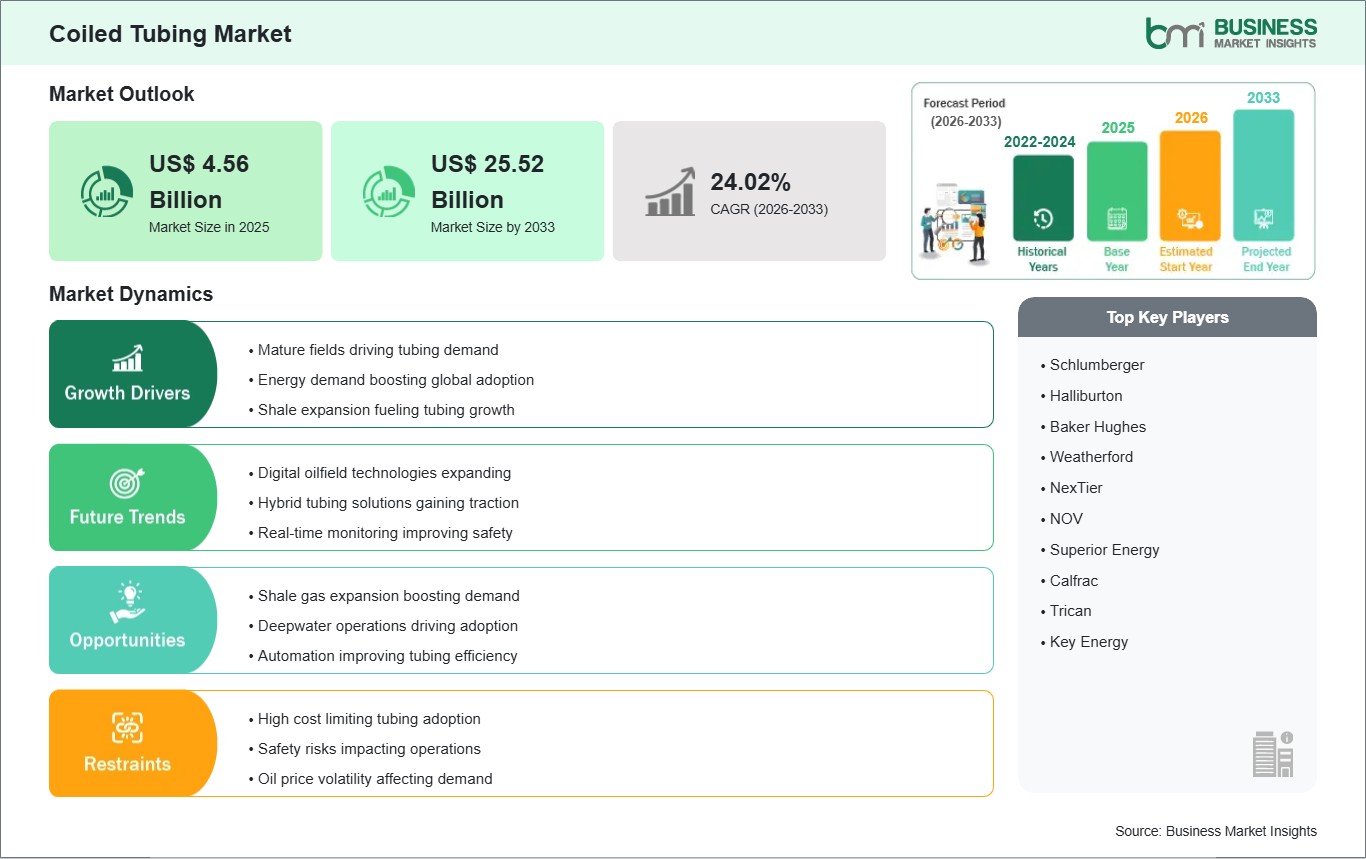
The Coiled Tubing Market size is expected to reach US$ 25.52 Billion by 2033 from US$ 4.56 Billion in 2025.The market is estimated to record a CAGR of 24.02% from 2026 to 2033.
Coiled tubing is one of the most crucial segments of the oilfield services industry that involves the use of long lengths of flexible steel or composite tubing wound around large drums in order to perform intervention, drilling, well completion, and well optimization activities in oil and gas wells. Unlike the use of jointed pipe strings, coiled tubing can be deployed continuously downhole without any interruption, which results in increased operational speed and efficiency both in offshore and onshore operations.
As per the data revealed by SLB in 2024 the firm extended its portfolio of digitally-integrated well intervention techniques with the use of sophisticated coiled tubing technology designed to enhance well productivity and decrease intervention times amid complicated drilling conditions. In general, industry players have started allocating substantial investments in automated coiled tubing, real-time downhole monitoring systems, as well as fatigue-proof tubing material in order to enhance operational safety and efficiency.
In addition, the offshore energy development projects and redevelopment of mature wells provide lucrative prospects for intervention services worldwide. Nevertheless, the industry is exposed to fluctuations in the price of crude oil, fluctuations in upstream investment, and high maintenance expenses related to coiled tubing.
The demand for coiled tubing operations is highly dependent on the increasing well intervention, older oilfield assets, and shale exploration campaigns. There is an extensive use of coiled tubing by operators to conduct well cleanouts, acid stimulation treatments, fracturing support, nitrogen lift operations, and logging because of its capability to work inside active wells without stopping production. Increasing complexity in horizontal well drilling and deepwater exploration campaigns is also driving demand for coiled tubing units that are technologically equipped to operate under high pressure and temperature conditions.

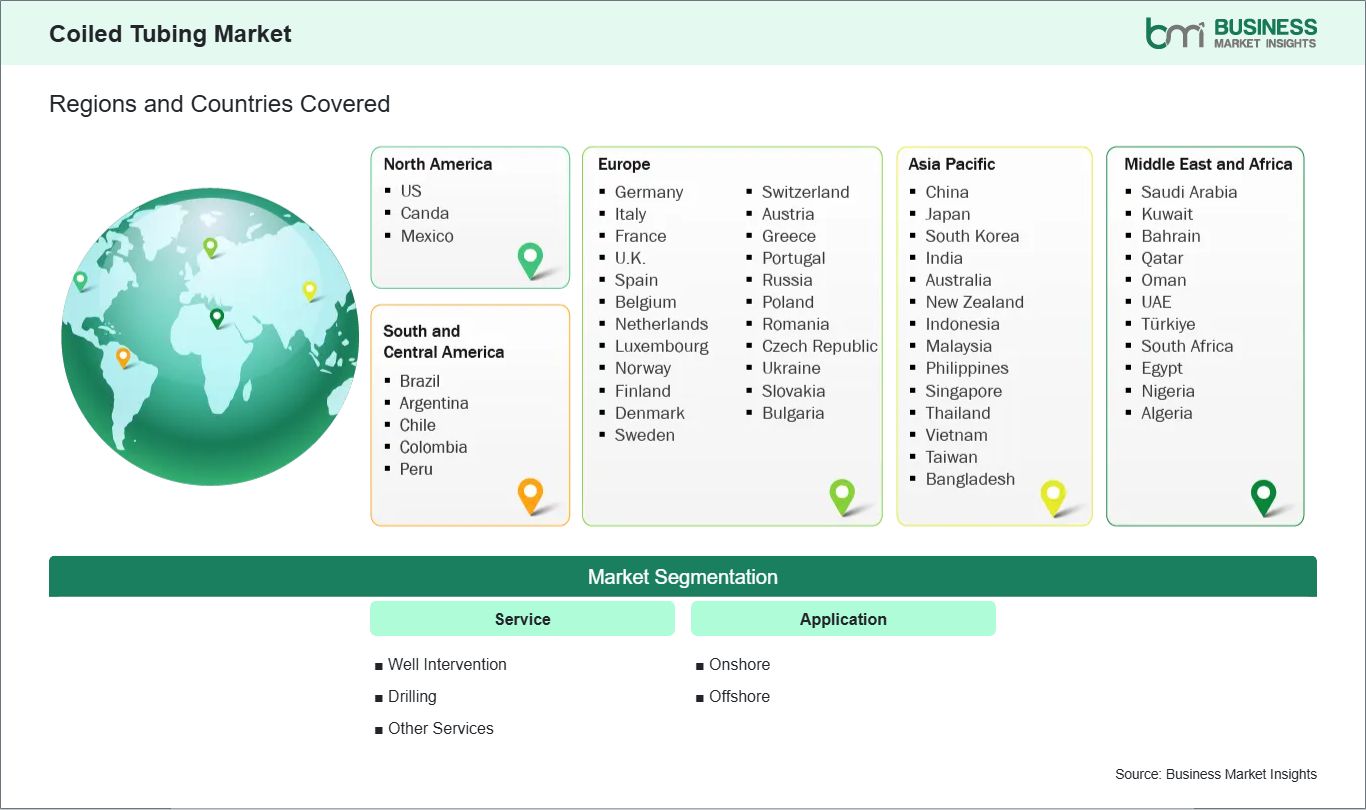
The coiled tubing market is segmented based on service and application, reflecting the growing demand for efficient well maintenance, drilling operations, and production optimization in the oil and gas industry.
The global coiled tubing market continues to show consistent growth as older oil and gas reserves necessitate improved well intervention and optimization services. The mature oilfields generally suffer from depleted pressures and decreased production, giving rise to the need for better maintenance strategies that can improve their longevity without incurring the cost of drilling. There is an increased trend towards using coiled tubing technology for cleaning out wells, acidizing, nitrogen lifting, and descaling since this process does not have any downtime as compared to other pipe-based procedures.
As operators of mature off-shore and on-shore assets emphasize efficient recovery strategies for maximum exploitation of resources through existing infrastructure, the use of coiled tubing will ensure that the process becomes highly cost-effective. Intervention processes can be conducted without shutting down production, thus making operations much more efficient and minimizing disruptions during production. Such an approach works well in mature fields where cost-effectiveness depends greatly on reduced production interruption and costs. With global energy demand remaining stagnant, producers have shifted attention to maximizing recovery of resources through existing assets and not depending on explorations.
Technical developments are driving market growth as tubing gains greater resistance to wear, increased ability to withstand pressure, and improved capabilities to perform complex interventions. New coiled tubing units with digitalized monitoring systems are able to conduct complex operations deep within mature wells. The increased ability to incorporate real-time data analysis is improving accuracy and reducing risks associated with interventions. Given that mature oil fields are responsible for most of global hydrocarbon production, high demand for coiled tubing services in such operations is expected.
The increasing demand for shale gas and other forms of unconventional hydrocarbons will present substantial growth potential for the worldwide coiled tubing industry. In general, shale gas wells need constant maintenance and stimulation with hydraulic fracturing, after which a cleanout process is required, all of which depend extensively on coiled tubing techniques. As the exploration of unconventional resources increases, so does the use of coiled tubing systems.
The increase in drilling operations and fracking activities in the shale formation has led to an increased need for coiled tubing. They are commonly employed to mill plugs, remove cuttings, provide stimulation fluid delivery, and carry out intervention tasks in extended reach horizontal wells. Compared to other intervention procedures, coiled tubing is much quicker and less labor-intensive, and it has continuous pipe operation. Thus, it is more effective in large scale shale development applications.
Moreover, the increased investments in unconventional energy infrastructure have boosted the need for coiled tubing that operates in high-pressure and high-temperature conditions. There is a continued trend of development of coiled tubing with larger diameters, injector heads that automate operations, and intervention systems that use digital controls. Shale gas extraction has further led to technological developments related to well completion and stimulation; thus, there will be increased use of coiled tubing in the future. With the evolution of unconventional resource extraction across the globe, the market can gain from increased intervention operations and complicated wells.

The Coiled Tubing Market is projected to grow from US$ 4.56 Billion in 2025 to US$ 25.52 Billion by 2033 , registering a CAGR of 24.02% from 2026 to 2033.
By Service, well intervention dominates the market due to the extensive use of coiled tubing in well cleaning, stimulation, logging, and repair operations. Its ability to perform cost-effective and faster interventions without removing production tubing makes it highly preferred across mature and active oilfields.
By Application, onshore dominates the market owing to the large number of onshore oil and gas fields, lower operational costs, and higher frequency of well intervention and maintenance activities. Growing exploration and production investments in shale and conventional reserves further support segment dominance.
| Report Attribute | Details |
|---|---|
| Market size in 2025 | US$ 4.56 Billion |
| Market Size by 2033 | US$ 25.52 Billion |
| Global CAGR (2026 - 2033) | 24.02% |
| Historical Data | 2022-2024 |
| Forecast period | 2026-2033 |
| Segments Covered | By Service
|
|
Regions and Countries Covered
| |
| North America | US, Canada, Mexico |
| Europe | Germany, Italy, France, U.K., Spain, Belgium, Netherlands, Luxembourg, Norway, Finland, Denmark, Sweden, Switzerland, Austria, Greece, Portugal, Russia, Poland, Romania, Czech Republic, Ukraine, Slovakia, Bulgaria |
| Asia-Pacific | China, Japan, South Korea, India, Australia, New Zealand, Indonesia, Malaysia, Philippines, Singapore, Thailand, Vietnam, Taiwan, Bangladesh |
| South and Central America | Brazil, Argentina, Chile, Colombia, Peru |
| Middle East and Africa | Saudi Arabia, United Arab Emirates, Kuwait, Bahrain, Qatar, Oman, Turkiye, South Africa, Egypt, Nigeria, Algeria |
| Market leaders and key company profiles |
|
The "Coiled Tubing Market Size and Forecast (2022 and 2033)" report provides a detailed analysis of the market covering below areas:
There has been significant growth recorded in the global coiled tubing industry owing to increased exploration activities in the oil and gas sector, high demand for well intervention processes, and growing use of cost-effective drilling and completion solutions. This technology finds application in well cleaning, drilling, stimulation, logging, and production activities owing to the continuous deployment of pipe and high efficiency levels as opposed to traditional drilling technologies. This industry is gaining momentum through innovations in offshore exploration activities as well as maximization of oil production from existing fields.
North America accounts for a sizable share in the coiled tubing market because of the large presence of shale gas and tight oil drilling operations in countries such as the United States and Canada. The continent is home to a well-established oilfield service industry with robust drilling facilities that have promoted the use of coiled tubing throughout North America in offshore and onshore operations. The trend among companies in this continent has been increasing automation and development of coiled tubing units, real-time monitoring tools, and high-pressure machines.
Asia Pacific is fast becoming one of the most rapidly developing regions in terms of market growth as a result of high energy consumption, greater oil and gas exploration activity, and increasing investment in upstream infrastructure. Several countries, including China, India, Indonesia, and Australia, have taken measures to improve their oil and gas extraction capacity in order to limit reliance on energy imports. There has been an increase in the usage of coiled tubing equipment in well servicing and interventions in old and offshore wells. Another factor boosting the market development in Asia Pacific includes advancements in drilling technologies and deepwater drilling activity.
The market for coiled tubing is expected to be driven by increasing energy demand worldwide, efficiency in operations in oilfield activities, as well as continual technological improvements in drilling and well intervention processes, where the technology for coiled tubing is more developed in North America, while Asia Pacific shows rapid growth due to exploration activities.

The coiled tubing market is evaluated by gathering qualitative and quantitative data post primary and secondary research, which includes important corporate publications, association data, and databases. A few of the key developments in the coiled tubing market are:
The Coiled Tubing Market is valued at US$ 4.56 Billion in 2025, it is projected to reach US$ 25.52 Billion by 2033.
As per our report Coiled Tubing Market, the market size is valued at US$ 4.56 Billion in 2025, projecting it to reach US$ 25.52 Billion by 2033. This translates to a CAGR of approximately 24.02% during the forecast period.
The Coiled Tubing Market report typically cover these key segments-
The historic period, base year, and forecast period can vary slightly depending on the specific market research report. However, for the Coiled Tubing Market report:
The Coiled Tubing Market is populated by several key players, each contributing to its growth and innovation. Some of the major players include:
The Coiled Tubing Market report is valuable for diverse stakeholders, including:
Essentially, anyone involved in or considering involvement in the Coiled Tubing Market value chain can benefit from the information contained in a comprehensive market report.
Please tell us your area of interest
(Market Segments/ Regions and Countries/ Companies)