Market Summary
Executive Summary and Global Market Analysis
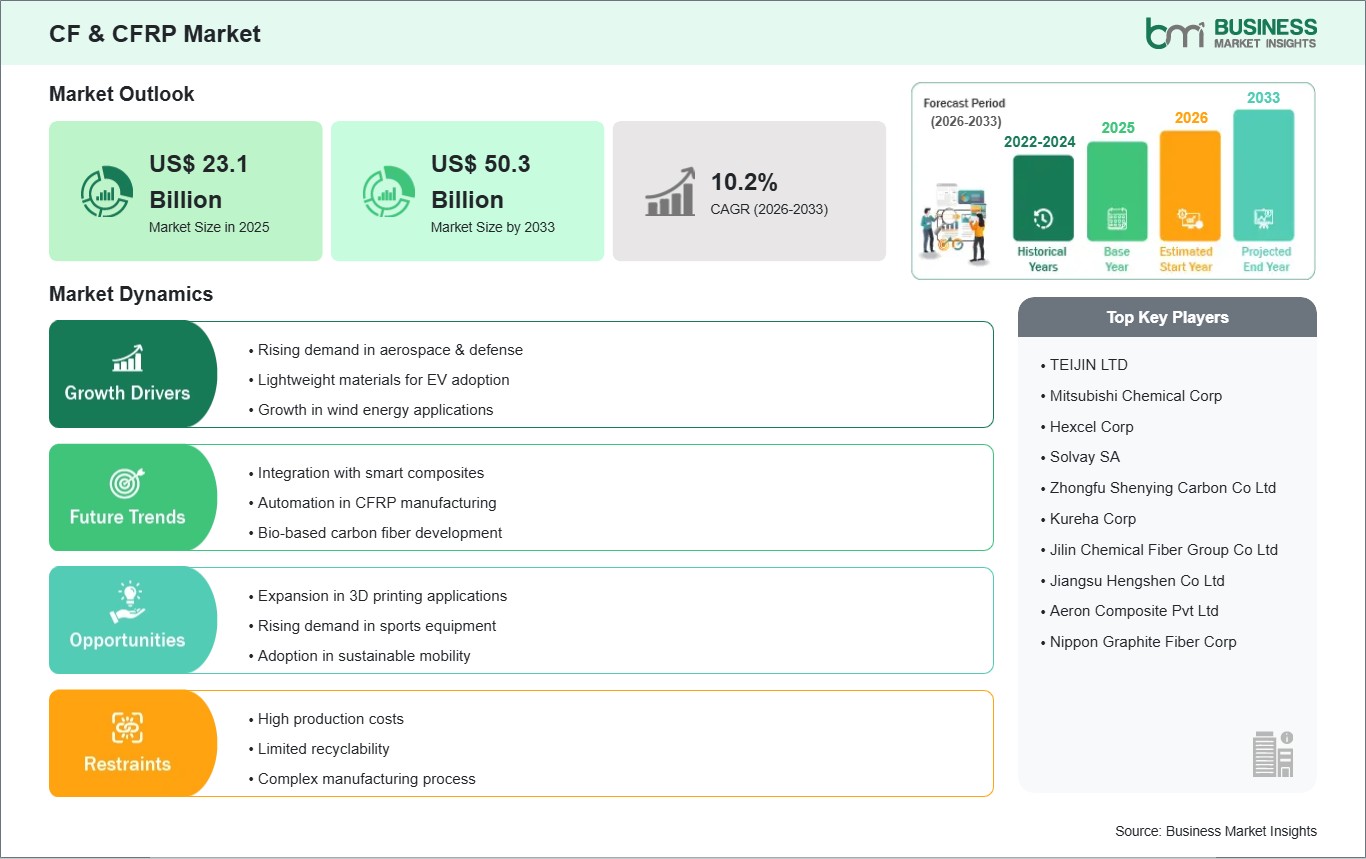
Carbon Fiber (CF) and Carbon Fiber Reinforced Polymers (CFRP) represent advanced materials known for their exceptional strength-to-weight ratio, high stiffness, durability, and corrosion resistance. These attributes make them indispensable for industries seeking lightweight yet high-performance solutions, particularly aerospace, automotive, and wind energy.
Despite their advantages, market growth faces notable challenges. The production of CF, especially from Polyacrylonitrile (PAN) precursors, is highly energy-intensive, driving up costs significantly compared to traditional metals. Additionally, manufacturing large CFRP components requires specialized equipment and complex processes, creating bottlenecks in scalability. Competition from alternative lightweight materials such as high-strength steel, aluminum alloys, and glass fiber reinforced polymers (GFRPs) further intensifies market pressure.
Nevertheless, the push for sustainability is accelerating the adoption of recycled carbon fiber (rCF), which offers cost efficiency and reduced environmental impact. Similarly, advancements in thermoplastic CFRP and rapid manufacturing technologies, such as resin transfer molding, automated fiber placement, and 3D printing, are paving the way for faster production cycles and recyclability. These innovations position CF and CFRP as critical enablers for next-generation aerospace, electric vehicles, and industrial applications.
Segment Analysis
CF & CFRP Market Segmentation
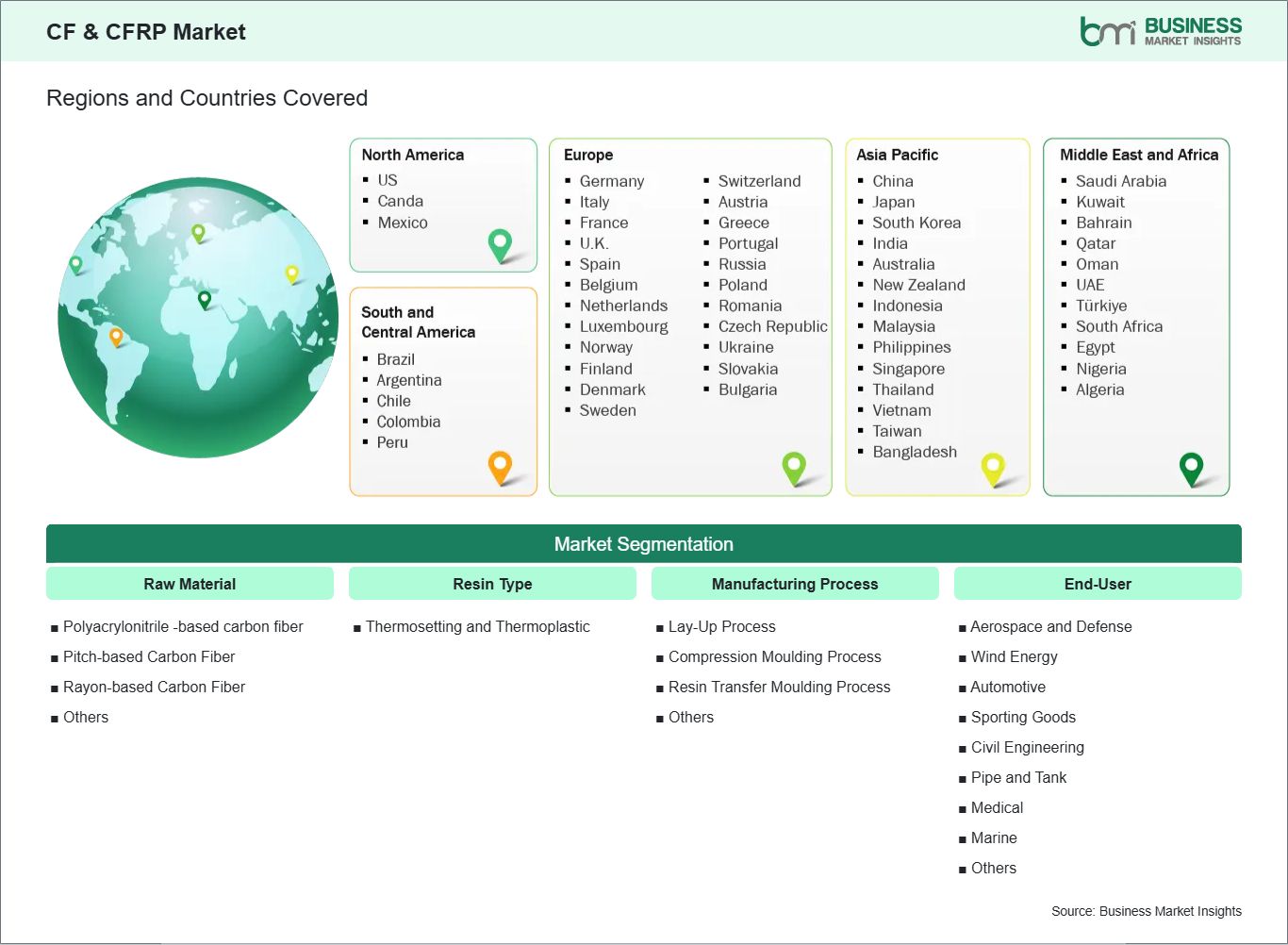
Key segments that contributed to the derivation of the CF &CFRP market analysis are raw material, resin type, manufacturing process, and end user.
- By Raw Material, the market is segmented into Polyacrylonitrile (PAN)-Based Carbon Fiber, Pitch-Based Carbon Fiber, Rayon-Based Carbon Fiber, and Others.
- By Resin Type, the market is segmented into Thermosetting and Thermoplastic.
- By Manufacturing Process, the market is segmented into Lay-Up Process, Compression Moulding Process, Resin Transfer Moulding Process, and Others.
- By End User, the market is segmented into Aerospace and Defense, Wind Energy, Automotive, Sporting Goods, Civil Engineering, Pipe and Tank, Medical, Marine, and Others.
Market Forces
CF & CFRP Market Drivers and Opportunities
Lightweighting Mandate in Aerospace and Automotive
The primary impetus for the CF & CFRP market lies in the relentless demand for lightweight materials in two major end user industries: Aerospace and Automotive (EVs and Performance). Modern commercial airliners are incorporating carbon composites extensively. For example, the use of CFRP in wings, fuselage sections, and stabilizers in aircraft like the Boeing 787 and Airbus A350 drastically reduces overall weight. This reduction translates directly into significant fuel savings (estimated up to 20%) and reduced carbon emissions, aligning with global environmental targets and operational cost reductions for airlines.
In the automotive sector, CFRP is moving from high-end performance cars into mass-market Electric Vehicles (EVs). Since heavy battery packs compromise an EV's range, manufacturers leverage CFRP to reduce the weight of other components (e.g., body panels, battery enclosures, and chassis parts) to extend the driving range and improve vehicle handling. Stringent global fuel economy standards are accelerating this replacement of traditional materials like steel and aluminum with carbon composites.
Sustainability and Advanced Manufacturing
The market faces pressure on cost and environmental impact, leading to two key commercial opportunities: recycled carbon fiber (rCF) and rapid-cure thermoplastics. The development of advanced recycling processes (pyrolysis or solvolysis) that can recover up to 90% of the original fiber strength from end-of-life components offers a significant opportunity. Recycled CF provides a cost-effective and lower-carbon alternative to virgin CF, making the material accessible for less critical, high-volume applications like sporting goods and some automotive parts, thereby expanding the overall addressable market.
The shift towards thermoplastic CFRP and rapid manufacturing technologies (RTM, AFP, and 3D printing) offers a pathway to mass production. Thermoplastics allow for faster processing cycles and enable components to be remolded, facilitating material recycling. This technological evolution is crucial for overcoming the production bottlenecks and high cycle times historically associated with thermoset composites, paving the way for wider adoption in mainstream automotive and industrial manufacturing.
Size and Share Analysis
CF & CFRP Market Size and Share Analysis
The CF & CFRP Market demonstrates steady growth, with size and share analysis revealing evolving trends and competitive positioning among key players. The report further examines subsegments categorized within raw material, resin type, manufacturing process, and end user, offering insights into their contribution to overall market performance.
Among raw materials, PAN-based carbon fiber continues to hold the largest market share due to its superior mechanical properties and widespread use in aerospace and automotive applications. In resin types, thermosetting resins remain the preferred choice for structural components, offering high strength and thermal stability. For manufacturing processes, resin transfer molding (RTM) is gaining traction for its ability to deliver high-quality, complex parts efficiently. In end-user industries, aerospace and defense lead adoption, driven by stringent performance standards and the need for lightweighting in aircraft structures.
Report Coverage
CF & CFRP Market Report Coverage and Deliverables
The CF & CFRP Market Size and Forecast (2022–2033) report provides a detailed analysis of the market covering below areas:
- CF & CFRP Market size and forecast at global, regional, and country levels for all the key market segments covered under the scope.
- CF & CFRP Market trends, as well as market dynamics such as drivers, restraints, and key opportunities.
- CF & CFRP Market analysis covering key market trends, global and regional framework, major players, regulations, and recent market developments
- Industry landscape and competition analysis covering market concentration, heat map analysis, prominent players, and recent developments for the CF & CFRP Market
- Detailed company profiles, including SWOT analysis
Geographic Insights
CF & CFRP Market Geographic Insights
The geographical scope of the CF & CFRP market report is divided into five regions: North America, Europe, Asia Pacific, the Middle East & Africa, and South & Central America.
North America is a hub for aerospace innovation and electric vehicle development, fueling demand for advanced composites. Europe emphasizes sustainability and renewable energy, with strong applications in wind turbine blades and high-end automotive manufacturing. Asia Pacific is witnessing rapid industrialization and expanding production capacity, particularly in China and India, across automotive and wind energy sectors. Middle East & Africa is emerging with investments in aerospace and infrastructure projects requiring non-metallic solutions. South & Central America shows growing interest in automotive and construction applications, supported by regional industrial development.
Industry Activity
Recent Developments
The CF & CFRP market is evaluated by gathering qualitative and quantitative data post-primary and secondary research, which includes important corporate publications, association data, and databases. A few of the key developments in the CF & CFRP market are:
- In December 2025, Mitsubishi Chemical to double Aichi, Sacramento carbon fiber plant production capacity. Strengthened carbon fiber capacity will support high-end applications in sport, aerospace, hypercar and others in Japan and across the U.S.
- In November 2025, Toray Industries announced the development of an advanced recycling technology capable of decomposing diverse CFRP made from thermosetting resins while maintaining the strength and surface quality of the recovered fibres.
- In March 2025, Hexcel Corporation and FIDAMC announced a partnership focused on advancing composite materials for aerospace and industrial applications, with an emphasis on developing innovative manufacturing processes to enhance lightweight, high-performance composites.
Trust & Transparency
Research Methodology
The market analysis combines proprietary research with secondary data from government agencies, company disclosures, regulatory filings, industry databases and expert interviews. Market estimates are validated through data triangulation, cross-market benchmarking and analyst
review.
View Full Research Methodology
Key Sources Referred:
World Bank – Global Trade IndicatorsWorld Trade Organization (WTO)International Monetary Fund (IMF)International Trade Administration (ITA)Company WebsitesCompany Annual ReportsCompany Investor Presentations