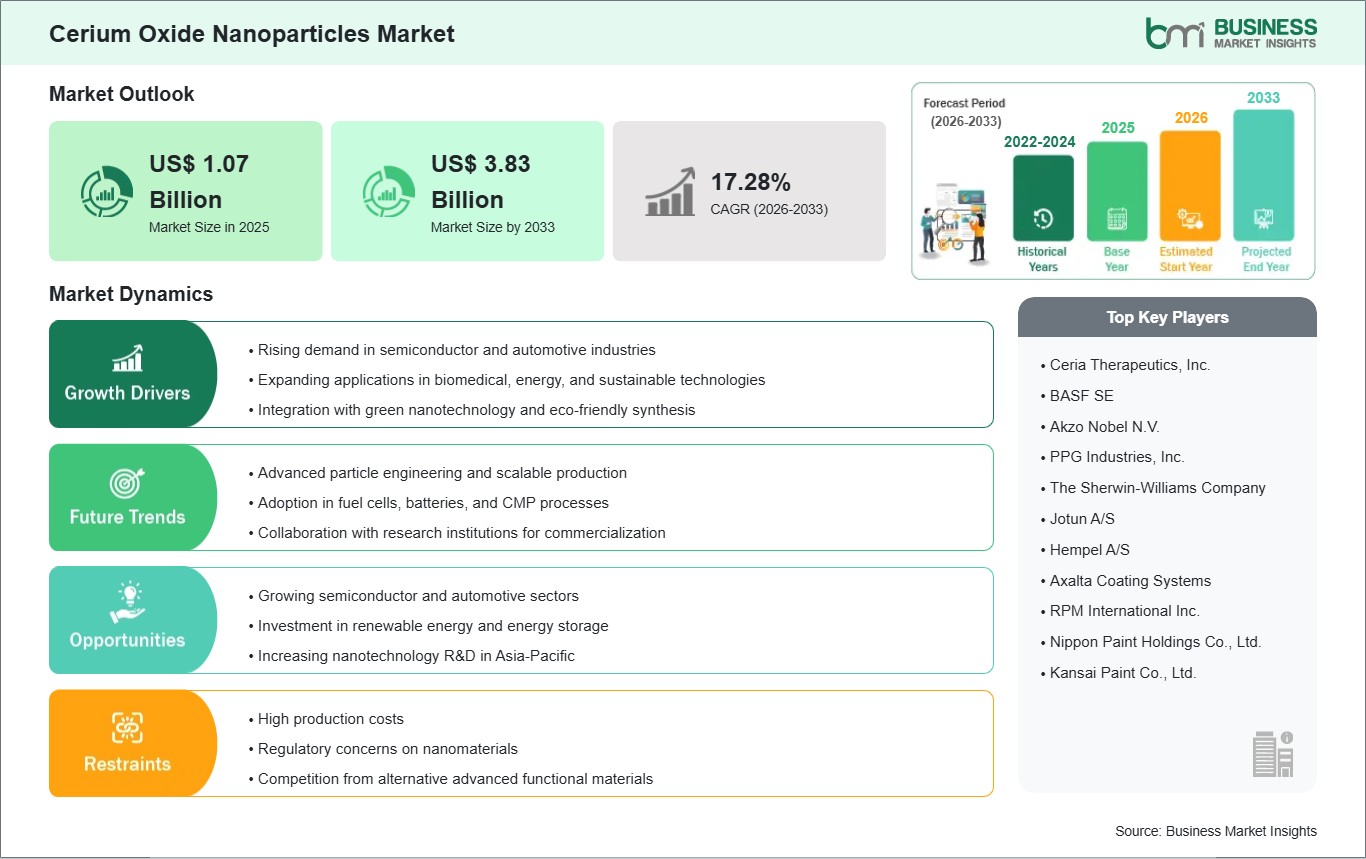
The Cerium Oxide Nanoparticles Market size is expected to reach US$ 3.83 Billion by 2033 from US$ 1.07 Billion in 2025. The market is estimated to record a CAGR of 17.28% from 2026 to 2033.
The global cerium oxide nanoparticles market is defined by increasing demand for advanced functional materials across semiconductor manufacturing, automotive catalysis, biomedical innovation, and energy systems. Cerium oxide nanoparticles (CeO₂ NPs) are valued for their unique redox properties, oxygen storage capacity, and catalytic efficiency, making them essential in high-performance and precision-driven industrial applications.
The market is experiencing steady expansion as industries prioritize efficiency, miniaturization, and sustainability. In semiconductor fabrication, cerium oxide nanoparticles are widely used in chemical mechanical planarization (CMP), a critical process for achieving ultra-smooth wafer surfaces required in advanced electronics. In parallel, automotive manufacturers are integrating cerium-based catalysts to meet stringent emission standards and improve fuel efficiency.
Competitive dynamics increasingly focus on particle engineering, including size uniformity, dispersion stability, and purity optimization. Manufacturers are investing in scalable production technologies and application-specific customization to meet evolving industry requirements. Strategic collaborations with research institutions and downstream industries are accelerating innovation and commercialization.
Regulatory frameworks concerning nanomaterial safety, environmental impact, and industrial usage continue to shape market strategies. Companies are adopting sustainable production methods and lifecycle management approaches to align with global environmental standards. As industries transition toward cleaner and more efficient technologies, cerium oxide nanoparticles are emerging as critical enablers of next-generation material solutions.

Key segments that contributed to the derivation of the cerium oxide nanoparticles market analysis are product and application.
The demand for cerium oxide nanoparticles is driven by two primary sector trends: increased demand from the semiconductor industry and increased demand from the automotive industry - both of which utilize high-performance materials with specific functional properties. In the semiconductor industry, cerium oxide nanoparticles are used extensively in chemical mechanical planarization (CMP) to polish wafers and achieve defect-free, ultra-smooth wafer surfaces. As the designs of chips become smaller and more densely packed with transistors, the need for high purity and uniformity of nanoparticles is accelerating. In addition, global capacities for semiconductor manufacturing are expanding due to technologies such as artificial intelligence, 5G and high-performance computing.
In the automotive industry, cerium oxide nanoparticles are important for catalytic converters because of their ability to store and release oxygen, increasing the efficiency of combustion while reducing the emissions of harmful gases including carbon monoxide and nitrogen oxides from vehicles. With governments around the globe implementing stricter emissions regulations and moving towards cleaner mobility alternatives, automakers are increasingly utilising advanced catalytic materials; during this time, manufacturers have begun to use cerium-based fuel additives to improve fuel efficiency and reduce particulate emissions, particularly from diesel engines.
The cerium oxide nanoparticle market is expected to grow substantially due to a number of applications, including biomedical applications, energy generation applications, and sustainable technology applications.
The properties of cerium oxide nanoparticles make them attractive for biomedical applications. They are known to have regenerative antioxidant characteristics and can rapidly switch between two different oxidation states (Ce³⁺ and Ce⁴⁺), which enables them to specifically neutralize reactive oxygen species. As a result of these properties, cerium oxide nanoparticles have potential as therapeutics for many chronic diseases such as cancer, neurological and neurodegenerative disorders, and inflammatory conditions. Evidence from numerous studies suggests that cerium oxide nanoparticles will serve as innovative nanotherapeutic agents by protecting healthy cells from oxidative stress while specifically targeting cells undergoing oxidative stress.
In addition to their use in biomedicine, cerium oxide nanoparticles are being used for energy applications as well. The use of cerium oxide nanoparticles in fuel cells, batteries, and solar energy systems is increasing due to their oxygen buffering capacity as well as their electrochemical properties, both of which improve the overall efficiency of energy conversion and increase the long-term stability of energy systems. The increase in global investment in renewable energy and energy storage technologies is expected to increase the demand for advanced nanomaterials, such as cerium oxide nanoparticles. In particular, cerium oxide nanoparticles are critical to the operation and longevity of solid oxide fuel cells and the next generation of batteries.
Sustainable manufacturing and the emergence of green nanotechnology is another area of opportunity for cerium oxide nanoparticle manufacturers. Researchers and companies are developing eco-friendly synthesis and low-energy manufacturing methods to produce cerium oxide nanoparticles in an environmentally friendly manner.

The Cerium Oxide Nanoparticles market demonstrates steady growth, with size and share analysis highlighting evolving trends and competitive dynamics among key players. The report examines subsegments categorized within product and application, offering insights into their contribution to overall market performance.
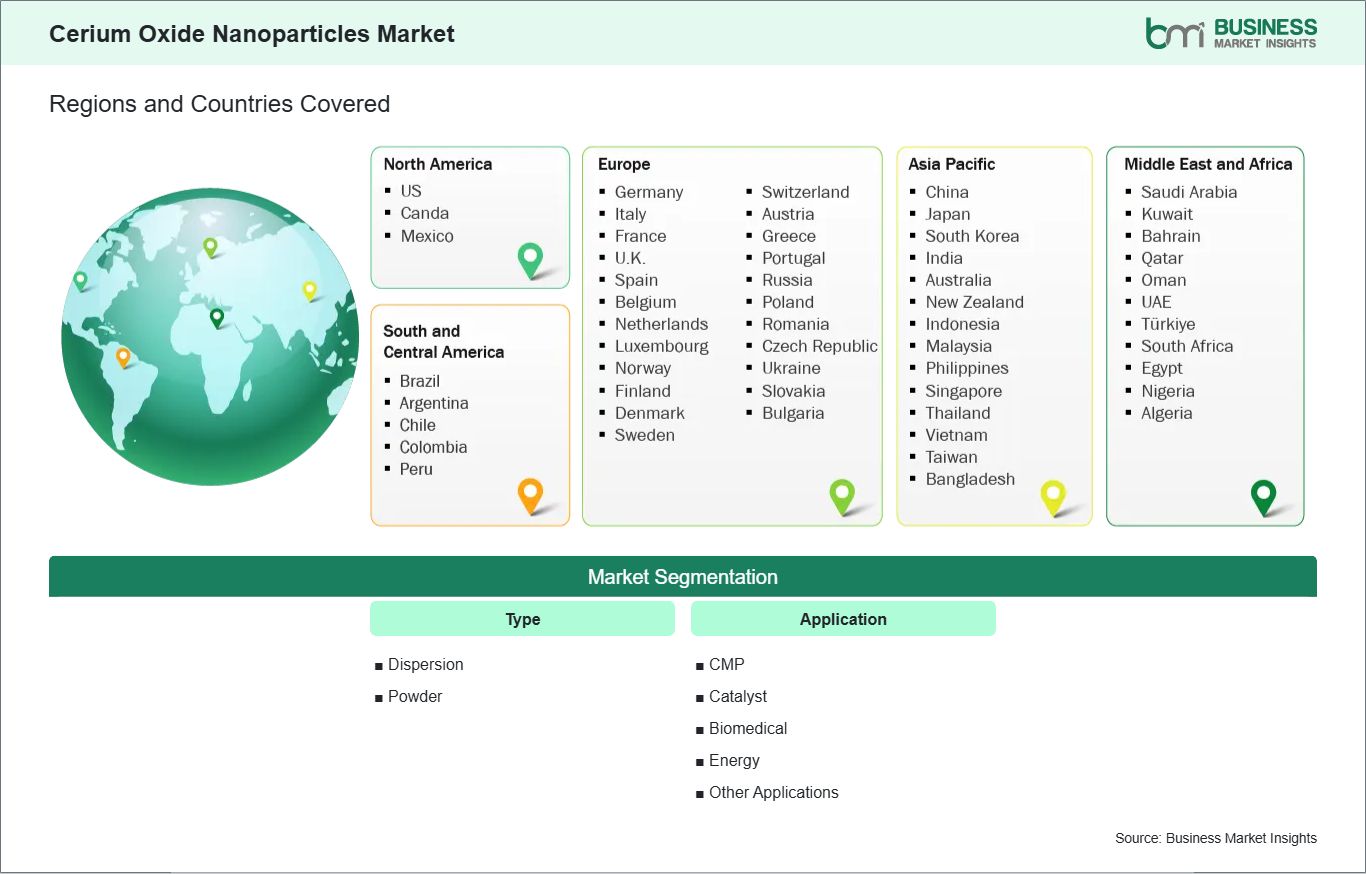
By product, the dispersion subsegment dominated the market in 2025, driven by its ease of integration and superior stability.
In terms of application, the CMP subsegment dominated the market in 2025, driven by increasing semiconductor manufacturing demand.
| Report Attribute | Details |
|---|---|
| Market size in 2025 | US$ 1.07 Billion |
| Market Size by 2033 | US$ 3.83 Billion |
| Global CAGR (2026 - 2033) | 17.28% |
| Historical Data | 2022-2024 |
| Forecast period | 2026-2033 |
| Segments Covered | By Type
|
|
Regions and Countries Covered
| |
| North America | US, Canada, Mexico |
| Europe | Belgium, Austria, Finland, Denmark, Greece, Poland, Romania, Russia, Ukraine, Czech Republic, Slovakia, Bulgaria, Italy, Luxembourg, Germany, Switzerland, France, Netherlands, Norway, Portugal, Spain, Sweden, United Kingdom |
| Asia-Pacific | Australia, China, India, Japan, South Korea, Indonesia, Malaysia, Philippines, Singapore, Thailand, Vietnam, Bangladesh, New Zealand, Taiwan |
| South and Central America | Brazil, Argentina, Peru, Chile, Colombia |
| Middle East and Africa | Bahrain, Kuwait, Oman, Qatar, Saudi Arabia, United Arab Emirates, Turkiye, South Africa, Egypt, Algeria, Nigeria |
| Market leaders and key company profiles |
|
The "Cerium Oxide Nanoparticles Market Size and Forecast (2022 - 2033)" report provides a detailed analysis of the market covering below areas:
The geographical scope of the Cerium Oxide Nanoparticles market report is divided into North America, Asia Pacific, Europe, Middle East & Africa, and South & Central America. North America held the largest share in 2025.
North America shows significant growth driven by advanced research capabilities, strong automotive and energy sectors, and increasing adoption of clean technologies. Europe follows closely, supported by strict environmental regulations and focus on sustainable industrial practices.
Asia Pacific market is growing due to strong semiconductor manufacturing ecosystems and increasing investments in nanotechnology research. Countries such as China, Japan, South Korea, and Taiwan are key contributors, supported by large-scale electronics production and favorable industrial policies.
Emerging regions such as Latin America and the Middle East & Africa are witnessing gradual adoption, driven by industrial development and increasing interest in clean energy and environmental solutions.

The Cerium Oxide Nanoparticles market is evaluated by gathering qualitative and quantitative data post primary and secondary research, which includes important corporate publications, association data, and databases. A few of the key developments in the cerium oxide nanoparticles market are:
The Cerium Oxide Nanoparticles Market is valued at US$ 1.07 Billion in 2025, it is projected to reach US$ 3.83 Billion by 2033.
As per our report Cerium Oxide Nanoparticles Market, the market size is valued at US$ 1.07 Billion in 2025, projecting it to reach US$ 3.83 Billion by 2033. This translates to a CAGR of approximately 17.28% during the forecast period.
The Cerium Oxide Nanoparticles Market report typically cover these key segments-
The historic period, base year, and forecast period can vary slightly depending on the specific market research report. However, for the Cerium Oxide Nanoparticles Market report:
The Cerium Oxide Nanoparticles Market is populated by several key players, each contributing to its growth and innovation. Some of the major players include:
The Cerium Oxide Nanoparticles Market report is valuable for diverse stakeholders, including:
Essentially, anyone involved in or considering involvement in the Cerium Oxide Nanoparticles Market value chain can benefit from the information contained in a comprehensive market report.
Please tell us your area of interest
(Market Segments/ Regions and Countries/ Companies)