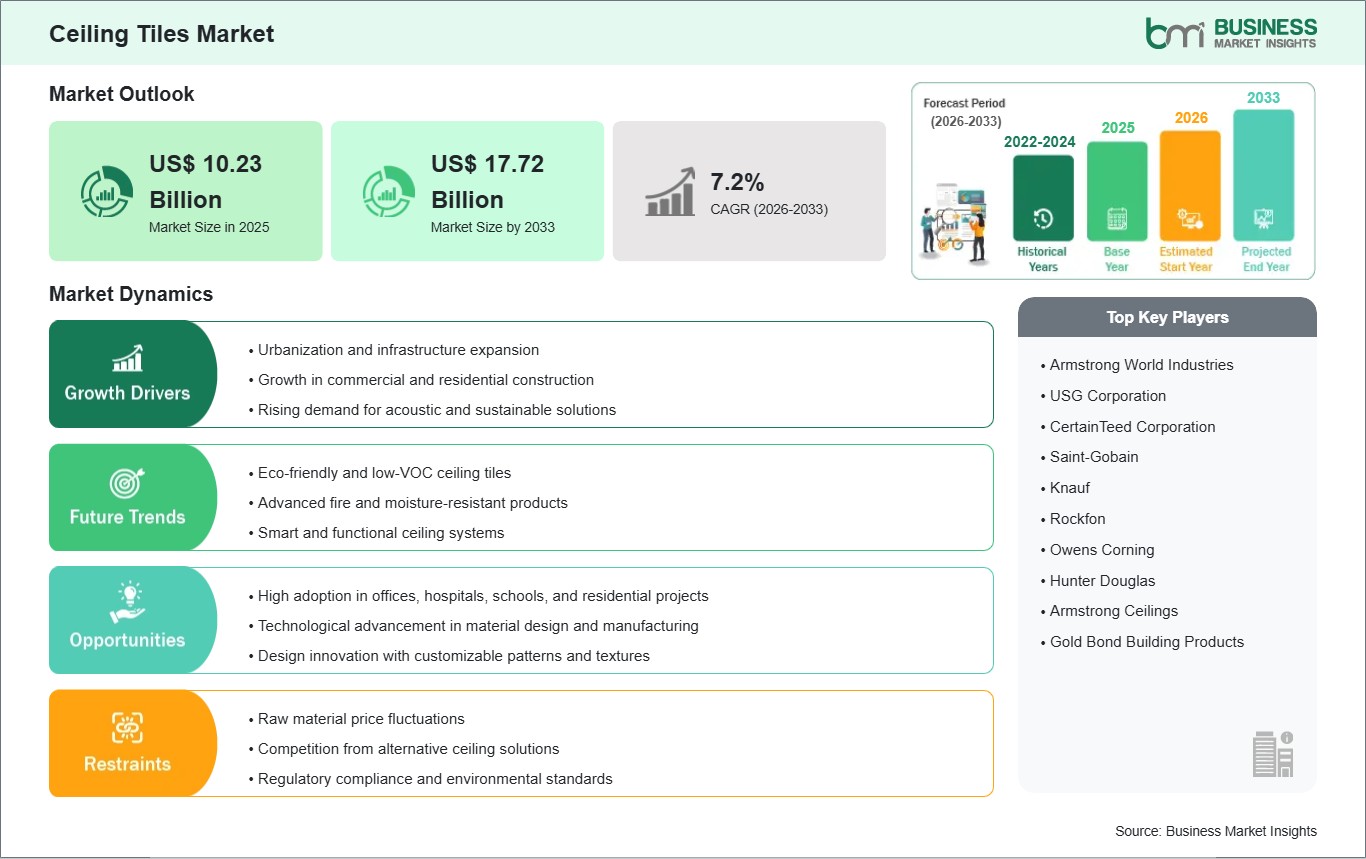
The Ceiling Tiles Market size is expected to reach US$ 17.72 billion by 2033 from US$ 10.23 billion in 2025. The market is estimated to record a CAGR of 7.2% from 2026 to 2033.
The global ceiling tiles market is experiencing steady growth driven by increasing demand for aesthetically appealing, functional, and sustainable interior construction materials. Ceiling tiles are widely used in both residential and commercial buildings for enhancing acoustic performance, thermal insulation, and visual appeal. Their ease of installation, low maintenance, and ability to conceal wiring and ductwork make them a preferred choice in modern construction practices.
Rapid urbanization, growth in infrastructure development, and increasing renovation activities are major factors contributing to market expansion. In commercial spaces such as offices, healthcare facilities, educational institutions, and retail outlets, ceiling tiles play a critical role in improving indoor environments by reducing noise levels and enhancing lighting efficiency.
Technological advancements in material design and manufacturing processes have led to the development of high-performance ceiling tiles with improved fire resistance, moisture resistance, and durability. Additionally, growing awareness of sustainable building practices is encouraging the adoption of eco-friendly ceiling tile materials made from recycled and low-emission components.

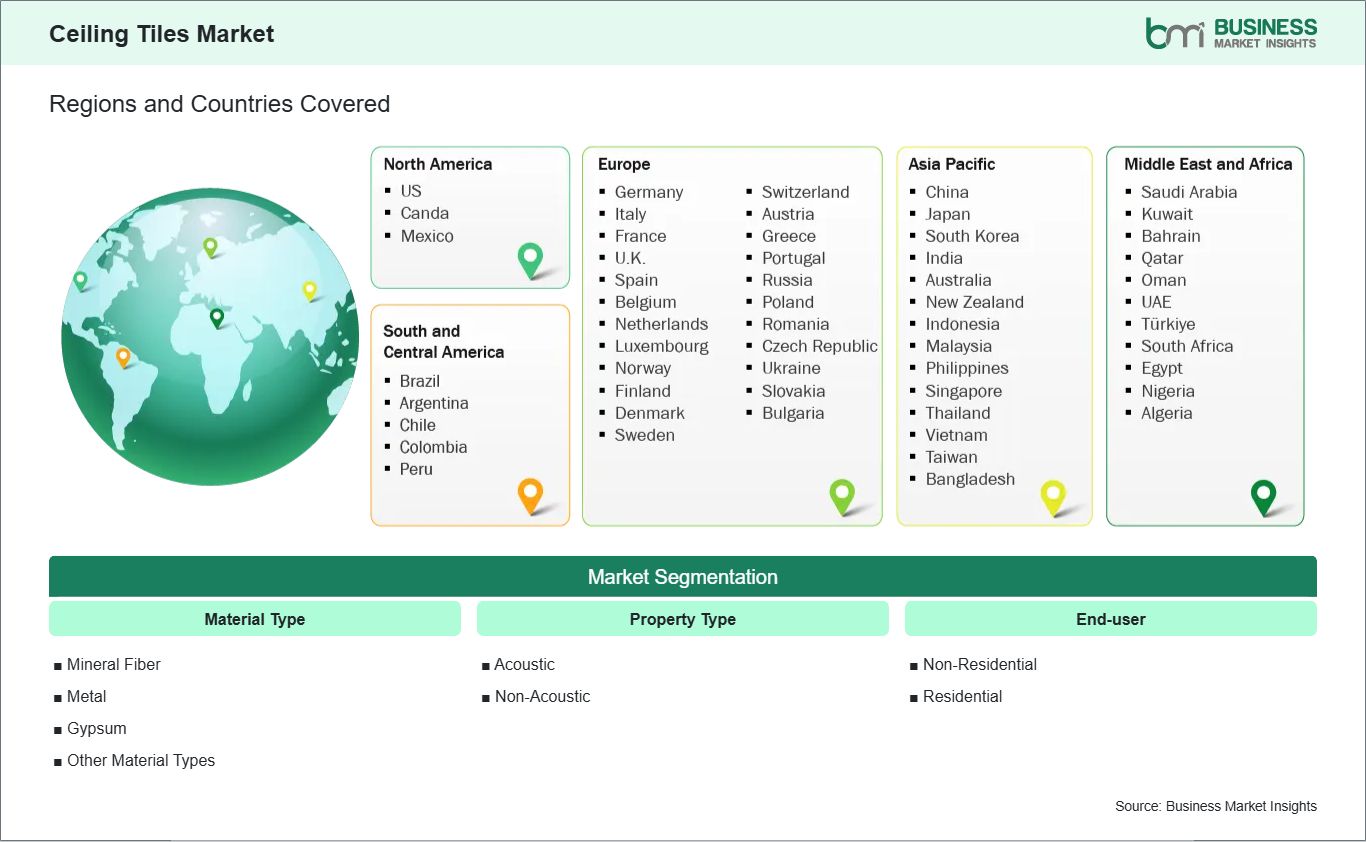
Key segments that contributed to the derivation of the ceiling tiles market analysis are material type, property type, and end-user.
The growing ceiling tile market is a result of the accelerating growth rate of the construction and infrastructure sectors globally, specifically in emerging countries. Significant amounts of funds are being allocated by both governments and private investors to develop modern commercial buildings like office buildings, hospitals, airports, and schools. The need for ceiling solutions in these types of projects not only includes meeting functional requirements but also meeting aesthetic needs. Ceiling tiles are becoming increasingly attractive because of their ability to create better acoustics, optimize lighting use, and be more easily accessed for things like HVAC and electrical systems.
Increasingly urbanizing trends combined with population growth continue to drive residential construction, and as such increase the demand for ceiling tiles in new residential construction. Both homeowners and developers are using ceiling tiles because they add decorative value, provide insulation, and help make homes more energy efficient. The rise of smart buildings further accelerates this trend as new ceiling systems include things like lighting, sensors, and climate controls to provide smart, sustainable environments.
Additionally, the increased focus on developing visually attractive interiors across both commercial and residential spaces continues to drive the use of ceiling tiles. Ceiling tiles offer a wide variety of designs, textures, and finishes and therefore work with many of today's modern architectural styles. With the rapid growth rate of infrastructure development around the planet, ceiling tiles will continue to be key elements in creating functional, sustainable, and visually appealing spaces.
The growing need for acoustic comfort in both commercial and residential environments is a major driver of the ceiling tiles market. Modern workplaces, hospitals, and educational institutions require sound-absorbing materials to reduce noise pollution and create productive, healthy indoor environments. Acoustic ceiling tiles are designed to minimize reverberation, enhance speech clarity, and improve overall well-being, making them indispensable in settings where concentration and communication are critical.
Parallel to acoustic performance, sustainability has emerged as a defining trend in the market. With increasing awareness of environmental impact, manufacturers are focusing on eco-friendly ceiling tiles made from recycled materials and engineered with low-VOC emissions.
Design innovation is another factor expanding the scope of ceiling tiles. Customizable patterns, textures, and colors allow architects and interior designers to tailor solutions to diverse aesthetic preferences. This flexibility makes ceiling tiles not only functional but also a key element of modern interior design. As consumers and businesses increasingly prioritize sustainability and acoustic comfort, ceiling tiles are evolving into multi-functional solutions that balance performance, environmental responsibility, and visual appeal. This convergence of trends positions the market for robust growth, with acoustic and sustainable solutions leading the way in shaping future demand.

The Ceiling Tiles Market demonstrates steady growth, with size and share analysis highlighting evolving trends and competitive dynamics among key players. The report examines subsegments categorized within material type, property type, and end-user, offering insights into their contribution to overall market performance.
Based on material type, the mineral fiber subsegment dominated the market in 2025, driven by its cost-effectiveness, acoustic properties, and widespread use in commercial buildings.
Based on property type, the acoustic subsegment dominated the market in 2025, driven by increasing demand for sound control solutions across various industries.
In terms of end-user, the non-residential subsegment dominated the market in 2025, driven by extensive usage in offices, healthcare facilities, and educational institutions.
| Report Attribute | Details |
|---|---|
| Market size in 2025 | US$ 10.23 Billion |
| Market Size by 2033 | US$ 17.72 Billion |
| Global CAGR (2026 - 2033) | 7.2% |
| Historical Data | 2022-2024 |
| Forecast period | 2026-2033 |
| Segments Covered | By Material Type
|
|
Regions and Countries Covered
| |
| North America | US, Canada, Mexico |
| Europe | Belgium, Austria, Finland, Denmark, Greece, Poland, Romania, Russia, Ukraine, Czech Republic, Slovakia, Bulgaria, Italy, Luxembourg, Germany, Switzerland, France, Netherlands, Norway, Portugal, Spain, Sweden, United Kingdom |
| Asia-Pacific | Australia, China, India, Japan, South Korea, Indonesia, Malaysia, Philippines, Singapore, Thailand, Vietnam, Bangladesh, New Zealand, Taiwan |
| South and Central America | Brazil, Argentina, Peru, Chile, Colombia |
| Middle East and Africa | Bahrain, Kuwait, Oman, Qatar, Saudi Arabia, United Arab Emirates, Turkiye, South Africa, Egypt, Algeria, Nigeria |
| Market leaders and key company profiles |
|
The "Ceiling Tiles Market Size and Forecast (2022 - 2033)" report provides a detailed analysis of the market covering below areas:
The geographical scope of the Ceiling Tiles Market report is divided into North America, Asia Pacific, Europe, Middle East & Africa, and South & Central America. North America held the largest share in 2025.
North America is a mature market characterized by strong demand from commercial construction and renovation activities. The presence of established infrastructure and stringent building regulations promotes the adoption of high-quality ceiling tiles with advanced features such as fire resistance and acoustic performance.
Europe is witnessing steady growth, supported by increasing focus on sustainable construction practices and energy-efficient buildings. Countries such as Germany, France, and the UK are adopting eco-friendly ceiling materials, contributing to market expansion.
Asia Pacific is expected to register significant growth due to rapid urbanization, industrialization, and infrastructure development. Countries such as China, India, Japan, and Southeast Asian nations are experiencing increased construction activities, driving demand for ceiling tiles in both residential and commercial sectors.
In the Middle East & Africa, the market is expanding due to large-scale infrastructure projects and growing investments in commercial real estate. Meanwhile, South & Central America is experiencing moderate growth, supported by urban development and increasing demand for modern building materials.
Across all regions, factors such as urbanization, sustainability initiatives, and technological advancements are shaping market dynamics. Manufacturers are focusing on expanding their product portfolios and regional presence to capture growth opportunities.

The Ceiling Tiles Market is evaluated by gathering qualitative and quantitative data post primary and secondary research, which includes important corporate publications, association data, and databases. A few of the key developments in the ceiling tiles market are:
The Ceiling Tiles Market is valued at US$ 10.23 Billion in 2025, it is projected to reach US$ 17.72 Billion by 2033.
As per our report Ceiling Tiles Market, the market size is valued at US$ 10.23 Billion in 2025, projecting it to reach US$ 17.72 Billion by 2033. This translates to a CAGR of approximately 7.2% during the forecast period.
The Ceiling Tiles Market report typically cover these key segments-
The historic period, base year, and forecast period can vary slightly depending on the specific market research report. However, for the Ceiling Tiles Market report:
The Ceiling Tiles Market is populated by several key players, each contributing to its growth and innovation. Some of the major players include:
The Ceiling Tiles Market report is valuable for diverse stakeholders, including:
Essentially, anyone involved in or considering involvement in the Ceiling Tiles Market value chain can benefit from the information contained in a comprehensive market report.
Please tell us your area of interest
(Market Segments/ Regions and Countries/ Companies)