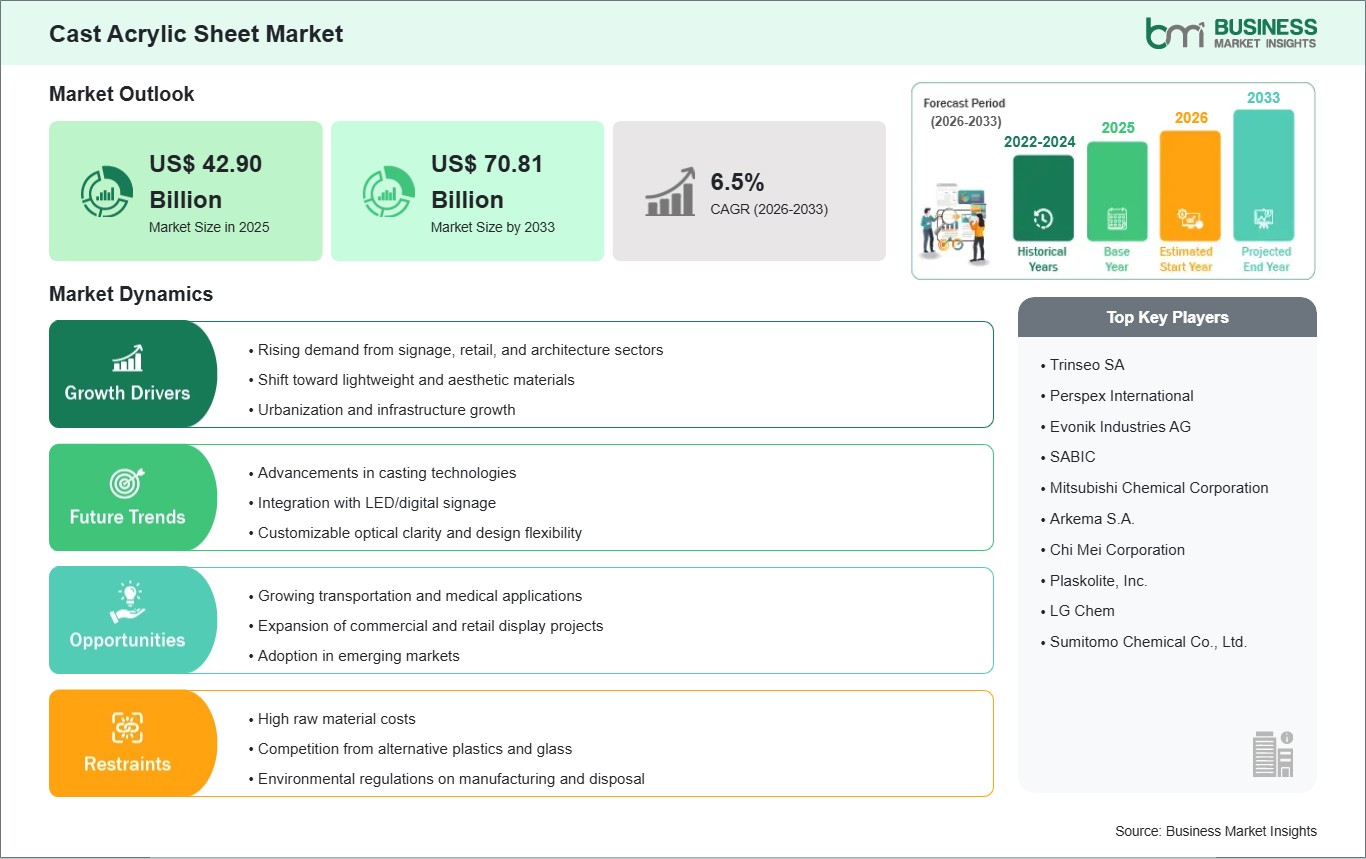
The Cast Acrylic Sheet Market size is expected to reach US$ 70.81 billion by 2033 from US$ 42.90 billion in 2025. The market is estimated to record a CAGR of 6.5% from 2026 to 2033.
The global cast acrylic sheet market is driven by broad adoption across construction, advertising, transportation, medical, and food & catering applications, owing to the material’s superior optical clarity, dimensional stability, and resistance to weathering and chemicals compared to traditional glass and many thermoplastics.
Cell cast acrylic sheets—manufactured by pouring PMMA resin between molds and curing—offer high optical clarity, enhanced surface finish, and superior mechanical properties, making them popular for premium and customized applications. Continuous cast sheets, produced through automated casting lines, provide uniform thickness and cost advantages for high‑volume industrial uses.
Demand has been reinforced by increasing urbanization and infrastructure expansion, which fuel the need for modern architectural glazing, illuminated signage, and durable display panels. The transition toward lightweight, impact‑resistant materials in transportation, retail, and medical equipment also supports market growth.

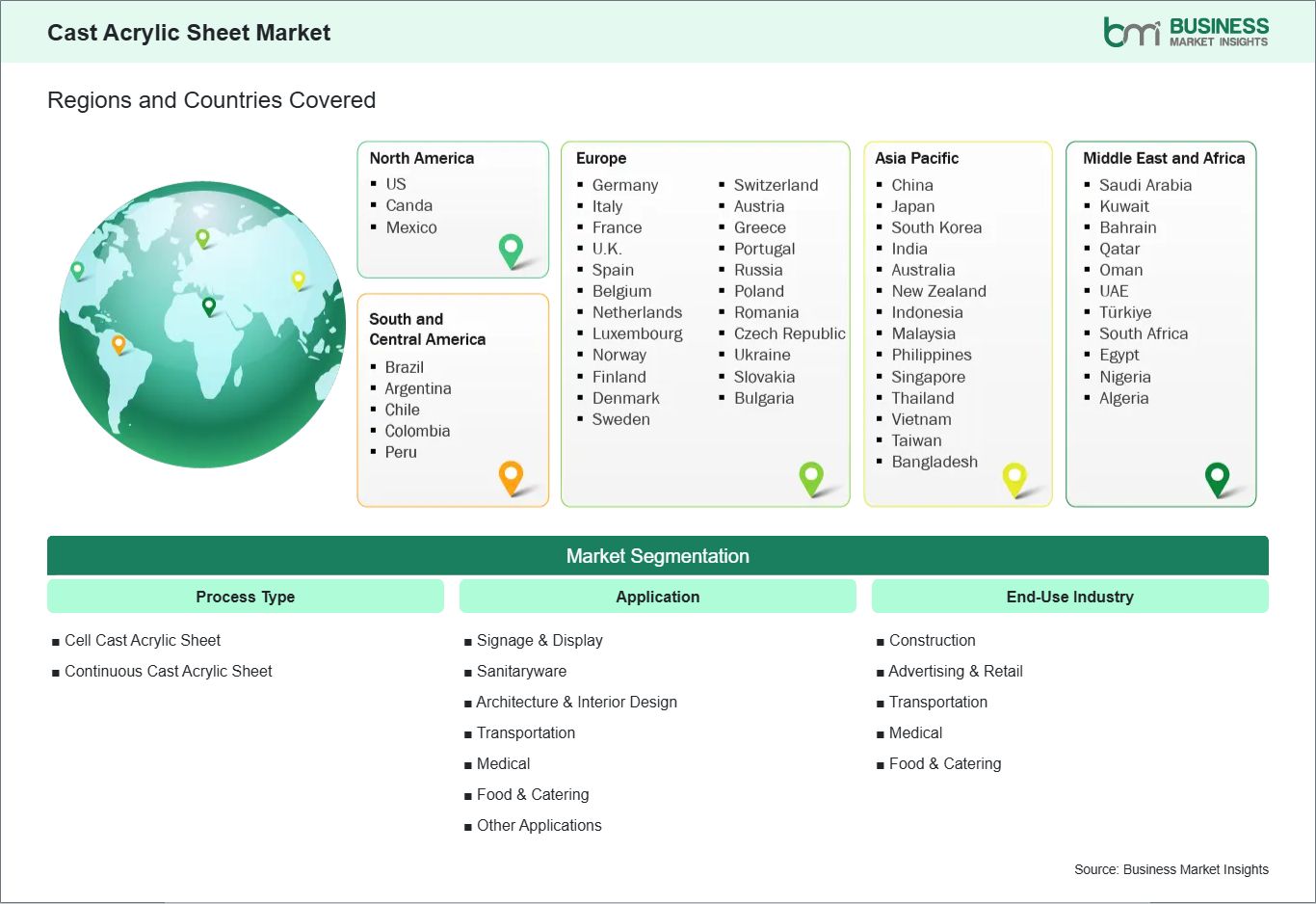
Key segments that contributed to the derivation of the cast acrylic sheet market analysis are process type and application.
The strong demand from the advertising and retail display sectors, architecture, and other industries are what drive the cast acrylic sheet market. Cast acrylic sheets have become very popular for these types of applications, including illuminated signage and point-of-sale display units, because they offer excellent optical clarity and high light transmission. Unlike traditional glass or other heavier thermoplastics, cast acrylic can be used to create vibrant, high-visibility displays and offer better performance than traditional materials. Since the retail and advertising sectors have been growing rapidly in emerging markets, such as India and China, this also drives demand for cast acrylic. There is also a significant increase in the urbanization of these areas, resulting in a higher level of disposable income per capita, as well as an increase in overall investment in outdoor advertising infrastructure. Therefore, businesses are utilizing quality acrylics for their signage in order to increase their brand awareness and engage consumers.
The ability to easily cut and thermoform cast acrylic makes it an attractive solution for creating custom displays. Furthermore, architects and designers include cast acrylic sheets as a better alternative to glass for architectural applications such as partitions and skylights, primarily due to the many benefits of cast acrylic, such as being lighter than glass, thereby reducing the overall weight on structure and reducing the complexity of installation, as well as providing a superior level of impact resistance in order to provide a safe and durable environment.
Acrylic sheets are also heavily referenced in the medical industry, as they are utilized for many types of medical enclosures, as well as a method of providing protective shields.
The shift toward lightweight, durable, and aesthetically versatile materials presents a significant opportunity for the cast acrylic sheet market. As industries seek alternatives to heavier glass and conventional plastics, acrylic sheets have emerged as a material of choice due to their superior optical properties, ease of fabrication, and design flexibility. These characteristics enable high‑performance solutions in applications ranging from modern architectural glazing to complex display installations.
In the architecture & interior design segment, cast acrylic sheets are used not only for windows and protective panels but also for custom decorative features, furniture inserts, and light diffusers. Their compatibility with a range of finishes—clear, tinted, UV‑stabilized, and patterned—allows architects and designers to incorporate visually compelling elements without compromising on structural performance.
Signage manufacturers leverage acrylic’s ability to hold printed graphics, backlighting, and color coatings to create high‑impact visual advertising materials that outperform traditional substrates. The rise of digital and LED signage has further propelled demand for acrylic sheet formats customized for light transmission and thermal stability.
Transportation applications offer another avenue for growth, as lightweight materials help improve vehicle fuel efficiency and reduce emissions. Acrylic’s strength‑to‑weight ratio makes it suitable for interior partitions, instrument clusters, and glazing alternatives in automotive, rail, and specialty vehicles. Meanwhile, the food & catering sector increasingly uses acrylic panels for protective shields, food display cases, and hygienic surfaces, responding to heightened hygiene awareness and regulatory standards in food service environments.
With ongoing advancements in casting technologies—such as improved resin formulations, co‑casting techniques, and surface treatments that enhance UV resistance and scratch durability—the opportunity for cast acrylic sheets to penetrate new and existing applications continues to expand.

The Cast Acrylic Sheet Market demonstrates steady growth, with size and share analysis highlighting evolving trends and competitive dynamics among key players. The report examines subsegments categorized within process type and application, offering insights into their contribution to overall market performance.
By process type, the cell cast acrylic sheet subsegment dominated in 2025, driven by its superior optical clarity, surface hardness, and fabrication versatility.
Based on application, the signage & display subsegment led in 2025, driven by the strong influence of advertising, retail, and branding activities on material demand.
| Report Attribute | Details |
|---|---|
| Market size in 2025 | US$ 42.90 Billion |
| Market Size by 2033 | US$ 70.81 Billion |
| Global CAGR (2026 - 2033) | 6.5% |
| Historical Data | 2022-2024 |
| Forecast period | 2026-2033 |
| Segments Covered | By Process Type
|
|
Regions and Countries Covered
| |
| North America | US, Canada, Mexico |
| Europe | Belgium, Austria, Finland, Denmark, Greece, Poland, Romania, Russia, Ukraine, Czech Republic, Slovakia, Bulgaria, Italy, Luxembourg, Germany, Switzerland, France, Netherlands, Norway, Portugal, Spain, Sweden, United Kingdom |
| Asia-Pacific | Australia, China, India, Japan, South Korea, Indonesia, Malaysia, Philippines, Singapore, Thailand, Vietnam, Bangladesh, New Zealand, Taiwan |
| South and Central America | Brazil, Argentina, Peru, Chile, Colombia |
| Middle East and Africa | Bahrain, Kuwait, Oman, Qatar, Saudi Arabia, United Arab Emirates, Turkiye, South Africa, Egypt, Algeria, Nigeria |
| Market leaders and key company profiles |
|
The "Cast Acrylic Sheet Market Size and Forecast (2022 - 2033)" report provides a detailed analysis of the market covering below areas:
The geographical scope of the Cast Acrylic Sheet Market report is divided into North America, Asia Pacific, Europe, Middle East & Africa, and South & Central America. North America held the largest share in 2025.
North America represents a mature market with strong adoption of high‑performance acrylic sheets for signage, retail displays, and architectural applications. The region’s established advertising and commercial infrastructure, coupled with high regulatory standards for material performance and safety, supports demand for premium cast acrylic products.
Europe shows steady growth influenced by robust architectural and design sectors, stringent construction standards, and a preference for durable, lightweight materials. Countries such as Germany, the UK, and France emphasize high‑quality sheet materials for building façades, retail environments, and industrial applications. In Asia Pacific, the growth of retail sectors, increasing outdoor advertising expenditure, and rising demand for lightweight, durable architectural materials are key factors bolstering acrylic sheet adoption. Urban development and rising disposable incomes have also supported higher construction activity and commercial projects, which in turn drive demand for display, sanitaryware, and interior design applications.
The Middle East & Africa and South & Central America exhibit increasing adoption, particularly in signage, architectural façades, and transportation projects, as urban infrastructure investment rises. Across all regions, regulatory frameworks, environmental performance standards, and materials innovation shape competitive strategies and market dynamics.

The Cast Acrylic Sheet Market is evaluated by gathering qualitative and quantitative data post primary and secondary research, which includes important corporate publications, association data, and databases. A few of the key developments in the cast acrylic sheet market are:
The Cast Acrylic Sheet Market is valued at US$ 42.90 Billion in 2025, it is projected to reach US$ 70.81 Billion by 2033.
As per our report Cast Acrylic Sheet Market, the market size is valued at US$ 42.90 Billion in 2025, projecting it to reach US$ 70.81 Billion by 2033. This translates to a CAGR of approximately 6.5% during the forecast period.
The Cast Acrylic Sheet Market report typically cover these key segments-
The historic period, base year, and forecast period can vary slightly depending on the specific market research report. However, for the Cast Acrylic Sheet Market report:
The Cast Acrylic Sheet Market is populated by several key players, each contributing to its growth and innovation. Some of the major players include:
The Cast Acrylic Sheet Market report is valuable for diverse stakeholders, including:
Essentially, anyone involved in or considering involvement in the Cast Acrylic Sheet Market value chain can benefit from the information contained in a comprehensive market report.
Please tell us your area of interest
(Market Segments/ Regions and Countries/ Companies)