Market Summary
Executive Summary and Global Market Analysis
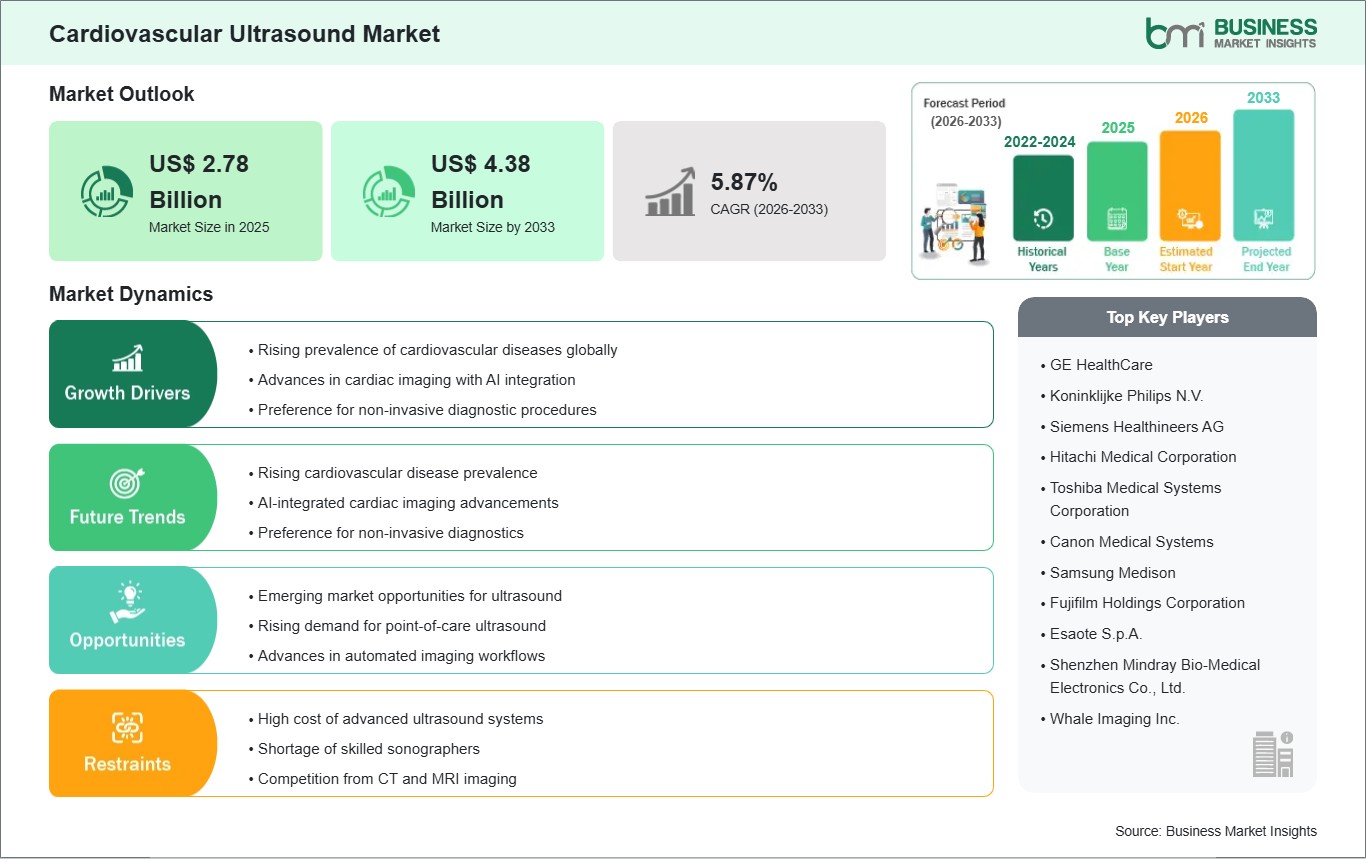
The cardiovascular ultrasound systems provide direct medical support for heart disease research by delivering real-time non-invasive imaging the doctors use to assess patient conditions. The systems serve vital functions which include evaluating structural heart conditions and detecting valve problems and studying congenital defects and assessing cardiac performance. The benefits of cardiovascular ultrasound include its portable nature and its ability to produce immediate test results without using radiation and its low testing expenses. The cardiovascular disease market expands because more people develop heart problems and the aging population increases and people learn about the advantages of early medical assessment. The development of 3D and 4D imaging technologies and Doppler techniques and artificial intelligence enhanced workflows results in better diagnostic performance and more efficient medical operations. The development of equipment in developing territories faces obstacles because equipment expenses remain high and there is a shortage of qualified personnel and reimbursement systems do not function properly. The regulatory framework and financial constraints that healthcare systems encounter both affect market performance.
The emerging healthcare market will create major business possibilities which result from developing medical facilities and the growing use of portable medical equipment and the increasing investment in developing regions. The global market will grow through new business opportunities which result from health systems focusing on value-based care and implementing digital health platforms across various medical settings.
Segment Analysis
Cardiovascular Ultrasound Market Segmentation
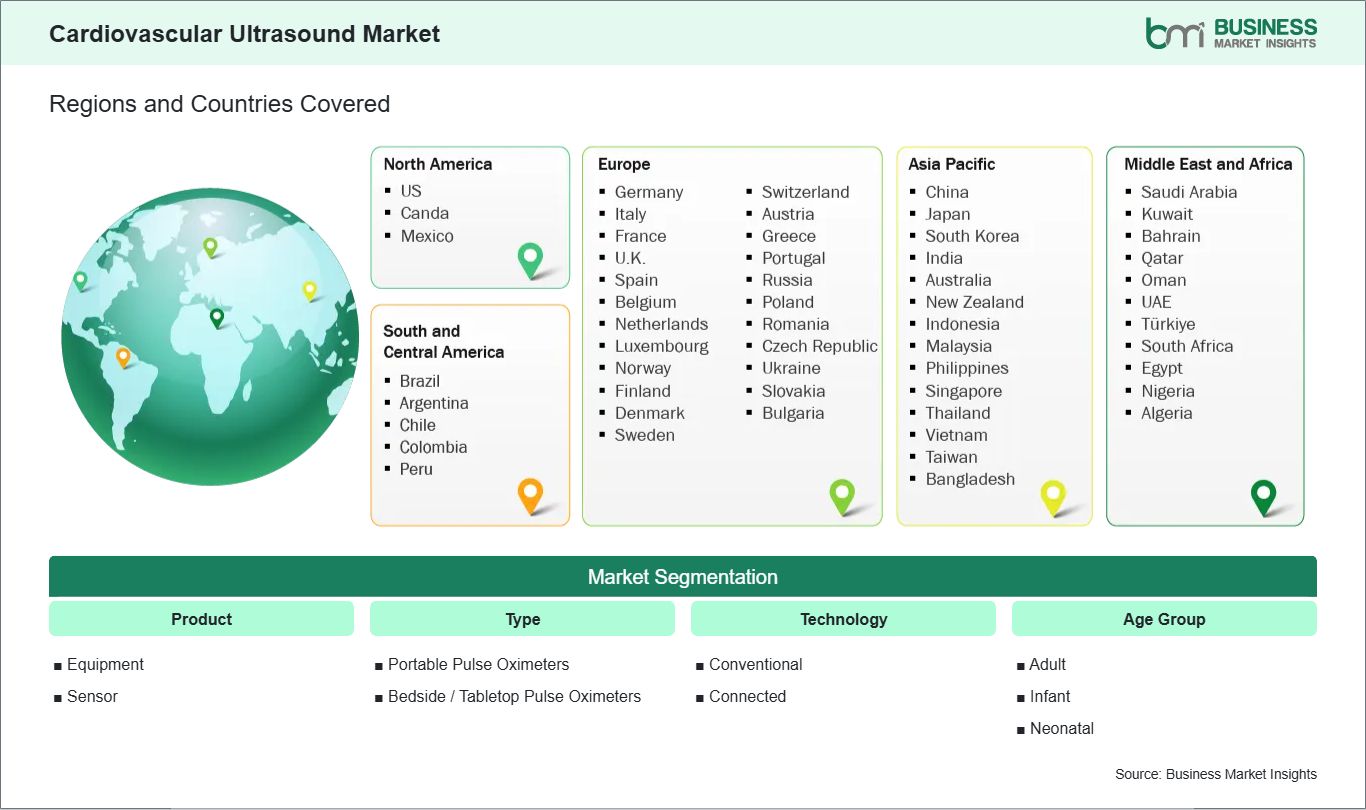
Key segments that contributed to the derivation of the cardiovascular ultrasound market analysis are Test Type, Technology, Device Display, End User.
- By test type, the cardiovascular ultrasound market is segmented into transthoracic echocardiogram, transesophageal echocardiogram, stress echocardiogram, and other echocardiograms. The transthoracic echocardiogram segment dominated the market in 2025.
- By technology, the market is segmented into 2D, 3D & 4D, doppler imaging. The doppler imaging segment held the largest share of the market in 2025.
- By device display, the cardiovascular ultrasound market is bifurcated into color display and black & white (B/W) display. The color display segment dominated the market in 2025.
- By end user, the market is segmented into hospitals / cardiology centers, ambulatory / home care, other end users. The hospitals / cardiology centers segment held the largest share of the market in 2025
Market Forces
Cardiovascular Ultrasound Market Drivers and Opportunities
Rising Prevalence of Cardiovascular Diseases
The rising global incidence of cardiovascular diseases (CVDs) which affects more people worldwide functions as the main factor that drives growth in the cardiovascular ultrasound market. The demand for precise non-invasive cardiac diagnostic solutions keeps increasing because of shifting population demographics and the rising rates of hypertension and diabetes and obesity. Echocardiography systems function as essential tools which enable medical professionals to identify and assess heart diseases during their initial stages.
The World Health Organization (WHO) reports that cardiovascular diseases account for the highest number of global fatalities which result in approximately 20.5 million deaths each year. People who live sedentary lifestyles and consume unhealthy diets and smoke tobacco and who experience greater longevity show increased diabetes prevalence. The cardiovascular ultrasound market expands because more patients require treatment and medical professionals use real-time imaging solutions to assess cardiac structure and function in various medical environments throughout the world.
Major healthcare systems and cardiology networks have expanded their diagnostic capabilities by investing in advanced echocardiography platforms equipped with 3D/4D imaging, Doppler technologies, and AI-powered analytics. The innovations improve diagnostic accuracy and enhance clinical operations while delivering better results for patients. Cardiovascular ultrasound provides a safe diagnosis method which does not use radiation and costs less than invasive diagnostic tests so it becomes ideal for routine hospital screenings and patient follow-up assessments in outpatient settings.
Technological Advancements and Expanding Healthcare Infrastructure
The cardiovascular ultrasound market experiences significant growth because of continuous technological advancements which drive market expansion. The range of cardiac ultrasound applications has expanded because of advancements which improve imaging resolution and enable device miniaturization and portable equipment development and digital health system integration. Portable and handheld ultrasound systems enable point-of-care diagnostics in emergency departments and ambulatory settings and remote locations.
The market has developed positive growth conditions because of three factors which include higher healthcare investments and developed markets with their reimbursement support systems and emerging economies that build their healthcare facilities. The increasing disease burden makes governments and private healthcare providers to develop stronger cardiac care services. The system now gains efficiency through artificial intelligence which provides automated measurement and decision support while decreasing the need for operators. The global market will experience growing demand for high-quality cardiovascular imaging solutions because healthcare systems move toward value-based care and preventive cardiology
Size and Share Analysis
Cardiovascular Ultrasound Market Size and Share Analysis
By test type, the cardiovascular ultrasound market is segmented into transthoracic echocardiogram, transesophageal echocardiogram, stress echocardiogram, and other echocardiograms. The transthoracic echocardiogram segment dominated the market in 2025. Transthoracic echocardiogram dominates due to its non-invasive nature, widespread availability, cost-effectiveness, and role as first-line diagnostic tool for evaluating cardiac structure and function across diverse patient populations globally.
By technology, the market is segmented into 2D, 3D & 4D, doppler imaging. The doppler imaging segment held the largest share of the market in 2025. Doppler imaging leads the market because it provides critical assessment of blood flow, valve function, and hemodynamics, enabling accurate diagnosis of cardiovascular abnormalities and enhancing overall clinical decision-making efficiency.
By device display, the cardiovascular ultrasound market is bifurcated into color display and black & white (B/W) display. The color display segment dominated the market in 2025. Color display dominates as it enhances visualization of blood flow patterns and structural details, improves diagnostic accuracy, and supports advanced imaging techniques, making it preferred in modern cardiac imaging systems.
By end user, the market is segmented into hospitals / cardiology centers, ambulatory / home care, other end users. The hospitals / cardiology centers segment held the largest share of the market in 2025. Hospitals and cardiology centers hold largest share due to high patient volumes, availability of skilled professionals, advanced infrastructure, and greater investments in comprehensive cardiovascular diagnostic equipment and technologies.
Report Coverage
Cardiovascular Ultrasound Market Report Coverage and Deliverables
The "Cardiovascular Ultrasound Market Size and Forecast (2022–2033)" report provides a detailed analysis of the market covering below areas:
- Cardiovascular ultrasound market size and forecast at global, regional, and country levels for all the key market segments covered under the scope
- Cardiovascular ultrasound market trends, as well as market dynamics such as drivers, restraints, and key opportunities
- Cardiovascular ultrasound market analysis covering key market trends, global and regional framework, major players, regulations, and recent market developments
- Industry landscape and competition analysis covering market concentration, heat map analysis, prominent players, and recent developments for the cardiovascular ultrasound market
- Detailed company profiles, including SWOT analysis
Geographic Insights
Cardiovascular Ultrasound Market Geographic Insights
The geographical scope of the cardiovascular ultrasound market report is divided into five regions: North America, Asia Pacific, Europe, Middle East & Africa, and South & Central America. The cardiovascular ultrasound market in North America is expected to grow significantly during the forecast period.
The North America cardiovascular ultrasound market is segmented into the United States, Canada, and Mexico. The North American market is experiencing steady growth, driven by the rising prevalence of cardiovascular diseases, increasing geriatric population, and strong adoption of advanced diagnostic imaging technologies. The United States leads the region, supported by well-established healthcare infrastructure, favorable reimbursement policies, and significant investments in research and development.
The region is also witnessing growing integration of advanced imaging technologies, including 3D/4D echocardiography, AI-enabled diagnostic software, and portable ultrasound systems particularly valuable for point-of-care and emergency cardiac assessments. Continuous technological innovation, along with strategic collaborations between healthcare providers and medical device manufacturers, is improving diagnostic accuracy and workflow efficiency. Additionally, the growing focus on preventive cardiology, early disease detection, and value-based healthcare delivery is strengthening demand for non-invasive cardiac imaging solutions. Strong regulatory standards, high healthcare expenditure, and expanding outpatient cardiac care services further reinforce North America`s leading position in the global cardiovascular ultrasound market.
Industry Activity
Recent Developments
The cardiovascular ultrasound market is evaluated by gathering qualitative and quantitative data post primary and secondary research, which includes important corporate publications, association data, and databases. A few of the key developments in the cardiovascular ultrasound market are:
- In August 2025, GE HealthCare announced the launch of Vivid Pioneer, an adaptive cardiovascular ultrasound system, which recently received CE Mark approval and FDA 510(k) clearance.
- In August 2025, Health technology company Royal Philips announced the release of Transcend Plus, its EPIQ CVx and Affiniti CVx cardiovascular ultrasound systems.
- In August 2023, Siemens Healthineers unveils Acuson Origin premium cardiovascular ultrasound system
Trust & Transparency
Research Methodology
The market analysis combines proprietary research with secondary data from government agencies, company disclosures, regulatory filings, industry databases and expert interviews. Market estimates are validated through data triangulation, cross-market benchmarking and analyst
review.
View Full Research Methodology
Key Sources Referred:
World Bank – Global Trade Indicators American Medical Association (AMA) National Center for Biotechnology Information (NCBI) National Library of Medicine (NLM) Centers for Disease Control and Prevention (CDC) Company website National Institutes of Health (NIH) International Hospital Federation (IHF) Company annual reports Company investor presentations