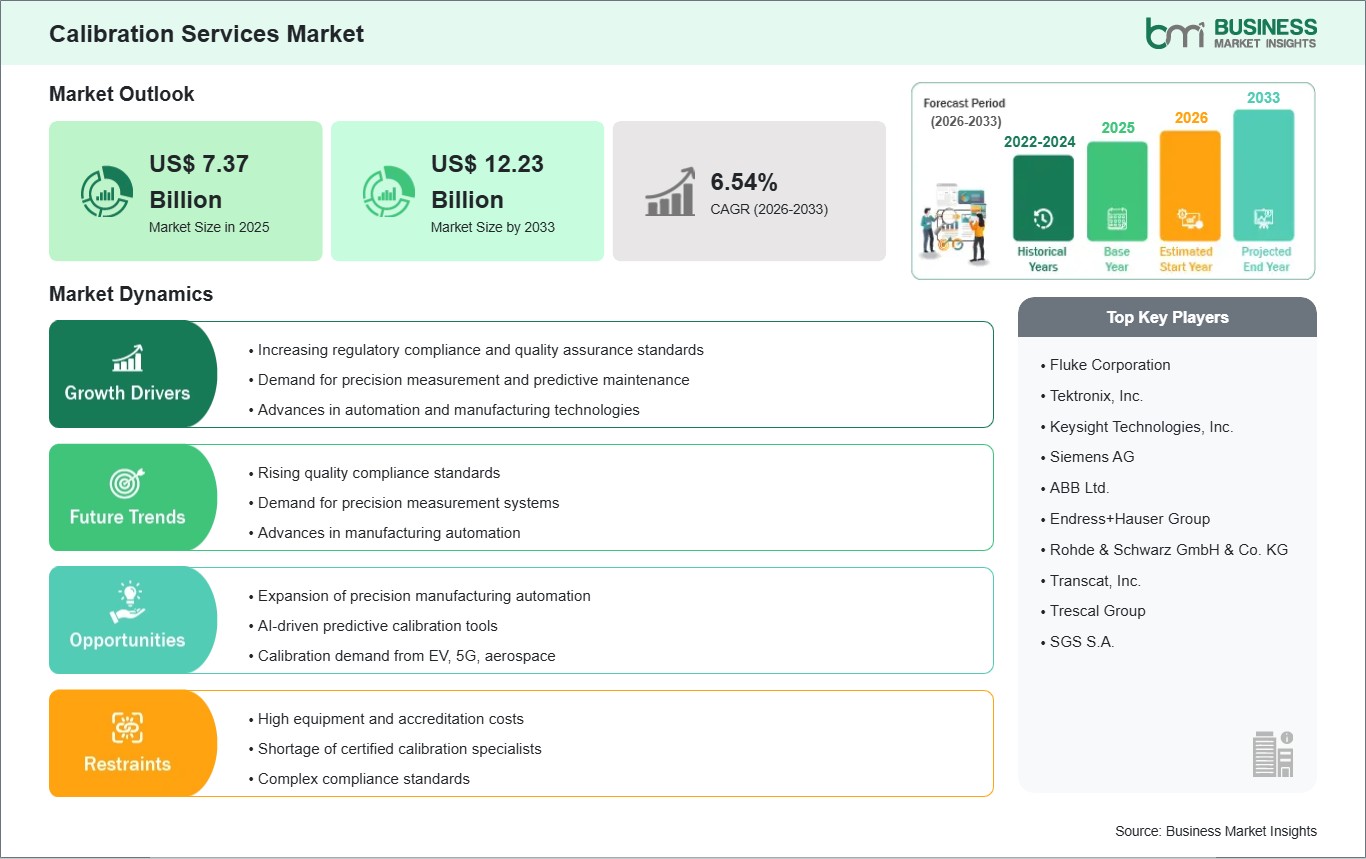
The Calibration Services Market size is expected to reach US$ 12.23 Billion by 2033 from US$ 7.37 Billion in 2025. The market is estimated to record a CAGR of 6.54% from 2026 to 2033.
The Calibration Services market is a critical enabler of measurement accuracy, process reliability, and regulatory compliance across industries such as manufacturing, aerospace and defense, automotive, healthcare, energy, and electronics. Calibration services ensure that measuring instruments, testing equipment, and monitoring systems operate within specified tolerances, supporting consistent product quality, safety, and operational efficiency. As industries increasingly adopt automation, digital manufacturing, and precision engineering, the role of calibration services has become integral to maintaining process integrity and minimizing operational risks.
Calibration services support a wide range of applications, including equipment validation, preventive maintenance, quality control, and regulatory audits. These services cover electrical, mechanical, thermal, and dimensional measurements and are essential for meeting international standards such as ISO, IEC, and industry-specific regulatory requirements. The growing adoption of Industry 4.0 practices, smart factories, and digitally controlled production environments is further increasing the need for accurate, traceable, and repeatable calibration processes.
Market growth is driven by strict regulatory frameworks, rising demand for high-precision instruments, increasing complexity of industrial systems, and expanding use of advanced testing and measurement equipment. Additionally, the growing focus on risk reduction, asset lifecycle management, and predictive maintenance is encouraging organizations to invest in regular calibration services. While the market faces challenges such as skilled labor shortages and cost pressures, advancements in digital calibration tools, automation, and remote calibration capabilities are improving service efficiency and scalability.

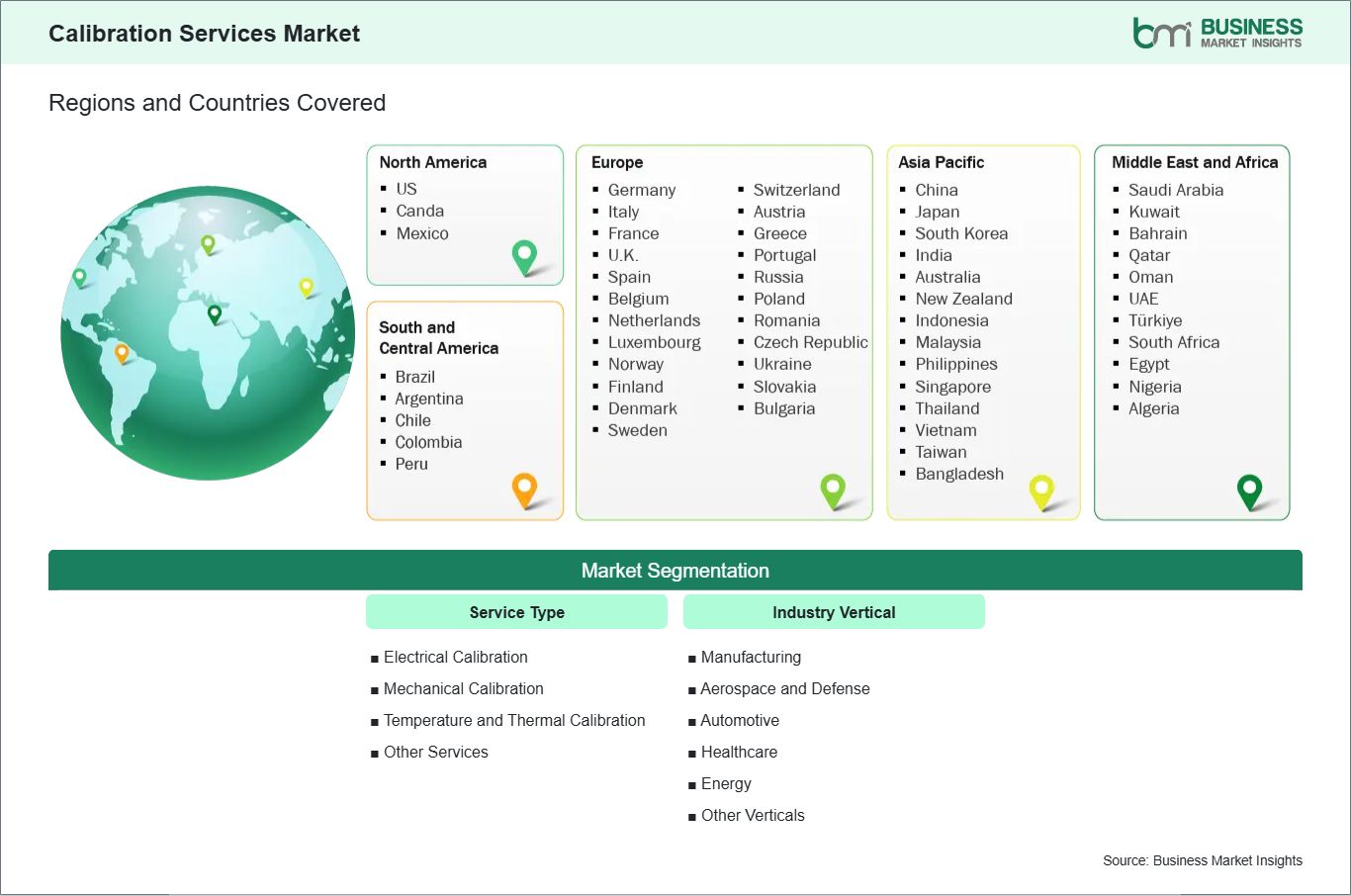
Key segments that contributed to the derivation of the Calibration Services market analysis are service type, and end user.
The increasing enforcement of regulatory compliance and quality assurance standards across global industries is a key driver of the Calibration Services market. Regulatory authorities and industry bodies mandate periodic calibration of measuring and testing instruments used in safety-critical, production, and quality-control processes to ensure accuracy, repeatability, and traceability. Industries such as aerospace and defense, healthcare, pharmaceuticals, automotive, and energy are subject to stringent standards including ISO, IEC, FDA, and other national and international guidelines.
Non-compliance can lead to operational shutdowns, financial penalties, product recalls, and loss of certification, significantly impacting business continuity and brand reputation. As production processes become more complex and precision-driven, even minor measurement deviations can result in substantial quality issues. Consequently, organizations are increasingly adopting structured calibration schedules and documented compliance programs. Many companies are also outsourcing calibration activities to accredited third-party service providers to ensure technical expertise, standardized procedures, and audit readiness, thereby driving sustained demand for professional calibration services.
The rapid expansion of industrial automation, precision manufacturing, and digitally enabled production environments is creating substantial growth opportunities for the Calibration Services market. Modern manufacturing facilities rely heavily on automated machinery, robotics, CNC equipment, sensors, and advanced control systems that require precise measurement and consistent performance. Accurate calibration of these instruments is essential to maintain process stability, minimize production errors, and ensure product consistency. As manufacturers adopt Industry 4.0 practices, real-time monitoring and data-driven decision-making are becoming increasingly dependent on reliable measurement systems.
Regular calibration supports predictive and preventive maintenance strategies by identifying performance drift before it leads to equipment failure or downtime. Additionally, rising investments in high-precision manufacturing across electronics, automotive, and aerospace sectors are increasing the demand for specialized and high-accuracy calibration services. The growing integration of digital twins, smart sensors, and automated inspection systems further reinforces the critical role of calibration services in sustaining operational efficiency and manufacturing excellence.

By service type, electrical calibration represents the largest revenue-generating segment, driven by its widespread application across industrial, energy, and electronics sectors. Temperature and thermal calibration is expected to witness strong growth due to its importance in healthcare, pharmaceuticals, and process industries.
By industry vertical, manufacturing dominates the market, followed by aerospace and defense and automotive sectors, where precision, safety, and compliance requirements are particularly stringent.
| Report Attribute | Details |
|---|---|
| Market size in 2025 | US$ 7.37 Billion |
| Market Size by 2033 | US$ 12.23 Billion |
| Global CAGR (2026 - 2033) | 6.54% |
| Historical Data | 2022-2024 |
| Forecast period | 2026-2033 |
| Segments Covered | By Service Type
|
|
Regions and Countries Covered
| |
| North America | US, Canada, Mexico |
| Europe | Belgium, Austria, Finland, Denmark, Greece, Poland, Romania, Russia, Ukraine, Czech Republic, Slovakia, Bulgaria, Italy, Luxembourg, Germany, Switzerland, France, Netherlands, Norway, Portugal, Spain, Sweden, United Kingdom |
| Asia-Pacific | Australia, China, India, Japan, South Korea, Indonesia, Malaysia, Philippines, Singapore, Thailand, Vietnam, Bangladesh, New Zealand, Taiwan |
| South and Central America | Brazil, Argentina, Peru, Chile, Colombia |
| Middle East and Africa | Bahrain, Kuwait, Oman, Qatar, Saudi Arabia, United Arab Emirates, Turkiye, South Africa, Egypt, Algeria, Nigeria |
| Market leaders and key company profiles |
|
The "Calibration Services Market Size and Forecast (2022-2033)" report provides a detailed analysis of the market covering below areas:
The Calibration Services market is geographically segmented into North America, Asia Pacific, Europe, the Middle East & Africa, and South & Central America, with each region demonstrating distinct growth dynamics influenced by industrial maturity, regulatory frameworks, and technological adoption.
Asia Pacific is projected to witness the fastest growth and maintain a leading market position throughout the forecast period. This growth is driven by rapid industrialization, expansion of large-scale manufacturing hubs, and increasing investments in automation and precision engineering across countries such as China, India, Japan, South Korea, and Southeast Asian economies. Rising adoption of international quality standards, growing export-oriented manufacturing, and strengthening regulatory oversight are compelling organizations to implement structured calibration programs. Additionally, the presence of a vast electronics, automotive, and industrial equipment manufacturing base is significantly boosting demand for both on-site and laboratory-based calibration services.
North America and Europe represent mature markets, characterized by strict regulatory enforcement, well-established accreditation systems, and advanced manufacturing and testing practices. Industries in these regions place strong emphasis on preventive maintenance, traceability, and audit readiness, ensuring consistent demand for calibration services across aerospace, healthcare, energy, and industrial sectors. The Middle East & Africa and South & Central America are experiencing steady market growth, supported by infrastructure development, energy diversification initiatives, and expanding industrial activity. Increasing awareness of quality assurance, safety standards, and operational reliability is gradually strengthening the adoption of professional calibration services across these emerging regions.

The Calibration Services market is evaluated by gathering qualitative and quantitative data post primary and secondary research, which includes important corporate publications, association data, and databases. A few of the key developments in the Calibration Services market are:
The Calibration Services Market is valued at US$ 7.37 Billion in 2025, it is projected to reach US$ 12.23 Billion by 2033.
As per our report Calibration Services Market, the market size is valued at US$ 7.37 Billion in 2025, projecting it to reach US$ 12.23 Billion by 2033. This translates to a CAGR of approximately 6.54% during the forecast period.
The Calibration Services Market report typically cover these key segments-
The historic period, base year, and forecast period can vary slightly depending on the specific market research report. However, for the Calibration Services Market report:
The Calibration Services Market is populated by several key players, each contributing to its growth and innovation. Some of the major players include:
The Calibration Services Market report is valuable for diverse stakeholders, including:
Essentially, anyone involved in or considering involvement in the Calibration Services Market value chain can benefit from the information contained in a comprehensive market report.
Please tell us your area of interest
(Market Segments/ Regions and Countries/ Companies)