Market Summary
Executive Summary and Global Market Analysis
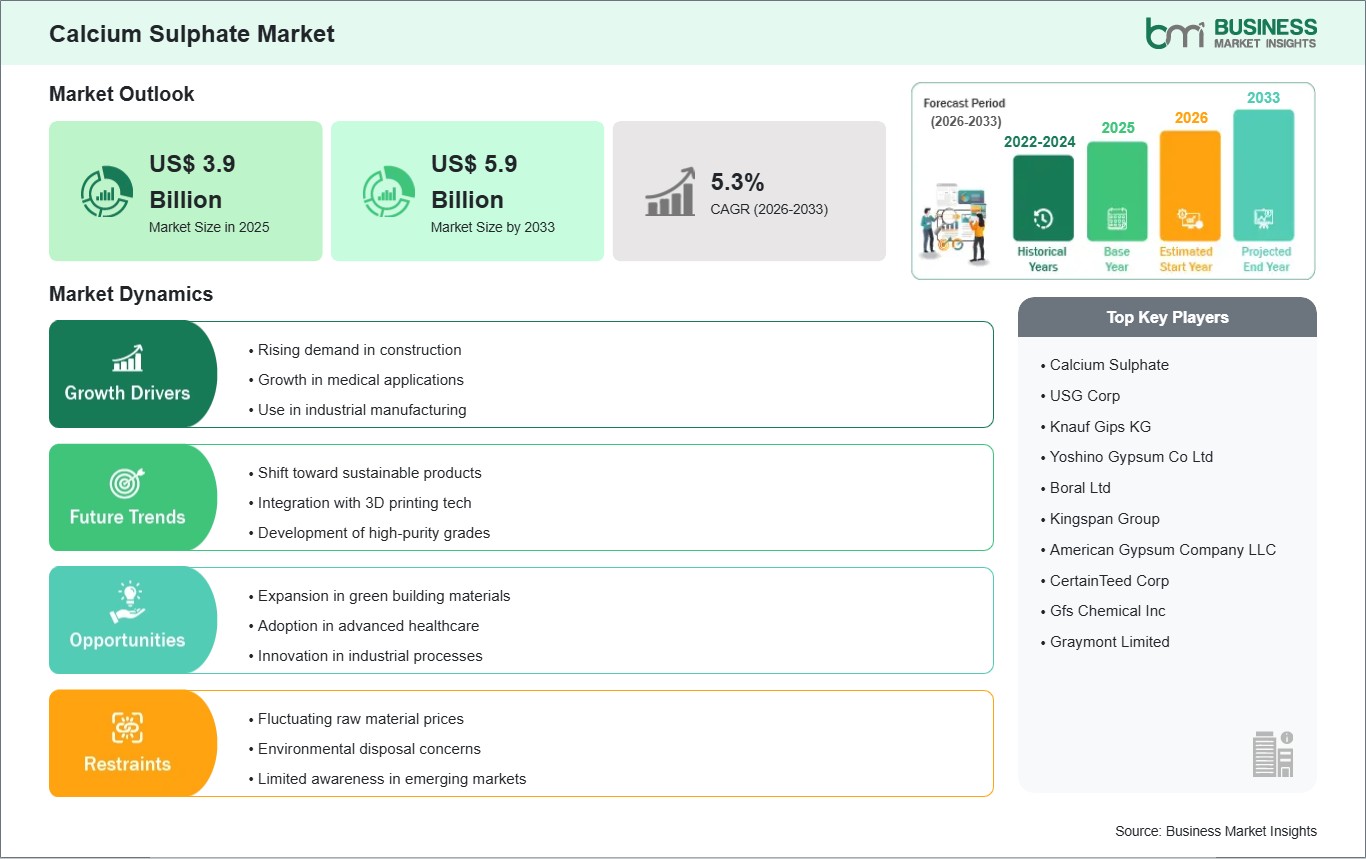
Calcium Sulphate is an important inorganic compound used extensively in different industries, and this particular compound is often referred to as dihydrate gypsum or gypsum. Calcium sulphate has immense binding properties, resistance to fire, non-toxicity, and is stable and versatile. Calcium sulphate can be found in both natural and manufactured forms as an industrial by-product. This by-product is created through Flue Gas Desulfurization at coal-fired power stations and also through gypsum mining.
However, some factors might slow down the growth of the market. These include issues relating to mining environmental concerns in the case of natural gypsum, prices of energy and materials used in the calcination method, and health risks from working with gypsum dust during manufacturing and installation. Additionally, due to the bulky nature of calcium sulphate, transport costs significantly influence prices. Despite environmental concerns, energy costs, and logistical challenges, the calcium sulphate market continues to present significant growth opportunities. Rising demand for sustainable construction materials, driven by green building initiatives, positions gypsum-based products as a preferred choice due to their fire resistance and non-toxic nature.
Additionally, the increasing adoption of Flue Gas Desulfurization (FGD) technology in power plants ensures a steady supply of synthetic gypsum, reducing dependency on natural mining and aligning with circular economy principles. Expanding applications in agriculture as a soil conditioner, in medical-grade plaster, and in advanced industrial processes further broaden the market potential. Emerging economies with rapid infrastructure development and stringent building safety regulations are expected to fuel demand, making calcium sulphate a critical component in future industrial and environmental solutions.
Segment Analysis
Calcium Sulphate Market Segmentation
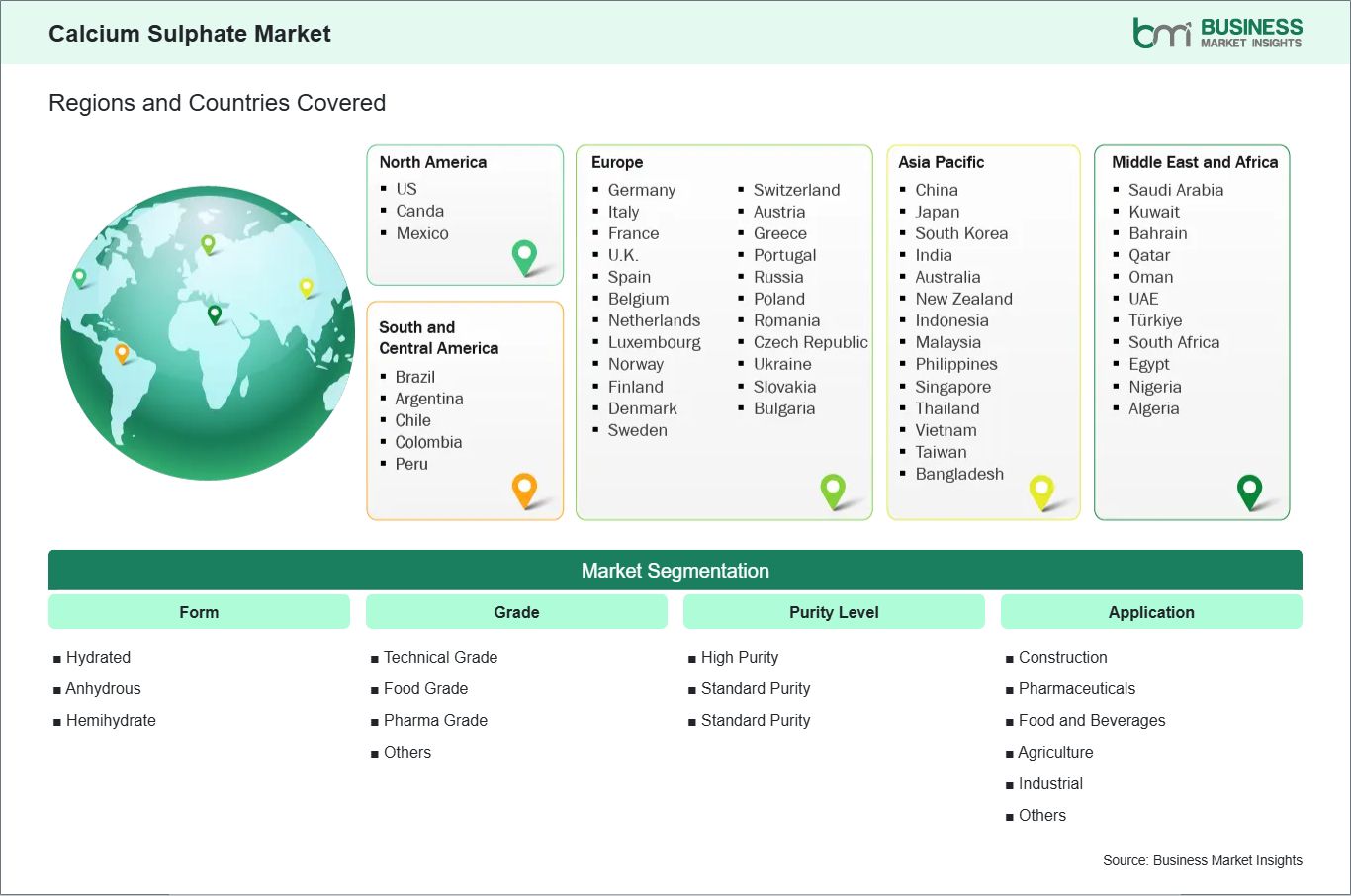
Key segments that contributed to the derivation of the Calcium Sulphate market analysis are form type and end-use industry.
- By Form Type, the market is segmented into Anhydrous and Hydrated.
- By End-Use Industry, the market is divided into Healthcare, Construction, Pharmaceuticals, Agriculture, Cement, Ore Mining, Chemicals, Drying Agent, Anti-caking Agent, and Others.
Market Forces
Calcium Sulphate Market Drivers and Opportunities
Boom in Global Construction and Infrastructure Development
The key driving force behind the Calcium Sulphate market is the constantly increasing construction activities worldwide, and this trend is being noticed in the Asia Pacific and Latin American countries to a large extent. The factors of urbanization and population growth are also contributing to the increasing demand for gypsum products.
Calcium sulphate, especially in the form of gypsum, is the main raw material for the production of plasterboard or drywall, which is a vital component of modern Construction on account of superior workability, resistance to fire, insulation properties, and economy. Calcium sulphate is also a key component in the production of cement and functions as a setting time regulator and grinding aid. With a forecast of over 5 billion tons of cement production worldwide by 2030, the market for calcium sulphate used in this sector is assured. Infrastructure development activities, including the construction of bridges, high-speed rail, and commercial centers, also ensure a positive outlook for market growth.
Shift Toward Synthetic Gypsum and Circular Economy
The market presents a significant opportunity through the transition from natural gypsum mining toward the utilization of synthetic gypsum, particularly FGD gypsum. Environmental regulations mandating sulfur dioxide capture from coal-fired power plants have made FGD gypsum an abundant by-product. Policies promoting waste reuse and reduced environmental impact of mining have increased the attractiveness of synthetic gypsum, which often offers high purity suitable for premium construction applications.
In parallel, recycling and sustainability initiatives are gaining traction. Advanced plasterboard recycling technologies are enabling the recovery and reuse of gypsum from construction and demolition waste, diverting material from landfills and supporting circular economy objectives. This creates a sustainable, cost-effective supply stream and opens new revenue opportunities for manufacturers aligned with global sustainability goals.
Size and Share Analysis
Calcium Sulphate Market Size and Share Analysis
The Calcium Sulphate market demonstrates steady growth, with size and share analysis revealing evolving trends and competitive positioning among key players. The report further examines subsegments categorized within form type and end-use industry, offering insights into their contribution to overall market performance.
The Calcium Sulphate market is fundamentally segmented by its chemical composition and water content into Anhydrous and Hydrated forms, with the hydrated form having superior setting and binding properties. Market demand spans multiple End-Use Industries, in which Construction for gypsum board manufacturing and cement regulation is always in demand. Agriculture follows this as a soil conditioner, Pharmaceuticals as an excipient, and specialty applications such as Drying Agents and Anti-caking Agents.
Report Coverage
Calcium Sulphate Market Report Coverage and Deliverables
The "Calcium Sulphate Market Size and Forecast (2022 - 2033)" report provides a detailed analysis of the market covering below areas:
- Calcium Sulphate market size and forecast at global, regional, and country levels for all the key market segments covered under the scope
- Calcium Sulphate market trends, as well as market dynamics such as drivers, restraints, and key opportunities
- Calcium Sulphate market analysis covering key market trends, global and regional framework, major players, regulations, and recent market developments
- Industry landscape and competition analysis covering market concentration, heat map analysis, prominent players, and recent developments for the Calcium Sulphate market
- Detailed company profiles, including SWOT analysis
Geographic Insights
Calcium Sulphate Market Geographic Insights
The geographical scope of the Calcium Sulphate market report is divided into five regions: North America, Europe, Asia Pacific, the Middle East & Africa, and South & Central America.
The global Calcium Sulphate market is defined by regional specialization. Asia Pacific represents a fast-growing market, driven by extensive infrastructure development, rapid urbanization, and booming construction activity in countries such as China and India, alongside strong demand from agriculture and industrial chemical applications. North America is a mature and stable market, characterized by consistent gypsum board demand, advanced agricultural usage, and high-purity pharmaceutical applications. Europe also represents a mature market, where growth is strongly influenced by stringent environmental regulations promoting the adoption of synthetic FGD gypsum and sustainable construction practices. The Middle East and Africa region is emerging as a high-growth market, fueled by large-scale Construction and real estate projects in GCC countries and increasing agricultural soil amendment needs. South and Central America remain a developing market, with growth driven primarily by rising investments in Construction and agriculture, particularly in Brazil and Argentina.
Industry Activity
Recent Developments
The Calcium Sulphate market is evaluated by gathering qualitative and quantitative data post primary and secondary research, which includes important corporate publications, association data, and databases. A few of the key developments in the Calcium Sulphate market are:
- In April 2025, Reward Minerals (ASX: RWD) made a strategic move to secure its supply chain by applying for exploration licence E08/3802, covering the historic Warroora Gypsum deposits located approximately 120km north of its flagship Carnarvon Potash Project in Western Australia. This acquisition represents a vertical integration opportunity for Reward, as gypsum (hydrated calcium sulphate) is a key consumable in the company's proprietary processing technologies for extracting Potassium Sulphate (SOP) from seawater.
- In April 2025, SUL4R-PLUS inaugurated a new facility in Marissa, Illinois, capable of producing 100,000 tons of calcium sulfate fertilizer. This is the company’s second production site, situated near the Prairie State power plant. Distributed by HELM, the Marissa facility has the capacity to serve up to 2 million acres of cropland.
Trust & Transparency
Research Methodology
The market analysis combines proprietary research with secondary data from government agencies, company disclosures, regulatory filings, industry databases and expert interviews. Market estimates are validated through data triangulation, cross-market benchmarking and analyst
review.
View Full Research Methodology
Key Sources Referred:
World Bank - Global Trade IndicatorsWorld Trade Organization (WTO)International Trade Administration (ITA)Company WebsitesCompany Annual ReportsCompany Investor Presentations