Market Summary
Executive Summary and Global Market Analysis
Business aviation represents a collection of airplanes that serve the unique air transport needs of companies and individual customers on an exclusive and unscheduled basis. This includes planes that provide an effective means of transportation where efficiency, directness, and privacy form some of the important considerations in their usage. The aviation segment comprises light, medium, large airplanes, and executive airliners that cater to short and long-distance transport purposes. Increased globalization and dispersed corporate operations will further underscore the need for adequate aviation infrastructure in various industries.
Increasing interest in smooth travel connections has led to the development of purchasing activity in the aviation sphere. Companies tend to purchase aircraft models that will help them avoid flight connection delays related to the use of scheduled commercial flights at busy airports. Individual travelers prefer to rely on aviation services that provide flexible scheduling options, fewer interruptions while traveling, and access to remote locations. In addition, there is a high demand in the business aviation sector from private charter companies and affluent individuals.
There is diversification in terms of market segmentation in terms of aircraft types, business nature, and use. There is continuous use of light and medium-sized aircraft in regional transport flights, while large cabin business jets are used for long-range business flights. The operator-based model is gaining prominence, as companies choose the flexible leasing option rather than ownership. Original equipment manufacturers play an important role in new aircraft sales, while pre-owned aircraft ensure cost-effective purchases. Maintenance activities are also key to aftermarket services.
Further advances in technology will continue to transform the efficiency and safety standards of the planes while improving the passengers' experience. The use of advanced avionics has made it possible for aircraft to have superior navigation, communication, and flight management that enhance their situational awareness during flights. Innovations in the sector also relate to making aircraft lighter through aerostructures and optimizing them in terms of aerodynamics to boost fuel efficiency and minimize maintenance cycles. Other areas of concern regarding sustainability include the need to optimize fuel consumption and minimize emissions.
Segment Analysis
Business Jet Market Segmentation
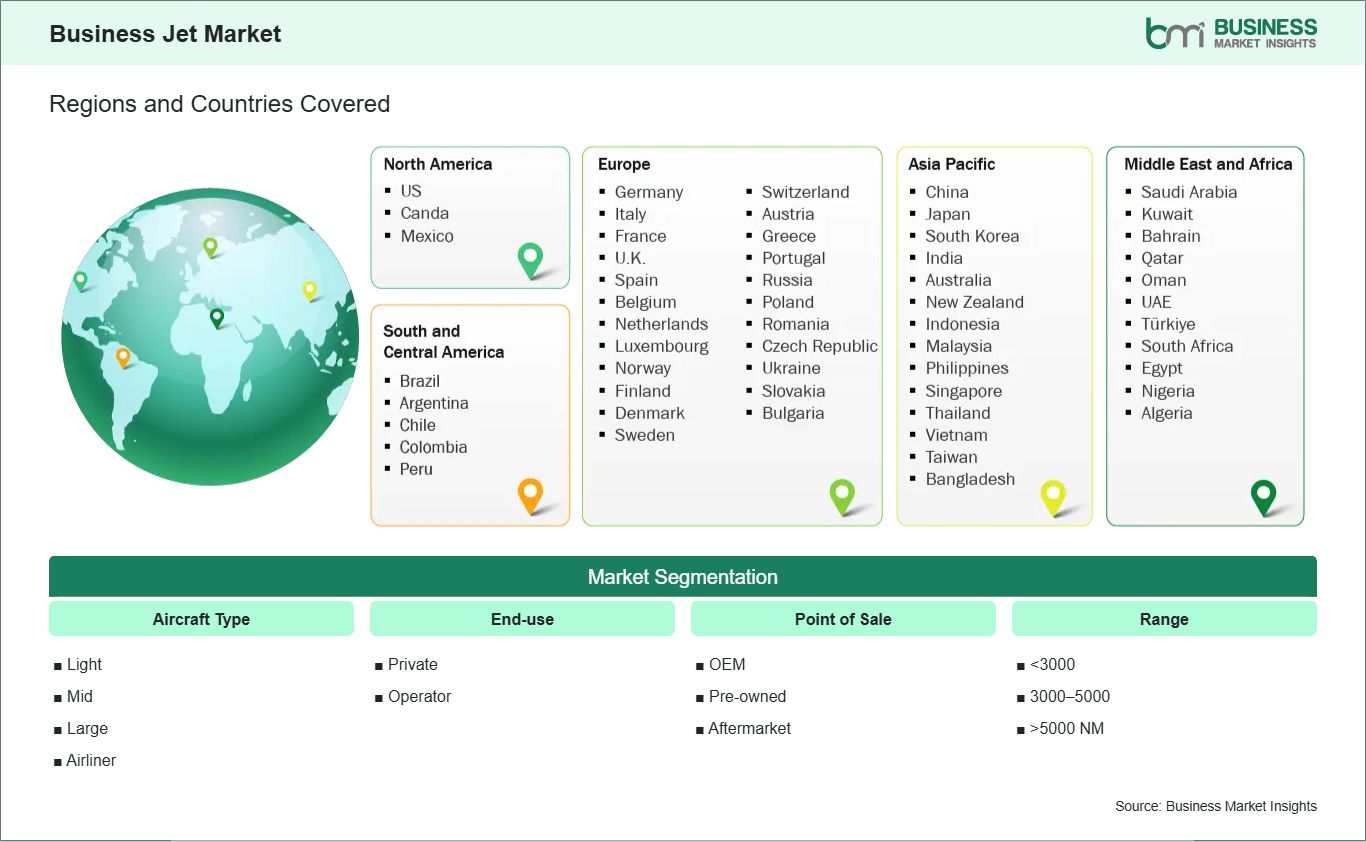
The business jet market is segmented based on aircraft type, end-use, point of sale, range, and systems, reflecting the growing demand for luxury air travel, operational efficiency, advanced avionics, and sustainable aviation solutions across corporate, private, and charter aviation sectors.
By Aircraft Type
- Light - Short-range mobility with efficient operational cost structures
- Mid - Balanced performance for transcontinental business travel
- Large - Extended cabin capacity supporting intercontinental missions
- Airliner - VIP-configured high-capacity executive transport platforms
By End-use
- Private - Individual ownership and exclusive travel usage
- Operator - Fleet-based charter and managed aviation services
By Point of Sale
- OEM - New aircraft procurement through original manufacturers
- Pre-owned - Secondary aircraft transactions across global fleets
- Aftermarket - Maintenance, upgrades, and refurbishment services
By Range
- <3000 NM - Regional business connectivity missions
- 3000 - 5000 NM - Medium-haul intercontinental operations
- >5000 NM - Long-haul global executive travel routes
By Systems
- Aerostructures - Airframe efficiency and structural optimization focus
- Avionics - Navigation intelligence and flight control systems
- Aircraft Systems - Integrated operational and safety subsystems
Market Forces
Business Jet Market Drivers and Opportunities
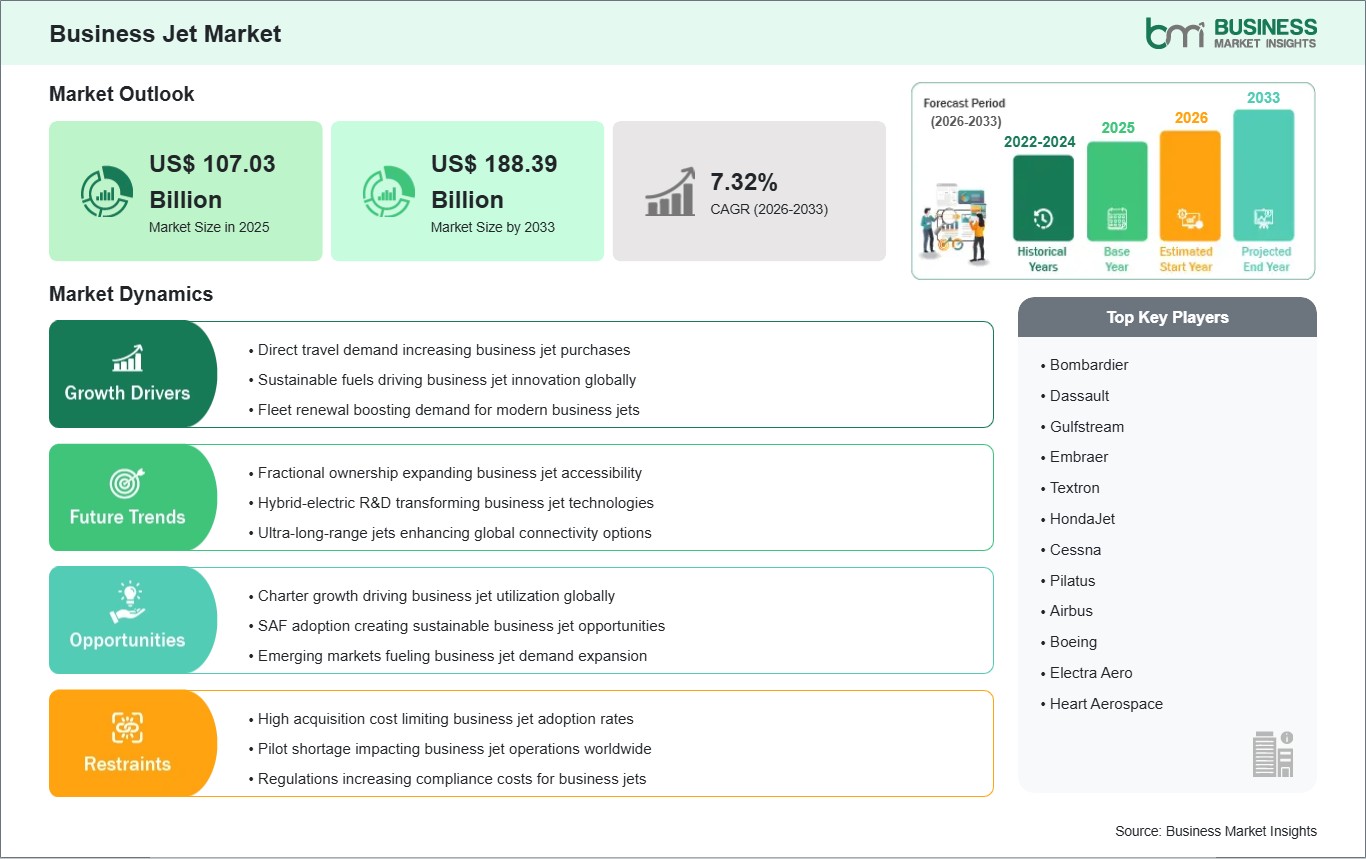
Direct travel demand increasing business jet purchases
The corporate mobility needs are gradually moving in favor of more efficient means of travel, which has promoted the need to allocate greater financial resources into business aviation equipment, especially in developed and developing nations. Corporations that are working from various locations place emphasis on the efficiency of the travel process to facilitate quicker decision-making and interactions. Restrictions associated with commercial aviation, such as reliance on flight routes and schedules, have encouraged a preference for the ownership of a dedicated fleet of planes. The use of private jets has several advantages, including convenience and improved scheduling practices.
The expanding importance of business continuity planning has elevated the relevance of private aviation across industries requiring immediate mobility access. Organizations increasingly align aviation investments with strategic productivity goals and executive travel management frameworks. Fleet modernization initiatives further contribute toward replacement demand for technologically advanced aircraft with enhanced operational efficiency. Long-range travel capability, cabin customization, and integrated digital systems continue influencing procurement preferences among buyers. As enterprises strengthen global operational footprints, direct aviation access remains a practical solution for maintaining efficient business connectivity across geographically distributed commercial environments.
Charter growth driving business jet utilization globally
The charter aviation segment is witnessing stronger utilization as customers increasingly seek flexible travel access without full aircraft ownership commitments. Digital booking ecosystems and subscription-based aviation models have improved accessibility across corporate users, entrepreneurs, and leisure travelers. Operators continue integrating advanced scheduling platforms and fleet management technologies to improve aircraft availability and operational efficiency. On-demand charter services provide adaptable travel solutions for short-notice business trips and regional connectivity requirements. Expanding awareness regarding shared aviation access is also encouraging first-time users to engage with business aviation services through cost-efficient operational models.
Future market growth will most certainly be linked to the growing sophistication of the worldwide charter ecosystems and fleet management services. The aviation companies are enhancing their service routes in order to increase their flexibility and ability to respond to customers needs at major business destinations. Higher rates of aircraft usage will result in better economies of operation as well as increased availability of executive air travel services. The charter companies are also paying attention to personalization of the travel experience, integrated concierge services, and cabin upgrades in order to build up customer loyalty.
Size and Share Analysis
Business Jet Market Size and Share Analysis
The Business Jet Market is projected to grow from US$ 107.03 Billion in 2025 to US$ 188.39 Billion by 2033 , registering a CAGR of 7.32% from 2026 to 2033.
By aircraft type, mid-size business jets account for a significant share due to their balanced operational range, cabin comfort, and suitability for regional and international corporate travel. Large business jets continue expanding with rising demand for long-distance executive transportation and premium onboard amenities, while light jets maintain stable adoption for short-haul business mobility and cost-efficient operations. Airliner-based executive aircraft are gaining traction among government authorities and high-net-worth individuals requiring high-capacity private travel solutions.
By end-use, operator services dominate market utilization as charter programs and managed aviation services provide flexible access to executive travel without ownership obligations. Private ownership continues witnessing steady expansion due to increasing preference for travel confidentiality, direct routing flexibility, and uninterrupted business mobility among enterprises and affluent travelers.
By point of sale, OEM aircraft account for a substantial share owing to rising procurement of technologically advanced aviation platforms with modern avionics and fuel-efficient systems. Pre-owned aircraft continue attracting cost-conscious buyers seeking operational flexibility at lower acquisition costs, while aftermarket services are expanding steadily through maintenance operations, refurbishment programs, cabin upgrades, and aircraft systems modernization activities.
By range, 3000 - 5000 NM aircraft maintain considerable deployment due to their ability to support medium-haul international business operations efficiently. Aircraft above 5000 NM continue witnessing rising utilization for uninterrupted intercontinental travel missions, while aircraft below 3000 NM remain widely adopted for regional executive transportation and short-duration business connectivity requirements.
By systems, avionics account for a significant share due to increasing integration of advanced navigation, communication, and flight management technologies across modern business aircraft. Aircraft systems continue expanding through demand for operational monitoring and safety enhancement solutions, while aerostructures are gaining attention with growing adoption of lightweight materials and efficiency-focused structural upgrades.
Report Coverage
Business Jet Market Report Coverage and Deliverables
The "Business Jet Market Size and Forecast (2022 - 2033)" report provides a detailed analysis of the market covering below areas:
- The market size and forecast at global, regional, and country levels for all market segments covered under the scope
- The market trends, as well as drivers, restraints, and opportunities
- The market analysis covering key trends, global and regional framework, major players, regulations, and recent developments
- Industry landscape and competition analysis covering market concentration, heat map analysis, prominent players, and recent developments for the market
- Detailed company profiles, including SWOT analysis
Geographic Insights
Business Jet Market Geographic Insights
There are evident geographical distinctions concerning the penetration rate of the business jets industry, which depend on such factors as the development of aviation infrastructure, corporate presence in particular regions, different regulatory frameworks and aviation services infrastructure in particular geographical areas. All the above-mentioned aspects have an impact on the demand rates, use of airplanes, and intensity of usage of business aircraft services all over the world.
The North American market is the most developed one in terms of the maturity of business jet services. It features a dense network of airports, developed aviation infrastructure and a well-established structure of operators and service providers. Corporate travel is actively supported by organizations, and business jets are extensively used both as scheduled corporate transportation and charter aircraft.
Asia-Pacific countries are experiencing fast development due to growing economic activities and globalization of firms and increased cross-border business transactions. As international companies grow, they require fast means of traveling and hence business aviation becomes necessary. Despite not yet having the infrastructure that is available in other developed regions, the increasing investments made in airport services make them have huge future prospects.
Europe has been characterized by structured and consistent demand for business aviation, which has been facilitated by good regulatory structure of the industry and developed operators. Business aviation has been effectively utilized for short and medium distances.
Industry Activity
Recent Developments
The business jet market is evaluated by gathering qualitative and quantitative data post primary and secondary research, which includes important corporate publications, association data, and databases. A few of the key developments in the business jet market are:
- In March 2026, Dassault Aviation announced the launch of its Falcon 10X business jet program update, highlighting progress toward entry into service with a 7,500-nautical-mile range and positioning the aircraft to compete in the ultra-long-range business jet segment against Gulfstream and Bombardier.
- In November 2025, Contrinex S.A. launched its SMART CAMERA 3D, a compact industrial 3D vision solution featuring embedded intelligence and no-code configuration. Utilizing Time-of-Flight (ToF) technology, the camera enables real-time depth measurement and onboard analysis for applications such as object sizing, completeness checks, and distance measurement.
Trust & Transparency
Research Methodology
The market analysis combines proprietary research with secondary data from government agencies, company disclosures, regulatory filings, industry databases and expert interviews. Market estimates are validated through data triangulation, cross-market benchmarking and analyst
review.
View Full Research Methodology
Key Sources Referred:
International Civil Aviation Organization publications
Federal Aviation Administration regulatory updates
European Union Aviation Safety Agency reports
Aviation industry technical journals
Aircraft manufacturer technical disclosures
Aerospace market intelligence databases
Global air transport statistical reviews