Market Summary
Executive Summary and Global Market Analysis
Business aviation charters include aircraft access provided on an on-demand basis, which includes both private and corporate travel purposes. This service is characterized by the absence of aircraft ownership while still providing the convenience of air transport across both domestic and international territories. Operations become increasingly oriented towards travel constraints and confidentiality-related demands.
This is further fueled by increased demand for direct flights in areas of poor commercial connectivity. Organizations adopt chartering as a means of boosting efficiency in executive duties while avoiding any scheduling inconveniences. In terms of mobility policies within organizations, quick access to aircraft services becomes essential.
Trends in Segmentation indicate an equal distribution in terms of service models, with on-demand bookings prevailing for short-term needs. Membership provides predictability for regular customers. Fractional structures offer more cost-sharing efficiency. Aircraft choice depends on distance and mission complexity, with middle-range jets balancing range and cost efficiency.
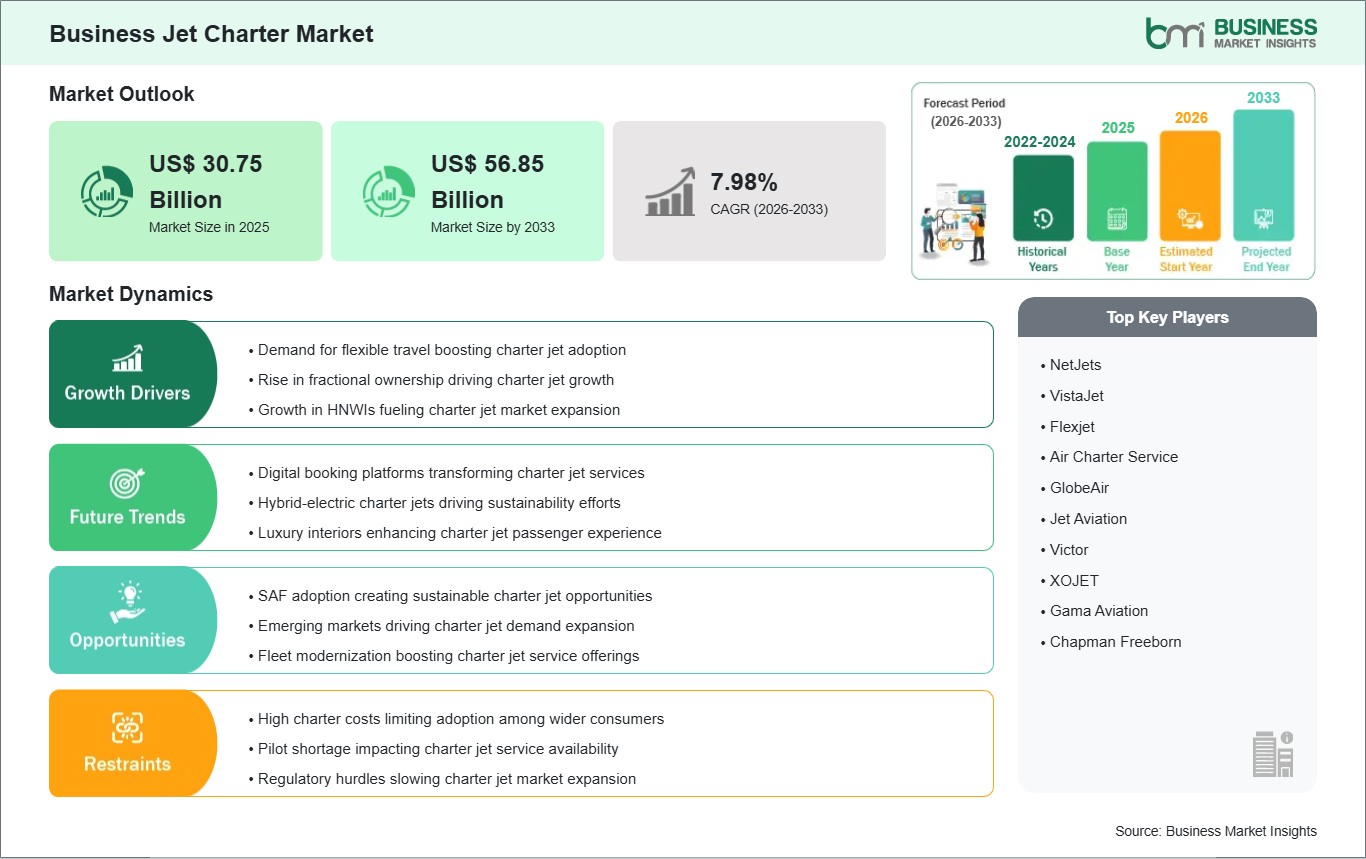
Technological integration influences operating strategies through digital booking platforms and fleet management. Real-time aircraft tracking helps improve aircraft distribution and scheduling while optimizing utilization rates. Fuel-efficient routing solutions allow for greater fuel savings and reduced turnaround times. A competitive structure still includes only large players with diverse fleets and subscription services. Service personalization, digitalization capacity, and fleet renewal efforts play an important role in market differentiation. Alternative aviation fuel integration through sustainability is slowly emerging in strategy formulation by leaders in the industry.
Segment Analysis
Business Jet Charter Market Segmentation
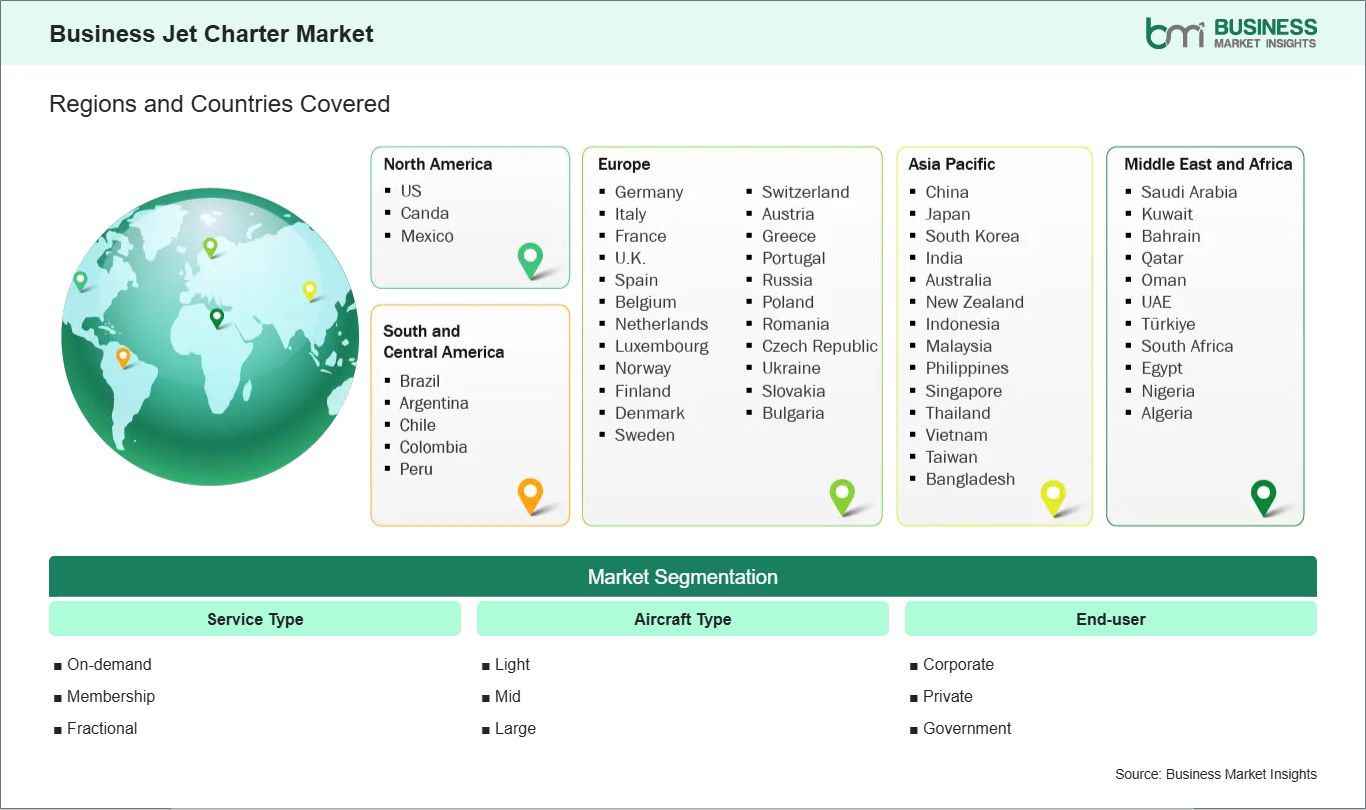
The business jet charter market is segmented based on service type, aircraft type, and end-user, reflecting the growing demand for flexible, time-efficient, and premium air travel solutions that prioritize convenience, privacy, and operational efficiency.
By Service Type
- On-demand - Immediate access for single-trip and urgent travel needs
- Membership - Recurring access model with prioritized aircraft allocation
- Fractional - Shared ownership enabling optimized cost and usage balance
By Aircraft Type
- Light - Efficient short-range travel with lower operational expenditure
- Mid - Balanced performance for regional and cross-border connectivity
- Large - Extended range capability with premium cabin configurations
By End-user
- Corporate - Structured executive mobility and enterprise travel continuity
- Private - Personalized luxury travel for individual requirements
- Government - Mission-critical transportation and official mobility operations
Market Forces
Business Jet Charter Market Drivers and Opportunities
Demand for flexible travel boosting charter jet adoption
There is an increasing emphasis on the need for mobility in terms of scheduling and the ability to move quickly in business contexts around the globe. The importance of continuous mobility within organizations, especially in managing multiple locations where there is a need for constant travel between cities or even crossing national borders, cannot be understated. This problem is solved through charter flights because they allow immediate access to the plane regardless of any commercial scheduling concerns.
Furthermore, the development of international business linkages is changing travelers’ expectations in many businesses that have geographical dispersion. The companies that are operating in more than one region use charter aircraft because of their requirement for maintaining uninterrupted mobility among their top managers to facilitate better coordination. Chartering is also beneficial in implementing decisions quickly by minimizing the complexities of commercial flight arrangements.
SAF adoption creating sustainable charter jet opportunities
Incorporation of sustainable aviation fuel into operations is slowly transforming the industry of business jet chartering. Operators are embracing the use of environmentally friendly fuels to meet the growing demands for improved environmental compliance as well as sustainability initiatives by corporations. This change helps ensure that there are lower emissions of carbon without compromising aircraft performance for various fleet types. The earliest adopters of sustainable aviation fuels have been in the realm of premium charters, where environmentally aware corporations can utilize their services.
This trend will be strengthened in the future due to rising environmental regulations as well as expanding sustainability reporting requirements. With an increased capacity and network for the delivery of sustainable aviation fuels, implementation is increasingly realistic as an operational strategy across other fleets as well. The change will enable operators to engage in emission reduction measures while retaining the key advantage of flexibility offered by the charter aviation model. Sustainability integration is anticipated to develop further over time to emerge as a key competitive strength among others.
Size and Share Analysis
Business Jet Charter Market Size and Share Analysis
The Business Jet Charter Market is projected to grow from US$ 30.75 Billion in 2025 to US$ 56.85 Billion by 2033 , registering a CAGR of 7.98% from 2026 to 2033.
By service type, on-demand charter services account for a significant share due to immediate aircraft availability without ownership obligations or long-term commitments. This model supports urgent travel requirements where schedule flexibility and rapid deployment are essential for executive mobility. Membership programs are expanding steadily as frequent travelers prioritize structured access, predictable availability, and simplified booking management. Fractional ownership continues gaining traction, offering shared usage rights that balance cost efficiency with consistent access to business aviation assets for corporate and high-net-worth users requiring recurring travel flexibility.
By aircraft type, light jets maintain stable adoption due to efficient short-haul performance and lower operational costs across regional routes. Mid-size jets represent a substantial share, supported by their balanced range capability, cabin comfort, and operational efficiency for both domestic and international business travel. Large jets continue expanding with rising demand for long-distance executive mobility and enhanced onboard luxury features. These aircraft are preferred for intercontinental missions requiring extended range capacity, higher passenger comfort, and premium cabin configurations.
By end-user, corporate travelers dominate market utilization as enterprises rely on charter services for time-efficient executive transportation and uninterrupted business operations across multiple locations. Private users contribute steadily, driven by confidentiality needs, flexible routing options, and personalized travel experiences without commercial airline constraints. Government usage remains consistent, supporting official missions, diplomatic travel, and secure transportation requirements where operational reliability, schedule control, and mission-critical mobility are essential.
Report Coverage
Business Jet Charter Market Report Coverage and Deliverables
The "Business Jet Charter Market Size and Forecast (2022 - 2033)" report provides a detailed analysis of the market covering below areas:
- The market size and forecast at global, regional, and country levels for all market segments covered under the scope
- The market trends, as well as drivers, restraints, and opportunities
- The market analysis covering key trends, global and regional framework, major players, regulations, and recent developments
- Industry landscape and competition analysis covering market concentration, heat map analysis, prominent players, and recent developments for the market
- Detailed company profiles, including SWOT analysis
Geographic Insights
Business Jet Charter Market Geographic Insights
The business jet charter market reflects distinct regional adoption patterns shaped by infrastructure development levels, enterprise concentration, and aviation network accessibility. Demand distribution varies across regions as mobility requirements, fleet utilization intensity, and business travel behavior differ within global aviation ecosystems.
North America maintains a highly developed operational framework supported by extensive airport connectivity and established aviation service networks. Strong corporate travel activity and widespread charter service usage sustain consistent aircraft deployment across key business corridors and financial centers.
Asia Pacific is experiencing accelerating adoption supported by expanding corporate activity and increasing demand for time-efficient travel solutions. Growing cross-border trade and rising business expansion initiatives are reinforcing reliance on flexible aviation options for executive mobility across major economic hubs.
Europe demonstrates steady and structured demand supported by mature regulatory systems and well-established operator networks. The Middle East and South America are gradually expanding adoption, driven by infrastructure development, increasing premium travel demand, and growing integration of business aviation services within emerging commercial landscapes.
Industry Activity
Recent Developments
The business jet charter market is evaluated by gathering qualitative and quantitative data post primary and secondary research, which includes important corporate publications, association data, and databases. A few of the key developments in the business jet charter market are:
- In March 2026, Fly Alliance announced that it was entering the Indian business jet charter market with an initial US$ 12 million investment, planning to operate up to 10 aircraft and expand its charter brokerage and aircraft management services in one of the fastest-growing aviation regions.
- In July 2025, Flexjet announced that it had secured an $800 million investment led by L Catterton, strengthening its balance sheet and enabling fleet expansion and international growth across its fractional ownership and charter operations.
Trust & Transparency
Research Methodology
The market analysis combines proprietary research with secondary data from government agencies, company disclosures, regulatory filings, industry databases and expert interviews. Market estimates are validated through data triangulation, cross-market benchmarking and analyst
review.
View Full Research Methodology
Key Sources Referred:
International Civil Aviation Organization (ICAO) publications
Federal Aviation Administration (FAA) aviation statistics
European Business Aviation Association (EBAA) reports
National Business Aviation Association (NBAA) insights
Aviation Week intelligence reports
Aviation sustainability and SAF research journals
Global air mobility and transport economics studies