Market Summary
Executive Summary and Global Market Analysis
The bullet train or high-speed rail market refers to advanced passenger rail systems engineered to operate at very high speeds. These trains are designed to provide rapid, reliable, and comfortable travel across domestic and international routes, combining cutting-edge rail technology with modern cabin arrangements to deliver efficient mobility solutions.
The demand for high-speed rail services is driven by efficient travel requirements within organizations and affluent individuals. Fleet renewal activities increasingly emphasize improved range, connectivity, and minimized downtime, which is altering procurement preferences toward new deliveries and replacements.
The segmentation process based on train type demonstrates that different operational purposes depend on specific categories. Light high-speed trains cater to short-haul travel demands, mid-sized trains represent an optimized balance between operational effectiveness and passenger capacity, while large-capacity trains meet long-distance and intercontinental travel requirements.
Advancements in rail technologies have contributed to enhanced accuracy and safety within operations. Innovations in rail structures have reduced train weight and improved energy efficiency, while digital cabin technologies enable customized passenger experiences. In addition, safety systems ensure reliable and secure travel. The competitive environment reflects the dominance of a few suppliers who emphasize product differentiation, lifecycle services such as maintenance and upgrades, and global expansion into emerging economies with growing infrastructure investments.
Segment Analysis
Bullet Train/High-Speed Rail Market Segmentation
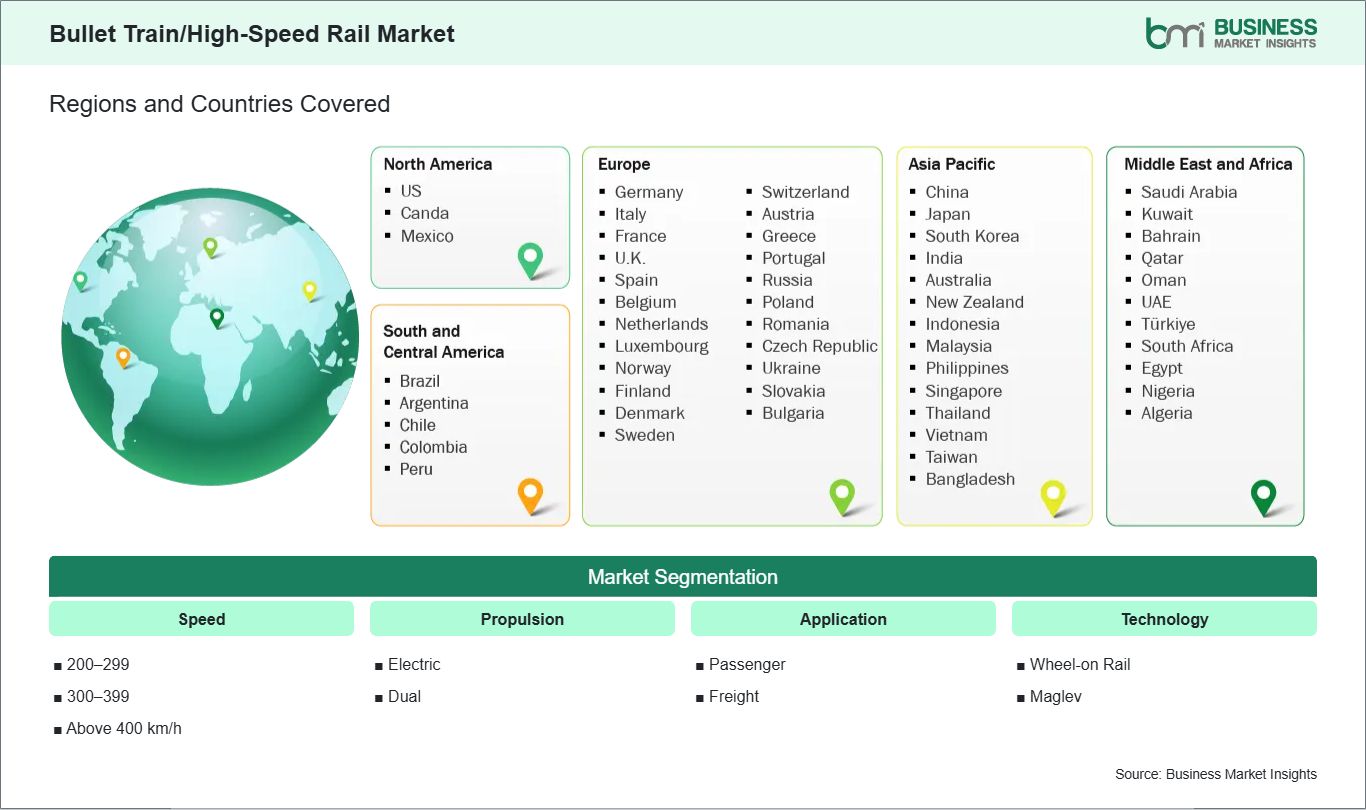
The bullet train/high-speed rail market is segmented based on speed, propulsion, application, technology, component, reflecting the growing focus on ultra-fast, energy-efficient rail transport that enhances intercity connectivity, reduces travel time, and supports sustainable mobility.
By Speed
- 200 - 299 - Cost-efficient intercity corridor operations
- 300 - 399 - Balanced performance and infrastructure efficiency
- Above 400 km/h - Premium ultra-fast mobility systems
By Propulsion
- Electric - Standardized electrified rail networks
- Dual - Flexible cross-network operational capability
By Application
- Passenger - High-density commuter and intercity demand
- Freight - Time-sensitive logistics corridor utilization
By Technology
- Wheel-on Rail - Established infrastructure compatibility
- Maglev - Contactless high-velocity transport systems
By Component
- Axle - Structural load-bearing performance unit
- Transformer - Voltage regulation and power distribution
- Traction Motor - Propulsion force generation unit
- Converter - Energy conversion and control module
- Pantograph - Overhead power collection interface
Market Forces
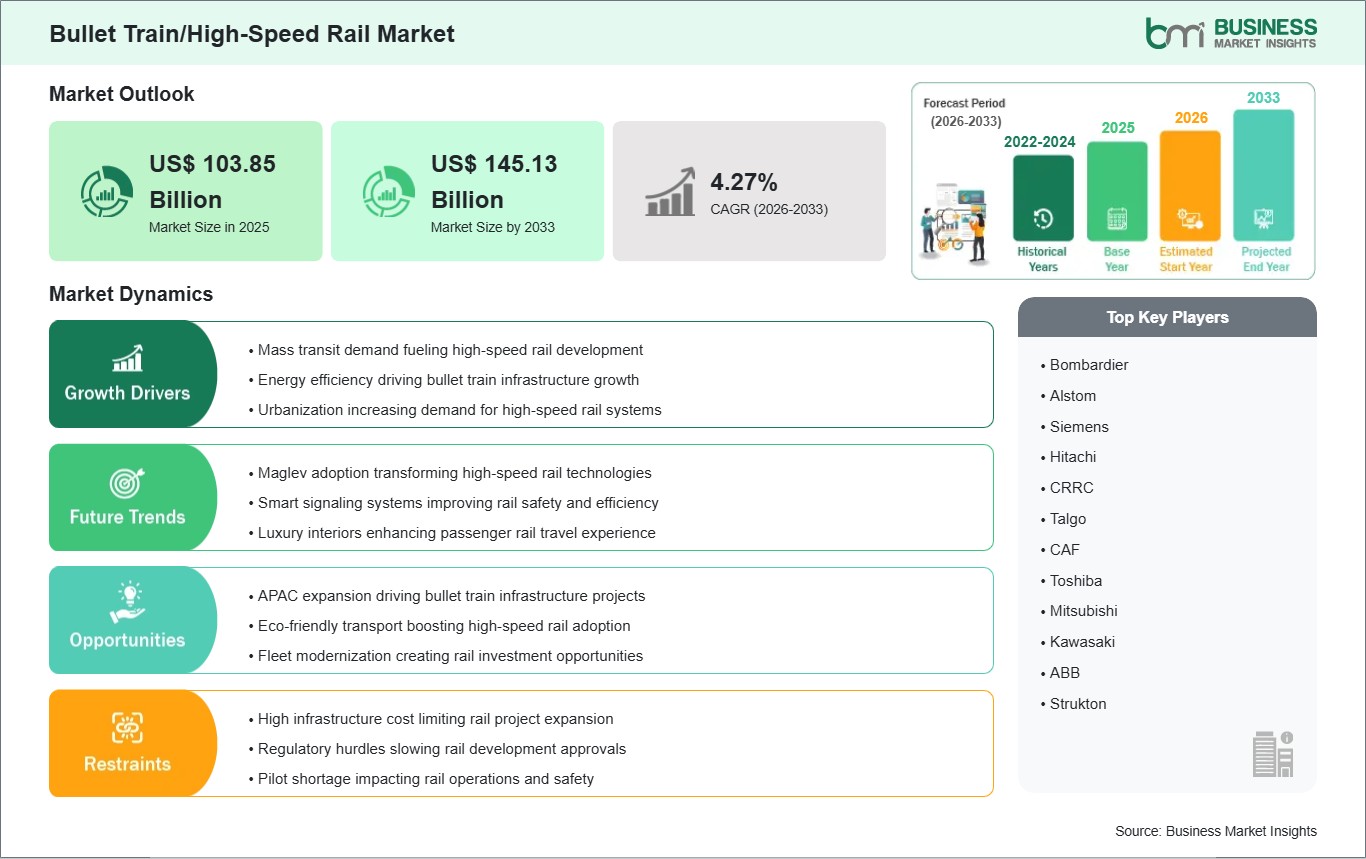
Bullet Train/High-Speed Rail Market Drivers and Opportunities
Mass Transit Demand Fueling High-Speed Rail Development
Increasing urban density has significantly affected the requirements for inter-city travel along important economic routes, putting pressure on traditional modes of transport like roads and flights. With the increase in the number of passengers, existing transport systems have become less effective and congested due to the fact that they have reached their capacity limits. This is the reason why it has become imperative to opt for a systematic rail-based transport system, which would be more effective and predictable.
High-speed trains provide fast inter-city links, which can cope with increased passenger numbers without any problem. It is necessary for governments and authorities to consider investing in rail systems that are electrified to help improve accessibility and lessen the reliance on roadways and airlines. In other words, improved rail transport will ensure better connectivity between cities economically.
Asia Pacific Expansion Driving Bullet Train Infrastructure Projects
The high-speed railway network is developing rapidly in the Asia Pacific due to the launch of huge corridor development projects along with a growing need for efficient transportation systems. With rapid industrialization, clustering of people, and the emergence of megacities, rail-based infrastructures are preferred to road and air travel as it provides an affordable and sustainable means of moving passengers between cities. The region has been working toward standardizing its rail infrastructure to increase efficiency and reduce costs in the deployment of such projects.
Most of the expansion projects have involved connecting the newly developing cities and urban centers with existing metropolises using high-density and electrified railway corridors. This will not only help in reducing journey time but also make sure that there is balanced economic development among all cities. Besides, the flows of investment and collaboration among the countries in the region will enable the scalability of such projects. Consequently, the Asia Pacific is emerging as a leader in next-generation high-speed railways and bullet trains.
Size and Share Analysis
Bullet Train/High-Speed Rail Market Size and Share Analysis
The Bullet Train/High-Speed Rail Market is projected to grow from US$ 103.85 Billion in 2025 to US$ 145.13 Billion by 2033 , registering a CAGR of 4.27% from 2026 to 2033.
By speed, the 200 - 299 km/h segment accounts for a significant share as it supports cost-efficient intercity connectivity across moderately dense corridors. The 300 - 399 km/h range is gaining steady traction due to balanced performance efficiency and optimized infrastructure utilization. Above 400 km/h systems remain limited but are increasingly explored for ultra-fast mobility corridors requiring reduced travel time between major economic hubs.
By propulsion, electric systems dominate adoption as they align with large-scale electrified rail infrastructure and ensure stable energy distribution across long-distance operations. Dual propulsion systems are expanding with growing demand for operational flexibility across mixed electrification environments and multi-network route compatibility.
By application, passenger transport leads market adoption due to sustained intercity travel demand and structured scheduling requirements across high-density urban corridors. Freight applications remain more niche, focusing on time-sensitive cargo movement where reliability and controlled transit conditions are prioritized over volume.
By technology, wheel-on rail systems hold a significant share due to widespread infrastructure maturity and cost-efficient deployment across existing rail networks. Maglev systems are witnessing gradual uptake supported by interest in high-speed, low-friction transport models for advanced corridor development.
By component, traction motors account for strong utilization as they directly influence propulsion efficiency and operational stability. Pantographs and converters also maintain essential roles in power collection and energy regulation across electrified systems. Axles and transformers support structural integrity and voltage management, ensuring consistent high-speed performance across operational networks.
Report Coverage
Bullet Train/High-Speed Rail Market Report Coverage and Deliverables
The "Bullet Train/High-Speed Rail Market Size and Forecast (2022 - 2033)" report provides a detailed analysis of the market covering below areas:
- The market size and forecast at global, regional, and country levels for all market segments covered under the scope
- The market trends, as well as drivers, restraints, and opportunities
- The market analysis covering key trends, global and regional framework, major players, regulations, and recent developments
- Industry landscape and competition analysis covering market concentration, heat map analysis, prominent players, and recent developments for the market
- Detailed company profiles, including SWOT analysis
Geographic Insights
Bullet Train/High-Speed Rail Market Geographic Insights
The bullet train/high-speed rail market shows diverse regional adoption patterns influenced by expansion of intercity rail corridors, increasing emphasis on electrified transportation infrastructure, and rising integration of high-capacity mobility systems across densely populated economic routes.
On a global level, the implementation of rail projects through corridors is increasingly popular among centers of industry and commerce. Corridor-based transport connectivity projects across national borders still remain small-scale, but are slowly progressing due to the harmonization of transport policies in countries. High density of demand is most prominent in areas where population and economic activity abound, enabling high-speed rail operation at high intensity.
The North American continent shows the slow and gradual process of implementing high-speed rail technology as a result of planning for corridors and long-term reformation of intercity mobility systems. Timeframes involved in implementing the projects continue to be lengthy due to issues regarding approvals, land acquisition problems, and infrastructure updates. The investment trend in North America has shifted towards establishing links between important metro clusters via high-capacity rail transport that increases mobility efficiency and decreases reliance on short flights.
The Asia Pacific region has seen the largest number of projects in operation, backed by the existing large networks of rail lines, as well as plans to expand further into additional corridors. The dense population, increasing urbanization rates, and well-developed manufacturing industry are the factors that accelerate development in the field of high-speed rail transportation in many different nations. Europe is mostly concerned about modernizing the existing railways and establishing high-speed corridors across borders.
Industry Activity
Recent Developments
The bullet train/high-speed rail market is evaluated by gathering qualitative and quantitative data post primary and secondary research, which includes important corporate publications, association data, and databases. A few of the key developments in the bullet train/high-speed rail market are:
- In September 2024, Siemens Mobility announced investment in a new $60 million high-speed train manufacturing facility in upstate New York, aimed at producing next-generation high-speed trainsets for upcoming U.S. projects, including the Brightline West corridor, marking its expansion into North American high-speed rail production.
- In January 2024, Sojitz Corporation announced that it had received an order for electrification system works for India’s Mumbai - Ahmedabad High-Speed Rail corridor, in collaboration with Larsen and Toubro, supporting the 508 km bullet train project based on Japan’s Shinkansen technology standards.
Trust & Transparency
Research Methodology
The market analysis combines proprietary research with secondary data from government agencies, company disclosures, regulatory filings, industry databases and expert interviews. Market estimates are validated through data triangulation, cross-market benchmarking and analyst
review.
View Full Research Methodology
Key Sources Referred:
International Union of Railways (UIC) reports
European Railway Agency publications
Ministry of Railways (India) infrastructure updates
China State Railway Group technical disclosures
Alstom and Hitachi Rail corporate filings
Transport research journal publications
World Bank transport infrastructure datasets
OECD mobility and rail corridor studies