BRICS Skin Rejuvenation Market Outlook: Size, Share, Trends, Growth Analysis, Competitive Landscape & Forecast, 2022-2033

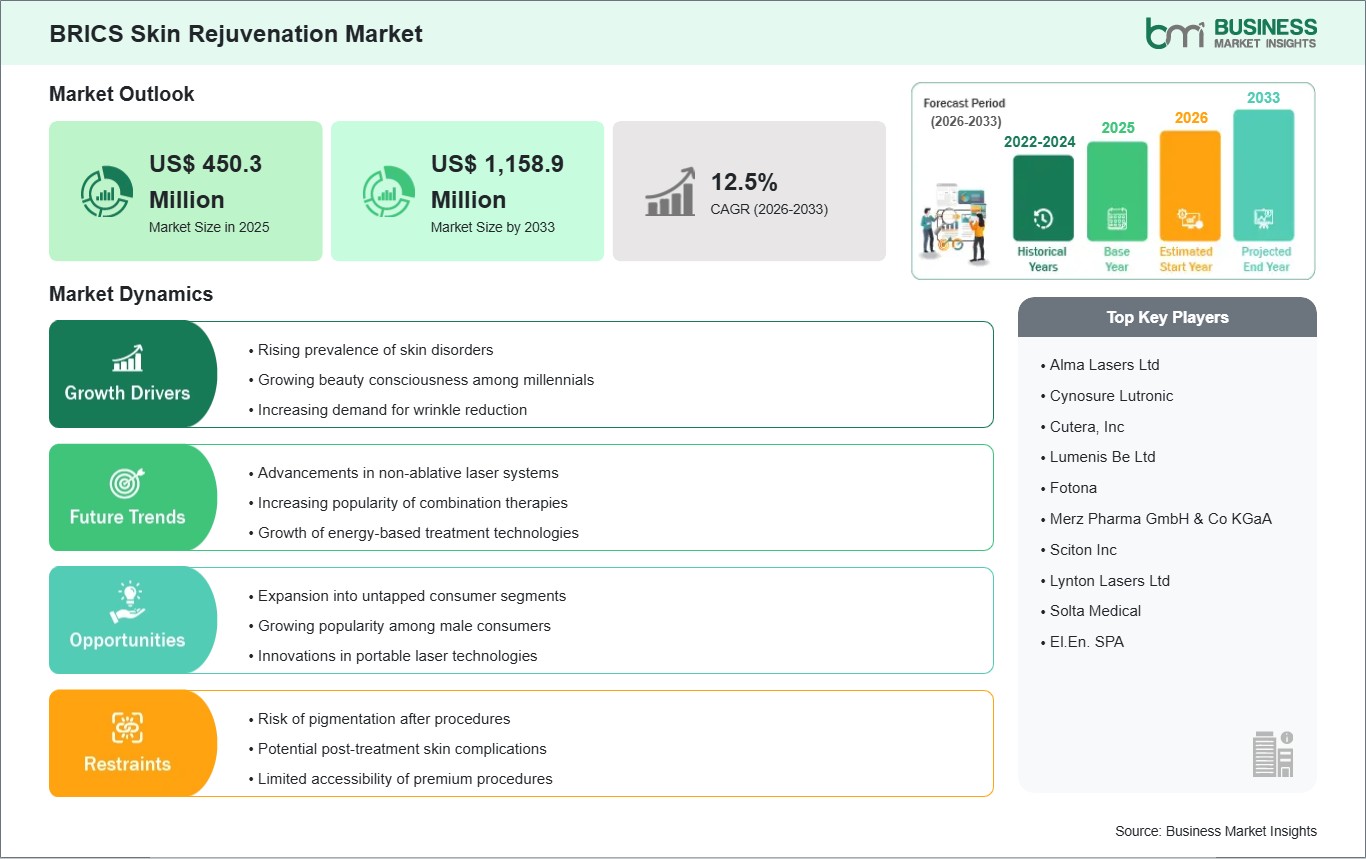
The BRICS skin rejuvenation market size is expected to reach US$ 1,158.9 million by 2033 from US$ 450.3 million in 2025. The market is estimated to record a CAGR of 12.5% from 2026 to 2033.

Report Coverage
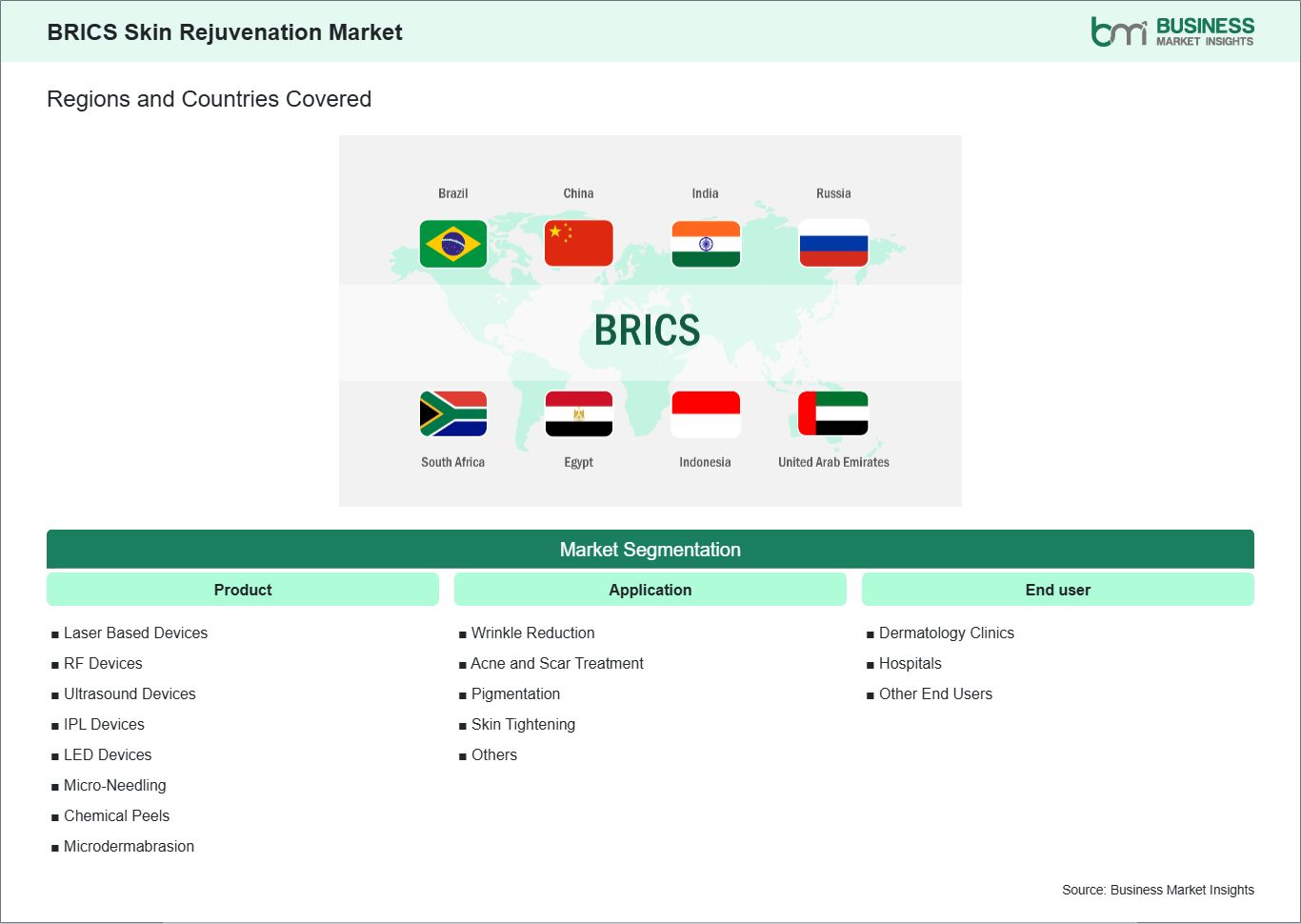
  • Product: Laser Based Devices, RF Devices, Ultrasound Devices, IPL Devices, LED Devices, Micro-Needling, Chemical Peels, Microdermabrasion
  • Application: Wrinkle Reduction, Acne and Scar Treatment, Pigmentation, Skin Tightening, Others
  • End user: Dermatology Clinics, Hospitals, Other End Users
US$ 450.3 Mn Market size in 2025
US$ 1,158.9 Mn Market Size by 2033
12.5% CAGR, 2026 - 2033
2026-2033 Forecast Period

Market Summary

Executive Summary and Market Analysis

The BRICS skin rejuvenation market comprising Brazil, Russia, India, China, and South Africa represents a highly dynamic and heterogeneous aesthetic dermatology ecosystem shaped by rising disposable incomes, rapid urbanization, and increasing social acceptance of cosmetic procedures. Demand in the region is largely driven by youth demographics, increased populations of middle classes, and increased exposure to international standards of beauty due to digital means of communication. Non-invasive procedures such as laser resurfacing, chemical peels, dermafilling, skin-tightening treatments, and other cosmetic surgery options for advanced pigmentation correction have gained momentum especially among people living in metropolitan cities. Growth in demand is fueled by the establishment of private dermatology clinics, medical spas, and cosmetic chain stores targeting both high-end and mid-range consumers. Technology uptake is also gaining pace, with advancements made in terms of artificial intelligence and devices. However, regulatory frameworks vary significantly across member countries, creating uneven standards in practitioner qualification, treatment safety, and service quality. Price sensitivity remains a critical factor in several BRICS economies, leading to the coexistence of highly premium urban clinics alongside more cost-conscious service providers. Medical tourism also plays a notable role, particularly in countries with established cosmetic surgery ecosystems, contributing to cross-border patient inflows. Strategic investments from global aesthetic companies and growing domestic manufacturing capabilities are further enhancing market competitiveness. Overall, the BRICS region reflects a dual-speed market structure where advanced urban centers drive innovation-led growth while emerging areas contribute scale and long-term demand expansion.

Strategic Insights

BRICS Skin Rejuvenation Market: Strategic Insights

BRICS Skin Rejuvenation Market Strategic Framework
FREE PDF
Request your free sample
Request free sample
Segment Analysis

BRICS Skin Rejuvenation Market Segmentation

Key segments that contributed to the derivation of the BRICS skin rejuvenation market analysis are product, application, and end user.

  • By product, the skin rejuvenation market is segmented into laser based devices, RF devices, ultrasound devices, IPL devices, LED devices, micro-needling, chemical peels, microdermabrasion. The laser based devices segment dominated the market in 2025.
  • Based on application, the skin rejuvenation market is categorized into wrinkle reduction, acne and scar treatment, pigmentation, skin tightening, others. The wrinkle reduction segment dominated the market in 2025.
  • In terms of end user, the skin rejuvenation market is categorized into dermatology clinics, hospitals, other end users. The dermatology clinics segment dominated the market in 2025.
Market Forces

BRICS Skin Rejuvenation Market Drivers and Opportunities

Expanding influence of social media beauty trends

The BRICS skin rejuvenation market is increasingly shaped by the expanding influence of social media-driven beauty trends, which are redefining consumer expectations across Brazil, Russia, India, China, and South Africa. Visual platforms and those featuring short videos are driving the popularity of aesthetics-related treatments, thus bringing skin rejuvenation treatments to wider attention. In Brazil, for instance, beauty communities that exist online contribute greatly to the popularity of glow-inducing treatments, while in China, e-commerce through live streaming is becoming increasingly popular among users interested in beauty products and treatments.

Rapid adoption of skincare regimen inspired by global influencers and dermatologists is being seen in younger, technologically connected generations in both India and South Africa. There is growing interest among such consumers in cosmetic procedures that offer visible results within shorter periods of time, such as laser skin resurfacing and tightening treatments. The same trend has been observed in Russia where young consumers have been exposed to international standards of beauty through social media, thus prompting their desire to pursue more complex dermatological procedures in big cities.

The cultural convergence resulting from the use of social media is also leading to the creation of standardized beauty standards among different demographic groups. Today, consumers are looking for “natural enhancement” procedures that are consistent with international beauty standards but at the same time take into account the skin tone of the locals. This has forced clinics and skin care specialists to change their marketing approaches and product lines to respond to the demands driven by social media.

Expansion of tele-dermatology consultation platforms

Tele-dermatology consultation platforms are rapidly expanding across the BRICS skin rejuvenation market, addressing the growing need for accessible dermatological care in both urban and underserved regions. In nations such as India, Brazil, and South Africa, the scarcity of dermatologists in rural and suburban regions has led to the quick embrace of virtual consultation systems. This is because these systems allow patients to get initial evaluations and prescriptions for their condition without physically going to see their dermatologists.

In addition to that, China and Russia have also been seen integrating themselves with the development of digital healthcare ecosystems through which tele-dermatology services are integrated within the e-health and smart clinics frameworks. The technology helps dermatologists to monitor images, treatment progression, and skin-care routines of their patients from afar. Brazil uses teleconsultation services within its private dermatology networks to facilitate post-treatment follow-ups, and India uses mobile-first healthcare platforms in tier-2 and tier-3 cities.

The development of tele-dermatology will also be encouraged by increased customer ease with digital solutions for healthcare and the trend towards integration between skincare and technology. The use of artificial intelligence to help diagnose customers' skin problems, such as pigmentation, acne, and skin problems associated with age, will allow faster diagnosis through consultation programs. This will make processes easier for medical professionals, while patients will benefit from increased personalization of their experience. Tele-dermatology is predicted to become an integral part of the skin rejuvenation industry in the BRICS countries.

Size and Share Analysis

BRICS Skin Rejuvenation Market Size and Share Analysis

The BRICS skin rejuvenation market demonstrates steady growth, with size and share analysis highlighting evolving trends and competitive dynamics among key players. The report examines subsegments categorized within product, application, and end user, offering insights into their contribution to overall market performance.

By product, the laser based devices segment dominated the market in 2025, driven by rapid expansion of aesthetic infrastructure, increasing affordability of energy-based technologies, and strong demand for non-invasive procedures like pigmentation correction, scar treatment, and wrinkle reduction across emerging economies in BRICS nations.

Based on application, the wrinkle reduction segment dominated the market in 2025, driven by rising aging populations in countries like China, Russia, and Brazil, along with growing aesthetic awareness and increasing preference for non-surgical anti-aging treatments supported by social media influence and urban lifestyle changes.

In terms of end user, the dermatology clinics segment dominated the market in 2025, driven by expanding penetration of specialized skin clinics and medical aesthetic centers offering advanced laser and RF-based procedures, supported by rising patient trust in medically supervised cosmetic treatments and improving access in urban markets.

Report Highlights

BRICS Skin Rejuvenation Market Report Highlights

Report Attribute Details
Market size in 2025 US$ 450.3 Million
Market Size by 2033 US$ 1,158.9 Million
CAGR (2026 - 2033)12.5%
Historical Data 2022-2024
Forecast period 2026-2033
Segments Covered By Product
  • Laser Based Devices
  • RF Devices
  • Ultrasound Devices
  • IPL Devices
  • LED Devices
  • Micro-Needling
  • Chemical Peels
  • Microdermabrasion
By Application
  • Wrinkle Reduction
  • Acne and Scar Treatment
  • Pigmentation
  • Skin Tightening
  • Others
By End user
  • Dermatology Clinics
  • Hospitals
  • Other End Users
Regions and Countries Covered
BRICS Russia, Brazil, South Africa, India, the UAE, China
Market leaders and key company profiles
  • Alma Lasers Ltd
  • Cynosure Lutronic
  • Cutera, Inc
  • Lumenis Be Ltd
  • Fotona
  • Merz Pharma GmbH & Co KGaA
  • Sciton Inc
  • Lynton Lasers Ltd
  • Solta Medical
  • El.En. SPA
FREE PDF
Request your free sample
Request free sample
Report Coverage

BRICS Skin Rejuvenation Market Report Coverage and Deliverables

The "BRICS Skin Rejuvenation Market Size and Forecast (2022-2033)" report provides a detailed analysis of the market covering below areas:

  • Market size and forecast at global, regional, and country levels for all the key market segments covered under the scope
  • Market trends, as well as drivers, restraints, and opportunities
  • Market analysis covering key trends, global and regional framework, major players, regulations, and recent developments
  • Market concentration, heat map analysis, prominent players, and recent developments for the Market
  • Detailed company profiles, including SWOT analysis
Geographic Insights

BRICS Skin Rejuvenation Market Geographic Insights

The geographical scope of the BRICS skin rejuvenation market report is divided into Russia, Brazil, South Africa, India, the UAE, China. China held the largest share in 2025.

Country-level dynamics within the BRICS skin rejuvenation market highlight distinct leadership patterns and demand structures, with China emerging as the dominant force due to its vast consumer base, rapidly expanding aesthetic clinic networks, and strong commercialization of advanced dermatological technologies. China’s market is characterized by high procedure volume, strong demand for pigmentation correction and anti-aging treatments, and rapid adoption of AI-integrated aesthetic solutions in urban centers. India represents a fast-scaling market driven by a large young population, increasing aesthetic awareness, and growing penetration of dermatology chains, although affordability remains a key determinant of service uptake. Brazil is a globally recognized hub for cosmetic dermatology and aesthetic procedures, with strong cultural acceptance of body and skin enhancement treatments and a well-developed private clinic ecosystem, particularly in São Paulo and Rio de Janeiro. Russia demonstrates steady demand concentrated in major urban centers such as Moscow and St. Petersburg, where consumers increasingly seek advanced anti-aging and skin rejuvenation solutions supported by private healthcare providers. South Africa serves as the leading aesthetic market in Africa within BRICS, driven by urban demand, expanding dermatology infrastructure, and rising adoption of non-invasive cosmetic treatments. Across the bloc, China leads in scale and technological commercialization, Brazil dominates in cultural acceptance and procedural maturity, India drives volume-based expansion, Russia maintains urban-centric premium demand, and South Africa anchors regional African aesthetic growth, collectively forming a multi-layered and high-potential global market cluster.

Global Market Geography
FREE PDF
Request your free sample
Request free sample
Report Guidance

BRICS Skin Rejuvenation Market Report Guidance

  • The report includes qualitative and quantitative data in the BRICS skin rejuvenation market across product, application, end user, and geography.
  • The report starts with the key takeaways (chapter 2), highlighting key trends and outlook of the BRICS Skin Rejuvenation Market.
  • Chapter 3 focuses on the research methodology of the study.
  • Chapter 4 includes ecosystem analysis.
  • Chapter 5 highlights the major industry dynamics in the BRICS Skin Rejuvenation Market, including factors that are driving the market, prevailing deterrents, potential opportunities, as well as future trends. Impact analysis of these drivers and restraints is also covered in this section.
  • Chapter 6 discusses the BRICS Skin Rejuvenation Market scenario, in terms of historical market revenues, and forecast till the year 2033.
  • Chapters 7 to 10 cover BRICS skin rejuvenation market segments by product, application, end user, and geography across Russia, Brazil, South Africa, India, the UAE, China. They cover the market revenue forecast and factors driving the market.
  • Chapter 11 describes the competitive analysis along with the heat map analysis for the key players operating in the market.
  • Chapter 12 describes the industry landscape analysis. It provides detailed descriptions of business activities such as market initiatives, new developments, mergers, and joint ventures globally, along with a competitive landscape.
  • Chapter 13 provides detailed profiles of the major companies operating in the BRICS Skin Rejuvenation Market. Companies have been profiled on the basis of their key facts, business descriptions, products, financial overview, SWOT analysis, and key developments.
  • Chapter 14, i.e., the appendix, is inclusive of a brief overview of the company, a list of abbreviations, and a disclaimer.
Industry Activity

Recent Developments

The BRICS skin rejuvenation market is evaluated by gathering qualitative and quantitative data post primary and secondary research, which includes important corporate publications, association data, and databases. A few of the key developments in the BRICS skin rejuvenation market are:

  • In November 2022, Sofwave Medical, announced that it had received approval from Brazil’s health regulatory agency (ANVISA) to market its SUPERB non-invasive wrinkle reduction device in Brazil, enabling the company to commercialize its ultrasound-based skin rejuvenation technology in the Brazilian aesthetic market.
  • In January 2024, Ilooda, announced that it had obtained regulatory approval in Russia for its Hyzer Me skin-tightening device, a high-intensity focused ultrasound (HIFU) system designed for non-invasive skin rejuvenation and wrinkle reduction treatments.
Trust & Transparency

Research Methodology

The market analysis combines proprietary research with secondary data from government agencies, company disclosures, regulatory filings, industry databases and expert interviews. Market estimates are validated through data triangulation, cross-market benchmarking and analyst review.

View Full Research Methodology

Key Sources Referred:

American Society for Laser Medicine and Surgery (ASLMS)European Academy of Dermatology and Venereology (EADV)Bharat Society of Laser Medicine & Surgery (BSLMS)S. Food and Drug Administration (FDA)European Medicines Agency (EMA)International Electrotechnical Commission (IEC)International Organization for Standardization (ISO)Beauty Device Association (BDA)Indian Laser Association (ILA)Association of Industrial Laser Users (AILU)

Questions Answered

Frequently Asked Questions

How big is the BRICS Skin Rejuvenation Market?

The BRICS Skin Rejuvenation Market is valued at US$ 450.3 Million in 2025, it is projected to reach US$ 1,158.9 Million by 2033.

What is the CAGR for BRICS Skin Rejuvenation Market by (2026 - 2033)?

As per our report BRICS Skin Rejuvenation Market, the market size is valued at US$ 450.3 Million in 2025, projecting it to reach US$ 1,158.9 Million by 2033. This translates to a CAGR of approximately 12.5% during the forecast period.

What segments are covered in this report?

The BRICS Skin Rejuvenation Market report typically covers these key segments-

  • Product (Laser Based Devices, RF Devices, Ultrasound Devices, IPL Devices, LED Devices, Micro-Needling, Chemical Peels, Microdermabrasion)
  • Application (Wrinkle Reduction, Acne and Scar Treatment, Pigmentation, Skin Tightening, Others)
  • End user (Dermatology Clinics, Hospitals, Other End Users)

What is the historic period, base year, and forecast period taken for BRICS Skin Rejuvenation Market?

The historic period, base year, and forecast period can vary slightly depending on the specific market research report. However, for the BRICS Skin Rejuvenation Market report:

  • Historic Period : 2022-2024
  • Base Year : 2025
  • Forecast Period : 2026-2033
Who are the major players in BRICS Skin Rejuvenation Market?

The BRICS Skin Rejuvenation Market is populated by several key players, each contributing to its growth and innovation. Some of the major players include:

  • Alma Lasers Ltd
  • Cynosure Lutronic
  • Cutera, Inc
  • Lumenis Be Ltd
  • Fotona
  • Merz Pharma GmbH & Co KGaA
  • Sciton Inc
  • Lynton Lasers Ltd
  • Solta Medical
  • El.En. SPA
Who should buy this report?

The BRICS Skin Rejuvenation Market report is valuable for diverse stakeholders, including:

  • Investors: Provides insights for investment decisions pertaining to market growth, companies, or industry insights. Helps assess market attractiveness and potential returns.
  • Industry Players: Offers competitive intelligence, market sizing, and trend analysis to inform strategic planning, product development, and sales strategies.
  • Suppliers and Manufacturers: Helps understand market demand for components, materials, and services related to concerned industry.
  • Researchers and Consultants: Provides data and analysis for academic research, consulting projects, and market studies.
  • Financial Institutions: Helps assess risks and opportunities associated with financing or investing in the concerned market.

Essentially, anyone involved in or considering involvement in the BRICS Skin Rejuvenation Market value chain can benefit from the information contained in a comprehensive market report.

Access the Full BRICS Skin Rejuvenation Market Report

Get segment-level forecasts, regional estimates, competitive benchmarking, company profiles and downloadable Excel datasets.

Access the full BRICS Skin Rejuvenation Market Report
159 pages PDF & Excel | 2026-07-01