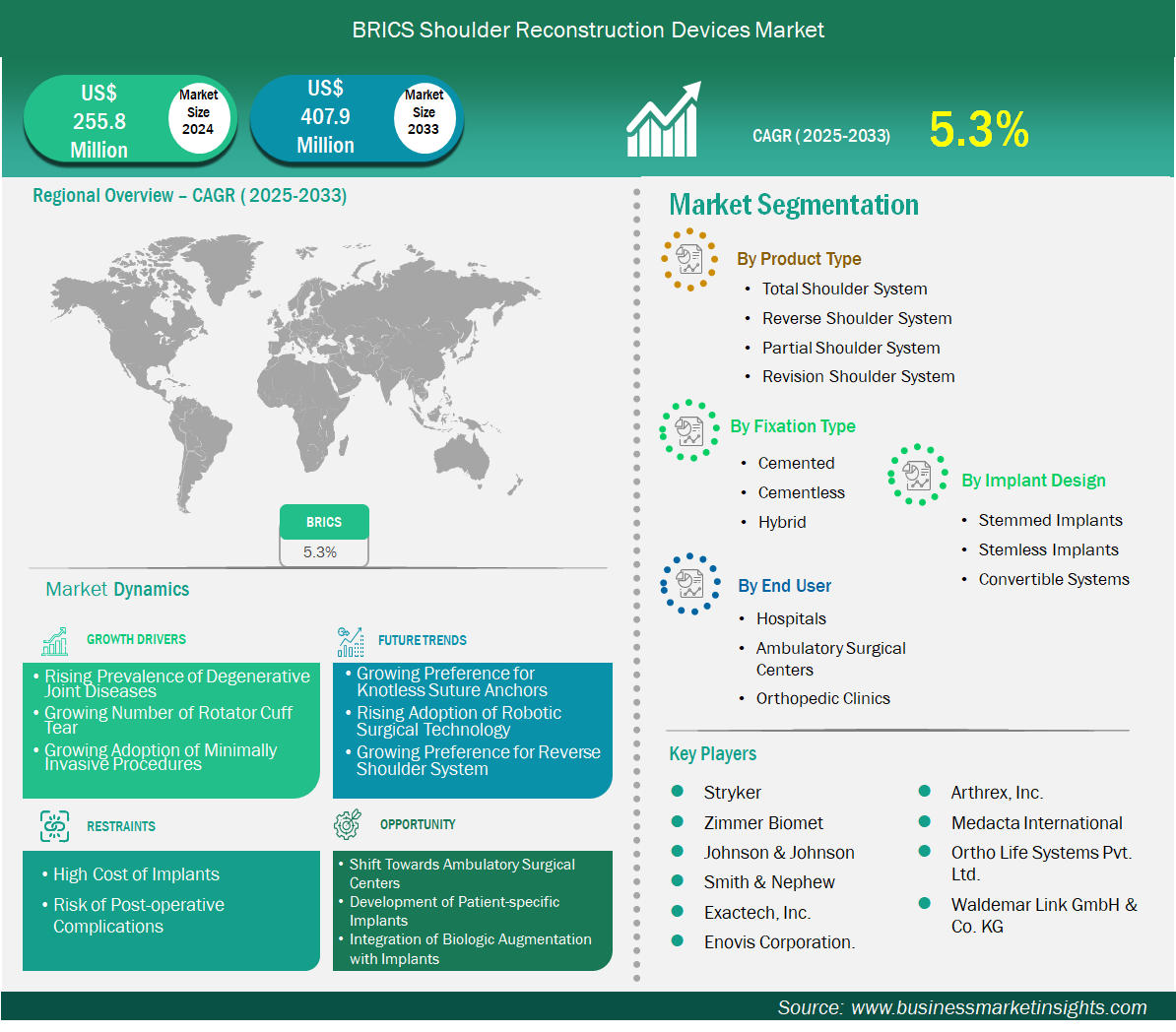
The BRICS shoulder reconstruction devices market size is expected to reach US$ 407.9 million by 2033 from US$ 255.8 million in 2024. The market is estimated to record a CAGR of 5.3% from 2025 to 2033.
Executive Summary and BRICS Shoulder Reconstruction Devices Market Analysis:
The shoulder reconstruction devices market across BRICS nations is gaining momentum as orthopedic care becomes a growing priority in these emerging economies. The rise in the number of traumas, arthritis, and degenerative shoulder diseases is resulting in the increasing need for advanced surgical solutions. These countries are investing in upgrading surgical technologies, and international manufacturers are increasing their presence through collaborations and joint ventures. Meanwhile, domestic companies are concentrating on the affordability and accessibility of products so that more patients can be reached. Awareness of surgical outcomes and rehabilitation benefits is steadily improving, encouraging more elective procedures. The availability of specialized surgeons through training programs and stronger hospital infrastructures bridges gaps in specialized care. To summarize, the BRICS region is a vibrant cluster of orthopedic innovation with huge long-term growth potential due to new technology, collaborative partnerships, and the expansion of healthcare capabilities.
BRICS Shoulder Reconstruction Devices Market Segmentation Analysis:
Key segments that contributed to the derivation of the shoulder reconstruction devices market analysis are product type, fixation type, implant design, and end user.
- By product type, the shoulder reconstruction devices market is segmented into total shoulder system, reverse shoulder system, partial shoulder system, and revision shoulder system. The reverse shoulder system segment dominated the market in 2024. Its ability to restore function in rotator cuff-deficient shoulders and growing elderly population made it the preferred choice. Surgeons favor it for complex cases due to better stability and outcomes.
- By fixation type, the shoulder reconstruction devices market is segmented into cemented, cementless, and hybrid. The cementless segment dominated the market in 2024. Rising demand for biologic integration, and reduced surgical time contributed to its dominance. It also lowers the risk of cement-related complications.
- By implant design, the market is segmented into stemmed implants, stemless implants and convertible systems. The stemless implants segment dominated the market in 2024. Their bone-preserving design and ease of implantation led to increased adoption. They’re especially suitable for younger, active patients.
- By end user, the market is segmented into hospitals, ambulatory surgical centers, and orthopedic clinics. The hospitals segment held the largest share of the market in 2024. Equipped with advanced surgical facilities and specialized staff, hospitals handle the majority of shoulder reconstruction procedures. Their capacity for post-operative care also attracts more patients.
BRICS Shoulder Reconstruction Devices Market Outlook
The BRICS market for shoulder reconstruction devices is growing due to the growing adoption of modern implants and surgical systems. Hospital emphasis on minimally invasive procedures and advanced prosthetics that improve recovery time and mobility is increasing. The increasing prevalence of musculoskeletal disorders, such as osteoarthritis and trauma-related injuries, and advancing diagnostic capabilities are contributing factors. Patients are looking for opportunities that restore function and quality of life, and this is pushing healthcare providers to invest in reliable devices. Growth is also being supported by a movement toward government programs that are strengthening orthopedic care, and investment by the private sector in specialized orthopedic clinics. The convergence of changing demographics, lifestyle, and understanding of the benefits of surgery will gradually drive demand for shoulder reconstruction devices in BRICS.
BRICS Shoulder Reconstruction Devices Market Country Insights
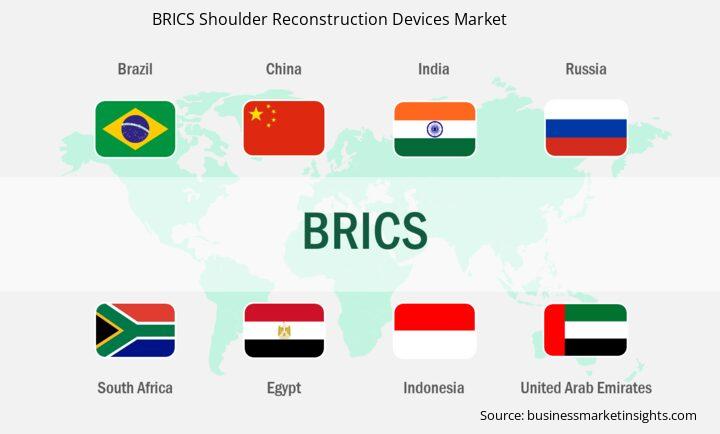
Based on country, the BRICS shoulder reconstruction devices market is segmented into Russia, Brazil, South Africa, India, China, Egypt, Indonesia, Saudi Arabia, and the UAE. China held the largest share in 2024.
China dominates the shoulder reconstruction devices market in the BRIC. The country’s large population and emerging middle class are the main factors fueling the demand for joint care. Surgical procedures in the city hospitals are facilitated with the latest surgical tools, and a growing number of patients are choosing shoulder operations as a way to regain their mobility. In addition, local manufacturers are developing high-quality implants that can compete with global brands which has increased the availability of advanced devices across the nation. The government is also investing in healthcare infrastructure and promoting medical innovation. Training programs for orthopedic surgeons are expanding, helping improve surgical outcomes. With robust local production, increasing demand, and favorable policies, China remains the leader in the region in terms of both volume and innovation of shoulder reconstruction.
BRICS Shoulder Reconstruction Devices Market Company Profiles
Stryker, Zimmer Biomet, Johnson & Johnson, Smith & Nephew, Exactech, Inc., Enovis Corporation, Arthrex, Inc., Medacta International, Ortho Life Systems Pvt. Ltd., and Waldemar Link GmbH & Co. KG are among the key players operating in the market. These players adopt strategies such as expansion, product innovation, and mergers and acquisitions to stay competitive in the market and offer innovative products to their consumers.
BRICS Shoulder Reconstruction Devices Market Research Methodology:
The following methodology has been followed for the collection and analysis of data presented in this report:
Secondary Research
The research process begins with comprehensive secondary research, utilizing both internal and external sources to gather qualitative and quantitative data for each market. Commonly referenced secondary research sources include, but are not limited to:
- Company websites, annual reports, financial statements, broker analyses, and investor presentations
- Industry trade journals and other relevant publications
- Government documents, statistical databases, and market reports
- News articles, press releases, and webcasts specific to companies operating in the market
Note: All financial data included in the Company Profiles section has been standardized to US$. For companies reporting in other currencies, figures have been converted to US$ using the relevant exchange rates for the corresponding year.
Primary Research
Business Market Insights conducts a significant number of primary interviews each year with industry stakeholders and experts to validate and analyze the data and gain valuable insights. These research interviews are designed to:
- Refine findings from secondary research
- Enhance the expertise and market understanding of the analysis team
- Gain insights into market size, trends, growth patterns, competitive dynamics, and future prospects
Primary research is conducted via email interactions and telephone interviews with industry experts across various markets, categories, segments, and sub-segments in different regions. Participants typically include:
- Industry stakeholders: Vice Presidents, business development managers, market intelligence managers, and national sales managers
- External experts: Valuation specialists, research analysts, and key opinion leaders with industry-specific expertise
Key Sources Referred:
- The World Bank
- World Health Organization (WHO)
- Center for Disease Control and Prevention (CDC)
- American Academy of Orthopedic Surgeons
- American Orthopedic Association
- The World Orthopedic Organization
- Company website
- Company annual reports
- Company investor presentations
BRICS Shoulder Reconstruction Devices Market Strategic Insights
BRICS Shoulder Reconstruction DevicesMarket Report Highlights
| Report Attribute | Details |
| Market size in 2024 | US$ 255.8 Million |
| Market Size by 2033 | US$ 407.9 Million |
| CAGR (2025 - 2033) | 5.3% |
| Historical Data | 2022-2023 |
| Forecast period | 2025-2033 |
| Segments Covered |
By Product Type
|
|
Regions and Countries Covered
|
|
| BRICS | Russia, Brazil, South Africa, India, China, Egypt, Indonesia, Saudi Arabia, United Arab Emirates |
| Market leaders and key company profiles |
|
BRICS Shoulder Reconstruction Devices Market Country and Regional Insights