
The BRICS robot-assisted endoscopes market size is expected to reach US$ 104.6 million by 2031 from US$ 49.4 million in 2024. The market is estimated to record a CAGR of 11.3% from 2025 to 2031.
Executive Summary and BRICS Robot-Assisted Endoscopes Market Analysis:
The BRICS robot-assisted endoscopy market is among the fastest growing globally. China and India are driving much of the innovation, while other BRICS nations remain in earlier stages of adoption. Market growth is shaped by highly diverse healthcare systems—ranging from advanced facilities to regions lacking basic infrastructure. China leads the group, both in the number of systems installed and in their routine clinical use, setting a benchmark for others. Its progress is influencing fellow BRICS members, many of whom are pursuing partnerships and pilot programs. Despite ongoing challenges related to affordability and specialist training, overall momentum remains positive. As robotic surgery becomes more mainstream, BRICS nations are expected to play an increasingly significant role in the global robot-assisted endoscopy landscape.
BRICS Robot-Assisted Endoscopes Market Strategic Insights
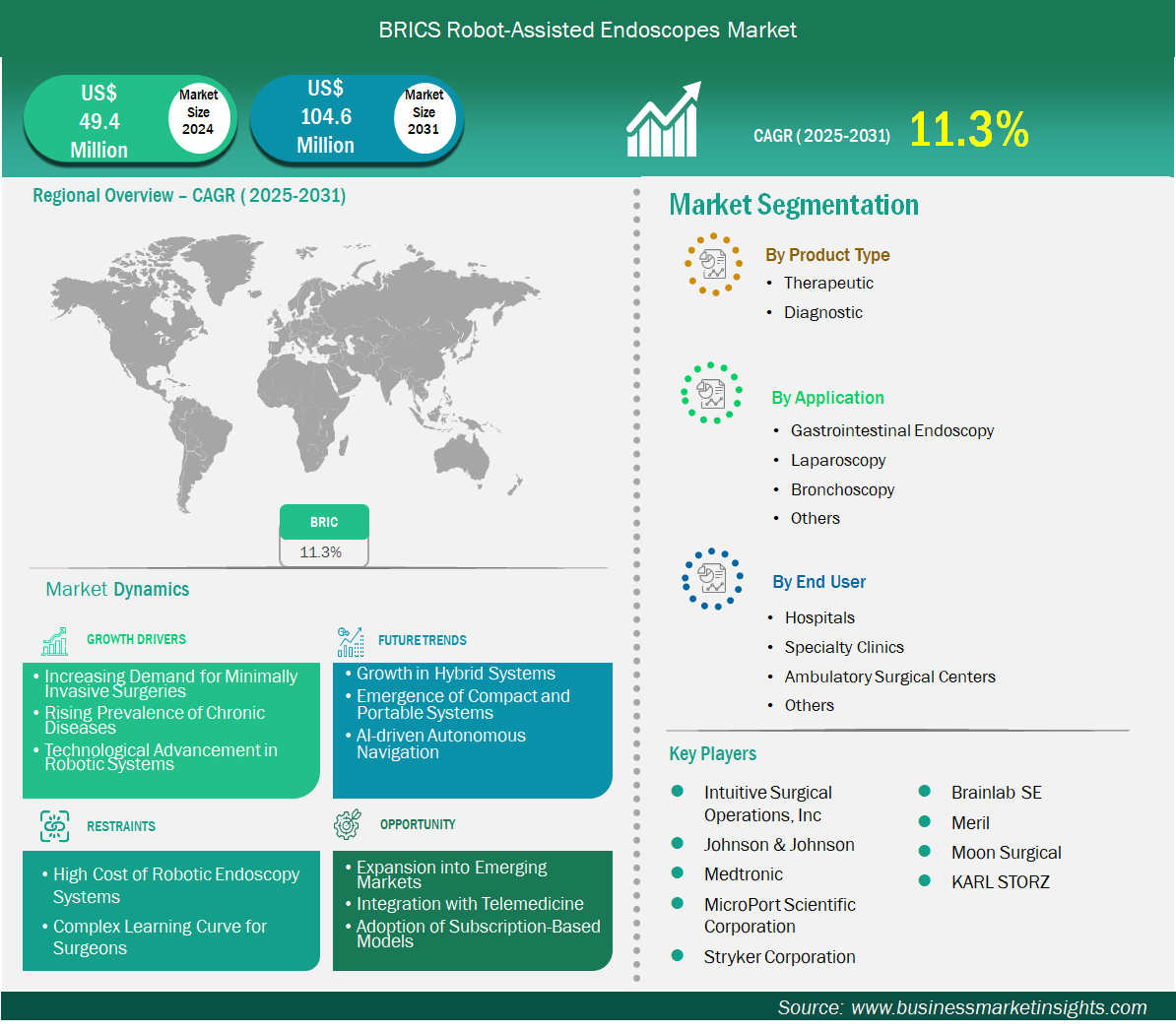
Key segments that contributed to the derivation of the robot-assisted endoscopes market analysis are product type, application, and end user.
- By product type, the robot-assisted endoscope market is segmented into therapeutic and diagnostic. The therapeutic segment dominated the market in 2024.
- By application, the robot-assisted endoscope market is segmented into gastrointestinal endoscopy, laparoscopy, bronchoscopy, and others. The gastrointestinal endoscopy segment dominated the market in 2024.
- By end user, the market is segmented into hospitals, specialty clinics, ambulatory surgical centers and others. The hospitals segment held the largest share of the market in 2024.
BRICS Robot-Assisted Endoscopes Market Outlook
The BRICS market outlook is driven by rising demand for precision-based diagnostics and greater surgical efficiency. Robot-assisted endoscopy offers faster recovery times and improved clinical outcomes, making it attractive to both patients and providers. Public–private partnerships aimed at healthcare modernization are a key growth catalyst, enabling the introduction of robotic systems in hospitals with limited advanced technologies. In countries such as India and Brazil, medical colleges are integrating robotic training modules, while Saudi Arabia and the UAE are making significant investments in smart hospitals. Although the market remains fragmented, a shared focus on innovation is generating strong momentum across the bloc, encouraging adoption and clinical experimentation.
BRICS Robot-Assisted Endoscopes Market Country Insights
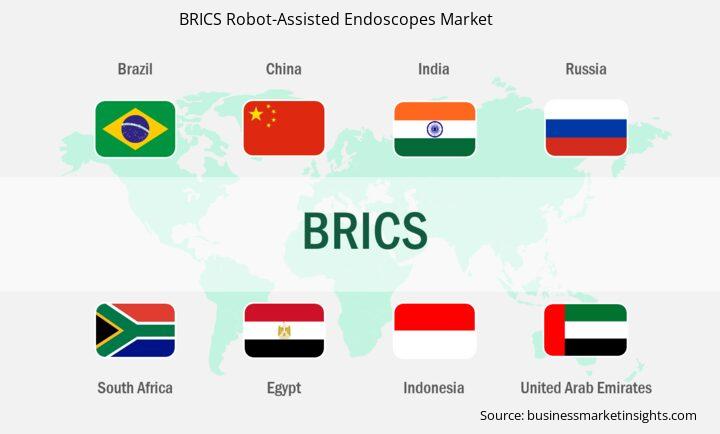
Based on country, the BRICS robot-assisted endoscopes market is segmented into Russia, Brazil, South Africa, India, China, Egypt, Indonesia, Saudi Arabia, and the UAE. China held the largest share in 2024.
China dominates the BRICS robot-assisted endoscopy market, driven by rapid healthcare digitization and strong investment in robotic surgery platforms. Leading hospitals in Beijing, Shanghai, and Guangzhou are deploying robot-assisted systems to improve diagnostic precision and clinical outcomes. The country’s focus on domestic innovation, combined with partnerships with global MedTech companies, has expanded access to robotic endoscopy solutions. In addition, government initiatives supporting high-end medical equipment manufacturing and structured surgeon training programs have accelerated adoption. Rising healthcare spending, an aging population, and increasing demand for minimally invasive procedures continue to reinforce China’s position as the regional leader in robot-assisted endoscopic technologies.
BRICS Robot-Assisted Endoscopes Market Report Highlights
| Report Attribute | Details |
| Market size in 2024 | US$ 49.4 Million |
| Market Size by 2031 | US$ 104.6 Million |
| CAGR (2025 - 2031) | 11.3% |
| Historical Data | 2021-2023 |
| Forecast period | 2025-2031 |
| Segments Covered |
By Product Type
|
|
Regions and Countries Covered
|
|
| BRICS | Russia, Brazil, South Africa, India, China, Egypt, Indonesia, Saudi Arabia, United Arab Emirates |
| Market leaders and key company profiles |
|
BRICS Robot-Assisted Endoscopes Market Company Profiles
Intuitive Surgical, Inc., Johnson & Johnson, Medtronic Plc, MicroPort Scientific Corporation, Stryker Corporation, Brainlab SE, Meril Life Sciences Pvt Ltd, Moon Surgical, and Karl Storz SE & Co KG are among the key players operating in the market. These players adopt strategies such as expansion, product innovation, and mergers and acquisitions to stay competitive in the market and offer innovative products to their consumers.
BRICS Robot-Assisted Endoscopes Market Research Methodology:
The following methodology has been followed for the collection and analysis of data presented in this report:
Secondary Research
The research process begins with comprehensive secondary research, utilizing both internal and external sources to gather qualitative and quantitative data for each market. Commonly referenced secondary research sources include, but are not limited to:
- Company websites, annual reports, financial statements, broker analyses, and investor presentations
- Industry trade journals and other relevant publications
- Government documents, statistical databases, and market reports
- News articles, press releases, and webcasts specific to companies operating in the market
Note: All financial data included in the Company Profiles section has been standardized to US$. For companies reporting in other currencies, figures have been converted to US$ using the relevant exchange rates for the corresponding year.
Primary Research
Business Market Insights conducts a significant number of primary interviews each year with industry stakeholders and experts to validate and analyze the data and gain valuable insights. These research interviews are designed to:
- Refine findings from secondary research
- Enhance the expertise and market understanding of the analysis team
- Gain insights into market size, trends, growth patterns, competitive dynamics, and future prospects
Primary research is conducted via email interactions and telephone interviews with industry experts across various markets, categories, segments, and sub-segments in different regions. Participants typically include:
- Industry stakeholders: Vice Presidents, business development managers, market intelligence managers, and national sales managers
- External experts: Valuation specialists, research analysts, and key opinion leaders with industry-specific expertise
BRICS Robot-Assisted Endoscopes Market Country and Regional Insights
BRICS Robot-Assisted Endoscopes Key Sources Referred:
- The World Bank
- World Health Organization (WHO)
- Center for Disease Control and Prevention (CDC)
- American Society for Gastrointestinal Endoscopy
- European Society of Gastrointestinal Endoscopy
- World Endoscopy Organization
- Society of American Gastrointestinal and Endoscopic Surgeons
- Global Cancer Observatory
- Company website
- Company annual reports
- Company investor presentations


