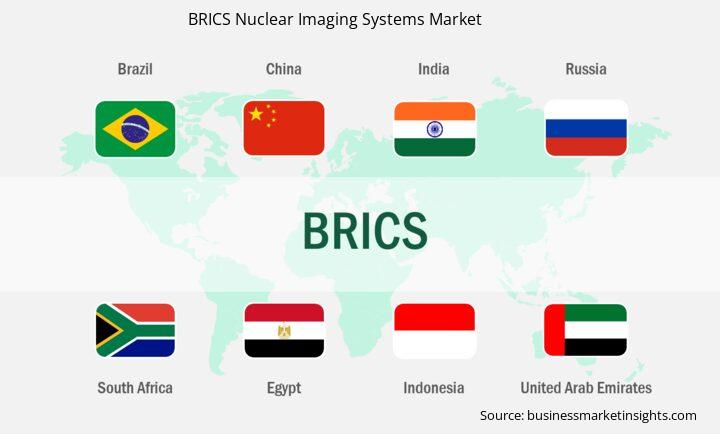
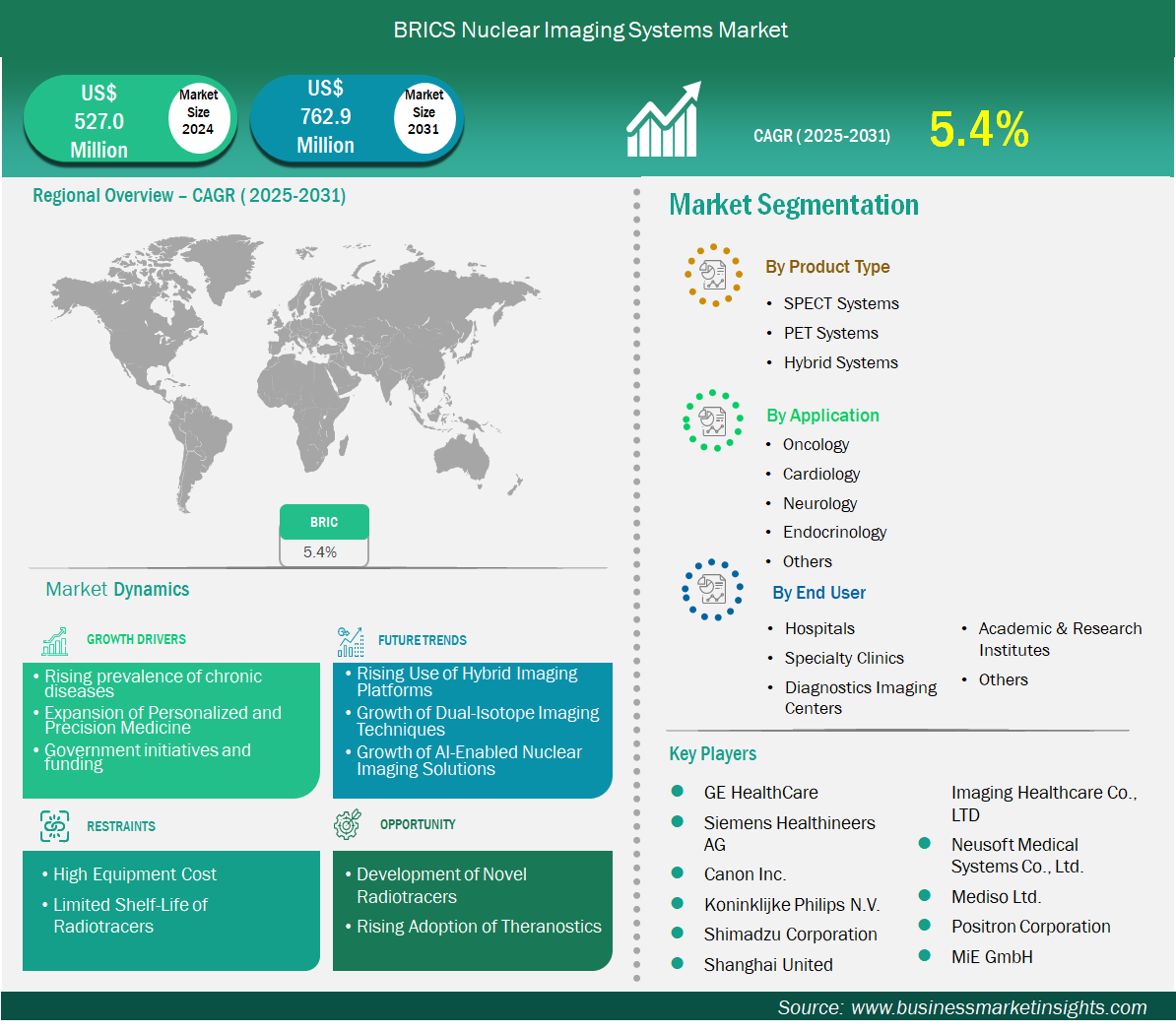
The BRICS nuclear imaging systems market size is expected to reach US$ 762.9 million by 2031 from US$ 527.0 million in 2024. The market is estimated to record a CAGR of 5.4% from 2025 to 2031.
Executive Summary and BRICS Nuclear Imaging Systems Market Analysis:
The BRICS Nuclear Imaging Systems market shows strong growth potential, driven by rapid improvements in healthcare infrastructure, a rising burden of chronic diseases, and expanding access to advanced diagnostics. Although adoption is markedly different across the countries, the growth for nuclear imaging is steady as oncology and cardiology cases increase. Brazil and Russia are gradually adopting technologies which are supported by healthcare investment in urban centers. India is continuing to develop the radiopharmaceutical supply chains and training programs. Conversely, China has taken the lead in this area due to national health service reforms, strong government backing of advanced imaging, and the increasing number of patients. While significant challenges, mostly related to cost and geographic access, nuclear imaging is becoming one of the keys to precision medicine and cancer management programs. International suppliers, along with local manufacturers, view BRICS as a strategic region with long-term opportunities, particularly in expanding hybrid imaging systems and advancing theranostics research.
BRICS Nuclear Imaging Systems Market Segmentation Analysis:
Key segments that contributed to the derivation of the nuclear imaging systems market analysis are product type, application, and end user.
- By product type, the nuclear imaging systems market is segmented into SPECT systems, PET systems and hybrid systems. The PET systems segment dominated the market in 2024.
- By application, the nuclear imaging systems market is segmented into oncology, cardiology, neurology, endocrinology and others. The oncology segment dominated the market in 2024.
- By end user, the market is segmented into hospitals, specialty clinics, diagnostics imaging centers, academic & research Institutes and others. The hospitals segment held the largest share of the market in 2024.
BRICS Nuclear Imaging Systems Market Outlook
In BRICS countries, nuclear imaging is becoming a vital component of ongoing healthcare modernization. PET/CT and SPECT systems are most commonly used in oncology, where precise detection and staging are critical for shaping treatment plans. The market is driven by rising demand for precision medicine and value based healthcare model. However, various factors such as concentration of imaging systems in major cities, and lack of skilled labor, limit the growth of the market. High equipment and operational costs add further pressure, particularly within public healthcare systems. With the ongoing rise in cancer prevalence, both governments and private providers are investing in nuclear imaging so as to improve oncology care. There is a rising momentum for molecular imaging, evidenced by governmental policy initiatives endorsing advanced diagnostics and growing acknowledgment from clinicians and patients on the role imaging therapies play in enhanced survival outcomes.
BRICS Nuclear Imaging Systems Market Country Insights
Based on country, the BRICS nuclear imaging systems market is further segmented into Russia, Brazil, South Africa, India, China, Egypt, Indonesia, Saudi Arabia, and the UAE. China held the largest share in 2024.
China leads the BRICS nuclear imaging market, owing to the broad healthcare reforms and its industrial strength. The Healthy China 2030 plan has pushed hospitals to adopt advanced systems, from full-body PET scanners to AI-assisted platforms. Domestic isotope production such as Technetium-99m and Fluorine-18 has increased significantly, which cuts import needs and steadies supply in many provinces. Leading hospitals in Beijing and Shanghai are collaborating with research institutions to advance molecular imaging technologies, with a primary focus on cancer and neurological disorders. Regulatory reforms have streamlined approval processes, offering both domestic and international suppliers a more transparent route into the market. While training programs continue to trail behind growing demand and cost barriers persist, the expansion of imaging centers remains steady. Backed by scale, supportive policies, and a robust manufacturing ecosystem, China is steadily establishing itself as the regional cornerstone for nuclear imaging.
BRICS Nuclear Imaging Systems Market Company Profiles
GE HealthCare, Siemens Healthineers AG, Canon Inc., Koninklijke Philips N.V., SHIMADZU CORPORATION, United Imaging Healthcare Co., Ltd., Neusoft Medical Systems Co., Ltd., Mediso Ltd., Positron Corporation, and MiE GmbH are among the key players operating in the market. These players adopt strategies such as expansion, product innovation, and mergers and acquisitions to stay competitive in the market and offer innovative products to their consumers.
BRICS Nuclear Imaging Systems Market Research Methodology:
The following methodology has been followed for the collection and analysis of data presented in this report:
Secondary Research
The research process begins with comprehensive secondary research, utilizing both internal and external sources to gather qualitative and quantitative data for each market. Commonly referenced secondary research sources include, but are not limited to:
- Company websites, annual reports, financial statements, broker analyses, and investor presentations
- Industry trade journals and other relevant publications
- Government documents, statistical databases, and market reports
- News articles, press releases, and webcasts specific to companies operating in the market
Note: All financial data included in the Company Profiles section has been standardized to US$. For companies reporting in other currencies, figures have been converted to US$ using the relevant exchange rates for the corresponding year.
Primary Research
Business Market Insights conducts a significant number of primary interviews each year with industry stakeholders and experts to validate and analyze the data and gain valuable insights. These research interviews are designed to:
- Refine findings from secondary research
- Enhance the expertise and market understanding of the analysis team
- Gain insights into market size, trends, growth patterns, competitive dynamics, and future prospects
Primary research is conducted via email interactions and telephone interviews with industry experts across various markets, categories, segments, and sub-segments in different regions. Participants typically include:
- Industry stakeholders: Vice Presidents, business development managers, market intelligence managers, and national sales managers
- External experts: Valuation specialists, research analysts, and key opinion leaders with industry-specific expertise
Key Sources Referred:
- The World Bank
- World Health Organization (WHO)
- Center for Disease Control and Prevention (CDC)
- Society of Nuclear Medicine and Molecular Imaging (SNMMI)
- European Association of Nuclear Medicine (EANM)
- American College of Nuclear Medicine (ACNM)
- American Society of Nuclear Cardiology (ASNC)
- Global Cancer Observatory
- Company website
- Company annual reports
- Company investor presentations
BRICS Nuclear Imaging Systems Market Strategic Insights
BRICS Nuclear Imaging SystemsMarket Report Highlights
| Report Attribute | Details |
| Market size in 2024 | US$ 527.0 Million |
| Market Size by 2031 | US$ 762.9 Million |
| CAGR (2025 - 2031) | 5.4% |
| Historical Data | 2021-2023 |
| Forecast period | 2025-2031 |
| Segments Covered |
By Product Type
|
|
Regions and Countries Covered
|
|
| BRICS | Russia, Brazil, South Africa, India, China, Egypt, Indonesia, Saudi Arabia, United Arab Emirates |
| Market leaders and key company profiles |
|
BRICS Nuclear Imaging Systems Market Country and Regional Insights