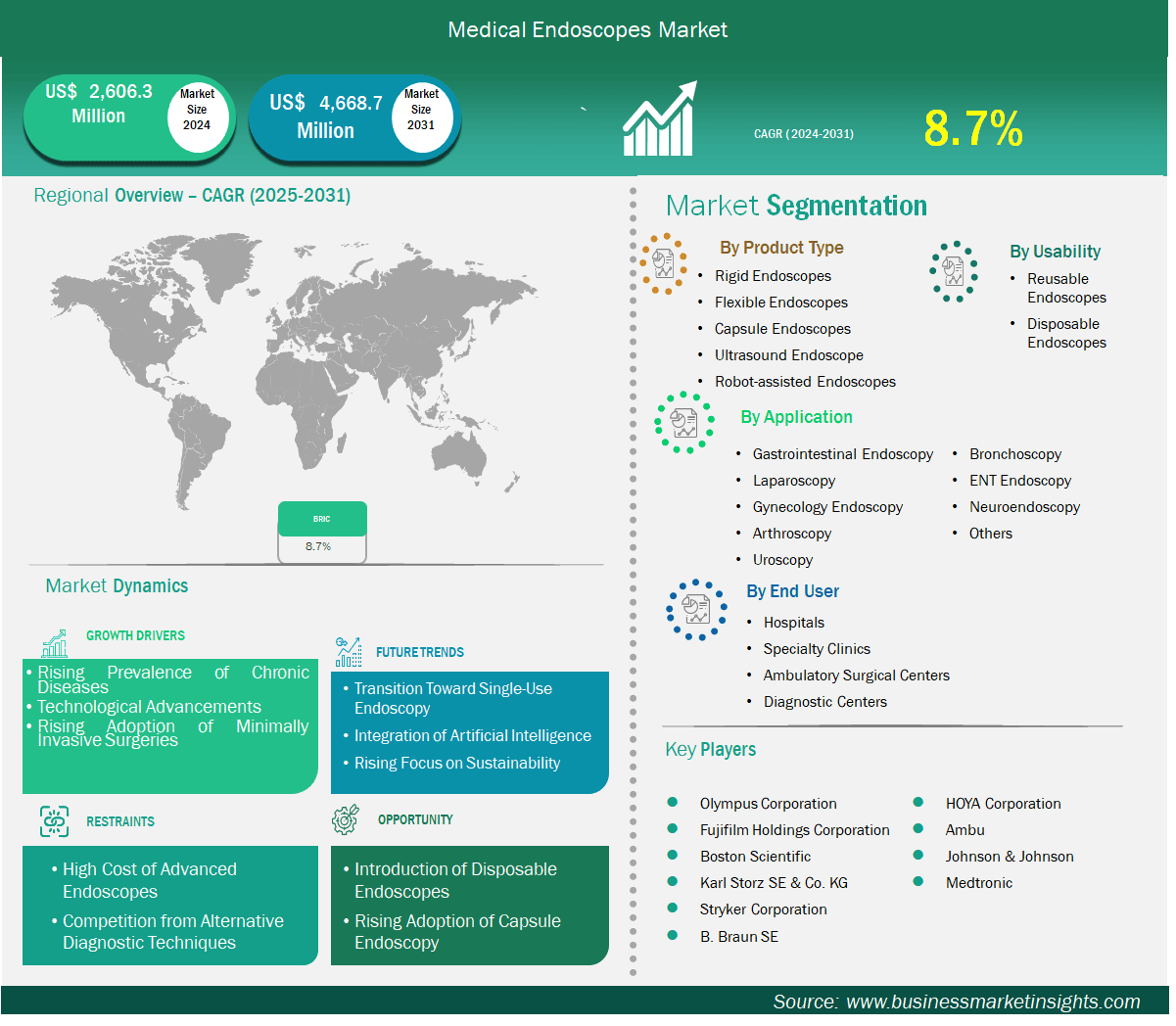
BRICS medical endoscopes market size is expected to reach US$ 4,668.7 million by 2031 from US$ 2,606.3 million in 2024. The market is estimated to record a CAGR of 8.7% from 2025 to 2031.
Executive Summary and BRICS Medical Endoscopes Market Analysis:
The BRICS nations represent a major growth engine for the global medical endoscope market, driven by large populations, rising healthcare needs, and a gradual shift toward modern, technology-enabled care. While each country differs in healthcare maturity and infrastructure, all five are witnessing increased demand for minimally invasive procedures.
India and China are the leaders among BRICS, with fast-growing hospital chains, increasing middle-class demographics, and robust governmental assistance for healthcare modernization. These nations are experiencing increasing demand for endoscopy in gastrointestinal, urology, and oncology screening uses, as well as increased local manufacturing and R&D efforts. Brazil is driving market expansion across Latin America through public and private healthcare providers that are investing in diagnostic technology. Russia continues to invest in the development of its medical infrastructure, although growth is moderated somewhat by financial and geopolitical issues. South Africa, albeit smaller in comparison, is the most developed endoscopy market in Africa, with high take-up in private hospitals.
BRICS Medical Endoscopes Market Segmentation Analysis:
Key segments that contributed to the derivation of the medical endoscopes Market analysis are type and application.
- By product type, the medical endoscopes market is segmented into rigid endoscopes, flexible endoscopes, capsule endoscopes, ultrasound endoscope, and robot-assisted endoscopes. The flexible endoscopes segment dominated the market in 2024.
- By usability, the medical endoscopes market is segmented into reusable endoscopes and disposable endoscopes. The reusable endoscopes segment dominated the market in 2024.
- In terms of applications, the market is segmented into gastrointestinal endoscopy, laparoscopy, gynecology endoscopy, arthroscopy, uroscopy, bronchoscopy, ENT endoscopy, neuroendoscopy and others. The gastrointestinal endoscopy segment held the largest share of the market in 2024.
- By end user, the market is segmented into hospitals, specialty clinics, ambulatory surgical centers, and diagnostic centers. The hospitals segment held the largest share of the market in 2024.
BRICS Medical Endoscopes Market Outlook
The medical endoscopy market in BRIC countries (Brazil, Russia, India, and China) is seeing great growth which is due to increasing health care spending, growing middle class populations, and an increase in the incidence of chronic and lifestyle related diseases.
These countries are putting large investments into health care infrastructure, also we see them improve access to diagnostic services and adopt advanced medical tech. Also, what we are seeing is a rise in minimally invasive procedures which do better in terms of recovery time and also are more affordable than traditional surgeries.
A large factor is that which present in the field of gastrointestinal and cancer related diseases which we see to be on the rise. In China we are seeing large scale government initiatives which are putting in place cancer screening and early diagnosis which is to report. Demand that of endoscopic equipment -- also in that India is seeing an expansion of diagnostic resources in public and private sectors which is for early detection and treatment.
BRICS Medical Endoscopes Market Country Insights
Based on region, the BRIC medical endoscopes Market is further segmented into the Russian Federation, Brazil, South Africa, India, and China. The China held the largest share in 2024.
In China, government efforts to improve cancer screening and more money going into public hospitals are really driving the need for medical devices. At the same time, India is seeing a big increase in growth thanks to more private healthcare options, a rise in medical tourism, and people becoming more aware of the benefits of less invasive procedures. Brazil is reaping the rewards of enhanced healthcare access and targeted public health initiatives that focus on gastrointestinal diseases, thereby contributing to the market's expansion. Similarly, Russia is making strides by upgrading its healthcare facilities and embracing modern diagnostic technologies.
Across all nations, several factors converge to fuel this upward trend: the rising prevalence of chronic diseases, an aging demographic that necessitates more comprehensive medical care, and an expanding middle class that increasingly demands high-quality healthcare solutions. Each of these elements plays a crucial role in shaping the landscape of the endoscope market in this dynamic region.
BRICS Medical Endoscopes Market Company Profiles
Olympus Corporation, Johnson & Johnson, Karl Storz SE & Co. KG, Smith+Nephew, Medtronic, Boston Scientific, B. Braun SE, Stryker Corporation, Fujifilm Holdings Corporation, HOYA Corporation, Ambu A/S are among the key players operating in the market. These players adopt strategies such as expansion, product innovation, and mergers and acquisitions to stay competitive in the market and offer innovative products to their consumers.
BRICS Medical Endoscopes Market Research Methodology:
The following methodology has been followed for the collection and analysis of data presented in this report:
- Secondary Research
The research process begins with comprehensive secondary research, utilizing both internal and external sources to gather qualitative and quantitative data for each market. Commonly referenced secondary research sources include, but are not limited to:
- Company websites, annual reports, financial statements, broker analyses, and investor presentations
- Industry trade journals and other relevant publications
- Government documents, statistical databases, and market reports
- News articles, press releases, and webcasts specific to companies operating in the market
Note: All financial data included in the Company Profiles section has been standardized to US$. For companies reporting in other currencies, figures have been converted to US$ using the relevant exchange rates for the corresponding year.
- Primary Research
Business Market Insights conducts a significant number of primary interviews each year with industry stakeholders and experts to validate and analyze the data and gain valuable insights. These research interviews are designed to:
- Refine findings from secondary research
- Enhance the expertise and market understanding of the analysis team
- Gain insights into market size, trends, growth patterns, competitive dynamics, and future prospects
Primary research is conducted via email interactions and telephone interviews with industry experts across various markets, categories, segments, and sub-segments in different regions. Participants typically include:
- Industry stakeholders: Vice Presidents, business development managers, market intelligence managers, and national sales managers
- External experts: Valuation specialists, research analysts, and key opinion leaders with industry-specific expertise
Key Sources Referred:
- The World Bank World Development Indicators
- World Health Organization (WHO)
- Center for Disease Control and Prevention (CDC)
- Global Cancer Observatory
- Medicines and Healthcare Products Regulatory Agency (MHRA)
- American Cancer Society
- Company website
- Accompany annual reports
- Company investor presentations
BRICS Medical Endoscopes Market Strategic Insights
BRICS Medical EndoscopesMarket Report Highlights
| Report Attribute | Details |
| Market size in 2024 | US$ 2,606.3 Million |
| Market Size by 2031 | US$ 4,668.7 Million |
| CAGR (2025 - 2031) | 8.7% |
| Historical Data | 2021-2023 |
| Forecast period | 2025-2031 |
| Segments Covered |
By Product Type
|
|
Regions and Countries Covered
|
|
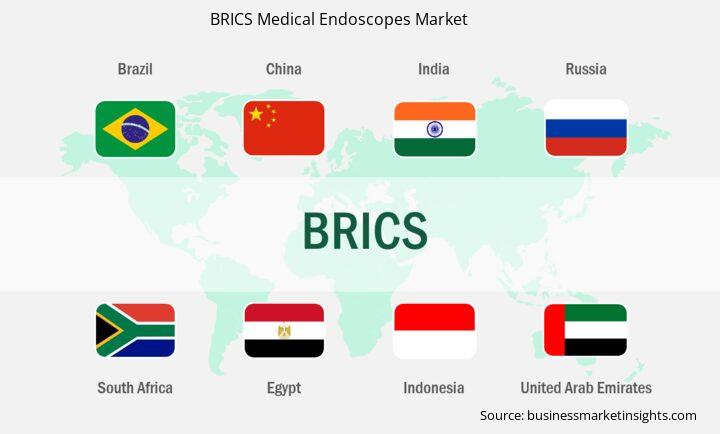
| BRICS | Russian Federation, Brazil, South Africa, India, China, Egypt, Indonesia, United Arab Emirates |
| Market leaders and key company profiles |
|
BRICS Medical Endoscopes Market Country and Regional Insights