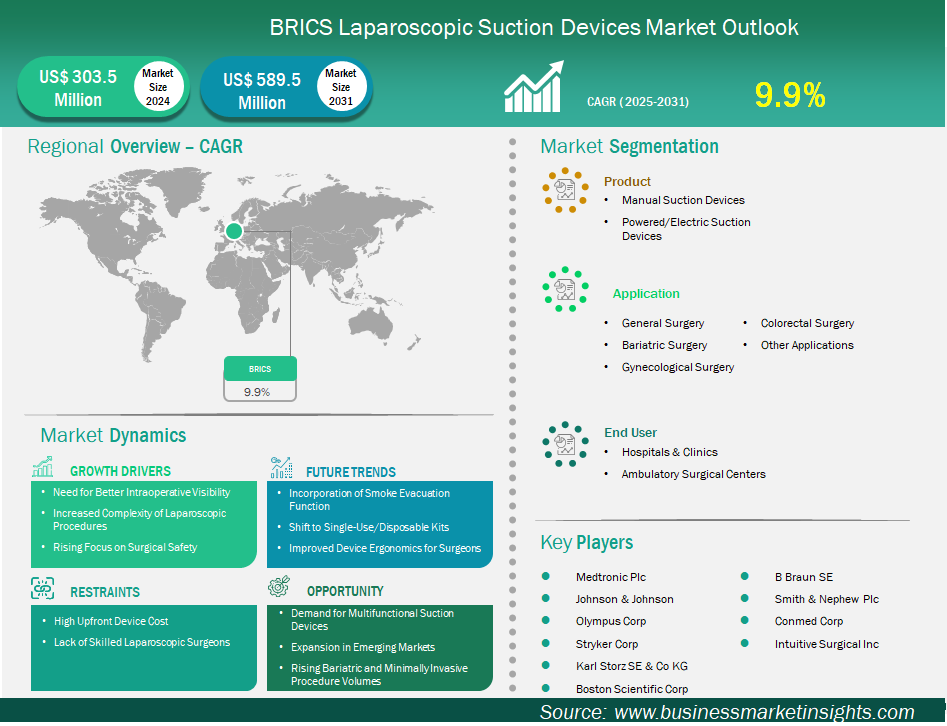
The BRICS laparoscopic suction devices market size is expected to reach US$ 589.5 million by 2031 from US$ 303.5 million in 2024. The market is estimated to record a CAGR of 9.9% from 2025 to 2031.
Executive Summary and BRICS Laparoscopic Suction Devices Market Analysis:
The laparoscopic suction devices market in BRICS is experiencing significant growth driven by the need for better intraoperative visibility, increased complexity of laparoscopic procedures, and rising focus on surgical safety. The BRICS laparoscopic suction devices market is a very intense and tough competition situation where large international multinational companies mainly concentrate on strategic pricing changes and the creation of strong local assembly or manufacturing partnerships to counter the severe price pressure coming from newly appeared local players. The technological uptake is quite divided: multi-utility powered suction systems, which can also serve other functions, and are thus dominating high-end private healthcare facilities, where the focus is on precise fluid and smoke control during procedures. At the same time, there is a huge and rapidly expanding demand for low-cost, disposable handheld devices and kits in lower-tier and public hospitals, this demand being driven by local infection control requirements and the concern of cross-contamination risk. The main market force is the transition to single-use products from reusables, a change caused by the growing rate of core and intermediate laparoscopic surgeries and supported by government contracts that are increasingly bidding in favour of single-use products because of their standardized quality and the eliminating of the sterilization equipment, which is expensive. So, the market is a mixture of advanced technology uptake in urban surgical facilities and volume purchasing of basic, low-cost equipment in bigger healthcare systems.
BRICS Laparoscopic Suction Devices Market Segmentation Analysis:
Key segments that contributed to the derivation of the laparoscopic suction devices market analysis are product, application, and end user.
- By product, the laparoscopic suction devices market is segmented into manual suction devices and powered/electric suction devices. The powered/electric suction devices segment dominated the market in 2024. Powered/Electric Suction Devices is the largest segment by product, due to the superior and consistent high-flow suction power required for effective fluid and smoke evacuation in complex laparoscopic procedures.
- In terms of application, the market is segmented into general surgery, bariatric surgery, gynecological surgery, colorectal surgery, and other applications. The general surgery segment held the largest market share in 2024. General Surgery is the largest segment by application due to its high volume and wide procedural scope (e.g., cholecystectomy, hernia repair), where laparoscopy is the preferred standard of care.
- By end user, the market is segmented into hospitals and clinics, and ambulatory surgical centers. The hospitals and clinics segment held the largest market share in 2024. Hospitals and clinics are the largest segment by end user due to their role as the primary facility for performing the vast majority of all complex and routine laparoscopic surgeries, which require continuous, high-volume device consumption.
BRICS Laparoscopic Suction Devices Market Outlook
The growth of public health insurance plans and aggressive local manufacturing efforts will primarily influence the future development of the BRICS laparoscopic suction devices market. The expanding reach of public and social security programs, especially in Brazil and Russia, will have a profound impact on the market's demand profile by enhancing patient access to laparoscopic procedures and orienting procurement power towards larger governmental purchasing organizations, thus favouring standardization and high-volume cost-plus contracts. In addition, the projection is supported by government 'Make in Country' initiatives of countries like India and China that offer regulatory and fiscal incentives to home players to innovate in the suction and irrigation space. This drive for home country self-reliance not only encourages the development of cost-effective and region-focused suction device design but is also expected to transform the traditional import-based supply chain model drastically. This trend will witness a shift in the market towards sophisticated, locally produced, value-engineered products that compete on an international quality basis, but within local economic limits and in compliance with local clinical practices.
BRICS Laparoscopic Suction Devices Market Country Insights
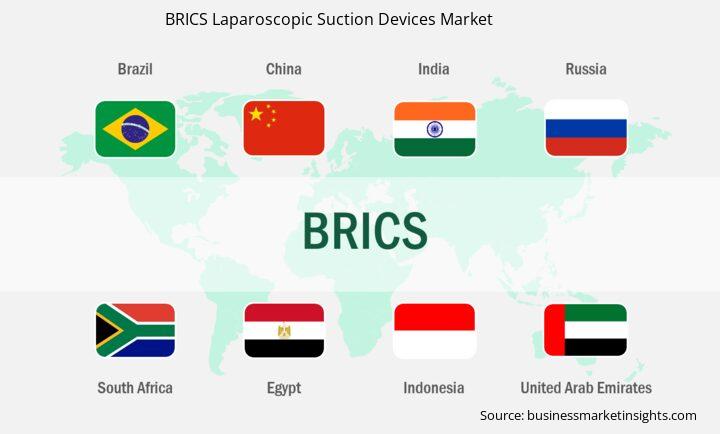
Based on country, the BRICS laparoscopic suction devices market is segmented into Brazil, Russia, India, China, South Africa, Egypt, Indonesia, the United Arab Emirates, and Saudi Arabia. China held the largest share in 2024.
The BRICS market exhibits uniquely country-specific differences in procurement models and regulatory complexity, which have a profound impact on commercial strategy. In China, the regulatory environment, overseen by the NMPA, has a strong localization mandate that renders market entry difficult for foreign players lacking a substantial in-country footprint. Meanwhile, procurement is increasingly dominated by centralized Volume-Based Procurement (VBP) tenders that require significant price reductions. By comparison, India's Central Drugs Standard Control Organisation is intent on expediting devices through a streamlined registration process; however, the market has a highly decentralized, multi-tiered hospital-level procurement system, which rewards distributors' effective network penetration and low-cost models. Brazil's Agencia Nacional de Vigilancia Sanitaria stands out for its strict, protracted approval process, comparable to Western procedures, but has a segmented procurement framework that comprises a blend of federal and state-level tenders as well as private hospital purchasing that supports established international brands with a history of quality and a commitment to long-term service support. This regulatory and logistical diversity requires highly tailored business and supply chain approaches for each member country.
BRICS Laparoscopic Suction Devices Market Company Profiles
Medtronic Plc; Johnson & Johnson; Olympus Corp; Stryker Corp; Karl Storz SE & Co KG, Boston Scientific Corp, B Braun SE, Smith & Nephew Plc, Conmed Corp, and Intuitive Surgical Inc., are among the key players operating in the market. These players adopt strategies such as expansion, product innovation, and mergers and acquisitions to stay competitive in the market and offer innovative products to their consumers.
BRICS Laparoscopic Suction Devices Market Research Methodology:
The following methodology has been followed for the collection and analysis of data presented in this report:
Secondary Research
The research process begins with comprehensive secondary research, utilizing both internal and external sources to gather qualitative and quantitative data for each market. Commonly referenced secondary research sources include, but are not limited to:
- Company websites, annual reports, financial statements, broker analyses, and investor presentations
- Industry trade journals and other relevant publications
- Government documents, statistical databases, and market reports
- News articles, press releases, and webcasts specific to companies operating in the market
Note: All financial data included in the Company Profiles section has been standardized to US$. For companies reporting in other currencies, figures have been converted to US$ using the relevant exchange rates for the corresponding year.
Primary Research
Business Market Insights conducts a significant number of primary interviews each year with industry stakeholders and experts to validate and analyze the data and gain valuable insights. These research interviews are designed to:
- Refine findings from secondary research
- Enhance the expertise and market understanding of the analysis team
- Gain insights into market size, trends, growth patterns, competitive dynamics, and future prospects
Primary research is conducted via email interactions and telephone interviews with industry experts across various markets, categories, segments, and sub-segments in different regions. Participants typically include:
- Industry stakeholders: Vice Presidents, business development managers, market intelligence managers, and national sales managers
- External experts: Valuation specialists, research analysts, and key opinion leaders with industry-specific expertise
Key Sources Referred:
- World Health Organization (WHO)
- The World Bank Group
- Worldometer
- The Lancet
- BMC Medical Education
- Eurostat
BRICS Laparoscopic Suction Devices Market Strategic Insights
BRICS Laparoscopic Suction DevicesMarket Report Highlights
| Report Attribute | Details |
| Market size in 2024 | US$ 303.5 Million |
| Market Size by 2031 | US$ 589.5 Million |
| CAGR (2025 - 2031) | 9.9% |
| Historical Data | 2021-2023 |
| Forecast period | 2025-2031 |
| Segments Covered |
By Product
|
|
Regions and Countries Covered
|
|
| BRICS | Russia, Brazil, South Africa, India, China, Egypt, Indonesia, United Arab Emirates, Saudi Arabia |
| Market leaders and key company profiles |
|
BRICS Laparoscopic Suction Devices Market Country and Regional Insights