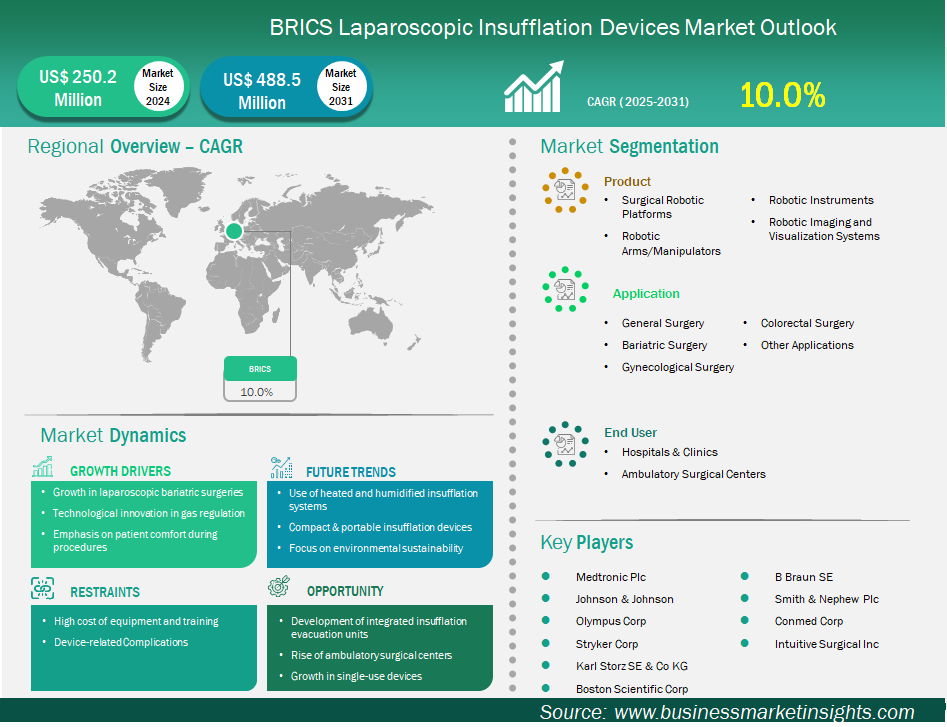
The BRICS laparoscopic insufflation devices market size is expected to reach US$ 488.5 million by 2031 from US$ 250.2 million in 2024. The market is estimated to record a CAGR of 10.0% from 2025 to 2031.
Executive Summary and BRICS Laparoscopic Insufflation Devices Market Analysis:
The laparoscopic insufflation devices market in BRICS is experiencing significant growth, driven by growth in laparoscopic bariatric surgeries, technological innovation in gas regulation, and emphasis on patient comfort during procedures. The BRICS laparoscopic insufflation devices market is a vibrant market influenced by the varied healthcare systems, increasing number of surgeries and the rising demand for minimally invasive procedures. As far as the product segment is concerned, CO₂ insufflators hold the majority share because of their low price, energy-saving features, and easy compatibility with standard laparoscopic setups, etc. Besides, the market is a combination of public-sector procurements and private hospital investments wherein buying decisions depend on cost-effectiveness, device reliability, and integration convenience mainly. The obesity epidemic has led bariatric surgery to become one of the largest application segments, as, the public health system's focus has shifted toward lifestyle-related diseases. Additionally, it is an issue in rural and semi-urban areas where even though hospitals in cities are well-equipped, they still lack healthcare access and training. On one hand, local manufacturers have started to attract buyers by providing low-cost devices that meet the specific needs of the region, on the other hand, international MedTech companies are still growing their presence through partnership opportunities and distribution channels. As far as regulatory environment is concerned, it is different in BRICS countries; some markets are simplifying the process of getting a device approved in order to speed up the change of the industry, while others are following a complicated certification system. In a nutshell, the market is a mix of advantages and disadvantages resulting from the differences in the economy, healthcare reform, and clinical demand.
BRICS Laparoscopic Insufflation Devices Market Segmentation Analysis:
Key segments that contributed to the derivation of the laparoscopic insufflation devices market analysis are product, application, and end user.
- By product, the laparoscopic insufflation devices market is segmented into CO₂ Insufflators, Warm Gas Insufflators, and Insufflation Tubing and Accessories. The CO₂ Insufflators segment dominated the market in 2024. This is the largest segment due to their affordability, operational efficiency, and widespread compatibility with standard laparoscopic systems across diverse healthcare settings.
- In terms of application, the market is segmented into general surgery, bariatric surgery, gynecological surgery, colorectal surgery, and other applications. The bariatric surgery segment held the largest market share in 2024. This is the largest segment due to rising obesity rates, increasing lifestyle-related health issues, and growing demand for minimally invasive weight-loss procedures.
- By end user, the market is segmented into hospitals and clinics, and ambulatory surgical centers. The hospitals and clinics segment held the largest market share in 2024. This is the largest segment due to centralized surgical infrastructure, high patient volumes, and continuous investment in laparoscopic equipment and training.
BRICS Laparoscopic Insufflation Devices Market Outlook
The demand for laparoscopic insufflation devices in BRICS countries is primarily influenced by healthcare digitization, infrastructural developments, and changes in surgical preferences. In fact, governments across the region are extensively modernizing surgery through national health initiatives, which result in a surge of demand for smart insufflation systems having features like automated pressure control, integrated smoke evacuation, and real-time monitoring. The establishment of outpatient surgical centers and mobile clinics is creating a booming demand for small, portable insufflation devices that facilitate decentralized care delivery.
Hospitals are increasingly choosing products that allow the use of reusable components and are less harmful to the environment as sustainability becomes more important factor in their purchasing decisions. The local surgeons' skill level is being raised through training programs conducted by international surgical societies and regional academic institutions, thus, the local surgeons will be more equipped to perform laparoscopic techniques. Moreover, the use of telemedicine and remote surgical mentoring is helping less-developed areas to have easier access to advanced surgical procedures. Insufflation systems that lead to fewer complications and faster recovery will be of strategic importance as reimbursement models reward procedural efficiency and safety. The market outlook is characterized by the interplay of technology, policy, and clinical innovation; thus, BRICS countries are getting positioned for sustained growth in laparoscopic capabilities.
BRICS Laparoscopic Insufflation Devices Market Country Insights
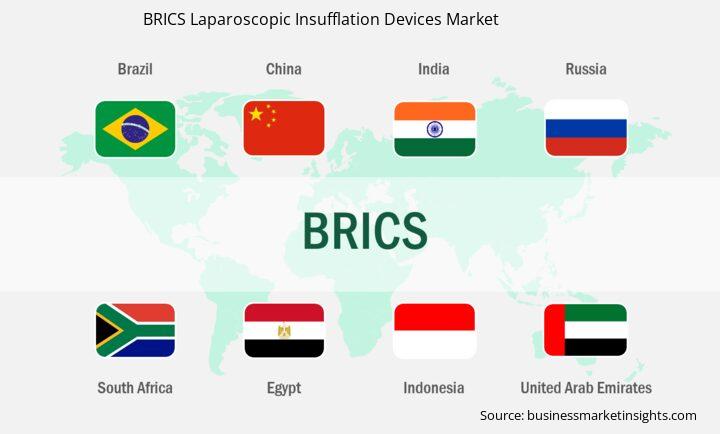
Based on country, the BRICS laparoscopic insufflation devices market is segmented into Brazil, Russia, India, China, South Africa, Egypt, Indonesia, the United Arab Emirates, and Saudi Arabia. China held the largest share in 2024.
Analysing the dynamics at a country-level in the BRICS market for laparoscopic insufflation devices shows a regionally diversified and strategically segmented scenario. China is boosting innovation through local manufacturing and large-scale public health programs; thus, positioning itself as a consumer and a promoter of laparoscopic technologies. Brazil is leading clinical adoption, which is a result of a strong private healthcare sector and a high demand for bariatric and gynecological procedures. Russia is upgrading surgical facilities through federal programs and hospitals are modernizing their infrastructure and increasing minimally invasive capabilities. India is a dual-market with premium devices getting popular in metropolitan hospitals while cost-effective solutions are reaching tier-2 and tier-3 cities. South Africa is broadening the access mainly in urban areas through private sector development and donor-supported programs. The path of each country is determined by its healthcare financing model, regulatory environment, and level of surgical specialization. Localized strategies are still necessary to solve specific institutional needs, patient demographics, and infrastructure even though the BRICS countries have common objectives regarding healthcare modernization. This geographic and operational variability highlights the need for customized product offerings, regional partnerships, and scalable training programs to be able to realize growth over the long term across the BRICS laparoscopic insufflation devices market.
BRICS Laparoscopic Insufflation Devices Market Company Profiles
Medtronic Plc; Johnson & Johnson; Olympus Corp; Stryker Corp; Karl Storz SE & Co KG, Boston Scientific Corp, B Braun SE, Smith & Nephew Plc, Conmed Corp, and Intuitive Surgical Inc., are among the key players operating in the market. These players adopt strategies such as expansion, product innovation, and mergers and acquisitions to stay competitive in the market and offer innovative products to their consumers.
BRICS Laparoscopic Insufflation Devices Market Research Methodology:
The following methodology has been followed for the collection and analysis of data presented in this report:
Secondary Research
The research process begins with comprehensive secondary research, utilizing both internal and external sources to gather qualitative and quantitative data for each market. Commonly referenced secondary research sources include, but are not limited to:
- Company websites, annual reports, financial statements, broker analyses, and investor presentations
- Industry trade journals and other relevant publications
- Government documents, statistical databases, and market reports
- News articles, press releases, and webcasts specific to companies operating in the market
Note: All financial data included in the Company Profiles section has been standardized to US$. For companies reporting in other currencies, figures have been converted to US$ using the relevant exchange rates for the corresponding year.
Primary Research
Business Market Insights conducts a significant number of primary interviews each year with industry stakeholders and experts to validate and analyze the data and gain valuable insights. These research interviews are designed to:
- Refine findings from secondary research
- Enhance the expertise and market understanding of the analysis team
- Gain insights into market size, trends, growth patterns, competitive dynamics, and future prospects
Primary research is conducted via email interactions and telephone interviews with industry experts across various markets, categories, segments, and sub-segments in different regions. Participants typically include:
- Industry stakeholders: Vice Presidents, business development managers, market intelligence managers, and national sales managers
- External experts: Valuation specialists, research analysts, and key opinion leaders with industry-specific expertise
Key Sources Referred:
- World Health Organization (WHO)
- The World Bank Group
- Worldometer
- The Lancet
- BMC Medical Education
- Eurostat
BRICS Laparoscopic Insufflation Devices Market Strategic Insights
BRICS Laparoscopic Insufflation DevicesMarket Report Highlights
| Report Attribute | Details |
| Market size in 2024 | US$ 250.2 Million |
| Market Size by 2031 | US$ 488.5 Million |
| CAGR (2025 - 2031) | 10.0% |
| Historical Data | 2021-2023 |
| Forecast period | 2025-2031 |
| Segments Covered |
By Product
|
|
Regions and Countries Covered
|
|
| BRICS | Russia, Brazil, South Africa, India, China, Egypt, Indonesia, United Arab Emirates, Saudi Arabia |
| Market leaders and key company profiles |
|
BRICS Laparoscopic Insufflation Devices Market Country and Regional Insights