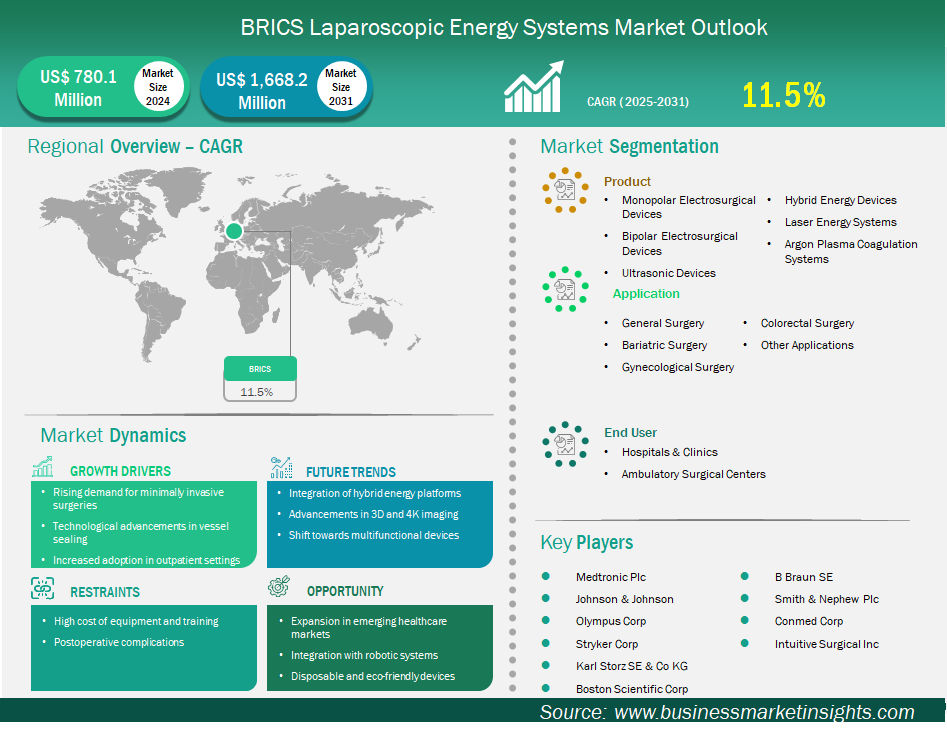
The BRICS laparoscopic energy systems market size is expected to reach US$ 1,668.2 million by 2031 from US$ 780.1 million in 2024. The market is estimated to record a CAGR of 11.5% from 2025 to 2031.
Executive Summary and BRICS Laparoscopic Energy Systems Market Analysis:
The laparoscopic energy systems market in BRICS is experiencing significant growth driven by rising demand for minimally invasive surgeries, technological advancements in vessel sealing, and increased adoption in outpatient settings. The BRICS laparoscopic energy systems market represents a strong channel for growth in the global medical devices landscape, supported by emerging economies, modernization of healthcare, and sheer patient volume. One of the main drivers appears to be the rising number of lifestyle-related conditions, including obesity and diabetes, attributable to urbanization and changes in diet, resulting in increased uptake of both general and bariatric surgery procedures. This is generating strong, immediate demand for laparoscopic energy systems. The competitive landscape of this market is robust: there are both multinational companies and an increasing number of strong domestic players, particularly in China and India. There is continued progression toward a hybrid market model, with public and private initiatives forthcoming to support expansion. The region is shifting toward utilizing advanced surgical techniques at a pace and investment level that accommodates economic and healthcare-specific circumstances.
BRICS Laparoscopic Energy Systems Market Segmentation Analysis:
Key segments that contributed to the derivation of the laparoscopic energy systems market analysis are product, application, and end user.
- By product, the laparoscopic energy systems market is segmented into monopolar electrosurgical devices, bipolar electrosurgical devices, ultrasonic devices, hybrid energy devices, laser energy systems, and argon plasma coagulation systems. The monopolar electrosurgical devices segment dominated the market in 2024. This is the largest segment due to their cost-effectiveness, widespread utility, and established presence in a wide array of surgical procedures, making them an essential and highly accessible tool in the region's diverse healthcare landscape.
- In terms of application, the market is segmented into general surgery, bariatric surgery, gynecological surgery, colorectal surgery, and other applications. The general surgery segment held the largest share of the market in 2024. This is the largest segment due to the high volume of routine procedures like appendectomies and hernia repairs, driven by a significant and increasing patient population, and the growing preference for minimally invasive techniques.
- By end user, the market is segmented into hospitals and clinics, and ambulatory surgical centers. The hospitals and clinics segment held the largest share of the market in 2024. This is the largest segment because they serve as the primary hubs for surgical procedures, possess the necessary infrastructure and high patient flow, and are the main points of care for the vast majority of patients requiring surgical interventions.
BRICS Laparoscopic Energy Systems Market Outlook
The outlook for the BRICS laparoscopic energy systems market is driven by a major technological advancement and sustained focus on enhancing access to care. The market outlook anticipates further adoption of robotic-assisted surgical systems that, while a small percentage of the market today, are expected to spur demand for high-precision energy instruments. This is particularly applicable in the private healthcare systems of these countries. The healthcare landscape will also continue to trend toward smarter, connected devices capable of providing real-time data and analytics proven to improve surgical outcomes and enhance surgical training. Companies will continue to prioritize product localization, developing and manufacturing energy systems designed for the clinical needs of the BRICS nations. The market growth will be further strengthened by government initiatives to improve healthcare infrastructure and growing spending on medical education and surgical training to promote the adoption of more advanced laparoscopic energy systems.
BRICS Laparoscopic Energy Systems Market Country Insights
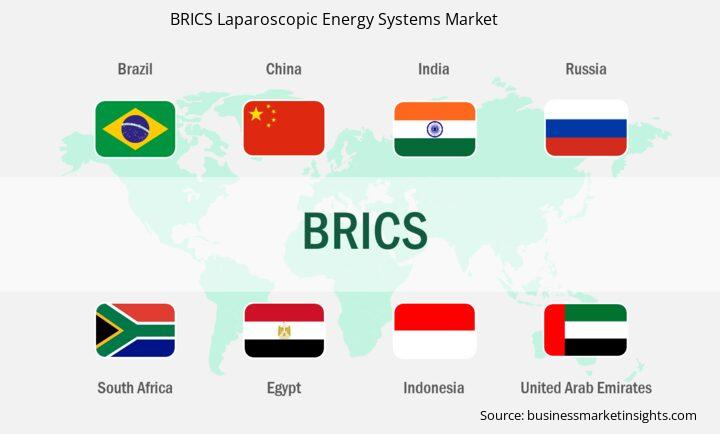
Based on country, the BRICS laparoscopic energy systems market is segmented into Brazil, Russia, India, China, South Africa, Egypt, Indonesia, the United Arab Emirates, and Saudi Arabia. China held the largest share in 2024.
The BRICS laparoscopic energy systems market is not a unified, homogenous market but a collection of unique national markets, each with unique drivers and traits. China is the leader, driven by a large patient population, rapid modernization of its healthcare system, and strong government policy for developing its domestic medical technology industry. Its market combines high-volume, cost-sensitive demand from public hospitals and a growing shift towards premium products for private clinics. India remains another high-growth market driven by a large population that is becoming more urban, the growth of the middle class, and significant medical tourism. India's market strongly emphasizes being price-sensitive and requires durable and low-cost energy systems with a high level of value. Brazil, with an advancing healthcare system and a high prevalence of obesity, leads the region in demand for bariatric surgery and will continue to have a high growth demand for laparoscopic systems in the future. Russia's market is influenced by its state-funded healthcare system and tendency to purchase domestic production.
BRICS Laparoscopic Energy Systems Market Company Profiles
Medtronic Plc; Johnson & Johnson; Olympus Corp; Stryker Corp; Karl Storz SE & Co KG, Boston Scientific Corp, B Braun SE, Smith & Nephew Plc, Conmed Corp, and Intuitive Surgical Inc., are among the key players operating in the market. These players adopt strategies such as expansion, product innovation, and mergers and acquisitions to stay competitive in the market and offer innovative products to their consumers.
BRICS Laparoscopic Energy Systems Market Research Methodology:
The following methodology has been followed for the collection and analysis of data presented in this report:
-
Secondary Research
The research process begins with comprehensive secondary research, utilizing both internal and external sources to gather qualitative and quantitative data for each market. Commonly referenced secondary research sources include, but are not limited to:
- Company websites, annual reports, financial statements, broker analyses, and investor presentations
- Industry trade journals and other relevant publications
- Government documents, statistical databases, and market reports
- News articles, press releases, and webcasts specific to companies operating in the market
Note: All financial data included in the Company Profiles section has been standardized to US$. For companies reporting in other currencies, figures have been converted to US$ using the relevant exchange rates for the corresponding year.
-
Primary Research
Business Market Insights conducts a significant number of primary interviews each year with industry stakeholders and experts to validate and analyze the data and gain valuable insights. These research interviews are designed to:
- Refine findings from secondary research
- Enhance the expertise and market understanding of the analysis team
- Gain insights into market size, trends, growth patterns, competitive dynamics, and future prospects
Primary research is conducted via email interactions and telephone interviews with industry experts across various markets, categories, segments, and sub-segments in different regions. Participants typically include:
- Industry stakeholders: Vice Presidents, business development managers, market intelligence managers, and national sales managers
- External experts: Valuation specialists, research analysts, and key opinion leaders with industry-specific expertise
Key Sources Referred:
- World Health Organization (WHO)
- The World Bank Group
- Worldometer
- The Lancet
- BMC Medical Education
- Eurostat
BRICS Laparoscopic Energy Systems Market Strategic Insights
BRICS Laparoscopic Energy SystemsMarket Report Highlights
| Report Attribute | Details |
| Market size in 2024 | US$ 780.1 Million |
| Market Size by 2031 | US$ 1,668.2 Million |
| CAGR (2025 - 2031) | 11.5% |
| Historical Data | 2021-2023 |
| Forecast period | 2025-2031 |
| Segments Covered |
By Product
|
|
Regions and Countries Covered
|
|
| BRICS | Russia, Brazil, South Africa, India, China, Egypt, Indonesia, United Arab Emirates, Saudi Arabia |
| Market leaders and key company profiles |
|
BRICS Laparoscopic Energy Systems Market Country and Regional Insights