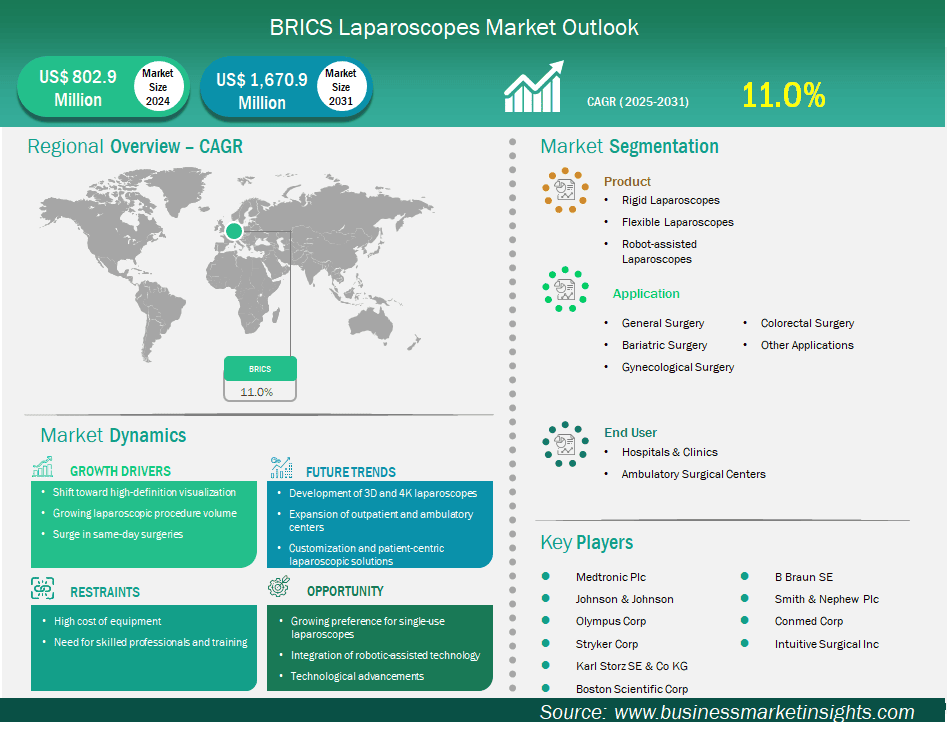
The BRICS laparoscopes market size is expected to reach US$ 1,670.9 million by 2031 from US$ 802.9 million in 2024. The market is estimated to record a CAGR of 11.0% from 2025 to 2031.
Executive Summary and BRICS Laparoscopes Market Analysis:
The laparoscopes market in BRICS is experiencing significant growth driven by a shift toward high-definition visualization, growing laparoscopic procedure volume, and a surge in same-day surgeries. The BRICS laparoscopes market is fast-growing due to macroeconomic and healthcare-specific drivers. The market expands at a strong rate; its expansion is due to a rising middle class, an increase in disposable income, and a greater awareness of the benefits of minimally invasive surgery. This is a behavioural shift, not just a shift of preference, and is seen as a strategic approach to decreasing recovery time, decreasing the healthcare system expense of hospital-acquired infections, and ultimately reducing healthcare costs. The market analysis reveals a very competitive landscape with presence of multinational companies and an increasing number of local companies. Multinational companies will invariably dominate with high-end, technologically enhanced systems, while local companies take a foothold based on price competitiveness and regional distribution models. The market can also be segmented by product type, with rigid laparoscopes taking the largest share due to their prevalence in general surgery and established protocols. There is the fastest growth in advanced visualization systems and complementary devices such as energy instruments and insufflators, as surgical teams recognize the need to improve procedural efficaciousness. The dynamism of the market is driven by government and private sector incentives to modernize hospital infrastructure and systemic access to healthcare resources.
BRICS Laparoscopes Market Segmentation Analysis:
Key segments that contributed to the derivation of the laparoscopes market analysis are product, application, and end user.
- By product, the laparoscopes market is segmented into rigid laparoscopes, flexible laparoscopes, and robot-assisted laparoscopes. The rigid laparoscopes segment dominated the market in 2024. This is the largest segment due to their established use, durability, and cost-effectiveness compared to more advanced, flexible, or robotic systems.
- In terms of application, the market is segmented into general surgery, bariatric surgery, gynecological surgery, colorectal surgery, and other applications. The general surgery segment held the largest share of the market in 2024. This is the largest segment due to its wide range of common procedures, such as hernia repairs, appendectomies, and cholecystectomies, which are increasingly performed using minimally invasive laparoscopic techniques.
- By end user, the market is segmented into hospitals and clinics, and ambulatory surgical centers. The hospitals and clinics segment held the largest share of the market in 2024. This is the largest segment due to their role as the primary settings for performing a high volume of surgical procedures, where a well-established infrastructure and large patient base are already in place.
BRICS Laparoscopes Market Outlook
Based on key trends and future developments, the BRICS laparoscopes market is expected to experience continued, long-term growth. A major trend is the increasing uptake of robotic-assisted laparoscopic surgery. The upfront cost of these systems hinders many institutions. Still, the BRICS countries are starting to register a slow and steady movement toward these systems in leading hospitals, likely due to their potential for improved surgical precision and outcomes for more complex procedures. There is also a marked trend toward single-use, disposable laparoscopic instruments to limit the infection risk and streamline the sterilization process. These are vital considerations in the high-volume surgical environments associated with BRICS countries. Another key trend is the increasing use of artificial intelligence and 3D imaging within laparoscopic systems to provide surgeons with real-time analytics and superior anatomical visualization during laparoscopic procedures. This technology shift impacts surgical safety and enables more complex laparoscopic procedures. Growth of the laparoscopes market will include specialized instruments for specific, niche procedures that could include a growing demand for bariatric surgery as obesity rates increase. Expanding telemedicine and remote surgery capabilities enabled by 5G technology will also offer growth opportunities.
BRICS Laparoscopes Market Country Insights
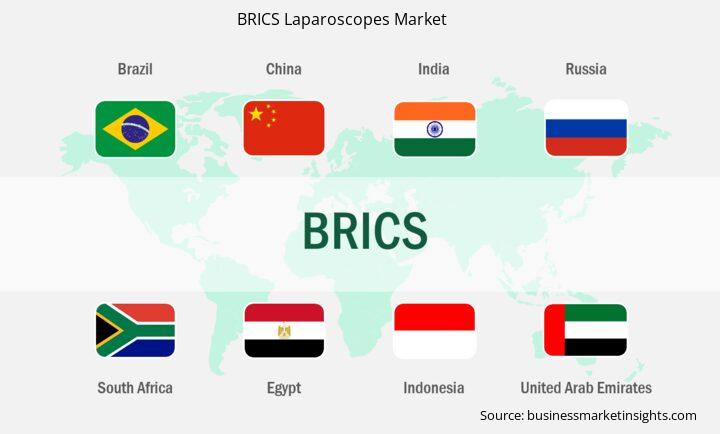
Based on country, the BRICS laparoscopes market is segmented into Brazil, Russia, India, China, South Africa, Egypt, Indonesia, the United Arab Emirates, and Saudi Arabia. China held the largest share in 2024.
Within the BRICS region, the market varies widely across member countries, shaped by their unique healthcare systems and trajectories. For example, in China's market, there is strong government support for the domestic manufacturing of medical devices and a push for the modernization of public hospitals. Public hospitals are contributing to the market by performing a high volume of general surgeries and an aging population. Additionally, the "Made in China" push is spurring competition in the market, both domestically and from foreign manufacturers. In India, the market is characterized by many healthcare settings, ranging from private hospitals that are among the most advanced in the world to public facilities with few medical devices. India also has a burgeoning medical tourism market, and private hospital chains are focused on investments into more advanced surgical technologies. Brazil benefits from a public health system and a strong private healthcare market, increasing demand for advanced laparoscopes in urban areas and private clinics primarily for cosmetic surgeries and elective procedures, including bariatrics. Russia contextually faces government-led healthcare reforms and focuses on infrastructure improvements in public healthcare, impacting the importation and sale of medical devices.
BRICS Laparoscopes Market Company Profiles
Medtronic Plc; Johnson & Johnson; Olympus Corp; Stryker Corp; Karl Storz SE & Co KG, Boston Scientific Corp, B Braun SE, Smith & Nephew Plc, Conmed Corp, and Intuitive Surgical Inc., are among the key players operating in the market. These players adopt strategies such as expansion, product innovation, and mergers and acquisitions to stay competitive in the market and offer innovative products to their consumers.
BRICS Laparoscopes Market Research Methodology:
The following methodology has been followed for the collection and analysis of data presented in this report:
Secondary Research
The research process begins with comprehensive secondary research, utilizing both internal and external sources to gather qualitative and quantitative data for each market. Commonly referenced secondary research sources include, but are not limited to:
- Company websites, annual reports, financial statements, broker analyses, and investor presentations
- Industry trade journals and other relevant publications
- Government documents, statistical databases, and market reports
- News articles, press releases, and webcasts specific to companies operating in the market
Note: All financial data included in the Company Profiles section has been standardized to US$. For companies reporting in other currencies, figures have been converted to US$ using the relevant exchange rates for the corresponding year.
Primary Research
Business Market Insights conducts a significant number of primary interviews each year with industry stakeholders and experts to validate and analyze the data and gain valuable insights. These research interviews are designed to:
- Refine findings from secondary research
- Enhance the expertise and market understanding of the analysis team
- Gain insights into market size, trends, growth patterns, competitive dynamics, and future prospects
Primary research is conducted via email interactions and telephone interviews with industry experts across various markets, categories, segments, and sub-segments in different regions. Participants typically include:
- Industry stakeholders: Vice Presidents, business development managers, market intelligence managers, and national sales managers
- External experts: Valuation specialists, research analysts, and key opinion leaders with industry-specific expertise
Key Sources Referred:
- World Health Organization (WHO)
- The World Bank Group
- Worldometer
- The Lancet
- BMC Medical Education
- Eurostat
BRICS Laparoscopes Market Strategic Insights
BRICS LaparoscopesMarket Report Highlights
| Report Attribute | Details |
| Market size in 2024 | US$ 802.9 Million |
| Market Size by 2031 | US$ 1,670.9 Million |
| CAGR (2025 - 2031) | 11.0% |
| Historical Data | 2021-2023 |
| Forecast period | 2025-2031 |
| Segments Covered |
By Product
|
|
Regions and Countries Covered
|
|
| BRICS | Russia, Brazil, South Africa, India, China, Egypt, Indonesia, United Arab Emirates, Saudi Arabia |
| Market leaders and key company profiles |
|
BRICS Laparoscopes Market Country and Regional Insights