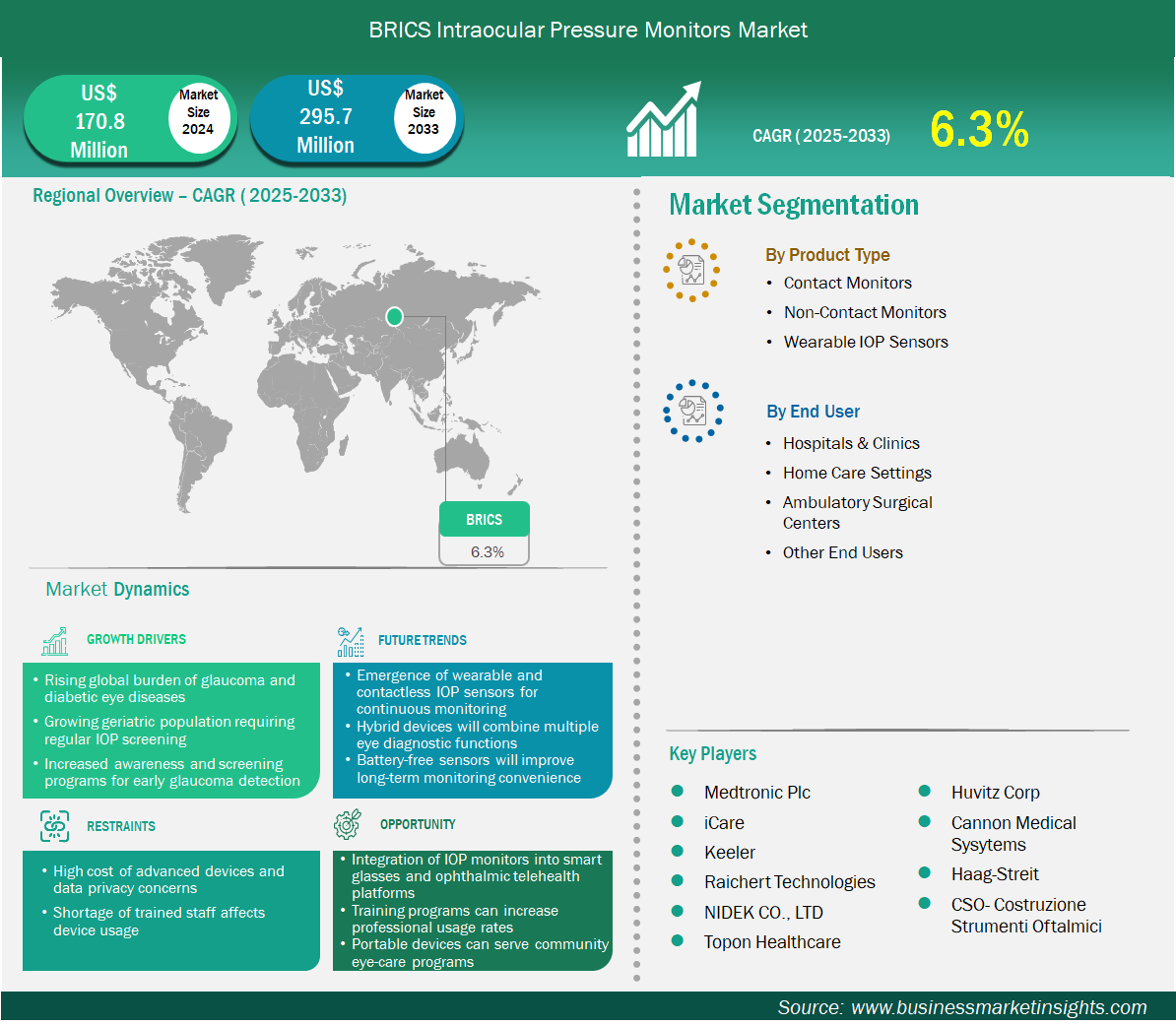
The BRICS intraocular pressure monitors market size is expected to reach US$ 295.7 million by 2033 from US$ 170.8 million in 2024. The market is estimated to record a CAGR of 6.3% from 2025 to 2033.
Executive Summary and BRICS Intraocular Pressure Monitors Market Analysis:
The intraocular pressure monitors market in BRICS is experiencing significant growth driven by the rising global burden of glaucoma and diabetic eye diseases, a growing geriatric population requiring regular IOP screening, increased awareness, and screening programs for early glaucoma detection. The BRICS intraocular pressure monitors market consists of a diverse healthcare environment, where advanced ophthalmic procedures are accessible even in developing regions.
Contact monitors continue to be the leading product segment, as they have been for a long time, due to their accurate and inexpensive nature, which makes them a suitable choice in healthcare facilities. Non-contact monitors are becoming more popular in the urban clinics of China and Brazil, where the comfort of the patient and the speed of the procedure are factors that are considered by the staff in a high-volume clinic. Hospitals & clinics have the highest share in the end-user segment, which is facilitated by the presence of glaucoma specialists and diagnostic infrastructure in big cities. The competition includes global manufacturers such as Reichert Technologies, Topcon, and NIDEK, along with regional players that offer cost-saving solutions. The changes in the market are influenced by government-led eye care strategies, donor-funded programs, and partnerships with NGOs, all aimed at eliminating glaucoma-caused blindness. There are still issues of affordability, uneven distribution of advanced devices, and scarcity of trained personnel in remote and less privileged areas, while the situation is improving. The market analysis, in general, portrays an area with strong demand drivers but significant disparities, thus requiring specially designed strategies to combine innovation and accessibility.
BRICS Intraocular Pressure Monitors Market Segmentation Analysis:
Key segments that contributed to the derivation of the intraocular pressure monitors market analysis are product and end user.
- By product, the intraocular pressure monitors market is segmented into contact monitors, non-contact monitors, and wearable IOP sensors. The contact monitors segment dominated the market in 2024. This is the largest segment due to their proven accuracy and widespread adoption in glaucoma diagnostics across BRICS nations.
- By end user, the market is segmented into hospitals and clinics, home-care Settings, ambulatory surgical centers, and other end users. The hospitals and clinics segment held the largest market share in 2024. This is the largest segment due to the concentration of specialized ophthalmic services and advanced diagnostic infrastructure in BRICS healthcare systems.
BRICS Intraocular Pressure Monitors Market Outlook
The future of the BRICS IOP monitors market is influenced by factors such as demographic changes, investments in healthcare, and technological advancements. As the incidence of glaucoma increases in the region, it is expected that early diagnosis and continuous monitoring will be the main reasons for the demand for advanced devices. It is estimated that non-contact monitors will have a greater presence in community health programs, especially in those countries where health policies support preventive care. Wearable IOP sensors, although still at an early stage, are the most rapidly expanding segment and are in line with the worldwide trend of personalized and home-based care. Regulatory harmonization across BRICS markets will be important in facilitating the approval process for devices and attracting investments. The outlook highlights a market marked by innovation, accessibility, and integration with larger healthcare systems; thus, the region can be considered a new source of growth for the IOP monitors market.
BRICS Intraocular Pressure Monitors Market Country Insights
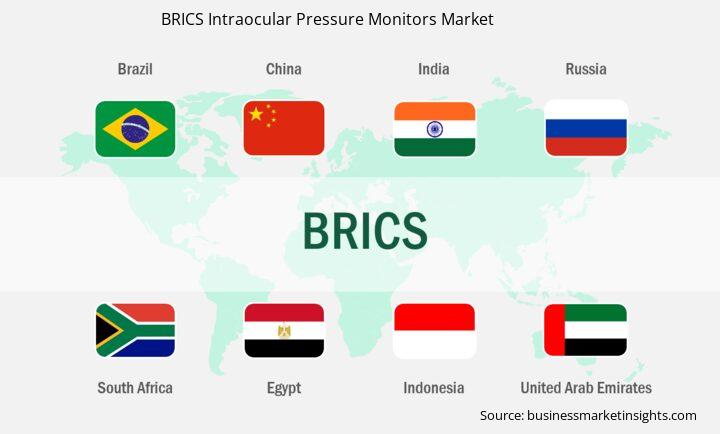
Based on country, the BRICS intraocular pressure monitors market is segmented into Russia, Brazil, South Africa, India, the UAE, China, Saudi Arabia, Indonesia, and Egypt. China held the largest share in 2024.
At the country level, the dynamics of the BRICS market reveal considerable variations in these countries. The adoption of glaucoma diagnostic devices varied significantly in these countries. China is the major leader in the BRICS countries with a well-developed ophthalmic infrastructure and a strong uptake of both contact and non-contact monitors. This is greatly supported by government-backed initiatives, which are aimed at expanding access to the diagnosis of glaucoma in rural areas. India has a clear trend, which points towards a strong demand for portable and cost-effective contact monitors. This corresponds with the fact of a large population and a resource-constrained healthcare system in India. Brazil’s main trend is the growing adoption of non-contact devices, especially in urban hospitals. Therefore, this is in line with the emphasis that Brazil has placed on patient comfort and the efficiency of healthcare services. Russia is investing in state-of-the-art ophthalmic diagnostics as a part of broader healthcare modernization strategies, thus opening doors for the premium device manufacturers. South Africa is different from the other BRICS countries due to its established ophthalmic infrastructure and the widespread use of both contact and non-contact monitors. Government-led eye health programs in South Africa largely support this. Together, these country insights emphasize that adoption has not been even in these countries. However, this region has several opportunities where customer-specific strategies—ranging from affordable solutions to advanced technologies—are necessary for market success.
BRICS Intraocular Pressure Monitors Market Company Profiles
Medtronic Plc, iCare, Keeler, Reichert Technologies, NIDEK, Topcon Healthcare, Huvitz, Canon Medical Systems, Haag-Streit Diagnostics, and CSO - Costruzione Strumenti Oftalmici are among the key players operating in the market. These players adopt strategies such as expansion, product innovation, and mergers and acquisitions to stay competitive in the market and offer innovative products to their consumers.
BRICS Intraocular Pressure Monitors Market Research Methodology:
The following methodology has been followed for the collection and analysis of data presented in this report:
-
Secondary Research
The research process begins with comprehensive secondary research, utilizing both internal and external sources to gather qualitative and quantitative data for each market. Commonly referenced secondary research sources include, but are not limited to:
- Company websites, annual reports, financial statements, broker analyses, and investor presentations
- Industry trade journals and other relevant publications
- Government documents, statistical databases, and market reports
- News articles, press releases, and webcasts specific to companies operating in the market
Note: All financial data included in the Company Profiles section has been standardized to US$. For companies reporting in other currencies, figures have been converted to US$ using the relevant exchange rates for the corresponding year.
-
Primary Research
Business Market Insights conducts a significant number of primary interviews each year with industry stakeholders and experts to validate and analyze the data and gain valuable insights. These research interviews are designed to:
- Refine findings from secondary research
- Enhance the expertise and market understanding of the analysis team
- Gain insights into market size, trends, growth patterns, competitive dynamics, and future prospects
Primary research is conducted via email interactions and telephone interviews with industry experts across various markets, categories, segments, and sub-segments in different regions. Participants typically include:
- Industry stakeholders: Vice Presidents, business development managers, market intelligence managers, and national sales managers
- External experts: Valuation specialists, research analysts, and key opinion leaders with industry-specific expertise
Key Sources Referred:
- World Health Organization (WHO)
- Organisation for Economic Cooperation and Development (OECD)
- The World Bank Group
- Worldometer
- The Lancet
- BMC Medical Education
- Eurostat
BRICS Intraocular Pressure Monitors Market Strategic Insights
BRICS Intraocular Pressure MonitorsMarket Report Highlights
| Report Attribute | Details |
| Market size in 2024 | US$ 170.8 Million |
| Market Size by 2033 | US$ 295.7 Million |
| CAGR (2025 - 2033) | 6.3% |
| Historical Data | 2022-2023 |
| Forecast period | 2025-2033 |
| Segments Covered |
By Product
|
|
Regions and Countries Covered
|
|
| BRICS | Russia, Brazil, South Africa, India, China, Egypt, Indonesia, United Arab Emirates, Saudi Arabia |
| Market leaders and key company profiles |
|
BRICS Intraocular Pressure Monitors Market Country and Regional Insights