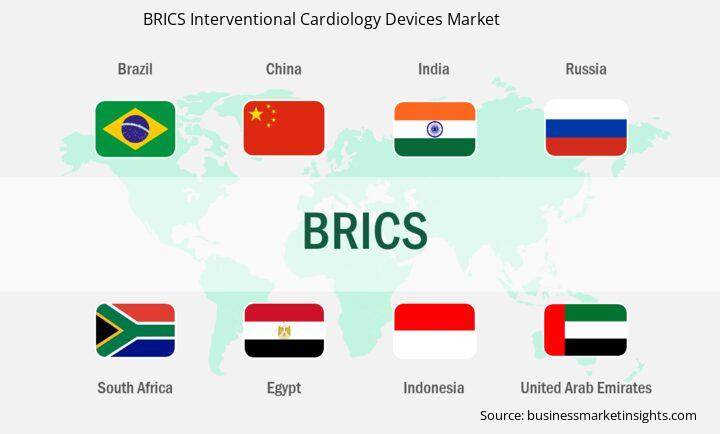
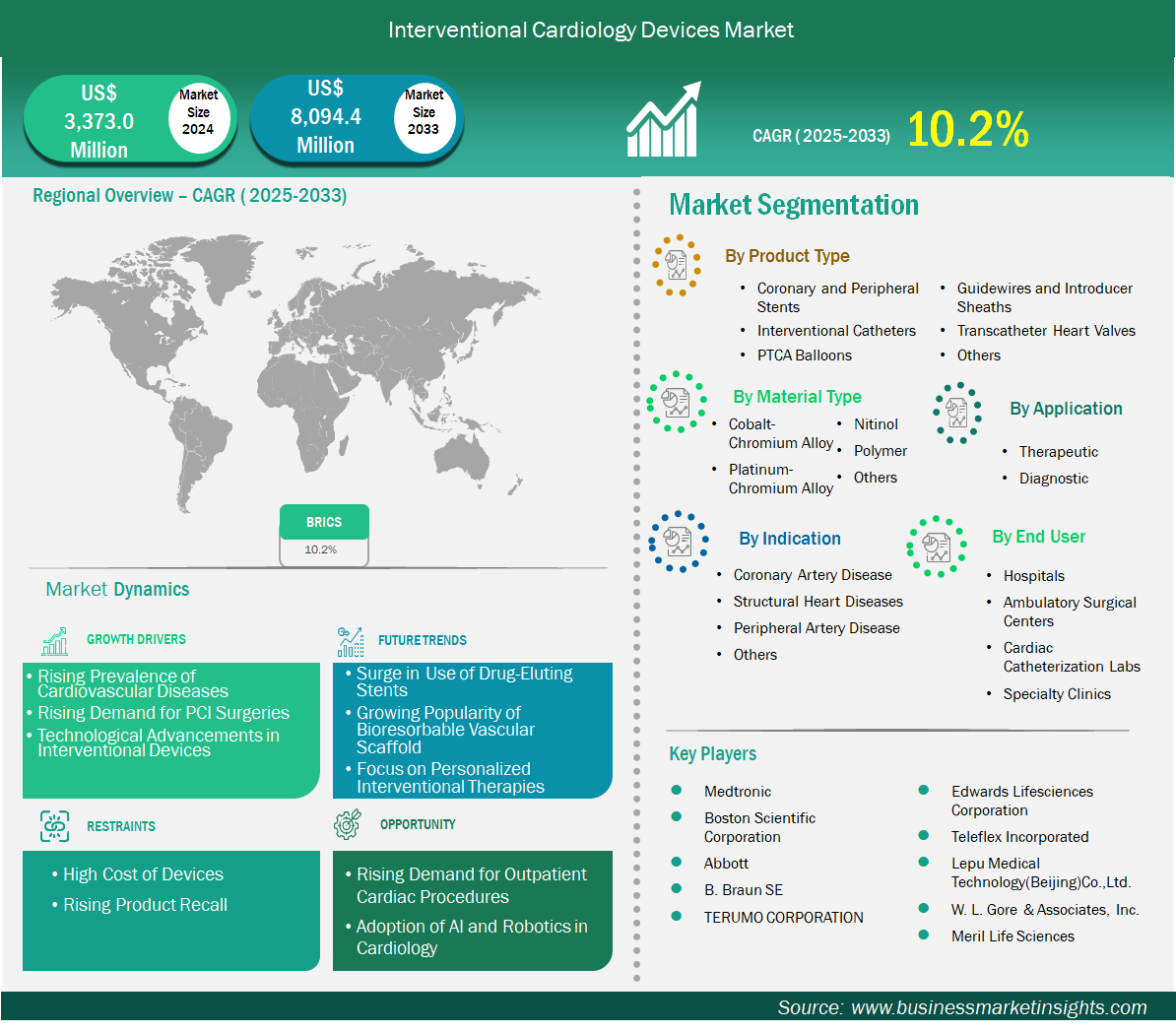
The BRICS interventional cardiology devices market size is expected to reach US$ 8,094.4 million by 2033 from US$ 3,373.0 million in 2024. The market is estimated to record a CAGR of 10.2% from 2025 to 2033.
Executive Summary and BRICS Interventional Cardiology Devices Market Analysis:
The BRICS countries represent a key growth cluster in the interventional cardiology devices market, driven by large populations, rising cardiovascular disease burden, and expanding access to advanced treatments. China and India are leading in terms of procedure volumes, supported by rapid healthcare infrastructure development, increasing urbanization, and growing awareness of minimally invasive cardiac care.
Brazil continues to see increased adoption of interventional procedures in both public and private hospitals, while Russia is expanding its capabilities in urban centers with steady uptake of coronary interventions. Although reimbursement gaps and affordability issues persist across these markets, demand for drug-eluting stents, diagnostic imaging tools, and transcatheter valves is steadily growing. BRICS nations are expected to remain major contributors to global market expansion in the years ahead.
BRICS Interventional Cardiology Devices Market Segmentation Analysis:
Key segments that contributed to the derivation of the interventional cardiology devices market analysis are product type, material type, application, indication, and end user.
- By product type, the interventional cardiology devices market is segmented into coronary and peripheral stents, interventional catheters, PTCA balloons, guidewires and introducer sheaths, transcatheter heart valves, and others. The coronary and peripheral stents segment dominated the market in 2024.
- By material type, the interventional cardiology devices market is segmented into cobalt-chromium alloy, platinum-chromium alloy, nitinol, polymer, and others. The cobalt-chromium alloy segment dominated the market in 2024.
- By application, the market is segmented into therapeutic and diagnostic. The therapeutic segment held a larger share of the market in 2024.
- By indication, the market is segmented into coronary artery disease, structural heart diseases, peripheral artery disease, and others. The coronary artery disease segment held the largest share of the market in 2024.
- By end user, the market is segmented into hospitals, ambulatory surgical centers, cardiac catheterization labs, and specialty clinics. The hospitals segment held the largest share of the market in 2024.
BRICS Interventional Cardiology Devices Market Outlook
The interventional cardiology market across the BRICS nations is a diverse yet high-growth segment. While the maturity of each market varies, from the rapid expansion in China and India to the more established systems in Russia and Brazil, the region as a whole is experiencing a major surge in demand. This is primarily driven by the increasing prevalence of cardiovascular diseases among their vast populations, fueled by urbanization and changing lifestyles.
A key driving factor is the escalating investment in healthcare infrastructure and rising health expenditure. As these economies grow, both public and private sectors are building and equipping more modern hospitals with advanced catheterization labs. This, coupled with a burgeoning middle class that has greater access to health insurance and the ability to afford expensive, modern treatments, is dramatically increasing the volume of interventional procedures performed and, consequently, the demand for devices like stents and catheters.
BRICS Interventional Cardiology Devices Market Country Insights
Based on country, the BRICS interventional cardiology devices market is segmented into Russia, Brazil, South Africa, India, China, Egypt, Indonesia, Saudi Arabia, and the UAE. China held the largest share in 2024.
China represents the most dynamic and largest market for interventional cardiology devices within the BRICS. The market is propelled by a vast population of over 1.4 billion people and a rapidly growing prevalence of cardiovascular diseases, which are now the leading cause of death in the country. This creates an enormous patient pool requiring frequent intervention.
A key factor driving this market is the strong government support for domestic medical device manufacturing. Initiatives like the Made in China strategy have led to significant investments in R&D and manufacturing capabilities for local companies like Lepu Medical and MicroPort. This has intensified competition and driven down prices, making interventional devices more affordable and accessible in a wider range of hospitals, including those in rural areas. This push for domestic innovation, coupled with a massive patient base, is making China a central force in the global market.
BRICS Interventional Cardiology Devices Market Company Profiles
Medtronic, Boston Scientific Corporation, Abbott, B. Braun SE, TERUMO CORPORATION, Edwards Lifesciences Corporation, Teleflex Incorporated, Lepu Medical Technology (Beijing) Co., Ltd., W. L. Gore & Associates, Inc., and Meril Life Sciences are among the key players operating in the market. These players adopt strategies such as expansion, product innovation, and mergers and acquisitions to stay competitive in the market and offer innovative products to their consumers.
BRICS Interventional Cardiology Devices Market Research Methodology:
The following methodology has been followed for the collection and analysis of data presented in this report:
- Secondary Research
The research process begins with comprehensive secondary research, utilizing both internal and external sources to gather qualitative and quantitative data for each market. Commonly referenced secondary research sources include, but are not limited to:
- Company websites, annual reports, financial statements, broker analyses, and investor presentations
- Industry trade journals and other relevant publications
- Government documents, statistical databases, and market reports
- News articles, press releases, and webcasts specific to companies operating in the market
Note: All financial data included in the Company Profiles section has been standardized to US$. For companies reporting in other currencies, figures have been converted to US$ using the relevant exchange rates for the corresponding year.
- Primary Research
Business Market Insights conducts a significant number of primary interviews each year with industry stakeholders and experts to validate and analyze the data and gain valuable insights. These research interviews are designed to:
- Refine findings from secondary research
- Enhance the expertise and market understanding of the analysis team
- Gain insights into market size, trends, growth patterns, competitive dynamics, and future prospects
Primary research is conducted via email interactions and telephone interviews with industry experts across various markets, categories, segments, and sub-segments in different regions. Participants typically include:
- Industry stakeholders: Vice Presidents, business development managers, market intelligence managers, and national sales managers
- External experts: Valuation specialists, research analysts, and key opinion leaders with industry-specific expertise
Key Sources Referred:
- The World Bank World Development Indicators
- World Health Organization (WHO)
- Center for Disease Control and Prevention (CDC)
- Medicines and Healthcare Products Regulatory Agency (MHRA)
- European Society of Cardiology
- American College of Cardiology
- American Heart Association
- Asian Pacific Society of Interventional Cardiology
- Company website
- Company annual reports
- Company investor presentations
BRICS Interventional Cardiology Devices Market Strategic Insights
BRICS Interventional Cardiology DevicesMarket Report Highlights
| Report Attribute | Details |
| Market size in 2024 | US$ 3,373.0 Million |
| Market Size by 2033 | US$ 8,094.4 Million |
| CAGR (2025 - 2033) | 10.2% |
| Historical Data | 2022-2023 |
| Forecast period | 2025-2033 |
| Segments Covered |
By Product Type
|
|
Regions and Countries Covered
|
|
| BRICS | Brazil, Russia, India, China, South Africa, Egypt, Indonesia, United Arab Emirates, Saudi Arabia |
| Market leaders and key company profiles |
|
BRICS Interventional Cardiology Devices Market Country and Regional Insights