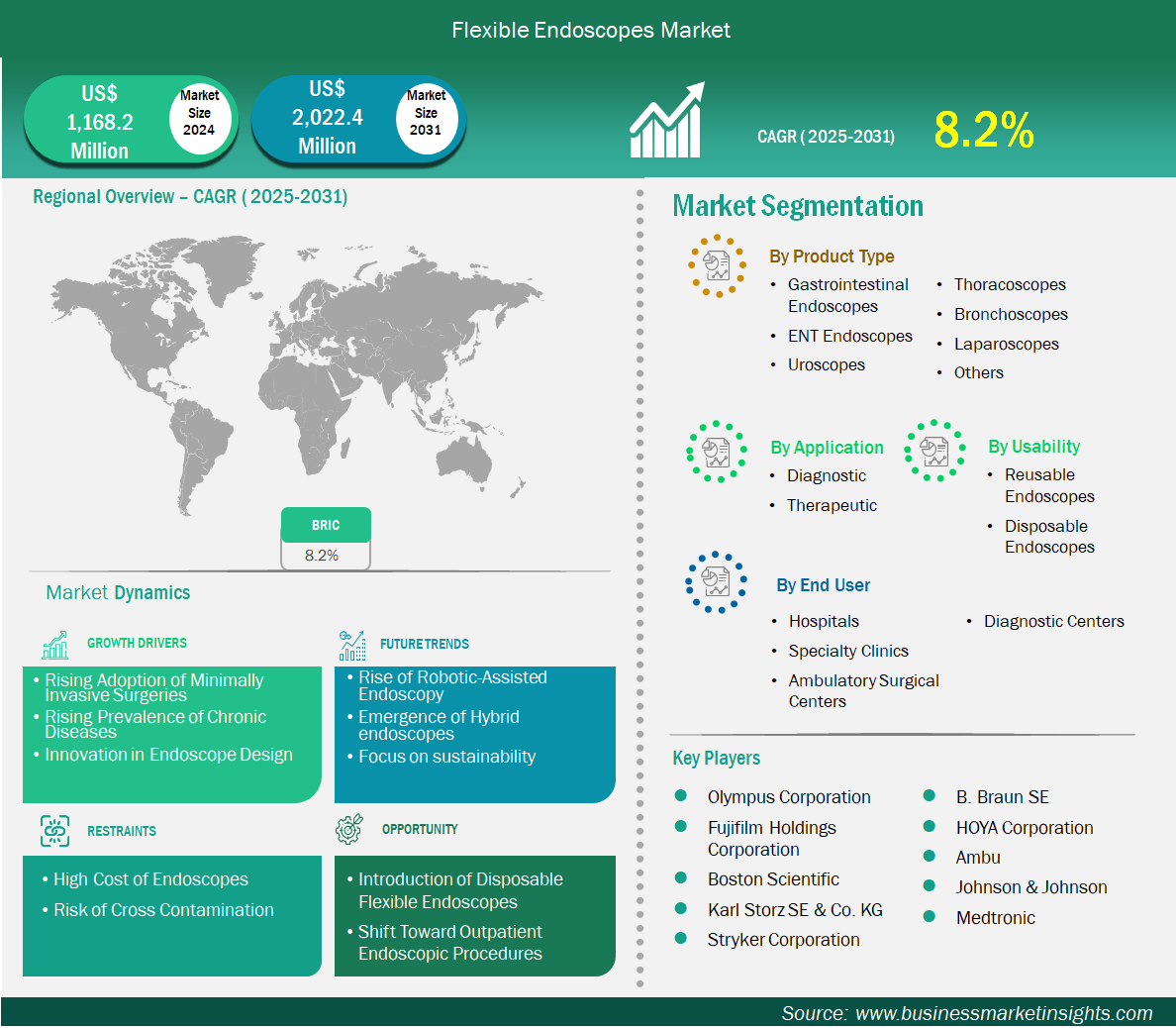
The BRICS flexible endoscopes market size is expected to reach US$ 2,022.4 million by 2031 from US$ 1,168.2 million in 2024. The market is estimated to record a CAGR of 8.2% from 2025 to 2031.
Executive Summary and BRICS Flexible Endoscopes Market Analysis:
The BRICS flexible endoscopes market is one of the fastest and most dynamic markets. While every country has its unique dynamics, the overall trend toward minimally invasive surgery is transforming surgical practices. Flexible endoscopes are gaining traction in gastrointestinal and ENT procedures as surgical volume increases, and awareness of the benefits of precision surgical tools grows. Public hospitals are gradually improving their infrastructure, while private hospitals are at the forefront of a variety of best-in-class visualization systems. China leads the market based on strength of manufacturing, its vast healthcare system, and the consistent and significant investment in surgical technology. Russia and South Africa emphasize the significance of modernization and training to enhance surgical efficiencies. BRICS countries are expected to focus on healthcare technology, particularly in clinical research and development. Thus, they will likely support the flexible endoscopes product diffusion level by enhancing manufacturing capabilities and increasing the availability to local professionals.
BRICS Flexible Endoscopes Market Segmentation Analysis:
Key segments that contributed to the derivation of the flexible endoscopes market analysis are product type, usability, application, and end user.
- By product type, the flexible endoscopes market is segmented into gastrointestinal endoscopes, ENT endoscopes, uroscopes, thoracoscopes, bronchoscopes, laparoscopes, and others. The gastrointestinal endoscopes segment dominated the market in 2024.
- By usability, the flexible endoscopes market is segmented into reusable endoscopes and disposable endoscopes. The reusable endoscopes segment dominated the market in 2024.
- By application, the flexible endoscopes market is segmented into diagnostic and therapeutic. The diagnostic segment dominated the market in 2024.
- By end user, the market is segmented into hospitals, specialty clinics, ambulatory surgical centers, and diagnostic centers. The hospitals segment held the largest share of the market in 2024.
BRICS Flexible Endoscopes Market Outlook
The adoption of flexible endoscopy in BRICS nations is concentrated in large hospitals, specialty clinics, and urban healthcare centers, while penetration in smaller cities and rural regions remains limited.
This trend is fueled by the growing emphasis on early and precise disease diagnosis, driving interest in minimally invasive procedures. Hospitals are increasingly shifting toward single-use flexible scopes and outsourcing scope reprocessing to mitigate cross-contamination risks and enhance operational efficiency.
Suppliers offering end-to-end solutions, including reprocessing services, staff training, and proprietary devices, are positioned as preferred partners for healthcare institutions.
Expanding training programs and improving access to care in underserved areas will accelerate adoption, strengthen patient safety, and contribute to overall market growth for flexible endoscopy across BRICS countries.
BRICS Flexible Endoscopes Market Country Insights
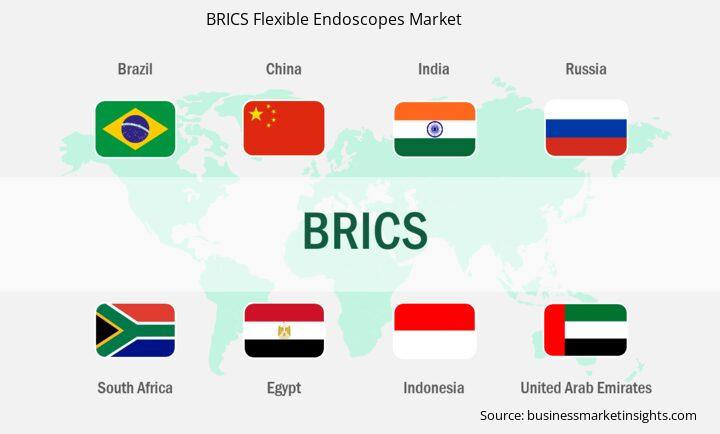
Based on country, the BRICS flexible endoscopes market is further segmented into Russia, Brazil, South Africa, India, China, Egypt, Indonesia, Saudi Arabia, and the UAE. China held the largest share in 2024.
China leads the BRICS region in flexible endoscopy adoption, driven by its advanced healthcare infrastructure, strong manufacturing base, and strategic investments in surgical innovation.
Hospitals in urban cities such as Beijing, Shanghai, and Guangzhou routinely perform complex and minimally invasive endoscopic procedures across specialties, including gastroenterology and ENT.
Government support has been significant, with minimally invasive surgery designated as a national health priority. Initiatives include funding programs, nationwide training, and infrastructure development to accelerate adoption.
Domestic manufacturers are scaling production rapidly, delivering competitively priced flexible endoscopes that comply with international standards. Additionally, China functions as a regional hub for clinical trials and device validation, shaping procurement trends across BRICS.
China is positioned to set benchmarks for flexible endoscope utilization, manufacturing innovation, and clinical excellence in the region.
BRICS Flexible Endoscopes Market Company Profiles
Olympus Corporation, Fujifilm Holdings Corporation, Boston Scientific, Karl Storz SE & Co. KG, Stryker Corporation, B. Braun SE, HOYA Corporation, Ambu, Johnson & Johnson, and Medtronic are among the key players operating in the market. These players adopt strategies such as expansion, product innovation, and mergers and acquisitions to stay competitive in the market and offer innovative products to their consumers.
BRICS Flexible Endoscopes Market Research Methodology:
The following methodology has been followed for the collection and analysis of data presented in this report:
-
Secondary Research
The research process begins with comprehensive secondary research, utilizing both internal and external sources to gather qualitative and quantitative data for each market. Commonly referenced secondary research sources include, but are not limited to:
- Company websites, annual reports, financial statements, broker analyses, and investor presentations
- Industry trade journals and other relevant publications
- Government documents, statistical databases, and market reports
- News articles, press releases, and webcasts specific to companies operating in the market
Note:
All financial data included in the Company Profiles section has been standardized to US$. For companies reporting in other currencies, figures have been converted to US$ using the relevant exchange rates for the corresponding year.
-
Primary Research
Business Market Insights conducts a significant number of primary interviews each year with industry stakeholders and experts to validate and analyze the data and gain valuable insights. These research interviews are designed to:
- Refine findings from secondary research
- Enhance the expertise and market understanding of the analysis team
- Gain insights into market size, trends, growth patterns, competitive dynamics, and future prospects
Primary research is conducted via email interactions and telephone interviews with industry experts across various markets, categories, segments, and sub-segments in different regions. Participants typically include:
- Industry stakeholders: Vice Presidents, business development managers, market intelligence managers, and national sales managers
- External experts: Valuation specialists, research analysts, and key opinion leaders with industry-specific expertise
Key Sources Referred:
- The World Bank
- World Health Organization (WHO)
- Center for Disease Control and Prevention (CDC)
- American Society for Gastrointestinal Endoscopy
- European Society of Gastrointestinal Endoscopy
- World Endoscopy Organization
- Society of American Gastrointestinal and Endoscopic Surgeons
- Global Cancer Observatory
- Company website
- Company annual reports
- Company investor presentations
BRICS Flexible Endoscopes Market Strategic Insights
BRICS Flexible EndoscopesMarket Report Highlights
| Report Attribute | Details |
| Market size in 2024 | US$ 1,168.2 Million |
| Market Size by 2031 | US$ 2,022.4 Million |
| CAGR (2025 - 2031) | 8.2% |
| Historical Data | 2021-2023 |
| Forecast period | 2025-2031 |
| Segments Covered |
By Product Type
|
|
Regions and Countries Covered
|
|
| BRICS | Russia, Brazil, South Africa, India, China, Egypt, Indonesia, Saudi Arabia, United Arab Emirates |
| Market leaders and key company profiles |
|
BRICS Flexible Endoscopes Market Country and Regional Insights