
Botanical Supplements Market Outlook: Size, Share, Trends, Growth Analysis, Competitive Landscape & Forecast, 2026-2033

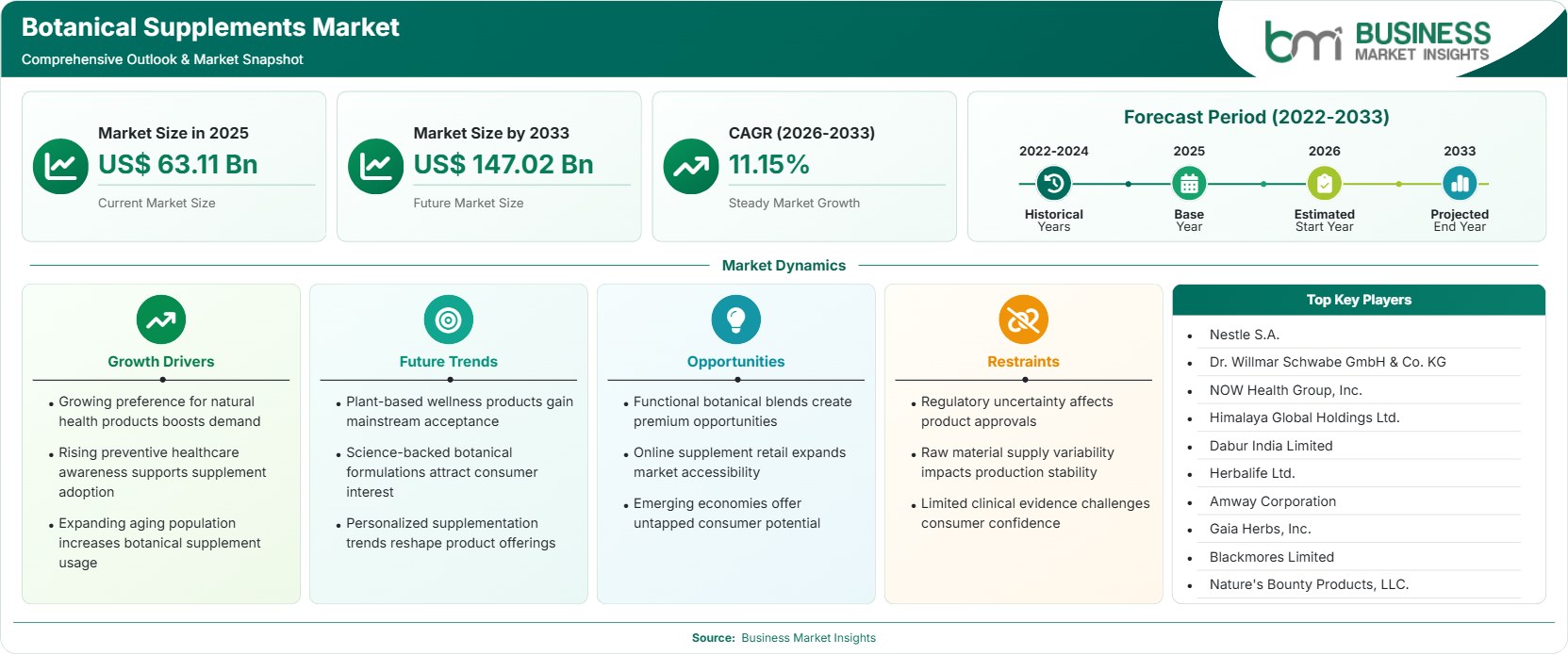
The Botanical Supplements Market size was valued at US$ 63.11 Billion in 2025 and is projected to reach US$ 147.02 Billion by 2033, growing at a CAGR of 11.15% during 2026–2033, supported by preventive healthcare adoption, clean-label demand, botanical innovation, personalized nutrition, e-commerce expansion, and wider clinical validation of herbal ingredients.

Report Coverage
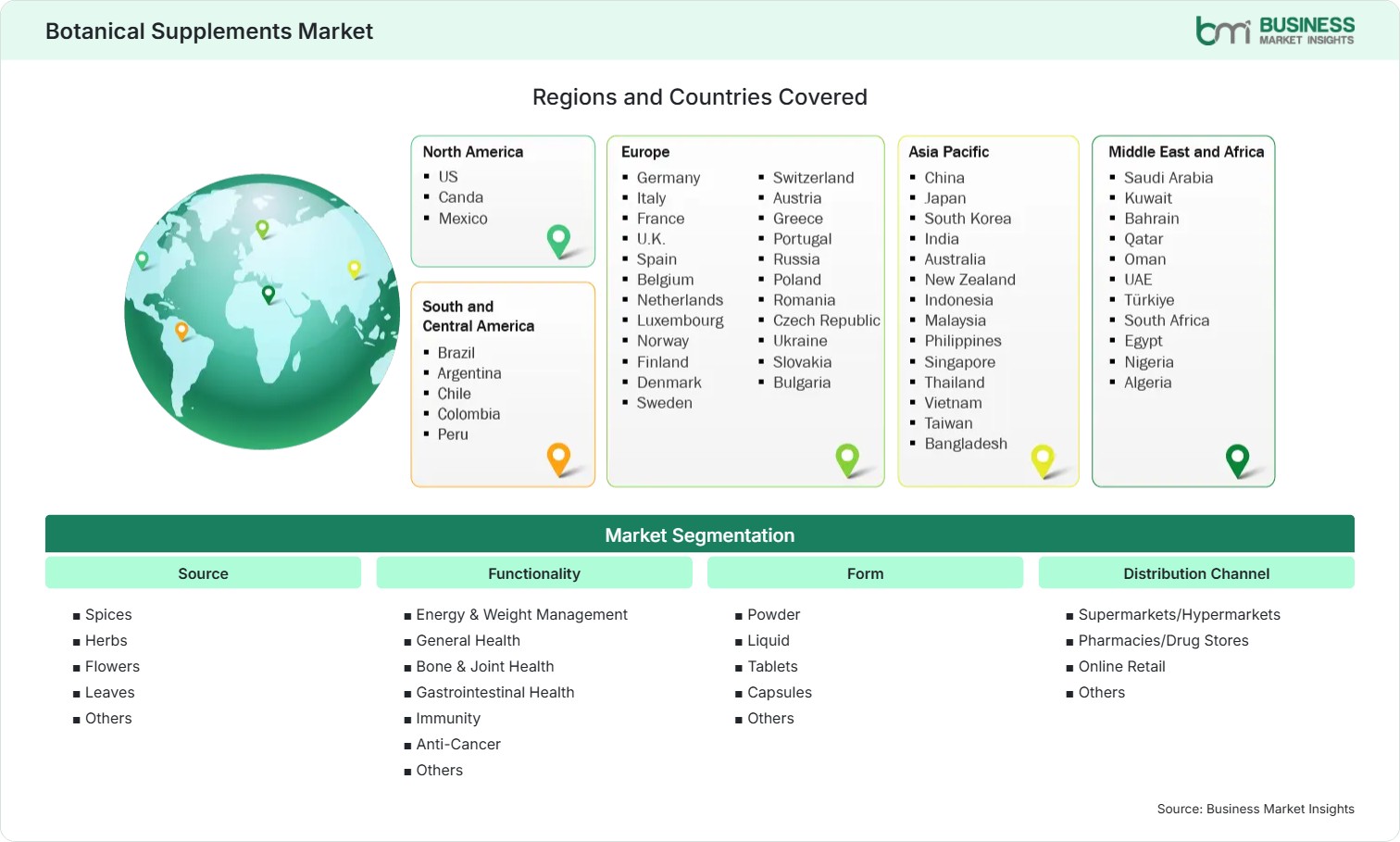
  • Source: Spices, Herbs, Flowers, Leaves, Others
  • Functionality: Energy & Weight Management, General Health, Bone & Joint Health, Gastrointestinal Health, Immunity, Anti-Cancer, Others
  • Form: Powder, Liquid, Tablets, Capsules, Others
  • Distribution Channel: Supermarkets/Hypermarkets, Pharmacies/Drug Stores, Online Retail, Others
US$ 63.11 Bn Market size in 2025
US$ 147.02 Bn Market Size by 2033
11.15% CAGR, 2026 - 2033
2026-2033 Forecast Period

AI Overview

Botanical Supplements Market Summary

  • North America Region: North America holds a market share of 34%–37% in 2025, growing at a CAGR of 9.8%–10.6% during 2026–2033, driven by premium wellness spending, regulatory compliance, branded formulations, digital retail expansion, preventive healthcare programs, clinically backed ingredients, aging demographics, personalized nutrition demand, and practitioner-recommended supplementation. US market benefits from strong consumer awareness, retail penetration, and an estimated CAGR of 10.0%–10.8%.
  • Fastest Growing Region: Asia Pacific holds a market share of 27%–30% in 2025, growing at a CAGR of 12.8%–13.7% during 2026–2033, supported by rising disposable income, traditional medicine acceptance, local botanical cultivation, expanding wellness channels, urbanization, online purchasing behavior, regulatory modernization, and growing middle-class health expenditure.
  • Leading Segment: Herbs holds a market share of 31%–34% in 2025, growing at a CAGR of 10.8%–11.6% during 2026–2033, supported by established consumer familiarity, extensive ingredient availability, diverse applications, clinical evidence expansion, retail accessibility, formulation flexibility, sustainability initiatives, and increasing use in preventive health programs.
  • High Growth Segment: Immunity holds a market share of 18%–21% in 2025, growing at a CAGR of 13.4%–14.2% during 2026–2033, driven by health awareness, demand for immune resilience, pandemic-influenced purchasing behavior, functional ingredient innovation, practitioner recommendations, scientific research investments, and premium supplement product launches.
  • Key Market Opportunity: Personalized botanical nutrition platforms integrating consumer health data, AI-supported recommendations, targeted formulations, subscription models, outcome monitoring, and direct-to-consumer channels are creating scalable, high-margin opportunities across developed and emerging markets.
  • Major Market Players: Nestlé S.A., Dr. Willmar Schwabe GmbH & Co. KG, NOW Health Group, Inc., Himalaya Global Holdings Ltd., Dabur India Limited, Herbalife Ltd., Amway Corporation, Gaia Herbs, Inc., Blackmores Limited, Nature's Bounty Products, LLC.
Strategic Insights

Botanical Supplements Market: Strategic Insights

Botanical Supplements Market Strategic Framework
FREE PDF
Request your free sample
Request free sample
Stakeholder View

Key Takeaways

  • Supply chains increasingly emphasize traceable botanical sourcing, standardized extraction, and certification programs, creating competitive advantages for vertically integrated manufacturers.
  • Immunity, gastrointestinal health, and personalized wellness applications present the strongest commercial upside due to recurring consumer demand and premium pricing potential.
  • Product development is shifting toward scientifically validated plant extracts, bioavailability enhancement technologies, and combination formulations targeting specific health outcomes.
  • India, China, Indonesia, and Vietnam offer compelling production and consumption opportunities supported by traditional botanical knowledge and expanding middle-class healthcare spending.
  • Strategic acquisitions continue to focus on specialty herbal brands, ingredient innovators, and direct-to-consumer wellness platforms with strong digital engagement.
  • Sustainability credentials, regenerative agriculture practices, and transparent ingredient tracing are becoming important purchasing criteria across premium consumer segments.
Geographic Outlook

Botanical Supplements Market Regional Highlights

North America Botanical Supplements Market

North America accounted for approximately 34%–37% of revenue in 2025 and is projected to expand at 9.8%–10.6% CAGR through 2033. The region benefits from high health awareness, established nutraceutical channels, premium product adoption, and widespread clinical acceptance of botanical ingredients. The Botanical Supplements Market share remains strongest in the United States due to extensive retail distribution and practitioner engagement. Product innovation increasingly focuses on condition-specific formulations, clean-label positioning, and personalized supplementation supported by sophisticated ecommerce ecosystems.

  • Preventive healthcare spending continues driving demand for immune-support, stress-management, and digestive-health formulations.
  • Retailers increasingly prioritize traceable ingredients and third-party testing certifications.
  • Personalized wellness subscriptions support recurring revenue streams and customer retention.
  • Strong regulatory oversight encourages premium positioning and consumer confidence.
  • Practitioner-recommended products gain visibility across specialized healthcare channels.

US Botanical Supplements Market

The United States represents approximately 74%–78% share within North America and is expected to grow at 10.0%–10.8% CAGR through 2033. Consumer demand remains supported by aging demographics, wellness-focused lifestyles, and growing acceptance of complementary health approaches. Digital health platforms increasingly influence purchasing behavior while specialty botanical brands expand premium offerings. Product differentiation increasingly revolves around efficacy data, sustainable sourcing, dosage transparency, and clinically substantiated ingredient claims.

  • Direct-to-consumer channels continue outperforming traditional specialty retail growth rates.
  • Demand for plant-based wellness solutions strengthens among younger consumers.
  • Premium immune and cognitive support categories demonstrate strong revenue contribution.
  • Ingredient transparency increasingly influences consumer purchasing decisions.

Europe Botanical Supplements Market

Europe maintains 25%–28% share in 2025 and is expected to record 10.2%–11.0% CAGR through 2033. Germany remains the leading market, while Eastern European countries demonstrate stronger expansion potential. Regulatory emphasis on product quality and standardized ingredients supports premium positioning. Consumer demand increasingly favors botanical formulations addressing healthy aging, mobility support, gut wellness, and stress management. Established herbal medicine traditions continue supporting adoption across multiple consumer demographics.

  • Germany leads regional consumption with strong pharmacy-based distribution.
  • Poland and Romania represent high-growth countries with CAGR above regional averages.
  • Organic certification strengthens premium market positioning.
  • Scientific validation increasingly influences commercial success.
  • Functional wellness products gain traction among senior populations.

Asia Pacific Botanical Supplements Market

Asia Pacific held 27%–30% share during 2025 and is forecast to expand at 12.8%–13.7% CAGR, making it the fastest-growing region. The region benefits from strong cultural familiarity with herbal therapies, expanding disposable income, and rapid digital commerce adoption. China remains the largest market, while India demonstrates among the strongest growth trajectories. Local cultivation capacity and ingredient availability support cost efficiency and manufacturing competitiveness.

  • China leads regional demand through extensive herbal wellness traditions.
  • India benefits from Ayurveda-driven consumption and manufacturing expansion.
  • Online retail accelerates access to premium international brands.
  • Middle-class healthcare expenditure continues rising significantly.
  • Regulatory modernization supports export-oriented production growth.

Rest of World Botanical Supplements Market

The Rest of World region accounts for approximately 10%–13% share and is projected to register 11.4%–12.3% CAGR through 2033.

South and Central America benefit from growing natural wellness awareness and indigenous botanical resources. Meanwhile, Middle East and Africa markets are supported by rising healthcare investment, premium wellness retail growth, and increasing consumer preference for plant-derived health products.

  • Brazil remains the largest Latin American market with strong natural ingredient demand.
  • Saudi Arabia demonstrates rising premium supplement consumption patterns.
  • Expanding ecommerce access improves product availability.
  • Local botanical biodiversity supports ingredient innovation.
  • Healthcare modernization programs increase wellness spending.
Global Market Geography
FREE PDF
Request your free sample
Request free sample
Segment Analysis

Botanical Supplements Market Segmentation

Source

This segment accounted for a significant portion of revenue, with Herbs leading demand. The segment represented roughly 31%–34% market share in 2025 and is projected to advance at 10.8%–11.6% CAGR. Consumer preference for recognizable natural ingredients, expanding cultivation programs, and clinical validation efforts continue influencing adoption. The Botanical Supplements Market scope within sourcing categories remains broad due to diverse ingredient availability.

  • Spices: Widely used for antioxidant and anti-inflammatory formulations, supported by growing consumer awareness regarding turmeric, cinnamon, and ginger-derived wellness solutions.
  • Herbs: Strong acceptance across digestive, immunity, and stress-management products due to traditional usage and expanding scientific validation.
  • Flowers: Increasingly incorporated into calming, sleep-support, and beauty-oriented formulations emphasizing natural positioning.
  • Leaves: Demand supported by green tea, moringa, and similar ingredients associated with metabolic and wellness benefits.

Functionality

Functionality-based segmentation highlights increasing consumer preference for targeted outcomes. Immunity remains the fastest-growing category with approximately 18%–21% share and 13.4%–14.2% CAGR. Demand increasingly favors evidence-based formulations addressing specific health objectives while combining multiple botanical ingredients for enhanced efficacy.

  • Energy & Weight Management: Supported by active lifestyle trends and growing preference for plant-derived metabolic support formulations.
  • General Health: Broad consumer appeal driven by preventive wellness adoption and routine supplementation habits.
  • Bone & Joint Health: Growing elderly populations support demand for mobility and comfort-focused botanical combinations.
  • Gastrointestinal Health: Expanding awareness of gut health encourages incorporation of digestive-support ingredients.
  • Immunity: Continues benefiting from health resilience priorities and ongoing product innovation.
  • Anti-Cancer: Primarily focused on complementary wellness support and antioxidant-rich ingredient applications.

Form

Formulation preferences vary according to convenience, dosage accuracy, and consumer demographics. Tablets and capsules collectively dominate consumption, while liquid products show notable expansion potential. The segment benefits from manufacturing advancements, extended shelf-life capabilities, and improved ingredient stability.

  • Powder: Popular among sports nutrition and customized wellness users seeking dosage flexibility.
  • Liquid: Gaining traction through bioavailability perceptions and ease of consumption.
  • Tablets: Remain preferred for affordability, storage efficiency, and dosage consistency.
  • Capsules: Strong acceptance due to convenience and premium positioning.

Distribution Channel

Distribution dynamics continue evolving as digital commerce expands. Online retail delivers the strongest growth momentum, while pharmacies maintain credibility-driven demand. The Botanical Supplements Market trends within distribution increasingly favor omnichannel strategies integrating consumer education, subscriptions, and direct engagement.

  • Supermarkets/Hypermarkets: Continue supporting mass-market accessibility and impulse purchasing behavior.
  • Pharmacies/Drug Stores: Benefit from consumer trust and healthcare professional influence.
  • Online Retail: Expands product visibility, personalized recommendations, and recurring subscription opportunities.
Market Forces

Botanical Supplements Market Dynamics

Key Market Drivers

Preventive Healthcare Adoption Across Consumer Segments

Growing healthcare costs and increasing chronic disease prevalence are encouraging consumers to prioritize prevention-oriented wellness solutions. WHO estimates indicate rising noncommunicable disease burdens globally, supporting demand for nutritional interventions. The botanical supplements that help in building immunity, alleviating stress, digestive wellness, and anti-aging can greatly benefit from such a change. Health-oriented customers prefer botanical products backed by a long history of use and growing scientific evidence. This leads to an expansion of product lines and educational activities among retailers. Growing recognition of complementary approaches to health will contribute to the category’s growth in the long run.

Scientific Validation of Botanical Ingredients

Growing investment in clinical studies and standardized extraction technologies is improving confidence among consumers and healthcare professionals. Increasingly, manufacturers are backing up their marketing messages about products with specific studies into ingredients. Universities, research organizations, and nutraceutical firms continue exploring the links between active ingredients and health benefits related to immune system strength, metabolism, and cognition. Increased transparency helps consumers feel more confident about making a purchase and aids in distinguishing brands. With an increased pool of information on the efficacy of products, marketers can better position them in the right health categories.

Expansion of Digital Commerce and Consumer Education

Online wellness platforms have transformed product discovery, comparison, and purchase behavior. Education, professional partnerships, subscription packages, and recommendation systems make customers more engaged. International commerce helps access specific products and top-notch international brands. Marketing analytics assist businesses in detecting demand trends and positioning products in the most efficient way. Digital channels also allow for fast commercialization and feedback from consumers. All this results in broader market coverage, higher customer retention, better educational resources, and ultimately contributes to market expansion.

Key Market Opportunities

Personalized Botanical Nutrition Ecosystems

The combination of health assessment of the consumers, the usage of wearable technology, digital wellness tools, and customizations provides significant growth opportunities. Personalized suggestions enhance relevance and increase the chances of customer engagement for longer periods. Customized supplements will help companies stand out in the market. Subscriptions provide steady revenue streams and outcome analysis. With emerging analytics, companies can match ingredients with health objectives. Long-term Botanical Supplements Market Forecasts increasingly incorporate personalized wellness solutions as a core growth avenue across developed and emerging economies.

Expansion in Emerging Consumer Economies

Rapid urbanization, rising disposable income, and growing health awareness across Asia, Latin America, and parts of Africa create favorable demand conditions. Governments are now encouraging the manufacture of nutraceuticals and modernizing herbal medicines. Manufacturing locally will increase cost-effectiveness and allow for export potential. Foreign brands are helped by cooperation with local distributors and manufacturers. As the wellness budget grows, higher-end and middle-class botanical products will be accepted by consumers of all demographics.

Sustainable and Regenerative Ingredient Sourcing

Sustainability expectations are reshaping botanical procurement practices. Environmental performance and effectiveness of products have become important considerations for consumers. Regenerative agriculture, biodiversity, and traceability provide differentiation prospects for companies. The adoption of responsible sourcing approaches can help improve the premium image and reliability of supply chains. Moreover, sustainability certificates make it easier to gain access to green retail outlets and foreign markets. Long-term investments in responsible agricultural practices should contribute to business success and build brand credibility.

Market Restraints and Challenges

Regulatory Fragmentation and Commercial Complexity

Factor: The variations between the approval processes of ingredients, labeling regulations, health claims, and quality standards among different countries make commercialization very difficult for firms operating globally.

Impact: Such differences usually result in higher costs for compliance, increased testing and certification efforts, and extended periods required for market entry. Lack of regulatory consistency in different regions complicates portfolio standardization and international business development. Small brands are especially affected because compliance with documentation and regional regulatory differences places an extra burden on the brand’s resources. Uncertainty regarding the approval of new botanical ingredients is another factor that adds to the burden.

Raw Material Volatility and Supply Disruptions

Factor: The provision of botanical resources is extremely vulnerable to the effects of global warming, natural disasters, agricultural diseases, limitations in biodiversity, and geopolitics.

Impact: Fluctuations in harvesting productivity may have a major effect on the quality of the raw materials, pricing, and the availability of the raw materials, hence causing problems for manufacturers. Firms that rely on a few regions for procurement purposes are more exposed to procurement and operational risk. The increased demand in global markets for some herb-based raw materials may be greater than the amount that can be grown.

Company Analysis

Competitive Landscape

The Botanical Supplements Market analysis indicates competition is centered on ingredient quality, scientific validation, global distribution strength, brand trust, and product innovation.

Company Name

Overview

Products and Services relevant to this market

Nestlé S.A.

Global nutrition leader with growing focus on health science and personalized nutrition solutions.

Botanical wellness supplements, functional nutrition products, consumer health formulations.

Dr. Willmar Schwabe GmbH & Co. KG

Specialist in phytomedicine with extensive herbal research capabilities.

Standardized plant extracts, herbal medicines, botanical health products.

NOW Health Group, Inc.

Major natural products manufacturer serving global wellness categories.

Herbal capsules, powders, extracts, specialty botanical formulations.

Himalaya Global Holdings Ltd.

Well-established herbal healthcare company with international presence.

Ayurvedic supplements, immunity products, digestive wellness formulations.

Dabur India Limited

Leading natural healthcare enterprise with strong herbal heritage.

Botanical supplements, herbal wellness products, preventive healthcare solutions.

Herbalife Ltd.

Global nutrition company with extensive direct-selling network.

Weight management, wellness, and botanical nutrition products.

Amway Corporation

Diversified wellness company with significant supplement operations.

Plant-based supplements, vitamins, and personalized health products.

Gaia Herbs, Inc.

Specialist botanical company emphasizing traceability and sustainability.

Herbal extracts, liquid formulations, targeted wellness supplements.

Blackmores Limited

Recognized natural health brand with Asia-Pacific presence.

Herbal supplements, immunity solutions, nutritional products.

Nature's Bounty Products, LLC

Established supplement manufacturer with broad retail distribution.

Botanical capsules, tablets, wellness formulations, herbal blends.

Trust & Transparency

Research Methodology

The market analysis combines proprietary research with secondary data from government agencies, company disclosures, regulatory filings, industry databases and expert interviews. Market estimates are validated through data triangulation, cross-market benchmarking and analyst review.

View Full Research Methodology

Questions Answered

Frequently Asked Questions

How can a Botanical Supplements Market Report support strategic planning?

A Botanical Supplements Market Report helps stakeholders evaluate competition, regional demand patterns, segmentation trends, regulatory developments, and investment opportunities for informed decision-making.

Which region offers the most attractive future investment potential?

Asia Pacific provides the strongest growth outlook because of expanding middle-class populations, traditional herbal medicine adoption, and increasing wellness expenditure.

What distinguishes botanical supplements from conventional supplements?

Botanical supplements primarily utilize plant-derived ingredients such as herbs, spices, flowers, and leaves to deliver targeted wellness benefits and natural positioning.

Which distribution channel is expanding most rapidly?

Online retail is experiencing the fastest expansion due to product accessibility, subscription models, educational content, and personalized recommendation capabilities.

Which consumer group drives the strongest demand for botanical supplements?

Health-conscious adults focused on preventive wellness, immune support, digestive health, and healthy aging currently represent the largest purchasing segment across most developed markets.

Access the Full Botanical Supplements Market Report

Get segment-level forecasts, regional estimates, competitive benchmarking, company profiles and downloadable Excel datasets.

Access the full Botanical Supplements Market Report
350 pages PDF & Excel | 2026-08-31