Market Summary
Executive Summary and Global Market Analysis
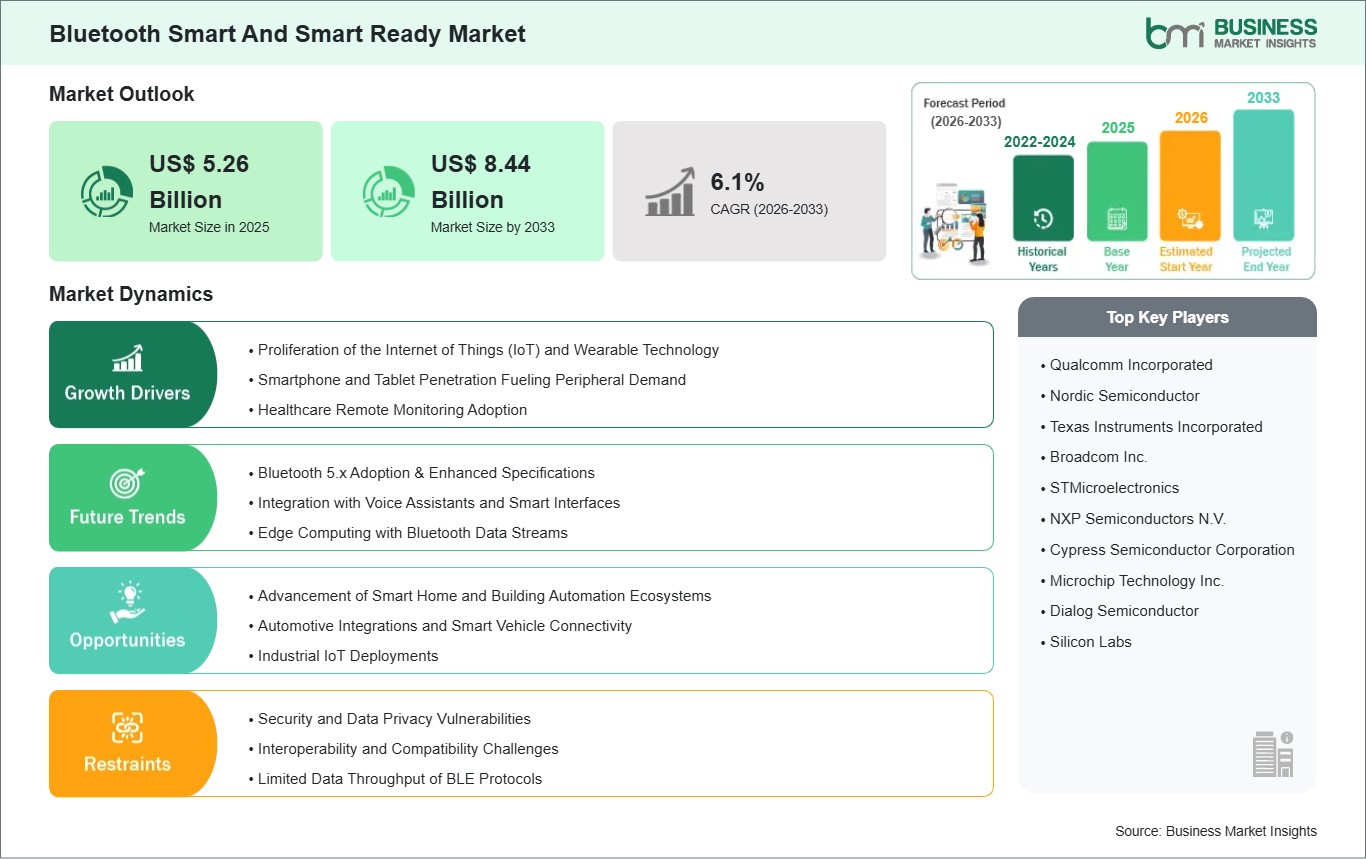
The global Bluetooth Smart and Smart Ready market serves as a foundational wireless connectivity layer powering the modern Internet of Things (IoT) ecosystem. These low-power, cost-effective protocols enable a vast array of devices to communicate, share data, and interact with control hubs like smartphones, gateways, and cloud platforms. The market is fueled by the explosive proliferation of connected devices, the drive towards smart home and smart building automation, and the increasing integration of wireless functionality into industrial, healthcare, and automotive systems. Bluetooth Smart, with its ultra-low power consumption, is ideal for sensors, wearables, and beacons, while Bluetooth Smart Ready devices act as intelligent hubs, connecting these sensors to broader networks.
However, the market navigates challenges including intense competition from other low-power wireless standards (e.g., Zigbee, Thread), concerns over interoperability and security in diverse ecosystems, and the constant need for technological evolution to support higher data rates and longer ranges. Despite this, significant opportunities are flourishing with the standardization of Bluetooth Mesh networking for large-scale device networks, the integration of advanced location services (Bluetooth Direction Finding), and the rising demand for contactless solutions and asset tracking in commercial and industrial environments post-pandemic.
Segment Analysis
Bluetooth Smart And Smart Ready Market Segmentation
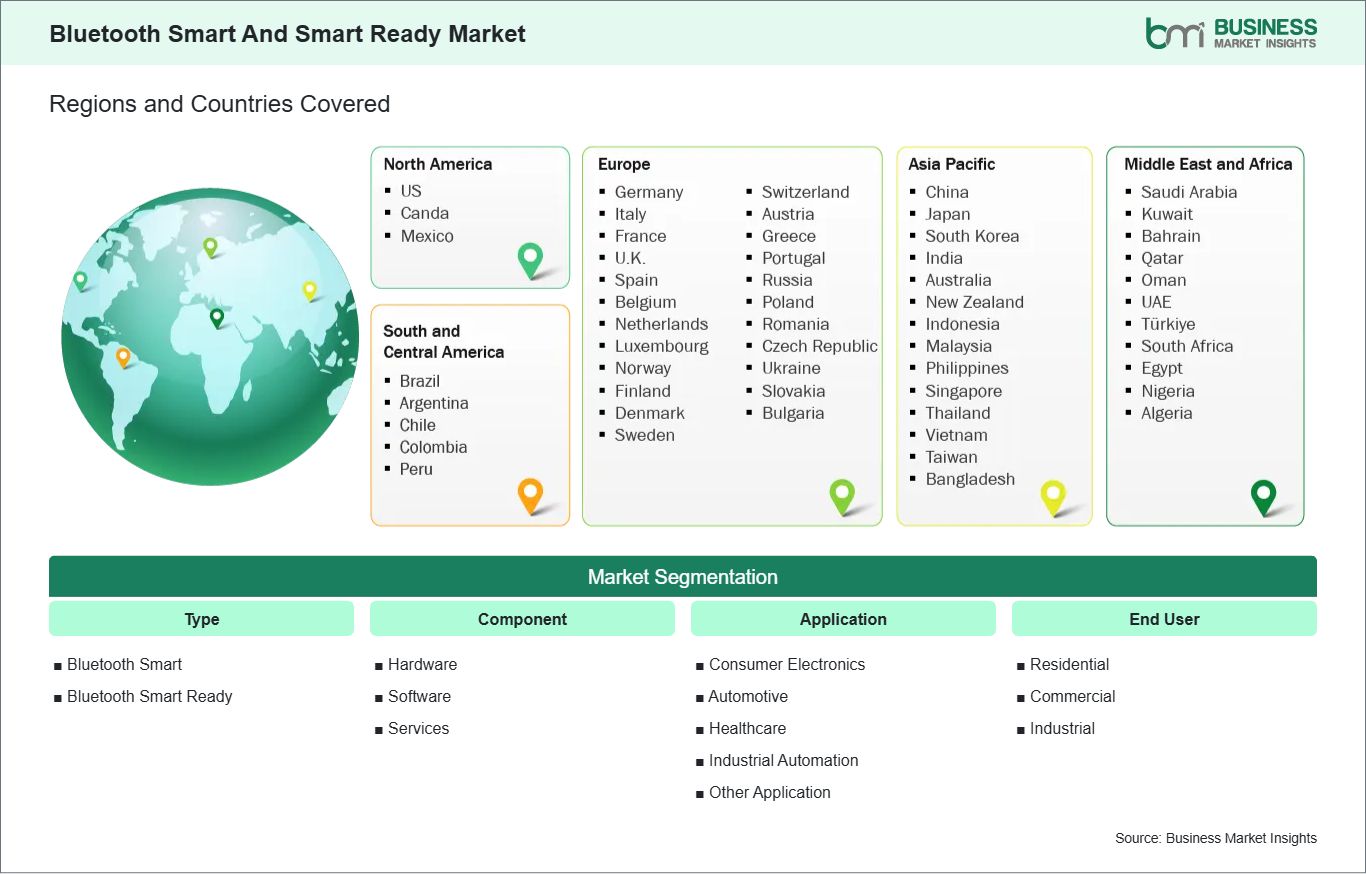
Key segments that contributed to the derivation of the Bluetooth smart and smart ready market analysis are type, component, application, and end user.
- By type, the market is bifurcated into Bluetooth Smart (Low Energy devices) and Bluetooth Smart Ready (dual-mode hubs). The Bluetooth Smart segment dominated the market in 2024, driven by the massive volume of endpoint devices like sensors, tags, and wearables.
- By component, the market is segmented into hardware, software, and services. The hardware segment, which includes chipsets, modules, and beacons, held the largest share of the market in 2024.
- By application, the market is categorized into consumer electronics, automotive, healthcare, industrial automation, and others. The consumer electronics segment accounted for the largest share in 2024, owing to its use in smartphones, wearables, audio devices, and smart home gadgets.
- By end user, the market is segmented into residential, commercial, and industrial. The commercial segment held a significant share, fueled by deployments in retail (beaconing), offices (smart lighting/access), and healthcare facilities.
Market Forces
Bluetooth Smart And Smart Ready Market Drivers and Opportunities
Proliferation of the Internet of Things (IoT) and Wearable Technology
The exponential growth of the IoT is the principal driver for Bluetooth Smart/Ready technologies. Their low power consumption, robust performance in crowded RF environments, and ubiquitous support in smartphones make them the de facto standard for personal area networks. This is critically evident in the wearable technology boom—fitness trackers, smartwatches, and medical monitors all rely on Bluetooth Smart for continuous, battery-efficient data syncing. The opportunity expands as IoT moves beyond consumer gadgets into enterprise asset tracking, smart agriculture sensors, and industrial condition monitoring, demanding reliable, low-maintenance wireless connectivity.
Advancement of Smart Home and Building Automation Ecosystems
The transition towards intelligent, energy-efficient, and convenient living and working spaces is a major growth vector. Bluetooth Smart devices (sensors, smart locks, lighting) communicate with Smart Ready hubs (smart speakers, thermostats, gateways) to create automated environments. The recent standardization of Bluetooth Mesh networking has been a game-changer, enabling the creation of large-scale, reliable networks for commercial lighting, building management, and smart city applications. This opens a substantial opportunity for system integrators and solution providers to deploy comprehensive, scalable automation solutions in both residential and commercial real estate.
Size and Share Analysis
Bluetooth Smart And Smart Ready Market Size and Share Analysis
By type, the Bluetooth Smart segment commands the largest volume share due to the billions of sensors, tags, and peripherals shipped annually. The Bluetooth Smart Ready segment, while smaller in volume, is crucial as it represents the higher-value hubs and gateways that enable system functionality.
By component, the hardware segment, particularly integrated circuits and modules from suppliers like Nordic Semiconductor, Dialog, and Texas Instruments, holds the dominant revenue share. The software and services segments, encompassing protocol stacks, development tools, and system integration, are growing rapidly as solutions become more complex and tailored.
By application, consumer electronics is the historical and volume leader. However, the automotive (for tire pressure monitoring, keyless entry) and healthcare (for remote patient monitoring, medical devices) segments are high-growth areas due to stringent reliability and certification requirements. Industrial automation is emerging as a fast-growing frontier for asset tracking and wireless sensor networks.
By end user, the commercial sector is a powerhouse, leveraging Bluetooth Smart for proximity marketing, indoor navigation, space utilization analytics, and smart office management. The residential sector continues strong growth with smart home adoption
Report Coverage
Bluetooth Smart And Smart Ready Market Report Coverage and Deliverables
The "Bluetooth Smart and Smart Ready Market Size and Forecast (2022–2033)" report provides a detailed analysis of the market covering below areas:
- Bluetooth Smart and Smart Ready Market size and forecast at global, regional, and country levels for all the key market segments covered under the scope
- Bluetooth Smart and Smart Ready Market trends, as well as market dynamics such as drivers, restraints, and key opportunities
- Bluetooth Smart and Smart Ready Market analysis covering key market trends, global and regional framework, major players, regulations, and recent market developments
- Industry landscape and competition analysis covering market concentration, heat map analysis, prominent players, and recent developments for the Bluetooth smart and smart ready market
- Detailed company profiles, including SWOT analysis
Geographic Insights
Bluetooth Smart And Smart Ready Market Geographic Insights
The geographical scope of the Bluetooth Smart and Smart Ready market report is divided into five regions: North America, Asia Pacific, Europe, Middle East & Africa, and South & Central America. The market in Asia Pacific is expected to register the highest growth during the forecast period, while North America holds a leading share in terms of advanced adoption and revenue.
The Asia-Pacific market, led by China, South Korea, Japan, and Taiwan, is the manufacturing and consumption epicenter. The region's dominance in consumer electronics production, combined with massive government investments in smart city infrastructure and a rapidly growing middle class adopting smart devices, fuels exceptional market growth. China, in particular, is a hub for low-cost Bluetooth Smart chipset and module manufacturing.
North America remains a technology innovation leader and early adopter. High consumer purchasing power, strong presence of leading technology firms (Apple, Google, Amazon driving ecosystem development), and significant investments in healthcare IT and industrial IoT contribute to its substantial market share. Europe follows closely, with a strong focus on standards, privacy (GDPR), and high-quality industrial and automotive applications, particularly in Germany and the Nordic countries.
Industry Activity
Recent Developments
The Bluetooth smart and smart ready market is evaluated by gathering qualitative and quantitative data post primary and secondary research, which includes important corporate publications, association data, and databases. A few of the key developments in the Bluetooth smart and smart ready market are:
- In November 2025, Ceva, Inc., the leading licensor of silicon and software IP for the Smart Edge, announced that IntelPro Inc., a Taiwan-based semiconductor and AIoT solutions provider, will debut its new IntelPro IPRO7AI system–on–chip (SoC). The IPRO7AI integrates the Ceva-Waves Bluetooth Low Energy 5 IP alongside 802.15.4, Thread, Zigbee and Matter support, a RISC–V security MCU, image processing, and an NPU for AI applications, delivering a Matter–ready platform for smart home, industrial, and consumer IoT devices.
- In September 2025, Nordic Semiconductor, a global leader in low power wireless connectivity solutions, announced the launch of the nRF54LM20A, the latest addition to its next-generation nRF54L Series of ultra-low power wireless SoCs. Built on Nordic’s innovative 22nm technology platform, the nRF54L Series simplifies design challenges while enabling reliable communication, extended battery life, and compact product designs.
- In May 2024, Microchip Technology (Nasdaq: MCHP) has expanded its Bluetooth Low Energy portfolio with 12 new products, aimed at providing designers with an extensive array of choices to tackle their unique challenges, effectively lowering barriers across designs spanning from the simplest to the most advanced. These additions include the RF-ready WBZ350 module and the PIC32CX-BZ3 SoC that offers the lowest entry point available for integrating a Bluetooth Low Energy microcontroller (MCU) into product designs.
Trust & Transparency
Research Methodology
The market analysis combines proprietary research with secondary data from government agencies, company disclosures, regulatory filings, industry databases and expert interviews. Market estimates are validated through data triangulation, cross-market benchmarking and analyst
review.
View Full Research Methodology
Key Sources Referred:
World Bank – Global Trade Indicators World Trade Organization (WTO) International Monetary Fund (IMF) International Trade Administration (ITA) Company website Company annual reports Company investor presentations