Market Summary
Executive Summary and Global Market Analysis
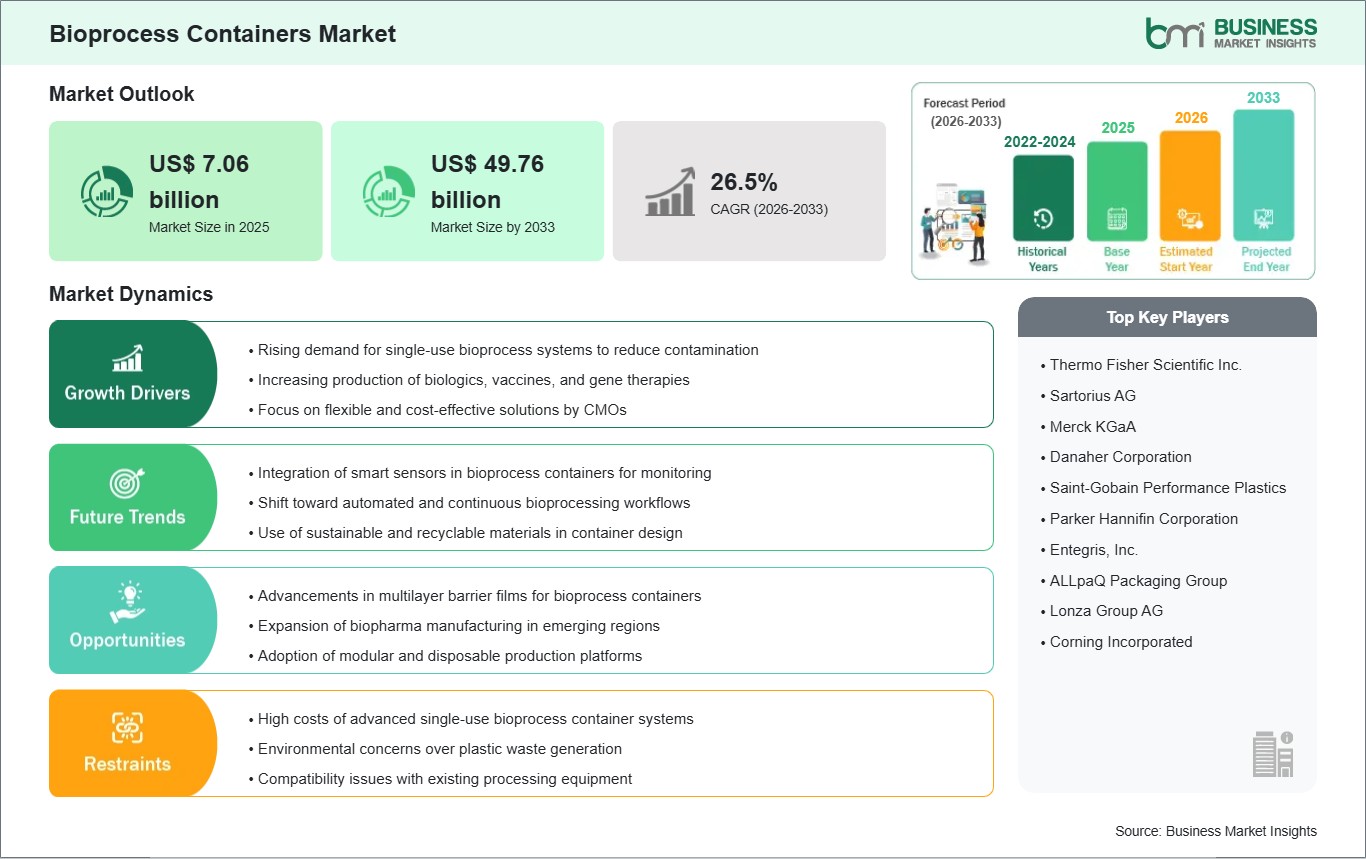
Bioprocess containers (BPCs) refer to specialized, sterile, single-use liquid handling systems engineered for the cultivation, storage, and transport of biological materials within the biopharmaceutical manufacturing lifecycle. These systems, constructed from medical-grade, multi-layer polymer films, predominantly polyethylene and polypropylene, are designed to maintain absolute sterility and product integrity while handling sensitive substances such as cell culture media, buffers, and intermediate bulk products. Market growth is fundamentally propelled by the global shift toward single-use technologies (SUTs), which offer superior operational flexibility and a lower capital footprint compared to traditional stainless-steel installations. The rising demand for biologics, monoclonal antibodies (mAbs), and vaccines, coupled with the emergence of personalized medicine and cell and gene therapies, has intensified the requirement for sterile, scalable fluid-handling solutions. Furthermore, the global expansion of biomanufacturing capacity in emerging economies continues to serve as a primary catalyst for sustained demand.
However, several factors may restrain market progression. Strict regulatory requirements concerning leachables and extractables (L&E) necessitate rigorous testing to ensure that plastic components do not compromise the safety or purity of the therapeutic product. Environmental concerns regarding plastic waste pose challenges as the industry faces increasing pressure to develop sustainable disposal or recycling pathways for single-use components. Additionally, the sector encounters constraints related to supply chain volatility for medical-grade resins and the high capital outlay required for high-purity polymer film production, which can influence procurement costs for manufacturers.
Despite these hurdles, the market holds significant opportunities in the integration of smart sensors and IoT for real-time monitoring of container integrity and fluid conditions. The rise of continuous bioprocessing, which relies on integrated, single-use fluid paths, and the expansion of modular manufacturing facilities are expected to support long-term development within the sector. Manufacturers are also finding growth potential in the development of high-strength, leak-resistant multilayer films designed to support large-volume biologics manufacturing.
Segment Analysis
Bioprocess Containers Market Segmentation
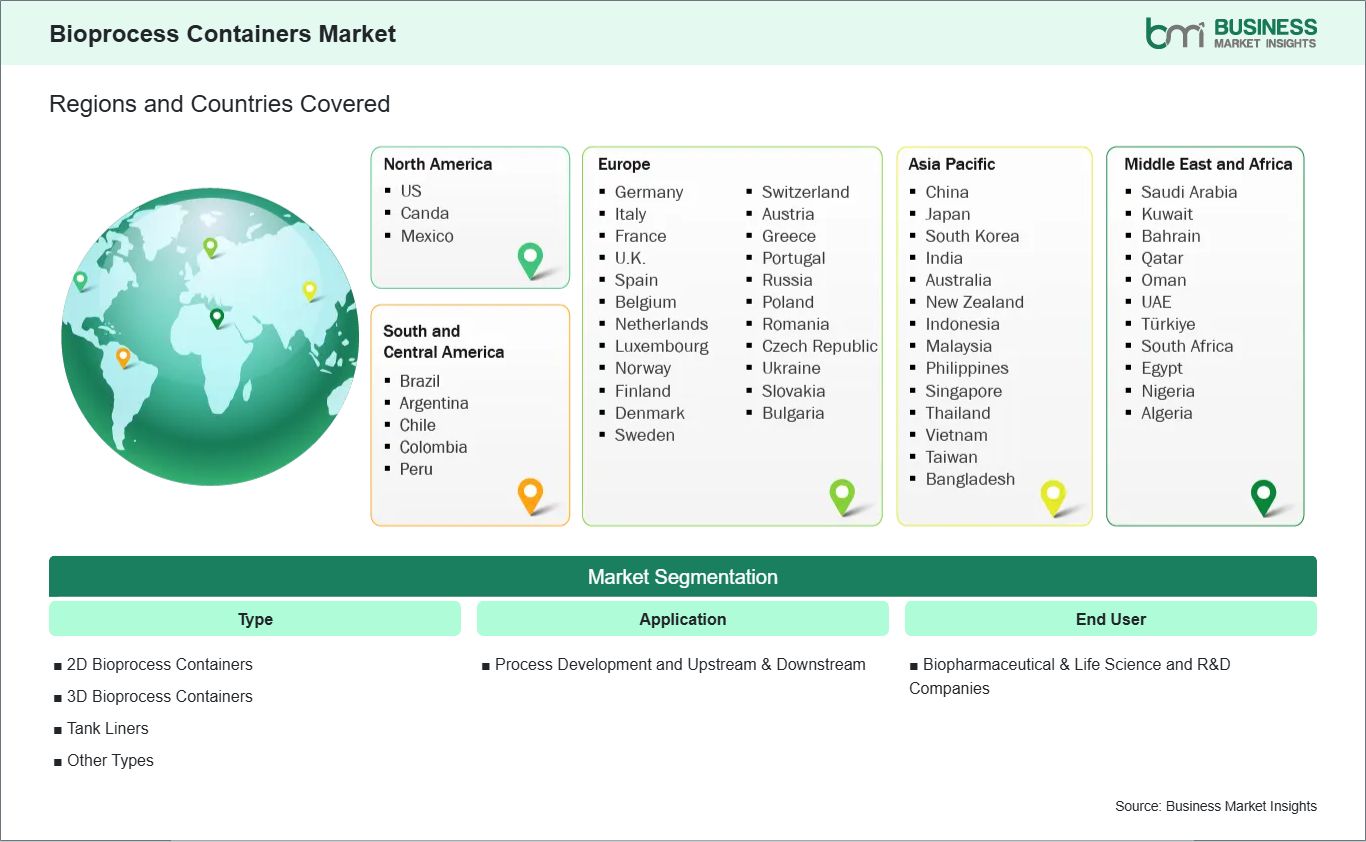
Key segments that contributed to the derivation of the Bioprocess Containers market analysis are type, application, and end user.
- By Type, the market is segmented into 2D Bioprocess Containers, 3D Bioprocess Containers, Tank Liners, and Other.
- By Application, the market is divided into Process Development and Upstream & Downstream.
- By End User, the market is categorized into Biopharmaceutical & Life Science and R&D Companies.
Market Forces
Bioprocess Containers Market Drivers and Opportunities
Expanding Biologics Pipelines and the Imperative for Capital Efficiency
The primary driver for the Bioprocess Containers Market is the accelerating global demand for complex biological therapies and the systemic shift toward more efficient manufacturing modalities. The Robust Expansion of the Global Biologics and Biosimilars Pipeline acts as a foundational catalyst, as the production of monoclonal antibodies, recombinant proteins, and vaccines necessitates a high volume of sterile fluid-handling solutions. This momentum is further propelled by the Strategic Adoption of Single-Use Technologies (SUT) for Cost and CAPEX Avoidance; by eliminating the need for extensive cleaning and sterilization (CIP/SIP) required by stainless-steel systems, manufacturers can reduce initial capital investment and significantly lower water and energy consumption. In the technological sphere, the Rising Prominence of Cell and Gene Therapies (CGT) serves as a critical driver, as these high-value, low-volume treatments require the exceptional aseptic integrity and rapid turnaround times provided by disposable bioprocess containers. Furthermore, the Expansion of Contract Development and Manufacturing Organizations (CDMOs) is driving market growth, as these entities utilize flexible SUT platforms to service multiple clients and switch between production runs with minimal downtime. Together, these factors, the biologics surge, fiscal optimization, and the rise of personalized medicine, ensure a robust and non-discretionary growth path for the global Bioprocess Containers Market.
Smart Film Innovation and the Proliferation of Continuous Bioprocessing
A significant high-value opportunity lies in the convergence of Bioprocess Containers with Advanced Material Science and Smart Sensor Integration. Manufacturers are increasingly developing next-generation polymer films with ultra-low leachable and extractable profiles to ensure the chemical stability of sensitive therapeutic proteins. There is also a major growth frontier in the development of Integrated Monitoring Solutions, where single-use sensors for pH, dissolved oxygen, and temperature are embedded directly into the container, allowing for real-time data collection and automated process control. Furthermore, the expansion of Continuous and Hybrid Bioprocessing Lines presents a lucrative opportunity, as these systems require specialized 2D and 3D bags designed to handle the constant fluid transfer and high-throughput demands of modern upstream and downstream workflows. Beyond the hardware, the rise of Regional Manufacturing Hubs in Emerging Markets, particularly in Asia-Pacific, offers a unique frontier as local firms invest in disposable infrastructure to support domestic biosimilar production. Manufacturers who focus on Customizable, Large-Volume (2,000L+) 3D Containers and those pioneering Sustainable, Recyclable Polymeric Solutions are positioned to lead the global Bioprocess Containers Market.
Size and Share Analysis
Bioprocess Containers Market Size and Share Analysis
The Bioprocess Containers market demonstrates steady growth, with size and share analysis revealing evolving trends and competitive positioning among key players. The report examines subsegments categorized within type, application, and end user, offering insights into their contribution to overall market performance.
Based on the type, the 2D Bioprocess Containers subsegment holds the primary market presence, acting as the ubiquitous foundational tool for small-to-medium volume liquid handling. These systems are indispensable for the market, maintaining a significant position due to their cost-efficiency and versatility in storing cell culture media, buffers, and intermediate products. 3D Bioprocess Containers and Tank Liners provide critical support for large-scale operations, with 3D formats serving as the essential solution for high-volume bioreactor applications. A notable trend is the surge in the 3D Bioprocess Containers subsegment, which is registering the highest pace of adoption. These technologies are becoming essential for Commercial-Scale Bio-Production, as the move toward large-volume, high-integrity bags allows for the efficient mixing and transport of high-value drug substances with significantly reduced capital expenditure compared to fixed-vessel systems.
Report Coverage
Bioprocess Containers Market Report Coverage and Deliverables
Bioprocess Containers Market Report Coverage and Deliverables
The "Bioprocess Containers Market Size and Forecast (2022–2033)" report provides a detailed analysis of the market covering below areas:
- Bioprocess Containers market size and forecast at global, regional, and country levels for all market segments covered under the scope
- Bioprocess Containers market trends, as well as drivers, restraints, and opportunities
- Bioprocess Containers market analysis covering key trends, global and regional framework, major players, regulations, and recent developments
- Industry landscape and competition analysis covering market concentration, heat map analysis, prominent players, and recent developments for the Bioprocess Containers market
- Detailed company profiles, including SWOT analysis
Geographic Insights
Bioprocess Containers Market Geographic Insights
The geographical scope of the Bioprocess Containers market report is divided into five regions: North America, Asia Pacific, Europe, Middle East & Africa, and South & Central America.
North America maintains the preeminent market position, supported by a dense concentration of major biopharmaceutical entities, high levels of investment in biologics research, and a favorable regulatory environment that encourages the adoption of single-use technologies. Europe represents a significant and mature market, driven by a robust pharmaceutical manufacturing sector, particularly in Germany and the United Kingdom, and an increasing institutional focus on reducing cross-contamination through disposable processing systems. Asia Pacific is identified as the most rapidly advancing region, propelled by accelerating biotech innovation, the expansion of contract manufacturing organizations (CMOs) in China and India, and substantial public investments in life sciences infrastructure.
The Asia-Pacific Bioprocess Containers Market is segmented into China, Japan, South Korea, India, Australia, and the Rest of Asia Pacific. China serves as a central engine for regional growth, driven by massive government initiatives to enhance domestic vaccine production and a rising demand for monoclonal antibodies. India is witnessing a notable transition as localized manufacturing hubs expand their capacity to meet both domestic and international pharmaceutical requirements. Japan continues to prioritize high-specification instrumentation, focusing on the integration of automated, high-integrity container systems to support its advanced cell and gene therapy research.
Industry Activity
Recent Developments
The Bioprocess Containers market is evaluated by gathering qualitative and quantitative data post primary and secondary research, which includes important corporate publications, association data, and databases. A few of the key developments in the Bioprocess Containers market are:
- In Feb 2026, BioLife Solutions signed a multi-year supply and collaboration agreement with Qkine Limited to distribute cytokines and integrate select products into its CellSeal® Connect vial system. The partnership expands BioLife`s bioprocess container portfolio and strengthens solutions for cell and gene therapy manufacturing.
- In September 2024, Sartorius and G-CON are collaborating to integrate ProcessGo® single-use bioprocessing solutions into modular G-CON POD® cleanrooms. The partnership accelerates deployment of flexible, sustainable cGMP facilities, enhancing bioprocess container use and supporting rapid production of cell and gene therapies.
Trust & Transparency
Research Methodology
The market analysis combines proprietary research with secondary data from government agencies, company disclosures, regulatory filings, industry databases and expert interviews. Market estimates are validated through data triangulation, cross-market benchmarking and analyst
review.
View Full Research Methodology
Key Sources Referred:
World Bank – Global Trade IndicatorsWorld Trade Organization (WTO)(International Monetary Fund )IMFInternational Trade Administration (ITA)Company websiteCompany annual reportsCompany investor presentations