Market Summary
Executive Summary and Global Market Analysis
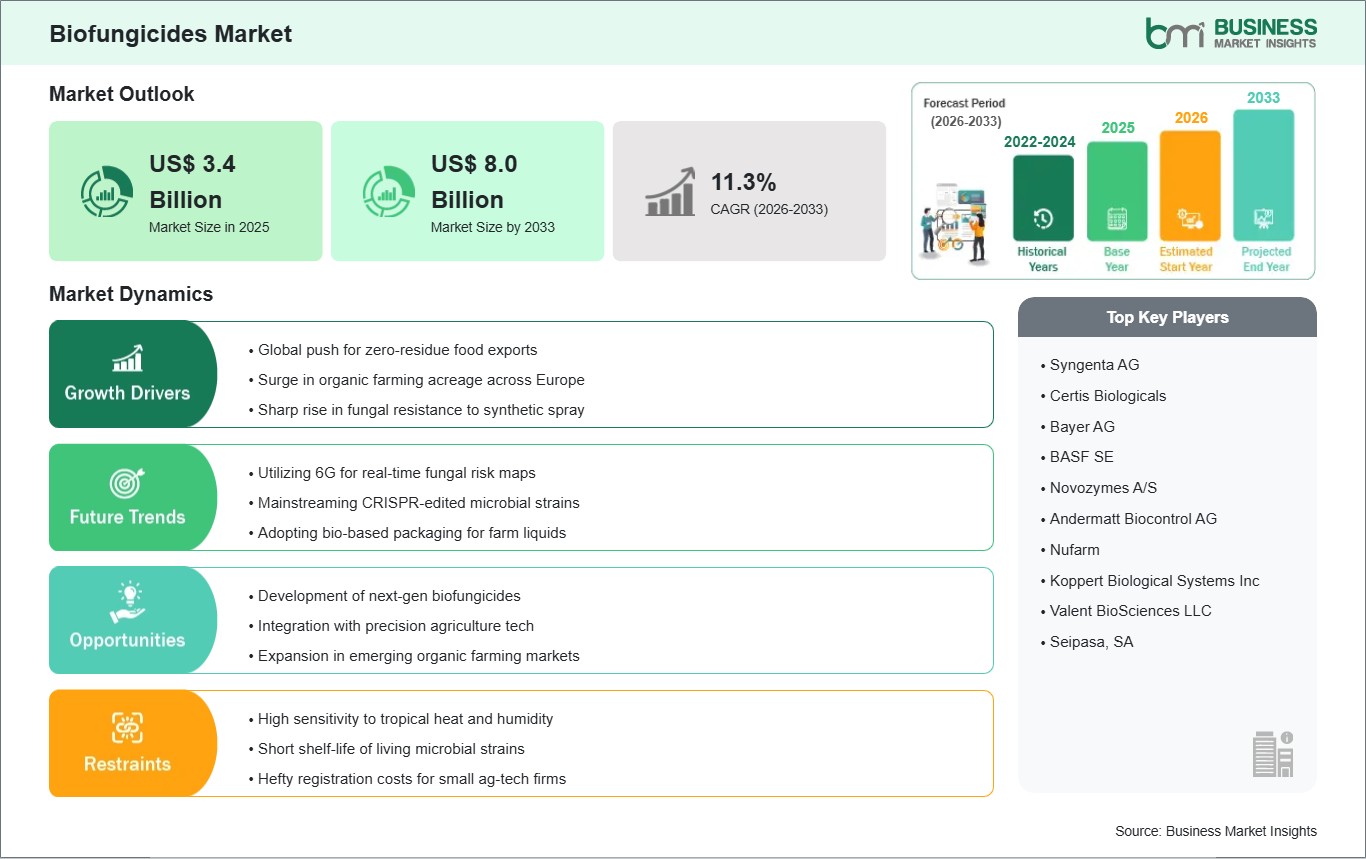
Biofungicides are biological control agents derived from natural sources, such as bacteria, fungi, and plant extracts, used to suppress or kill phytopathogenic fungi. Unlike synthetic counterparts, these formulations utilize non-toxic mechanisms like competition, parasitism, and induced systemic resistance (ISR) to protect crops while maintaining ecological balance. Growth in the biofungicides market is driven by the surging global demand for organic produce, stringent regulatory restrictions on synthetic pesticides (such as the EU’s Farm to Fork Strategy), and the rapid adoption of Integrated Pest Management (IPM) practices. Additionally, the shift toward "Green Chemistry" is fundamentally enhancing the environmental compliance and soil health profiles of modern farming.
However, several challenges can restrain market growth: higher production and application costs compared to mass-produced synthetics remain a barrier for small-scale farmers. Sensitivity to environmental conditions and a typically shorter shelf life pose constant logistics and reliability hurdles. Furthermore, the industry faces constraints due to complex regulatory approval cycles for living organisms and a persistent technical knowledge gap regarding the optimal timing and integration of biologicals into conventional spray programs. Despite these hurdles, the market holds immense opportunities due to the universal mandate for residue-free food supply chains and the accelerating deployment of nano-encapsulated microbial formulations for enhanced stability. The expansion of seed treatment applications and the transition toward AI-driven precision spraying are expected to create significant opportunities for market growth.
Segment Analysis
Biofungicides Market Segmentation
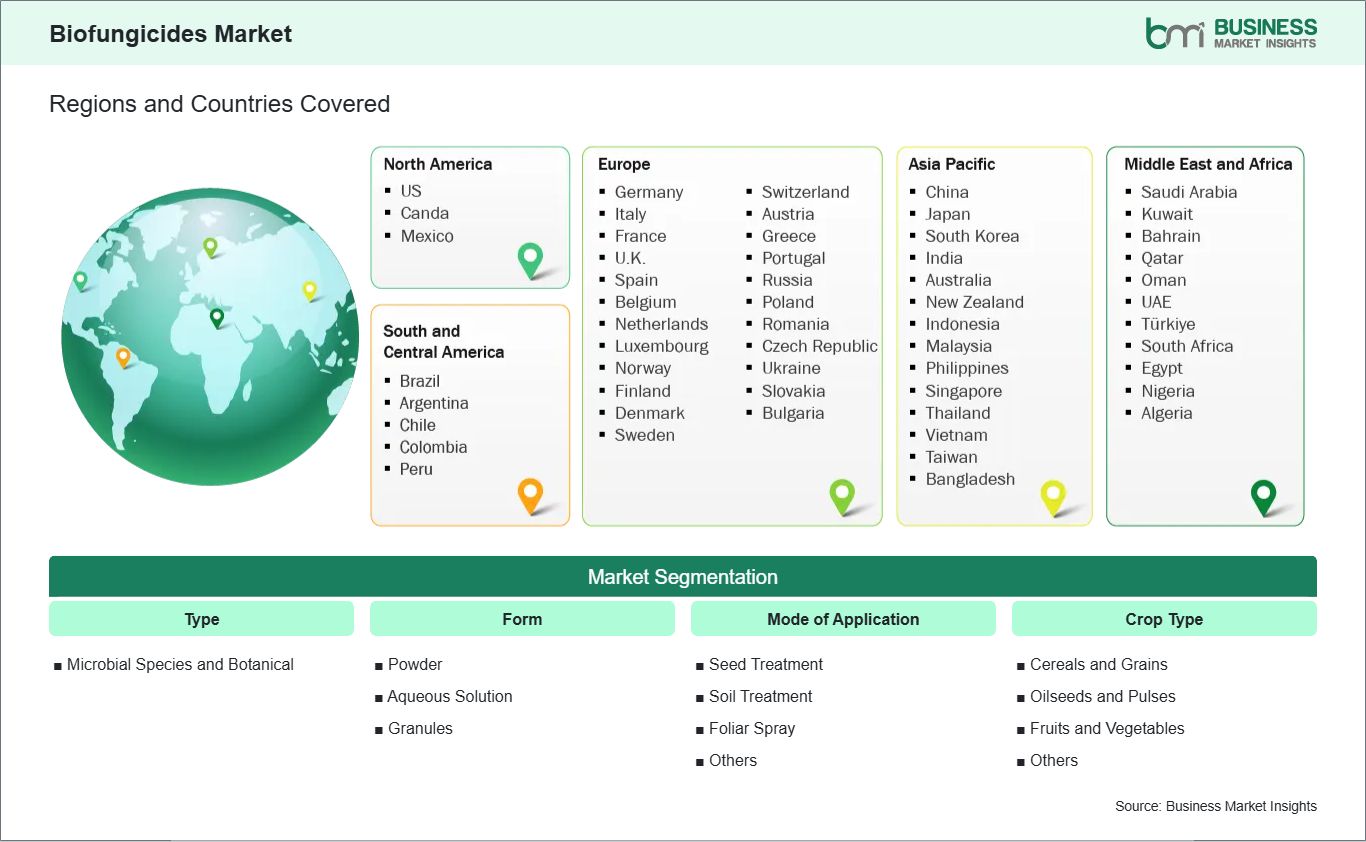
Key segments that contributed to the derivation of the Biofungicides market analysis are type, form, mode of application, and crop type.
- By Type, the market is bifurcated into Microbial Species and Botanical.
- By Form, the market is segmented into Powder, Aqueous Solution, and Granules.
- By Mode of Application, the market is segmented into Seed Treatment, Soil Treatment, Foliar Spray, and Others.
- By Crop Type, the market is segmented into Cereals and Grains, Oilseeds and Pulses, Fruits and Vegetables, and Others.
Market Forces
Biofungicides Market Drivers and Opportunities
Regulatory Pressure and Demand for Residue-Free Produce
The primary driver for the Biofungicides Market is the intensifying global regulatory crackdown on synthetic chemical pesticides, particularly within the European Union’s "Farm to Fork" strategy. As many traditional active ingredients are banned or restricted due to their environmental and health risks, farmers are left with a "regulatory vacuum" that biological solutions are uniquely positioned to fill. Simultaneously, there is an urgent consumer demand for residue-free produce. Modern grocery retailers and export markets now enforce stringent Maximum Residue Limits (MRLs), often more rigorous than government standards. Biofungicides, derived from beneficial microorganisms like Bacillus subtilis or Trichoderma, allow for zero-day pre-harvest intervals, enabling farmers to treat crops right up until the point of sale. This alignment with "Green Chemistry" and organic farming trends has shifted biofungicides from niche alternatives to essential components of modern, high-value agricultural supply chains.
Technological Bio-Formulation and Crop Management
A significant high-value opportunity lies in the advancement of specialized bio-formulations that overcome historical limitations regarding shelf life and field stability. Innovations such as micro-encapsulation and nano-biofungicides now protect delicate microbial spores from UV degradation and temperature fluctuations, extending shelf stability to over 24 months. Furthermore, there is a massive opportunity in the integration of biologicals with precision agriculture and digital scouting. By utilizing AI-driven drones and soil sensors, biofungicides can be applied as preventative seed treatments or targeted soil drenching precisely when environmental conditions favor pathogen growth. This "preventative" approach primes the plant’s systemic acquired resistance (SAR), reducing the need for emergency chemical intervention. Manufacturers who develop hybrid Integrated Pest Management (IPM) packages, combining robust biologicals with data-driven application tools, are positioned to dominate the broad-acre crop segment, offering scalable solutions for soil health and long-term yield resilience.
Size and Share Analysis
Biofungicides Market Size and Share Analysis
The Biofungicides market demonstrates steady growth, with size and share analysis revealing evolving trends and competitive positioning among key players. The report further examines subsegments categorized within type, form, mode of application, and crop type, offering insights into their contribution to overall market performance.
For instance, the Microbial Species subsegment holds a significant share of the market, primarily due to the high efficacy of beneficial bacteria and fungi like Bacillus and Trichoderma. These microbes are increasingly utilized for Fruits and Vegetables, where they provide a residue-free alternative to synthetic chemicals, a critical factor for meeting stringent export standards and organic certifications. The growth of this segment is supported by the transition toward Aqueous Solution products, which allow for easier mixing and more uniform coverage during application.
Report Coverage
Biofungicides Market Report Coverage and Deliverables
The Biofungicides Market Size and Forecast (2022–2033) report provides a detailed analysis of the market covering below areas:
- Biofungicides market size and forecast at global, regional, and country levels for all the key market segments covered under the scope
- Biofungicides market trends, as well as market dynamics such as drivers, restraints, and key opportunities
- Biofungicides market analysis covering key market trends, global and regional framework, major players, regulations, and recent market developments
- Industry landscape and competition analysis covering market concentration, heat map analysis, prominent players, and recent developments for the Biofungicides market
- Detailed company profiles, including SWOT analysis
Geographic Insights
Biofungicides Market Geographic Insights
The geographical scope of the Biofungicides market report is divided into five regions: North America, Asia Pacific, Europe, Middle East & Africa, and South & Central America.
The Asia-Pacific Biofungicides Market is segmented into China, Japan, South Korea, India, Australia, New Zealand, Indonesia, Malaysia, the Philippines, Singapore, Thailand, Vietnam, Taiwan, Bangladesh, and the Rest of Asia. The market is primarily driven by the region's massive agricultural base and the shift toward sustainable farming to ensure food security.
Growth is further bolstered by the increasing adoption of microbial formulations (such as Trichoderma and Bacillus species) to combat soil-borne diseases. The expansion of organic farming acreage and the rising awareness of chemical-related health risks solidify Asia Pacific as the primary global hub for biofungicide innovation and volume consumption.
Industry Activity
Recent Developments
The Biofungicides market is evaluated by gathering qualitative and quantitative data post primary and secondary research, which includes important corporate publications, association data, and databases. A few of the key developments in the Biofungicides market are:
- In January 2024, Sipcam Agro USA, Inc. proudly launched Mevalone in California. A revolutionary biofungicide that offers grape growers successful management of bunch rot and powdery mildew on wine, table, and raisin grapes. Mevalone is a specialty crop protection product with a novel soft chemistry and unique mode of action. Successfully used by European growers for years, Mevalone is now registered in CA and available in 16 other states.
- In January 2024, Certis Biologicals launched Convergence® Biofungicide, a powerful crop protection solution for corn, soybeans, and peanuts. This reliable biofungicide provides farmers with an EPA-approved, powerful, and convenient biological tool to protect and fortify crops. Convergence protects against soilborne fungal and bacterial diseases caused by Pythium, Rhizoctonia, Fusarium, and Phytophthora. It also provides an additional mode of action against tough-to-control foliar diseases, including tar spot, rusts, and leaf spots.
Trust & Transparency
Research Methodology
The market analysis combines proprietary research with secondary data from government agencies, company disclosures, regulatory filings, industry databases and expert interviews. Market estimates are validated through data triangulation, cross-market benchmarking and analyst
review.
View Full Research Methodology
Key Sources Referred:
World Bank – Global Trade IndicatorsWorld Trade Organization (WTO)International Monetary Fund (IMF)International Trade Administration (ITA)Company WebsitesCompany Annual ReportsCompany Investor Presentations