
Bi-Metal Band Saw Blade Market Outlook: Size, Share, Trends, Growth Analysis, Competitive Landscape & Forecast, 2026–2033

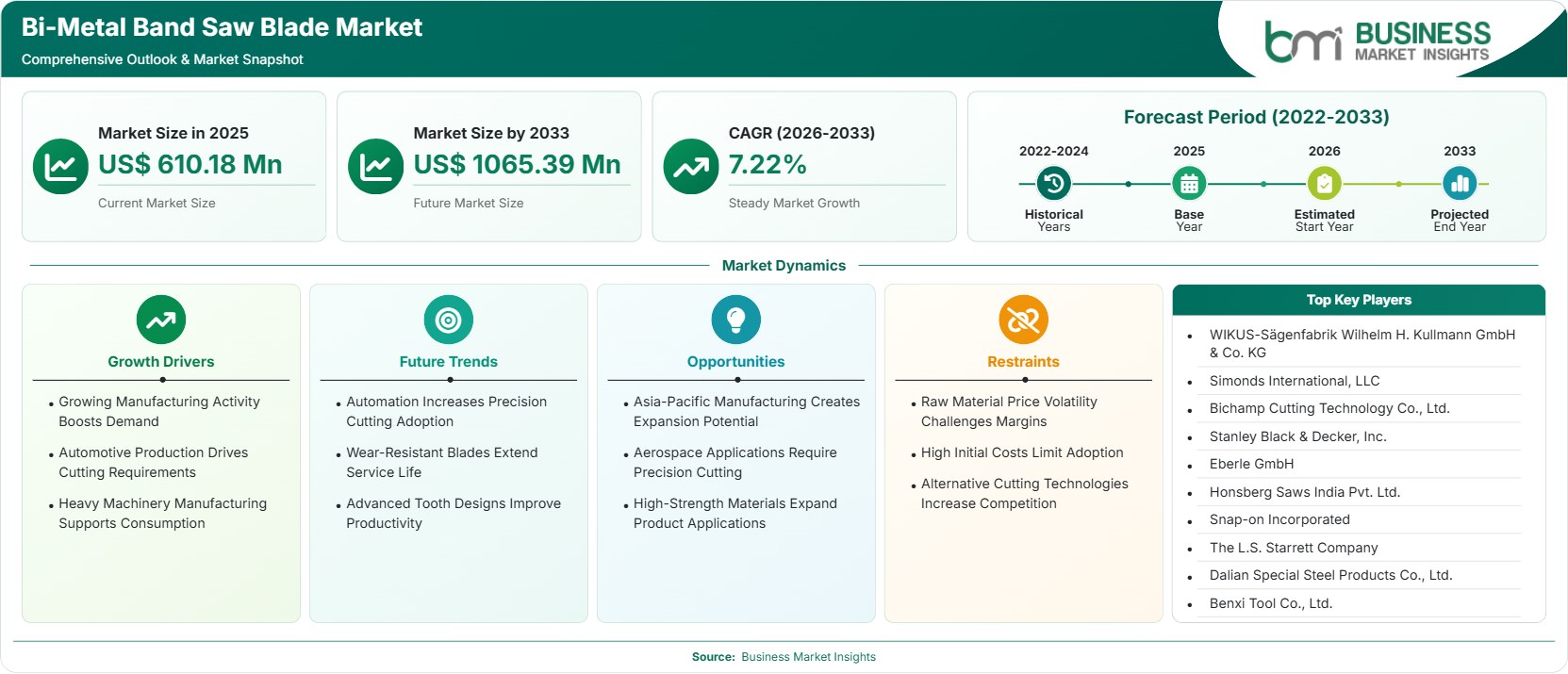
The Bi-Metal Band Saw Blade Market size was valued at US$ 610.18 Million in 2025 and is projected to reach US$ 1065.39 Million by 2033, growing at a CAGR of 7.22% during 2026–2033. Demand is being supported by precision metal-cutting requirements, manufacturing automation, automotive production expansion, and increasing adoption of high-performance sawing solutions across industrial machining operations.

Report Coverage
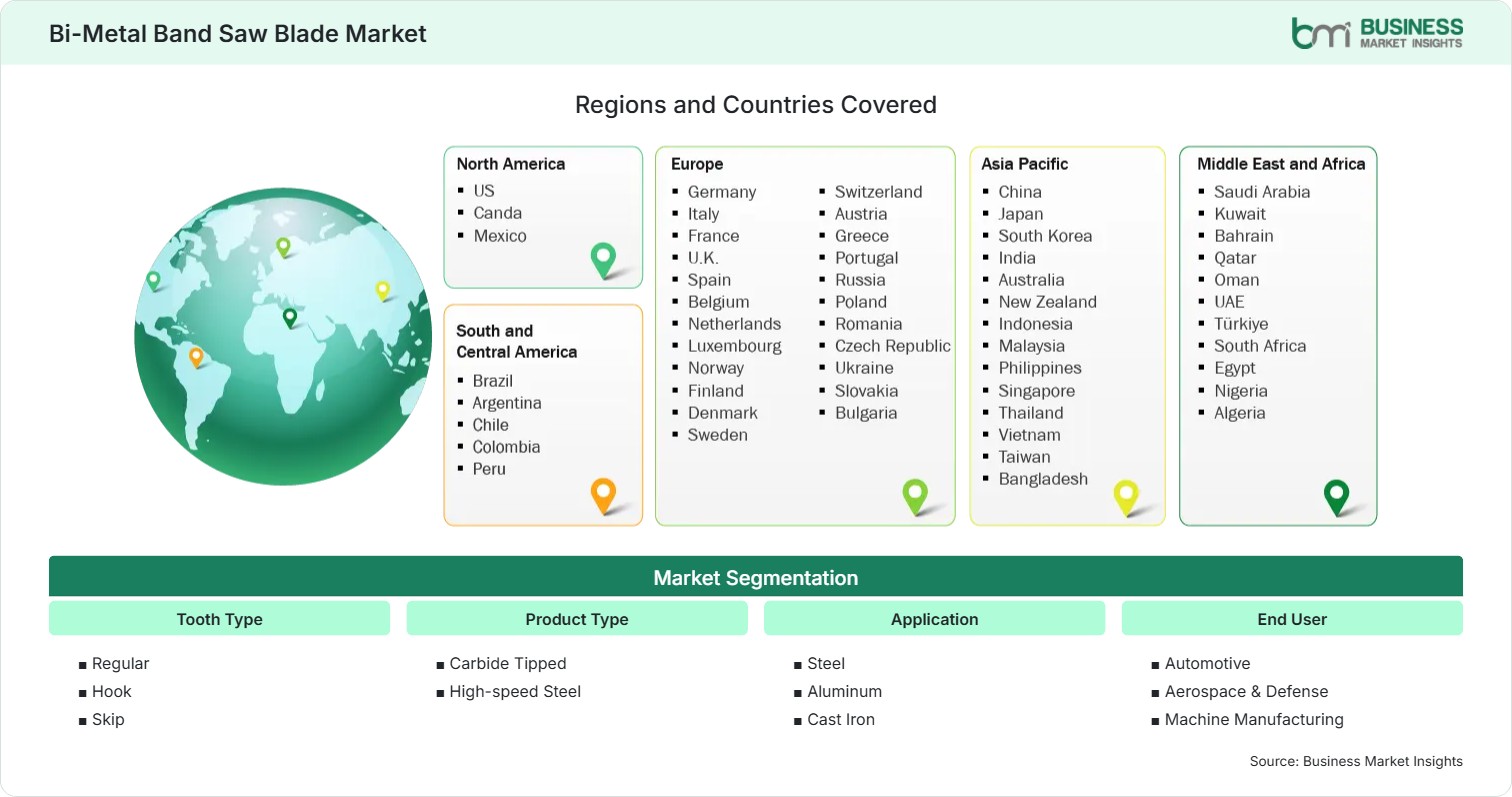
  • Tooth Type: Regular, Hook, Skip
  • Product Type: Carbide Tipped, High-speed Steel
  • Application: Steel, Aluminum, Cast Iron
  • End User: Automotive, Aerospace & Defense, Machine Manufacturing
US$ 610.18 Mn Market size in 2025
US$ 1065.39 Mn Market Size by 2033
7.22% CAGR, 2026 - 2033
2026-2033 Forecast Period

AI Overview

Bi-Metal Band Saw Blade Market Summary

  • North America Region: North America holds a market share of 34%–37% in 2025, growing at a CAGR of 6.2%–6.8% during 2026–2033. Growth is supported by aerospace machining investments, industrial automation, replacement demand, reshoring initiatives, productivity-focused cutting operations, advanced manufacturing upgrades, durable blade adoption, and metal fabrication expansion. US market benefits from aerospace, automotive and fabrication activity, representing 72%–76% of regional demand and advancing at 6.3%–6.9%.
  • Fastest Growing Region: Asia Pacific accounts for 30%–33% share in 2025 and is forecast to expand at 8.4%–9.1% CAGR during 2026–2033. Manufacturing relocation, infrastructure programs, industrial investment, machine-tool deployments, automotive production growth, export-oriented fabrication sectors, and rising metal processing capacity sustain long-term expansion.
  • Leading Segment: Steel application commands 48%–52% share in 2025 and grows at 6.8%–7.5% CAGR through 2033. Extensive structural fabrication, machinery manufacturing, automotive processing, industrial infrastructure activities, replacement demand, and continuous steel component machining support sustained consumption volumes globally.
  • High Growth Segment: Aerospace & Defense end users represent 16%–19% share in 2025 while advancing at 8.5%–9.2% CAGR. Rising aircraft production, defense manufacturing programs, titanium alloy machining, precision cutting requirements, advanced materials adoption, and stringent productivity targets accelerate premium blade demand.
  • Key Market Opportunity: Adoption of smart manufacturing environments creates opportunities for premium blades integrated with predictive maintenance programs, performance monitoring, optimized cutting parameters, reduced downtime, extended blade life, and productivity-focused service models.
  • Major Market Players: WIKUS-Sägenfabrik Wilhelm H. Kullmann GmbH & Co. KG; Simonds International, LLC; Bichamp Cutting Technology Co., Ltd.; Stanley Black & Decker, Inc.; Eberle GmbH; Honsberg Saws India Pvt. Ltd.; Snap-on Incorporated; The L.S. Starrett Company; Dalian Special Steel Products Co., Ltd.; Benxi Tool Co., Ltd.
Strategic Insights

Bi-Metal Band Saw Blade Market: Strategic Insights

Bi-Metal Band Saw Blade Market Strategic Framework
FREE PDF
Request your free sample
Request free sample
Stakeholder View

Key Takeaways

  • The value chain remains highly integrated, linking specialty steel suppliers, blade manufacturers, distributors, machine-tool providers, and industrial end users focused on productivity optimization.
  • Aerospace, defense, and advanced machine manufacturing applications offer the strongest long-term upside due to increasing requirements for precision alloy cutting.
  • Product innovation is shifting toward advanced tooth profiles, vibration-reduction designs, improved metallurgy, and application-specific blade engineering.
  • Asia Pacific presents an attractive investment case because of industrial expansion, expanding export manufacturing, and increasing machine-tool penetration.
  • Strategic partnerships between blade producers and equipment manufacturers are strengthening aftermarket service revenues and enhancing customer retention.
  • Premium-performance products are gaining share as end users increasingly prioritize total cost of ownership over initial blade purchase price.
Geographic Outlook

Bi-Metal Band Saw Blade Market Regional Highlights

North America Bi-Metal Band Saw Blade Market

North America accounts for 34%–37% of global demand in 2025 and is projected to expand at 6.2%–6.8% CAGR through 2033. The region benefits from aerospace production, industrial automation investments, and replacement demand from mature fabrication sectors. The Bi-Metal Band Saw Blade Market share remains highest in this region because manufacturers prioritize productivity, cutting accuracy, and blade longevity. Advanced machine shops continue increasing adoption of premium cutting solutions.

  • Aerospace manufacturing programs support premium blade penetration across precision machining applications.
  • Reshoring initiatives encourage investments in modern fabrication facilities and metalworking equipment.
  • Automotive component manufacturing maintains stable replacement demand for high-performance blades.
  • Digital manufacturing strategies improve cutting process efficiency and reduce operational waste.
  • Industrial maintenance activities sustain recurring aftermarket consumption.

US Bi-Metal Band Saw Blade Market

The United States represents 72%–76% of North American demand and records a 6.3%–6.9% CAGR. Strong metal fabrication activity, advanced industrial infrastructure, and extensive aerospace production support market expansion. Manufacturers increasingly deploy productivity-enhancing cutting technologies to manage labor constraints and improve output quality. Demand is especially concentrated across machinery, transportation equipment, and defense-related manufacturing operations.

  • Aerospace suppliers increasingly adopt advanced cutting solutions for specialty alloys.
  • Machine manufacturing investments drive replacement and premiumization demand.
  • Domestic production expansion supports sustained industrial tooling consumption.
  • Automation adoption encourages optimized cutting and maintenance practices.

Europe Bi-Metal Band Saw Blade Market

Europe holds approximately 27%–30% share in 2025 and expands at 6.4%–7.0% CAGR through 2033. Germany remains the leading market due to strong engineering and machine-tool industries, while Poland exhibits higher growth near 7.5%–8.2%. Regional demand is supported by industrial modernization, automotive manufacturing, and precision engineering activities. Sustainability initiatives encourage efficient production technologies and waste reduction.

  • Germany leads regional consumption through engineering and industrial machinery sectors.
  • Poland shows elevated investment activity in fabrication and manufacturing infrastructure.
  • Automotive supply chains require consistent cutting accuracy and productivity.
  • Industrial automation increases demand for premium blade solutions.
  • Export-oriented manufacturing strengthens replacement cycles.

Asia Pacific Bi-Metal Band Saw Blade Market

Asia Pacific captures 30%–33% share in 2025 and records the fastest expansion at 8.4%–9.1% CAGR. China remains the largest consumer, while India demonstrates growth exceeding 9.0%–9.8%. The Bi-Metal Band Saw Blade Market growth trajectory in the region is driven by industrial expansion, infrastructure activity, automotive production, and increasing metalworking capacity. Manufacturing relocation trends continue reinforcing long-term demand fundamentals.

  • China leads regional consumption through scale manufacturing operations.
  • India benefits from industrialization and machine manufacturing investments.
  • Infrastructure development stimulates metal processing requirements.
  • Export manufacturing supports capacity additions across fabrication facilities.
  • Machinery production increases demand for advanced cutting tools.

Rest of World Bi-Metal Band Saw Blade Market

Rest of World represents 8%–10% of global demand and advances at 7.0%–7.8% CAGR. South and Central America benefit from industrial recovery and fabrication investments. Middle East and Africa markets are supported by infrastructure projects, energy-sector manufacturing, and diversification initiatives. Brazil leads regional consumption, while Saudi Arabia demonstrates stronger growth prospects linked to industrial development programs and localized manufacturing strategies.

  • Brazil remains the primary market across South and Central America.
  • Saudi Arabia benefits from manufacturing diversification initiatives.
  • Energy-sector fabrication creates specialized cutting requirements.
  • Infrastructure projects increase industrial metalworking activity.
  • Import substitution strategies encourage localized production capacity.
Global Market Geography
FREE PDF
Request your free sample
Request free sample
Segment Analysis

Bi-Metal Band Saw Blade Market Segmentation

Tooth Type

This segment represents a critical performance differentiator across metal-cutting applications. The category accounts for approximately 26%–29% market share in 2025 and grows at 6.9%–7.5% CAGR. Selection depends on material hardness, chip evacuation requirements, cutting speed, and finish quality. The Bi-Metal Band Saw Blade Market scope continues expanding as end users seek application-specific tooth configurations.

  • Regular: Widely utilized for general-purpose cutting operations, offering balanced performance, operational flexibility, stable cutting behavior, and suitability across diverse industrial fabrication environments.
  • Hook: Preferred for thicker materials and aggressive cutting applications because enhanced rake angles improve penetration efficiency and facilitate faster chip removal.
  • Skip: Selected for softer materials and interrupted cuts where larger gullets improve chip clearance while lowering heat generation during operations.

Product Type

Product innovation remains concentrated in metallurgy and cutting-edge technologies. The segment holds roughly 31%–34% Bi-Metal Band Saw Blade Market share during 2025 and advances at 7.1%–7.8% CAGR. Growing productivity requirements encourage adoption of premium products capable of extended service life and consistent performance under demanding production conditions.

  • Carbide Tipped: Increasingly adopted in advanced industrial environments requiring superior wear resistance, extended blade life, and reliable cutting of difficult materials.
  • High-speed Steel: Maintains extensive use because of cost-effectiveness, operational reliability, broad application compatibility, and strong performance in routine metal-cutting operations.

Application

Application demand is strongly linked to manufacturing output and industrial investment cycles. This segment includes the largest revenue contribution, with steel accounting for 48%–52% share and expanding at 6.8%–7.5% CAGR. The Bi-Metal Band Saw Blade Market trends indicate rising demand for higher cutting efficiency and longer operational life.

  • Steel: Dominates consumption due to extensive use across structural fabrication, automotive manufacturing, construction equipment production, and industrial machinery applications.
  • Aluminum: Benefits from lightweight manufacturing trends and increasing production of transportation, aerospace, and industrial components requiring accurate cutting.
  • Cast Iron: Supports demand through machinery, engine components, and industrial equipment manufacturing requiring durable, precision-cutting capabilities.

End user

End-user demand reflects broader industrial production activity. The segment contributes approximately 22%–25% Bi-Metal Band Saw Blade Market share in 2025 while growing at 7.0%–7.7% CAGR. Productivity improvement initiatives, automation deployment, and precision machining requirements continue influencing adoption decisions across major manufacturing sectors.

  • Automotive: Requires efficient cutting solutions for components, tooling, structural parts, and production systems emphasizing throughput and operational consistency.
  • Aerospace & Defense: Benefits from machining requirements involving specialized alloys, precision tolerances, and high-value manufacturing processes.
  • Machine Manufacturing: Sustains recurring demand through equipment production, industrial machinery fabrication, and aftermarket maintenance activities.
Market Forces

Bi-Metal Band Saw Blade Market Dynamics

Key Market Drivers

Expansion of Global Metal Fabrication Capacity

Industrial manufacturing investment continues supporting demand for advanced cutting tools. Growth in automotive production, infrastructure development, machinery manufacturing, and industrial fabrication increases metal-cutting volumes across major economies. Rising production efficiency requirements encourage facilities to adopt higher-performance blades capable of improving throughput while reducing replacement frequency. Specialty alloy processing is also increasing, creating demand for products with stronger wear resistance and superior cutting stability. Manufacturers increasingly evaluate tooling based on total operating costs rather than acquisition price alone, supporting premium product adoption globally. These factors collectively strengthen demand across established and emerging industrial markets.

Growth in Aerospace and Defense Manufacturing

Aircraft production expansion, defense modernization programs, and increasing requirements for precision alloy machining support sustained demand. The production processes in aerospace often involve titanium, stainless steel, and nickel materials, which have specific requirements regarding their ability to cut successfully. With quality and productivity standards encouraging technological innovations in blades, producers are spending more money on the renovation of their equipment as well as the creation of automated environments that favor those products which show stable performance. As the number of regions involved in aerospace production keeps growing, the demand for quality blades will be steady.

Automation and Smart Manufacturing Adoption

Factory automation initiatives are transforming industrial cutting environments. Companies increasingly deploy connected manufacturing systems focused on productivity measurement, predictive maintenance, and process optimization. Higher-level blades enhance the automated process by adding to the consistency and accuracy of the operations along with increasing their operational life cycles. The integration of modern manufacturing techniques helps companies track their equipment performance and reduce interruptions. The factors such as productivity and energy efficiency, along with optimized labor utilization, motivate companies to invest in better cutting methods.

Key Market Opportunities

Premium Solutions for High-Performance Alloy Cutting

The demand for advanced alloys for aerospace, energy, and industrial equipment production presents significant opportunities. Such alloys usually tend to be challenging to machine and need special cutting capabilities. Companies that will manage to provide enhanced wear resistance, increased blade life, and improved cutting efficiency will be able to take advantage of high-margin business opportunities. Development of proprietary metallurgy and design solutions will continue to be strategically significant. According to long-term Bi-Metal Band Saw Blade Market Forecasts, value creation will increasingly shift toward specialized solutions serving complex industrial applications.

Industrial Expansion Across Emerging Economies

Rapid industrialization across Asia, the Middle East, and selected Latin American markets supports sustained demand growth. The manufacturing localization strategies will lead to investments in machine tools, fabrication plants, and metal processing facilities. Government-supported industrial programs will enhance efforts toward equipment upgrades and efficiency improvements. The suppliers who increase their distribution channels and technical support systems will be better positioned competitively in those areas. Production of machinery, transport equipment, and construction related equipment domestically will create the favorable environment for the usage of blades.

Value-Added Service and Lifecycle Management Models

Customers increasingly seek productivity-focused partnerships rather than purely transactional product purchases. Options for blade monitoring, application engineering, predictive maintenance, and performance optimization services allow for differentiation. It is possible to build more robust recurring revenue streams for suppliers through lifecycle service programs. The above-mentioned programs help users reduce downtime, ensure consistent cutting, and control their inventory. In addition, service-based approaches allow for building stronger relationships with customers and increasing retention rates. Competition in the field will result in integrated solutions becoming more important.

Market Restraints and Challenges

Volatile Raw Material Costs

Factor: Prices of alloy steels, cobalt-containing materials, and specialty metals remain vulnerable to supply-demand imbalances and geopolitical disruptions. Impact: Production expenses can rise sharply, putting price pressure on all parts of the supply chain. Suppliers can face shrinking margins when rising input costs are not passed on to consumers immediately. Price uncertainty can further make the job of purchasing goods more difficult. Industrial buyers often postpone purchase decisions in times of uncertainty, thereby making demand visibility difficult. It becomes important to maintain profitability through ongoing improvement and effective sourcing initiatives to counter this trend.

Competition from Alternative Cutting Technologies

Factor: Laser cutting, waterjet systems, abrasive technologies, and advanced machining processes continue improving performance across selected applications. Impact: Some consumers may shift away from traditional sawing systems as other technologies offer greater benefits. The competition forces suppliers to be constantly engaged in innovations and application engineering. The differentiation factor becomes very important in markets that prefer automation and multi-function processing. Suppliers have to show their cost efficiency and reliability to protect their position in the market.

Company Analysis

Competitive Landscape

The Bi-Metal Band Saw Blade Market analysis indicates competition centered on metallurgy expertise, product durability, cutting efficiency, application engineering, and global distribution capabilities.

Company Name

Overview

Products and Services relevant to this market

WIKUS-Sägenfabrik Wilhelm H. Kullmann GmbH & Co. KG

German specialist recognized for industrial sawing technologies and premium metal-cutting solutions.

Bi-metal band saw blades, carbide blades, application engineering, cutting optimization tools.

Simonds International, LLC

Long-established cutting tool manufacturer serving industrial and wood-processing sectors globally.

Bi-metal blades, industrial cutting tools, technical support, maintenance solutions.

Bichamp Cutting Technology Co., Ltd.

Major Chinese producer with international distribution and broad industrial customer base.

Bi-metal saw blades, carbide products, customized cutting solutions.

Stanley Black & Decker, Inc.

Global industrial tools company with extensive manufacturing and distribution capabilities.

Industrial cutting tools, sawing products, productivity-focused solutions.

Eberle GmbH

European manufacturer specializing in precision band saw blade technologies.

Bi-metal blades, alloy-cutting solutions, industrial sawing products.

Honsberg Saws India Pvt. Ltd.

Regional specialist supporting industrial metal-cutting applications and fabrication industries.

Band saw blades, cutting support services, industrial tooling products.

Snap-on Incorporated

Industrial tools supplier with a strong professional and manufacturing customer presence.

Precision tools, industrial cutting accessories, productivity solutions.

The L.S. Starrett Company

Global manufacturer recognized for sawing products and industrial measurement technologies.

Bi-metal blades, carbide-tipped blades, welded-to-length solutions.

Dalian Special Steel Products Co., Ltd.

Chinese manufacturer focused on specialty cutting and steel-related industrial products.

Metal-cutting blades, industrial sawing products, machining consumables.

Benxi Tool Co., Ltd.

Industrial tooling company serving metal fabrication and manufacturing sectors.

Band saw blades, tooling products, industrial cutting applications.

Trust & Transparency

Research Methodology

The market analysis combines proprietary research with secondary data from government agencies, company disclosures, regulatory filings, industry databases and expert interviews. Market estimates are validated through data triangulation, cross-market benchmarking and analyst review.

View Full Research Methodology

Questions Answered

Frequently Asked Questions

How is automation influencing future demand?

Automated manufacturing lines require consistent cutting precision, predictable blade performance, and minimized downtime, supporting premium-product adoption.

What does a Bi-Metal Band Saw Blade Market Report typically evaluate?

It assesses demand trends, technology developments, regional performance, competitive positioning, segmentation, growth drivers, opportunities, and industry risks.

Which region offers the strongest growth potential?

Asia Pacific presents the highest growth outlook due to industrialization, manufacturing investments, and expanding metalworking capacity.

Why are bi-metal blades preferred in industrial manufacturing?

Their combination of flexible backing material and hardened tooth edge provides durability, cutting accuracy, and cost-efficient operating performance.

What are the primary applications of bi-metal band saw blades?

They are extensively used for cutting steel, aluminum, cast iron, structural components, machinery parts, and specialty alloys across automotive, aerospace, and fabrication environments.

Access the Full Bi-Metal Band Saw Blade Market Report

Get segment-level forecasts, regional estimates, competitive benchmarking, company profiles and downloadable Excel datasets.

Access the full Bi-Metal Band Saw Blade Market Report
350 pages PDF & Excel | 2026-09-01