Market Summary
Executive Summary and Global Market Analysis
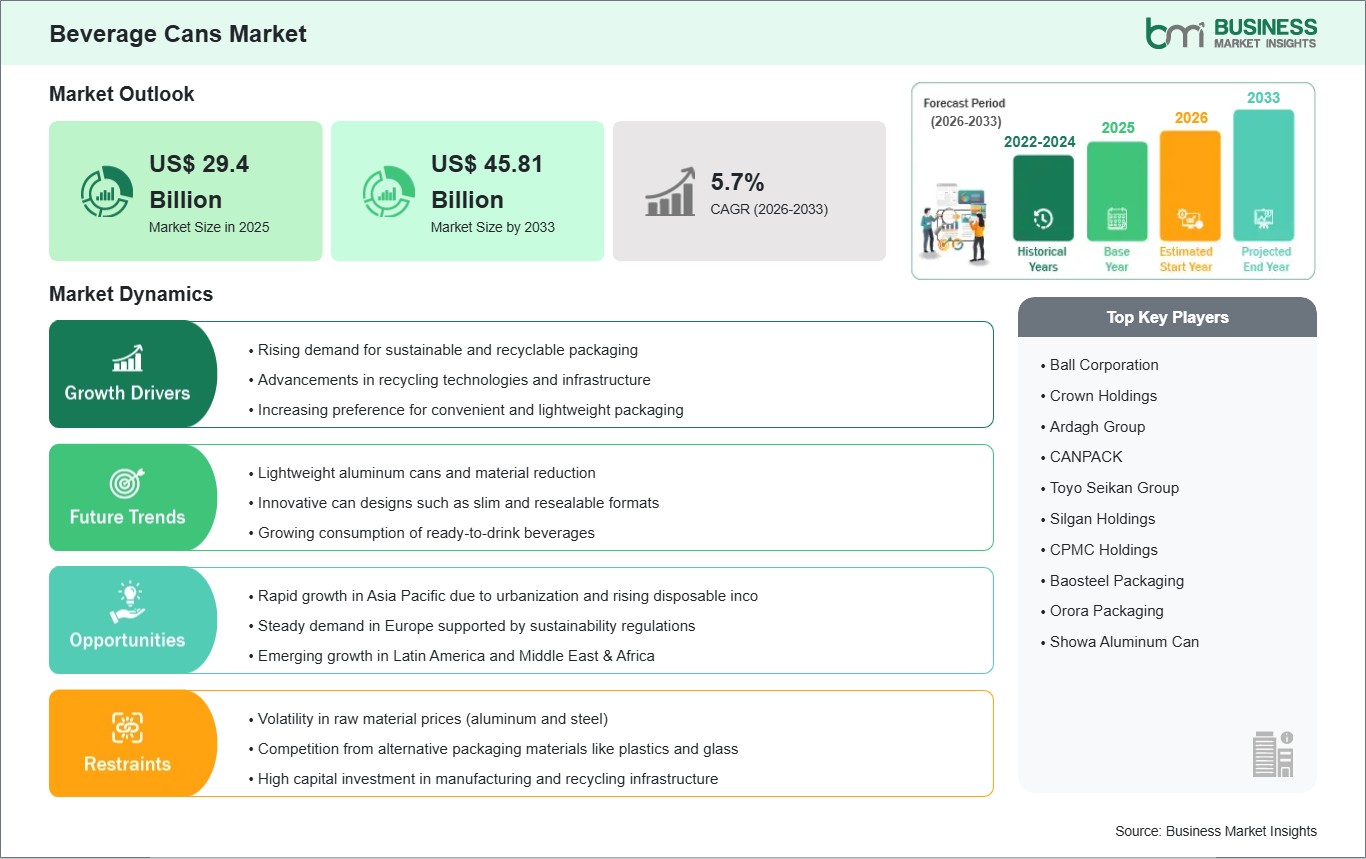
The global beverage cans market is driven by the growing demand for convenient, lightweight, and sustainable packaging solutions across the beverage industry. Beverage cans, particularly aluminum cans, are widely used for packaging carbonated drinks, energy drinks, beer, and ready-to-drink beverages due to their durability, recyclability, and ability to preserve product freshness.
The increasing consumer preference for on-the-go consumption and single-serve packaging formats is contributing significantly to market growth. Aluminum cans are gaining popularity due to their high recycling rates and lower environmental footprint compared to alternative packaging materials. Additionally, innovations in can design, such as slim cans and resealable lids, are enhancing consumer appeal and brand differentiation.
Competitive dynamics in the beverage cans market are centered on sustainability, cost efficiency, and design innovation. Manufacturers are focusing on lightweighting technologies to reduce material usage and transportation costs. Strategic partnerships with beverage companies and investments in recycling infrastructure are strengthening market presence. Regulatory pressures to reduce plastic waste are also driving the shift toward metal packaging solutions, further boosting demand for beverage cans.
Segment Analysis
Beverage Cans Market Segmentation
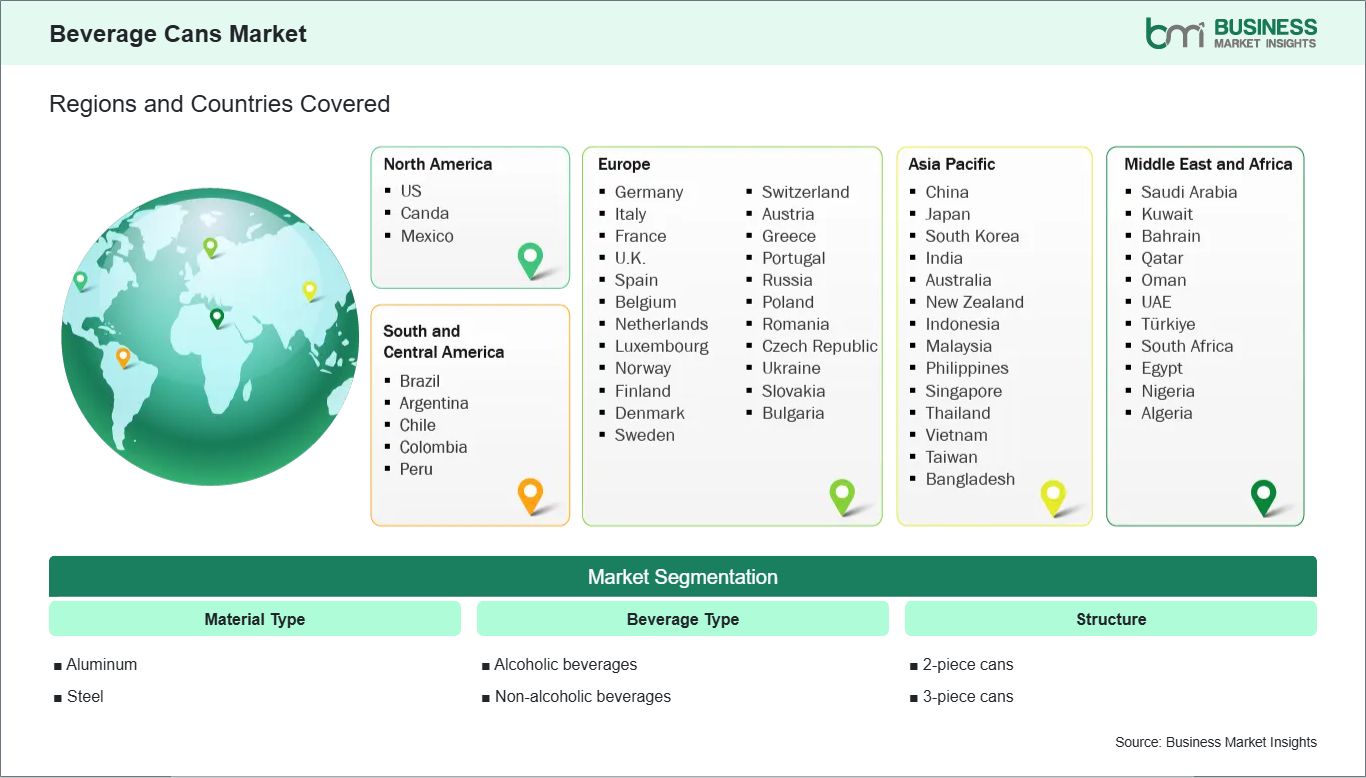
Key segments that contributed to the derivation of the beverage cans market analysis are material type, beverage type, and structure.
- By material type, the beverage cans market is segmented into aluminum and steel. The aluminum segment dominated the market in 2025.
- Based on beverage type, the beverage cans market is segmented into alcoholic beverages and non-alcoholic beverages. The non-alcoholic beverages segment dominated the market in 2025.
- In terms of structure, the market is segmented into 2-piece cans and 3-piece cans. The 2-piece cans segment dominated the market in 2025.
Market Forces
Beverage Cans Market Drivers and Opportunities
Rising Demand for Sustainable and Recyclable Packaging
One of the most important reasons for the growth of the beverage cans market is that there is a renewed emphasis on environmentalism and sustainability. Aluminum cans offer a significant advantage over plastic because they are 100 percent recyclable, and can be recycled a number of times while maintaining the same quality of material. Therefore, as a result of environmental policies, governments and regulatory agencies across the globe are encouraging companies to use less plastic, through implementing policies that will help reduce plastic waste.
There is also a growing trend among consumers who desire to purchase products packaged in recyclable materials. Consequently, beverage manufacturers are changing their packaging to utilize aluminum cans and promote sustainable practices; likewise, advancements in can manufacturing technology will allow for lighter weights of beverage cans and minimizing material and energy required for production and distribution.
Additionally, beverage cans have exceptional barrier properties to protect their contents from light, oxygen, and other contaminants. As sustainability remains an important initiative for businesses globally, the increasing demand for environmentally-friendly alternative packaging such as beverage cans will continue to increase.
Growth of Ready-to-Drink Beverages and Emerging Markets
The ready-to-drink (RTD) beverages like energy drinks, flavored water, and functional beverages are creating a lot of opportunities for the beverage can market due to the growing RTD beverage market. The convenience and portability of cans as a packaging type make it a great packaging choice for these products since they can meet evolving consumer lifestyle and consumption preferences.
Emerging markets in Asia Pacific, Latin America, and the Middle East are seeing an increase in the consumption of packaged beverages due to a trend of urbanization, increasing disposable incomes and changing food habits. This has driven demand for efficient and low-cost packaging solutions, such as beverage cans.
New can designs that are sleeker and thinner are appealing to younger consumers and premium product segments alike. The growing popularity of canned alcoholic beverages (i.e., craft beer and RTD cocktails) is contributing to the growth of the beverage can market. The demand for beverage cans will continue to grow as beverage companies develop new products and expand internationally into new markets.
Size and Share Analysis
Beverage Cans Market Size and Share Analysis
The Beverage Cans Market demonstrates steady growth, with size and share analysis highlighting evolving trends and competitive dynamics among key players. The report examines subsegments categorized within material type, beverage type, and structure, offering insights into their contribution to overall market performance.
By material type, the aluminum subsegment dominated the market in 2025, driven by its high recyclability and lightweight properties.
Based on beverage type, the non-alcoholic beverages subsegment dominated the market in 2025, driven by high consumption of soft drinks and energy beverages.
In terms of structure, the 2-piece cans subsegment dominated the market in 2025, driven by cost efficiency and widespread usage in beverage packaging.
Report Coverage
Beverage Cans Market Report Coverage and Deliverables
The "Beverage Cans Market Size and Forecast (2022 - 2033)" report provides a detailed analysis of the market covering below areas:
- Beverage Cans Market size and forecast at global, regional, and country levels for all the key market segments covered under the scope
- Beverage Cans Market trends, as well as drivers, restraints, and opportunities
- Beverage Cans Market analysis covering key trends, global and regional framework, major players, regulations, and recent developments
- Industry landscape and competition analysis covering market concentration, heat map analysis, prominent players, and recent developments for the Beverage Cans Market
- Detailed company profiles, including SWOT analysis
Geographic Insights
Beverage Cans Market Geographic Insights
The geographical scope of the Beverage Cans Market report is divided into North America, Asia Pacific, Europe, Middle East & Africa, and South & Central America. North America held the largest share in 2025.
The demand for beverage cans varies across regions, shaped by consumption patterns, packaging preferences, and regulatory frameworks. North America remains the largest market, supported by high per-capita beverage consumption, strong demand for aluminum cans, and well-established recycling systems. The U.S. and Canada lead in both alcoholic and non-alcoholic beverage categories, with consumer preference for sustainable and convenient packaging driving growth. The region’s advanced logistics infrastructure and strong presence of global packaging companies further reinforce its leadership position. Europe is another mature market, characterized by high recycling rates and strict sustainability regulations. Countries such as Germany, the UK, and France are pushing beverage producers toward eco-friendly packaging solutions, which has accelerated the adoption of aluminum cans. The region’s strong beer and craft beverage culture also contributes to steady demand.
Asia Pacific is the fastest-growing region, driven by rapid urbanization, rising disposable incomes, and expanding beverage industries in China, India, and Southeast Asia. Increasing consumption of soft drinks, energy drinks, and packaged water is fueling demand for cans, while local manufacturing capacity ensures cost efficiency. Latin America and the Middle East & Africa are emerging markets where demand is rising due to growing packaged beverage consumption and improving distribution networks. While their market shares are smaller compared to North America and Asia Pacific, investments in modern retail and beverage production are expected to support steady growth. Overall, sustainability initiatives, consumer preferences for convenience, and regulatory policies continue to shape the global beverage cans market, with North America holding the largest share and Asia Pacific driving future expansion.
Industry Activity
Recent Developments
The Beverage Cans Market is evaluated by gathering qualitative and quantitative data post primary and secondary research, which includes important corporate publications, association data, and databases. A few of the key developments in the beverage cans market are:
- In October 2025, Ball Corporation announced expansion of its aluminum beverage can production capacity in North America to meet rising demand for sustainable packaging.
- In June 2025, Crown Holdings introduced new lightweight aluminum cans aimed at reducing material usage and improving sustainability in beverage packaging.
Trust & Transparency
Research Methodology
The market analysis combines proprietary research with secondary data from government agencies, company disclosures, regulatory filings, industry databases and expert interviews. Market estimates are validated through data triangulation, cross-market benchmarking and analyst
review.
View Full Research Methodology
Key Sources Referred:
International Aluminium Institute (IAI)World Steel AssociationBeverage Marketing CorporationUnited Nations Environment Programme (UNEP)Food and Agriculture Organization (FAO)International Trade Administration