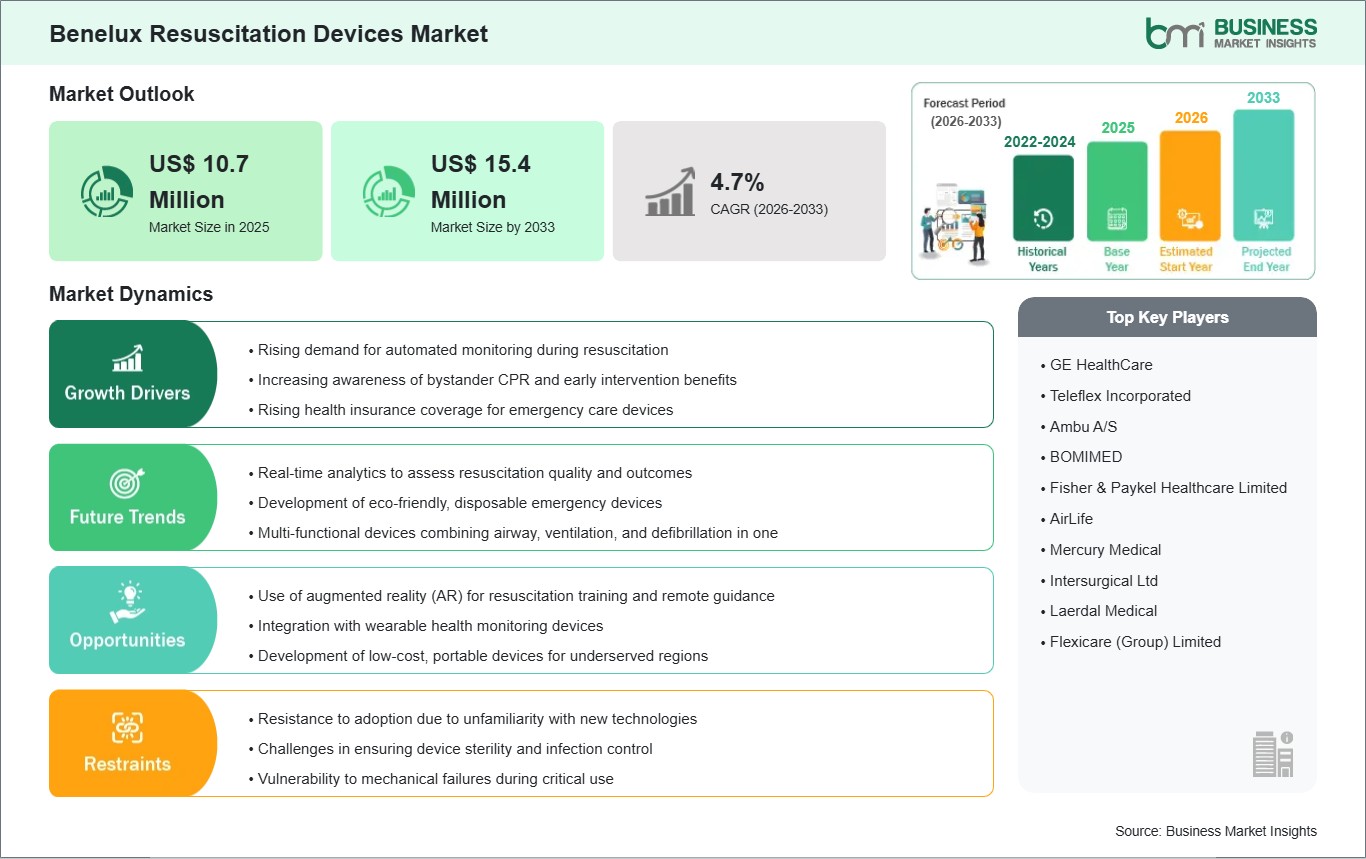
The Benelux resuscitation devices market size is expected to reach US$ 15.4 million by 2033 from US$ 10.7 million in 2025. The market is estimated to record a CAGR of 4.7% from 2026 to 2033.
The Benelux resuscitation devices market is steadily growing, supported by advanced healthcare systems, strong regulatory frameworks, and increasing awareness of emergency cardiac and respiratory care. The region includes Belgium, the Netherlands, and Luxembourg, with the Netherlands dominating the market due to its well-developed hospital infrastructure, urban emergency medical services, and proactive adoption of life-saving technologies. The growth in the market is mainly influenced by factors like the number of cardiovascular events, surgical procedures, and an increased focus on patients' survival rates. Hospitals in The Netherlands have been increasingly incorporating AEDs, defibrillators, CPR machines, and feedback monitors. In urban EMS networks, ambulances are now being fitted with portable resuscitation devices. There are some constraints in the market. For instance, the cost of the devices together with the constant need to train healthcare practitioners is likely to be a hindrance, especially to the small hospitals or the remote locations. There is also the issue of regulatory requirements that must be adhered to before introducing the devices into the market. Despite these constraints, the region enjoys full backing from the government regarding emergency services, public health initiatives, and collaboration with foreign device suppliers.

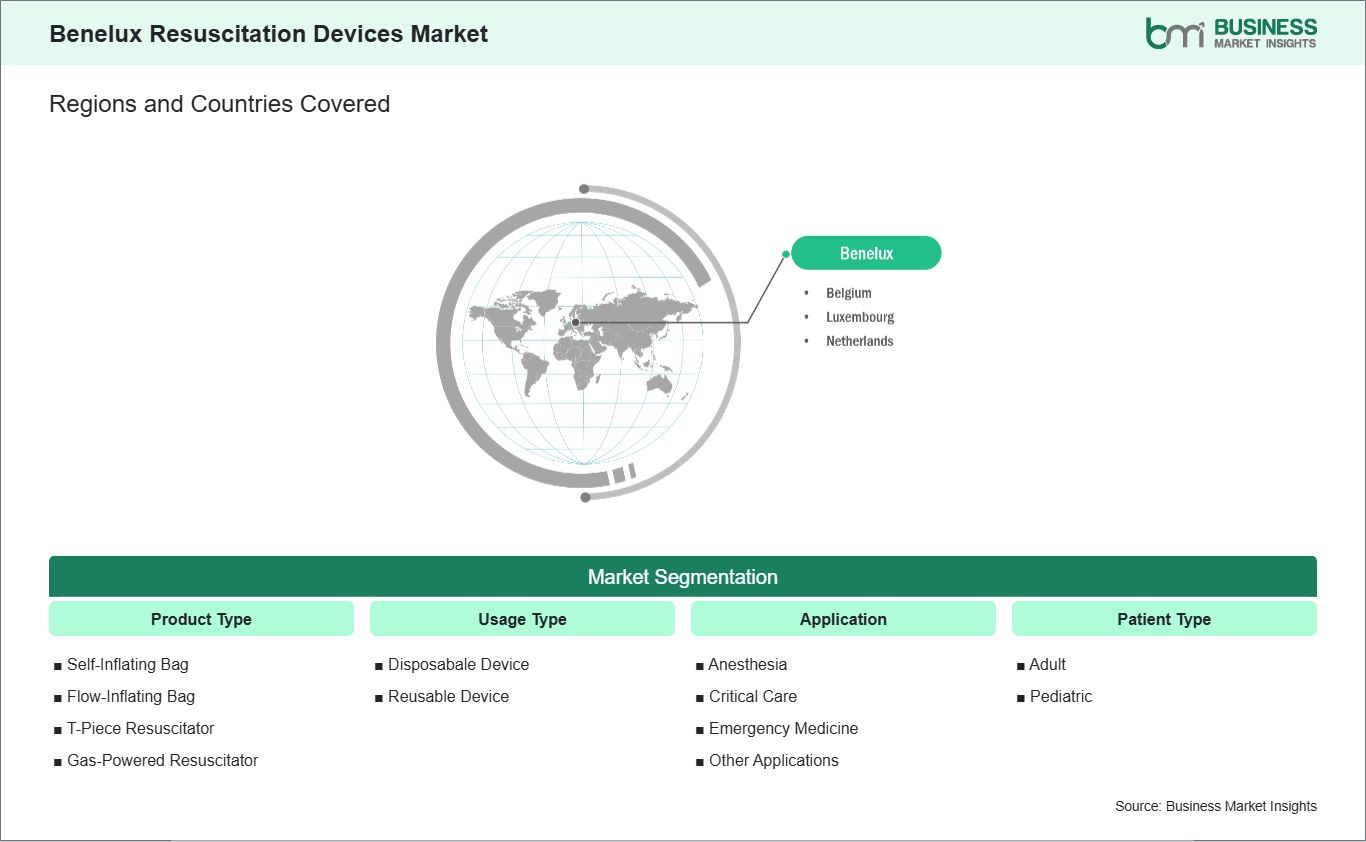
Key segments that contributed to the derivation of the Africa resuscitation devices marketanalysis are product type, usage type, application, patient type, and end user.
The market for Benelux resuscitation devices is seeing increased adoption of automated monitoring systems that increase the effectiveness and precision of life-saving procedures. Hospitals and emergency medical services in the Benelux countries are implementing resuscitation devices that offer instant feedback regarding the effectiveness of the cardiopulmonary resuscitation procedure, the cardiac rhythm, and oxygen saturation levels. This technology enables paramedics and doctors to deliver optimal chest compressions, ventilation support, and defibrillation timing, lowering the possibility of human error. EMS networks operating in urban centers such as Amsterdam, Brussels, and Luxembourg are focusing on portable monitoring devices.
Aside from feedback-capable instruments, an emerging trend is the use of automated monitoring technologies together with data analysis platforms. This type of technology enables the hospital to monitor the reactions of patients during the process of resuscitation, and such data can then be used for purposes of improving and refining protocols. Emergency departments will be able to assess how well their team does in critical situations and improve areas that need improvement by training.
On the other hand, smaller hospitals and regional EMS organizations in the Benelux are utilizing smaller and more versatile devices that include monitoring, airway support, and defibrillation functions in one device. These types of equipment are most useful in areas where transportation to a tertiary health facility may take some time. As both emergency care systems evolve, the emergence of automated monitoring systems can be considered one of the primary catalysts of innovation in resuscitation devices.
Augmented Reality (AR) is gaining prominence as an innovative solution for resuscitation education and remote guidance within the Benelux region. Augmented reality programs are being implemented by medical institutions in the Netherlands and Belgium, where they are used to provide visual information about real-time physiological processes and device mechanisms during CPR training. Immersive simulations assist healthcare professionals to develop muscle memory, improve their decision-making skills under pressure, and familiarize themselves with different resuscitation tools prior to working with live patients.
In addition to clinical applications, AR is being employed in pre-hospital guidance procedures. In Belgium and the Netherlands, EMS personnel are trying out AR glasses that link paramedics to cardiologists or specialists when dealing with complicated resuscitations. The software provides visual cues about where the best places for compressions and pads are located. Thus, it minimizes mistakes in crucial situations, allowing doctors to monitor the process without their physical presence.
Moreover, AR is being used by awareness programs across the Benelux countries. Educational institutions and companies have incorporated AR-based lessons that teach people basic cardiopulmonary resuscitation and automated external defibrillator utilization. As hospitals and EMS strive to improve training and guidance processes, the introduction of AR systems is expected to lead to widespread use of advanced resuscitation equipment.

The African resuscitation devices marketis experiencing steady growth, with market size and share analysis reflecting evolving treatment preferences and competitive dynamics among key players. The report evaluates important subsegments categorized within product type, usage type, application, patient type, and end user, highlighting their respective contributions to overall market performance.
By product type, the self-inflating Bag subsegment dominated the market in 2025, as they are easy to use and do not require external gas or power sources, making them ideal for emergencies. They allow precise manual control of ventilation, which is crucial in critical care. Their portability makes them suitable for both hospital wards and transport situations.
Based on usage type, the disposable devices subsegment dominated the market in 2025 due to their ability to prevent cross-contamination and infection. They eliminate the need for complex sterilization processes, saving time and reducing operational costs. In high-volume hospital settings, disposables improve workflow efficiency. This makes them highly preferred in emergency rooms, ICUs, and surgical units.
On the basis of application, the anesthesia subsegment dominated the market in 2025, as resuscitation devices are essential for safe ventilation during induction and recovery. They provide backup support if mechanical ventilators fail. Their precise control helps manage patients with varying lung compliances. Hospitals rely on these devices to prevent hypoxia and ensure patient safety during surgeries.
In terms of patient type, the adult subsegment dominated the market in 2025, as they experience more surgical procedures and critical emergencies than pediatric populations. Their larger lung capacity requires devices designed for adult ventilation. High prevalence of cardiac and respiratory conditions in adults increases usage frequency.
Based on end user, the hospitals subsegment dominated the market in 2025 due to constant emergency and surgical care needs. ICUs, operating rooms, and emergency departments require rapid access to resuscitation devices. High patient volume and stringent safety protocols make hospitals the key market driver. Their centralized procurement and standardized protocols ensure widespread device adoption.
| Report Attribute | Details |
|---|---|
| Market size in 2025 | US$ 10.7 Million |
| Market Size by 2033 | US$ 15.4 Million |
| CAGR (2026 - 2033) | 4.7% |
| Historical Data | 2022-2024 |
| Forecast period | 2026-2033 |
| Segments Covered | By Product Type
|
|
Regions and Countries Covered
| |
| Benelux | Belgium, Netherlands, Luxembourg |
| Market leaders and key company profiles |
|
The "Benelux Resuscitation Devices Market Size and Forecast (2022–2033)" report provides a detailed analysis of the market covering below areas:
The geographical scope of the Benelux Resuscitation devices marketreport is divided into: Belgium, the Netherlands, and Luxembourg. The Netherlands held the largest share in 2025.
The Netherlands dominates in the Benelux resuscitation devices market owing to its state-of-the-art health care system, well-organized emergency medical service operations, and concentration on patient-focused care systems. The hospitals of major cities such as Amsterdam, Rotterdam, and Utrecht have been investing heavily in state-of-the-art resuscitation devices technology, such as automatic defibrillators that feature a feedback system, mechanical CPR devices, and mobile emergency kits. The major contributing element that favors the dominance of the Netherlands is that of professional training and awareness. Resuscitation training of medical personnel is done using simulation in order to make sure that the resuscitation devices are used properly and in emergencies, and this helps save more lives. The public has also been trained by making available automated external defibrillators in airports, shopping malls, schools, and corporates. Furthermore, there are good relationships with both local distributors and the foreign makers of medical devices such that access to top-of-the-line resuscitation devices is ensured. This ensures an increase in survival rates in urban hospitals due to the use of connected devices that deliver information to healthcare professionals in real time. Consequently, the Netherlands emerges as the most dominant player in the Benelux resuscitation devices market.

The Benelux resuscitation devices marketis evaluated by gathering qualitative and quantitative data post primary and secondary research, which includes important corporate publications, association data, and databases. A few of the key developments in the Benelux resuscitation devices marketare:
The Benelux Resuscitation Devices Market is valued at US$ 10.7 Million in 2025, it is projected to reach US$ 15.4 Million by 2033.
As per our report Benelux Resuscitation Devices Market, the market size is valued at US$ 10.7 Million in 2025, projecting it to reach US$ 15.4 Million by 2033. This translates to a CAGR of approximately 4.7% during the forecast period.
The Benelux Resuscitation Devices Market report typically cover these key segments-
The historic period, base year, and forecast period can vary slightly depending on the specific market research report. However, for the Benelux Resuscitation Devices Market report:
The Benelux Resuscitation Devices Market is populated by several key players, each contributing to its growth and innovation. Some of the major players include:
The Benelux Resuscitation Devices Market report is valuable for diverse stakeholders, including:
Essentially, anyone involved in or considering involvement in the Benelux Resuscitation Devices Market value chain can benefit from the information contained in a comprehensive market report.
Please tell us your area of interest
(Market Segments/ Regions and Countries/ Companies)