Aviation Lubricants Market Outlook (2022-2033)

Historic Data: 2022-2024   |   Base Year: 2025   |   Forecast Period: 2026-2033
Report Content: Market Scope, Market Segmentation, Market Dynamics, and Competitive Analysis

Report Coverage:
  • Type (Engine Oil, Hydraulic Oil, Gear Oil, Transformer Oil, Refrigeration Oil, Grease, Turbine Oil, Metalworking Fluids, Other Types)
  • Application (Gas Turbine Engine, Piston Engine, Hydraulic Systems, Landing Gear, Airframe, Other Applications)
  • End User (Commercial Aircraft, Military Aircraft, Spacecraft/Satellites, Drone and UAV, Other End Users)

No. of Pages: 400
Report Code: BMIPUB00033682
Category: Chemicals and Materials
Aviation Lubricants Market

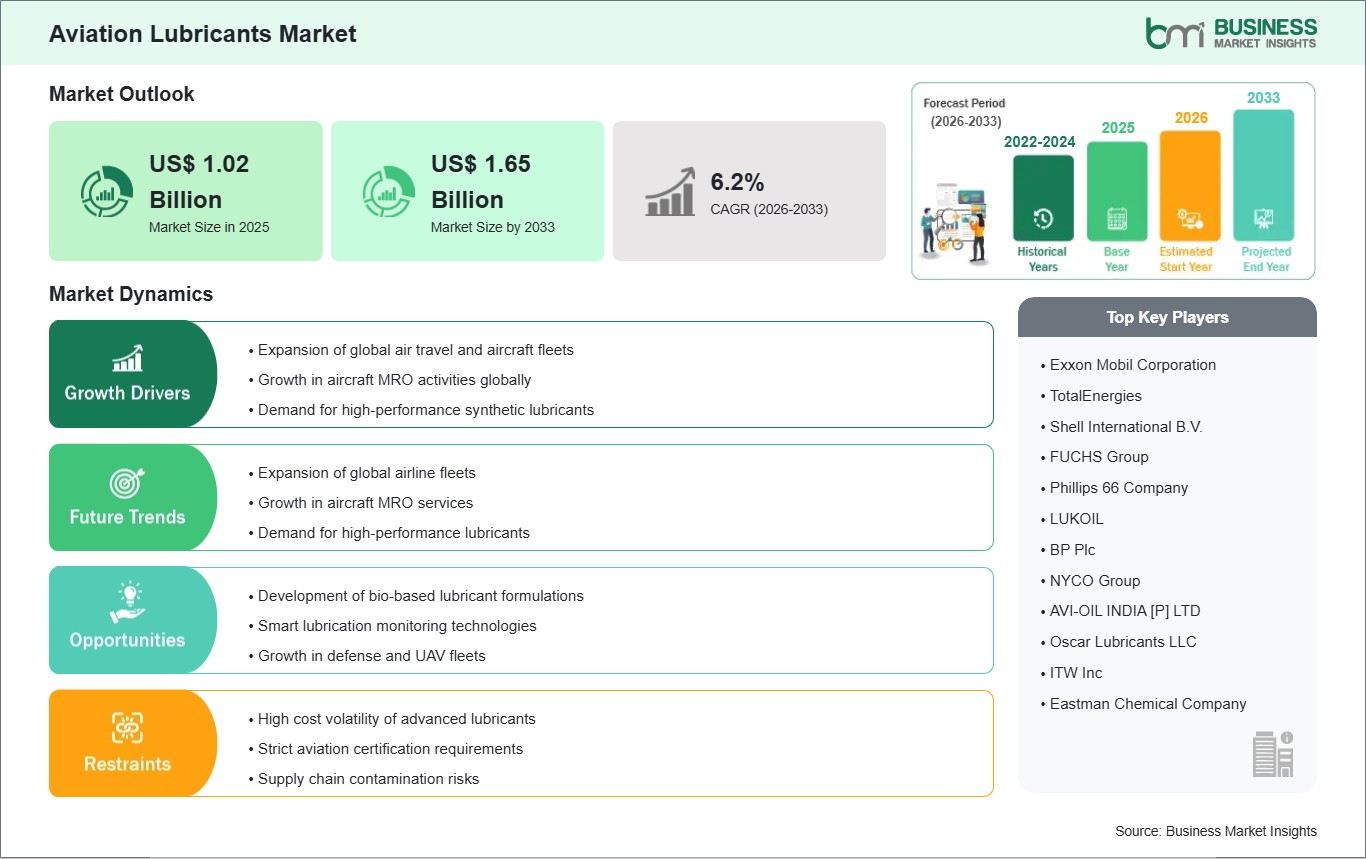
Aviation Lubricants market size is expected to reach US$ 1.65 billion by 2033 from US$ 1.02 billion in 2025. The market is estimated to record a CAGR of 6.2% from 2026 to 2033.

Executive Summary and Global Market Analysis:

Aviation lubricants are high-performance fluids specially made to reduce friction, control wear, dissipate heat, and protect vital aircraft components under extreme operating conditions. These lubricants are commonly used in aircraft engines, hydraulic systems, gearboxes, turbines, and other moving parts where reliability and safety matter. Built to handle high temperatures, heavy loads, and changing atmospheric pressures, aviation lubricants help keep engines efficient, extend the life of components, and ensure smooth operation. They include turbine oils, piston engine oils, hydraulic fluids, greases, and specialty lubricants, all designed to meet strict aviation standards and performance needs. Their thermal stability, resistance to oxidation, and anti-corrosion features make them essential in both commercial and military aviation. The demand for aviation lubricants is growing due to the steady rise in global air travel, the expansion of commercial aircraft fleets, and increased investment in defense aviation. As passenger and cargo air traffic recovers and expands, aircraft utilization rates are rising, leading to higher lubricant consumption for maintenance, repair, and overhaul activities.

The growing production of new-generation aircraft with more fuel-efficient and high-bypass turbofan engines also drives market growth, as these engines need specialized synthetic lubricants that can perform under tougher conditions. Additionally, the rise of low-cost carriers and regional aviation networks in emerging markets is boosting the need for reliable and high-quality aviation lubricants. Technological advancements in engine design and materials are influencing the market. Modern aircraft engines run at higher temperatures and pressures, which require lubricants with better thermal stability and longer service intervals. Manufacturers are working on developing advanced synthetic formulas that improve oxidation resistance, reduce deposit buildup, and enhance fuel efficiency. There is also a growing focus on environmentally friendly products, including lubricants with lower toxicity and better biodegradability, to meet strict environmental regulations. Digital monitoring systems and predictive maintenance practices are promoting the use of high-performance lubricants that ensure consistent performance and longer drain intervals.

Despite challenges like changing raw material prices, strict regulatory approvals, and high product qualification costs, the aviation lubricants market is expected to grow steadily. Increasing aircraft deliveries, rising maintenance activities, and ongoing innovation in lubricant chemistry are supporting long-term expansion. As airlines and defense operators focus on efficiency, safety, and sustainability, the global aviation lubricants market is set to remain strong, driven by technological advancements, fleet updates, and the continued growth of the global aviation industry.

Aviation Lubricants Market - Strategic Insights:

global-market-strategic-framework
Get more information on this report

Aviation Lubricants Market Segmentation Analysis:

Key segments that contributed to the derivation of the Aviation Lubricants market analysis are type, application, and end user.

  • By type, the Aviation Lubricants market is segmented into engine oil, hydraulic oil, gear oil, transformer oil, refrigeration oil, grease, turbine oil, metalworking fluids, and others. The engine oil segment dominated the market in 2025.
  • By application, the Aviation Lubricants market is segmented into gas turbine engine, piston engine, hydraulic systems, landing gear, airframe, others. The gas turbine engine segment dominated the market in 2025.
  • By end user, the Aviation Lubricants market is segmented into commercial aircraft, military aircraft, spacecraft/satellites, drone and UAV, and others. The commercial aircraft segment dominated the market in 2025.

Aviation Lubricants Market Drivers and Opportunities:

Expansion of Global Air Fleet and Rising Aircraft Utilization Rates

The global aviation lubricants market is driven by the ongoing growth of commercial and military air fleets. More passengers are flying, air cargo transportation is increasing, and low-cost carriers are expanding, all of which lead to higher aircraft utilization rates. As aircraft fly for longer hours and under tough conditions, the need for high-performance turbine oils, hydraulic fluids, and specialty greases rises. Modern jet engines and advanced propulsion systems require lubricants that can handle extreme temperatures, high pressures, and long service intervals. Additionally, more aircraft deliveries and fleet upgrades are boosting demand for both factory-fill and in-service lubricants. Maintenance, Repair, and Overhaul (MRO) activities are also growing worldwide, which further supports steady lubricant consumption. As airlines work to improve operational efficiency and reduce downtime, the demand for dependable and durable aviation lubricants is expected to grow consistently. Technological

Advancements in Engine Design and Emphasis on Safety and Sustainability

Another major factor driving the aviation lubricants market is the improvement of aircraft engine technology along with strict safety and environmental rules. Next-generation engines run at higher temperatures and are more efficient, requiring synthetic lubricants with better thermal stability, oxidation resistance, and deposit control. Manufacturers are creating new formulations that extend drain intervals, decrease wear on components, and improve overall engine performance. Regulatory agencies impose strict certification standards to ensure flight safety, which promotes the use of high-quality, tested lubricants. At the same time, there is a growing focus on environmentally friendly products that have lower toxicity and better biodegradability to meet sustainability goals in aviation. Airlines and defense operators are increasingly concentrating on fuel efficiency, reducing carbon emissions, and using predictive maintenance strategies, all of which rely on advanced lubrication solutions. As safety, performance optimization, and environmental compliance stay top priorities, the demand for technologically advanced aviation lubricants is expected to drive long-term growth in the global market.

Aviation Lubricants Market Size and Share Analysis:

The engine oil segment leads the market in 2025 because it plays a vital role in ensuring optimal performance, heat dissipation, and wear protection in aircraft engines, which operate under extreme temperatures and pressures. The rising number of aircraft deliveries and increasing flight hours worldwide are driving consistent demand for high-performance synthetic engine oils with longer service intervals.

Gas turbine engines make up the largest share of the market since they power most modern commercial and military aircraft. These engines run at very high speeds and temperatures, so they need lubricants with excellent thermal stability, oxidation resistance, and deposit control. This requirement significantly increases lubricant consumption.

The commercial aircraft segment is at the forefront due to the growth in global passenger traffic, the expansion of airline fleets, and higher aircraft utilization rates. More maintenance, repair, and overhaul (MRO) activities, along with fleet modernization programs, are also fueling continued demand for aviation lubricants in this area.

Aviation Lubricants Market Report Highlights:

Report Attribute Details
Market size in 2025 US$ 1.02 Billion
Market Size by 2033 US$ 1.65 Billion
Global CAGR (2026 - 2033)6.2%
Historical Data 2022-2024
Forecast period 2026-2033
Segments Covered By Type
  • Engine Oil
  • Hydraulic Oil
  • Gear Oil
  • Transformer Oil
  • Refrigeration Oil
  • Grease
  • Turbine Oil
  • Metalworking Fluids
  • Other Types
By Application
  • Gas Turbine Engine
  • Piston Engine
  • Hydraulic Systems
  • Landing Gear
  • Airframe
  • Other Applications
By End User
  • Commercial Aircraft
  • Military Aircraft
  • Spacecraft/Satellites
  • Drone and UAV
  • Other End Users
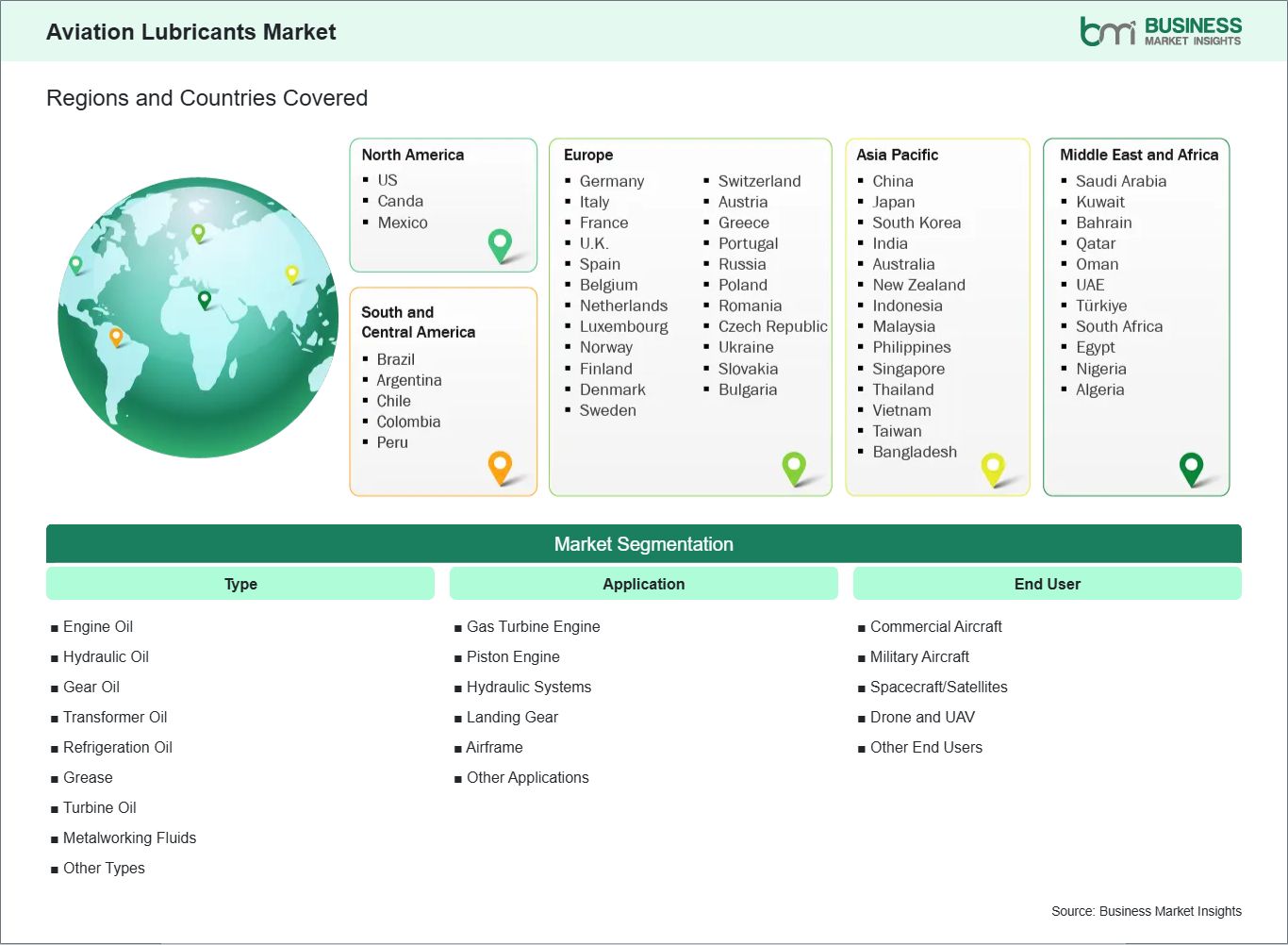
Regions and Countries Covered
North America US, Canada, Mexico
Europe Belgium, Austria, Finland, Denmark, Greece, Poland, Romania, Russia, Ukraine, Czech Republic, Slovakia, Bulgaria, Italy, Luxembourg, Germany, Switzerland, France, Netherlands, Norway, Portugal, Spain, Sweden, United Kingdom
Asia-Pacific Australia, China, India, Japan, South Korea, Indonesia, Malaysia, Philippines, Singapore, Thailand, Vietnam, Bangladesh, New Zealand, Taiwan
South and Central America Brazil, Argentina, Peru, Chile, Colombia
Middle East and Africa Bahrain, Kuwait, Oman, Qatar, Saudi Arabia, United Arab Emirates, Turkiye, South Africa, Egypt, Algeria, Nigeria
Market leaders and key company profiles
  • Exxon Mobil Corporation
  • TotalEnergies
  • Shell International B.V.
  • FUCHS Group
  • Phillips 66 Company
  • LUKOIL
  • BP Plc
  • NYCO Group
  • AVI-OIL INDIA [P] LTD
  • Oscar Lubricants LLC
Get more information on this report

Aviation Lubricants Market Report Coverage and Deliverables:

The "Aviation Lubricants Market Size and Forecast (2022–2033)" report provides a detailed analysis of the market covering below areas:

  • Aviation Lubricants market size and forecast at global, regional, and country levels for all the key market segments covered under the scope
  • Aviation Lubricants market trends, as well as market dynamics such as drivers, restraints, and key opportunities
  • Aviation Lubricants market analysis covering key market trends, global and regional framework, major players, regulations, and recent market developments
  • Industry landscape and competition analysis covering market concentration, heat map analysis, prominent players, and recent developments for the Aviation Lubricants market
  • Detailed company profiles, including SWOT analysis

Aviation Lubricants Market Geographic Insights:

The geographical scope of the Aviation Lubricants market report is divided into five regions: North America, Asia Pacific, Europe, Middle East & Africa, and South & Central America. The Aviation Lubricants market in the Asia Pacific is expected to grow significantly during the forecast period.

The Asia-Pacific Aviation Lubricants market is segmented into China, Japan, South Korea, India, Australia, New Zealand, Indonesia, Malaysia, the Philippines, Singapore, Thailand, Vietnam, Taiwan, Bangladesh, and the Rest of Asia.

The Asia-Pacific region is a rapidly growing market for aviation lubricants. This growth is driven by expanding commercial aviation networks, increasing air passenger traffic, and higher defense spending. Key countries such as China, India, Japan, and South Korea are making significant investments in new aircraft purchases, airport infrastructure, and domestic aerospace manufacturing. The rise of low-cost carriers and regional airlines in Southeast Asia is boosting aircraft usage rates, which in turn increases the demand for high-performance turbine oils, hydraulic fluids, and specialty greases. The growth of Maintenance, Repair, and Overhaul (MRO) facilities in the region is also enhancing local lubricant consumption. Governments are backing aviation sector growth through policy initiatives and infrastructure investments. This positions Asia-Pacific as a developing hub for aviation lubricant production, supply, and innovation.

North America and Europe still hold large shares in the global aviation lubricants market due to their established aerospace industries, strong defense aviation presence, and developed MRO networks. The United States leads in North America with a large commercial aircraft fleet and significant military aviation operations, along with major aircraft manufacturers and engine producers. High rates of aircraft modernization and ongoing advancements in engine design sustain the demand for synthetic lubricants.

In Europe, countries like Germany, France, and the United Kingdom play important roles because of their strong aerospace manufacturing and strict safety and environmental regulations. Meanwhile, the Middle East is becoming a crucial growth region, supported by new international airline hubs and expanding long-haul fleets. Latin America is also seeing gradual growth in demand as regional connectivity improves. In all regions, rising aircraft deliveries, more MRO activities, regulatory requirements, and the push for fuel efficiency and sustainability are expected to drive steady long-term growth in the global aviation lubricants market.

global-market-geography
Get more information on this report

Aviation Lubricants Market Research Report Guidance:

  • The report includes qualitative and quantitative data in the Aviation Lubricants market across type, application, end user, and geography.
  • The report starts with the key takeaways (chapter 2), highlighting the key trends and outlook of the Aviation Lubricants market.
  • Chapter 3 includes the research methodology of the study.
  • Chapter 4 further includes ecosystem analysis.
  • Chapter 5 highlights the major industry dynamics in the Aviation Lubricants market, including factors that are driving the market, prevailing deterrents, potential opportunities, as well as future trends. Impact analysis of these drivers and restraints is also covered in this section.
  • Chapter 6 discusses the Aviation Lubricants market scenario, in terms of historical market revenues, and forecast till the year 2031.
  • Chapters 7 to 10 cover Aviation Lubricants market segments by type, application, and end user across North America, Europe, Asia Pacific, Middle East and Africa, and South and Central America. They cover the market revenue and forecast and factors driving the market.
  • Chapter 11 describes the competitive analysis along with the heat map analysis for the key players operating in the market.
  • Chapter 12 describes the industry landscape analysis. It provides detailed descriptions of business activities such as market initiatives, new developments, mergers, and joint ventures globally, along with a competitive landscape.
  • Chapter 13 provides detailed profiles of the major companies operating in the Aviation Lubricants market. Companies have been profiled on the basis of their key facts, business descriptions, products and services, financial overview, SWOT analysis, and key developments.
  • Chapter 14, i.e., the appendix is inclusive of a brief overview of the company, a list of abbreviations, and a disclaimer.

Aviation Lubricants Market News and Key Development:

The Aviation Lubricants market is evaluated by gathering qualitative and quantitative data post primary and secondary research, which includes important corporate publications, association data, and databases. A few of the key developments in the Aviation Lubricants market are:

  • In December 2025, MOL Group completed a successful production test of hydrotreated vegetable oil (HVO) and sustainable aviation fuel (SAF) at its Slovnaft refinery in Bratislava, marking a significant step in the company’s energy-transition strategy. During the trial, HVO was produced by co-processing vegetable-origin feedstock — specifically cashew nut shell oil — with crude oil, while SAF was derived from partially refined used cooking oil alongside conventional feedstocks. Independent laboratory testing confirmed that both fuels met required specifications.
  • In Februry 2026, The world's leading producer of renewable diesel and sustainable aviation fuel (SAF), Neste also offers high-quality lubricants to its industry and agriculture customers, as well as consumers. To respond to its customers needs in Sweden. Neste opened its own lubricants warehouse in Jönköping to enable faster deliveries.

Key Sources Referred:

  • World Bank – Global Trade Indicators
  • World Trade Organization (WTO)
  • International Trade Administration (ITA)
  • Company website
  • Company annual reports
  • Company investor presentations
The List of Companies - Aviation Lubricants Market
  • <p>Exxon Mobil Corporation
  • TotalEnergies
  • Shell International B.V.
  • FUCHS Group
  • Phillips 66 Company
  • LUKOIL
  • BP Plc
  • NYCO Group
  • AVI-OIL INDIA [P] LTD
  • Oscar Lubricants LLC
  • ITW Inc
  • Eastman Chemical Company
  • Lanxess AG
  • IKV Group
  • Petron Corporation</p>
Frequently Asked Questions
How big is the Aviation Lubricants Market?

The Aviation Lubricants Market is valued at US$ 1.02 Billion in 2025, it is projected to reach US$ 1.65 Billion by 2033.

What is the CAGR for Aviation Lubricants Market by (2026 - 2033)?

As per our report Aviation Lubricants Market, the market size is valued at US$ 1.02 Billion in 2025, projecting it to reach US$ 1.65 Billion by 2033. This translates to a CAGR of approximately 6.2% during the forecast period.

What segments are covered in this report?

The Aviation Lubricants Market report typically cover these key segments-

  • Type (Engine Oil, Hydraulic Oil, Gear Oil, Transformer Oil, Refrigeration Oil, Grease, Turbine Oil, Metalworking Fluids, Other Types)
  • Application (Gas Turbine Engine, Piston Engine, Hydraulic Systems, Landing Gear, Airframe, Other Applications)
  • End User (Commercial Aircraft, Military Aircraft, Spacecraft/Satellites, Drone and UAV, Other End Users)

What is the historic period, base year, and forecast period taken for Aviation Lubricants Market?

The historic period, base year, and forecast period can vary slightly depending on the specific market research report. However, for the Aviation Lubricants Market report:

  • Historic Period : 2022-2024
  • Base Year : 2025
  • Forecast Period : 2026-2033
  • Who are the major players in Aviation Lubricants Market?

    The Aviation Lubricants Market is populated by several key players, each contributing to its growth and innovation. Some of the major players include:

  • Exxon Mobil Corporation
  • TotalEnergies
  • Shell International B.V.
  • FUCHS Group
  • Phillips 66 Company
  • LUKOIL
  • BP Plc
  • NYCO Group
  • AVI-OIL INDIA [P] LTD
  • Oscar Lubricants LLC
  • ITW Inc
  • Eastman Chemical Company
  • Lanxess AG
  • IKV Group
  • Petron Corporation
  • Who should buy this report?

    The Aviation Lubricants Market report is valuable for diverse stakeholders, including:

    • Investors: Provides insights for investment decisions pertaining to market growth, companies, or industry insights. Helps assess market attractiveness and potential returns.
    • Industry Players: Offers competitive intelligence, market sizing, and trend analysis to inform strategic planning, product development, and sales strategies.
    • Suppliers and Manufacturers: Helps understand market demand for components, materials, and services related to concerned industry.
    • Researchers and Consultants: Provides data and analysis for academic research, consulting projects, and market studies.
    • Financial Institutions: Helps assess risks and opportunities associated with financing or investing in the concerned market.

    Essentially, anyone involved in or considering involvement in the Aviation Lubricants Market value chain can benefit from the information contained in a comprehensive market report.

    Available Report Formats

    pdf-format excel-format pptx-format
    Buy Now
    Sales Assistance
    +1 646 791 7070 (US & UK)
    Customization Form

    Please tell us your area of interest
    (Market Segments/ Regions and Countries/ Companies)