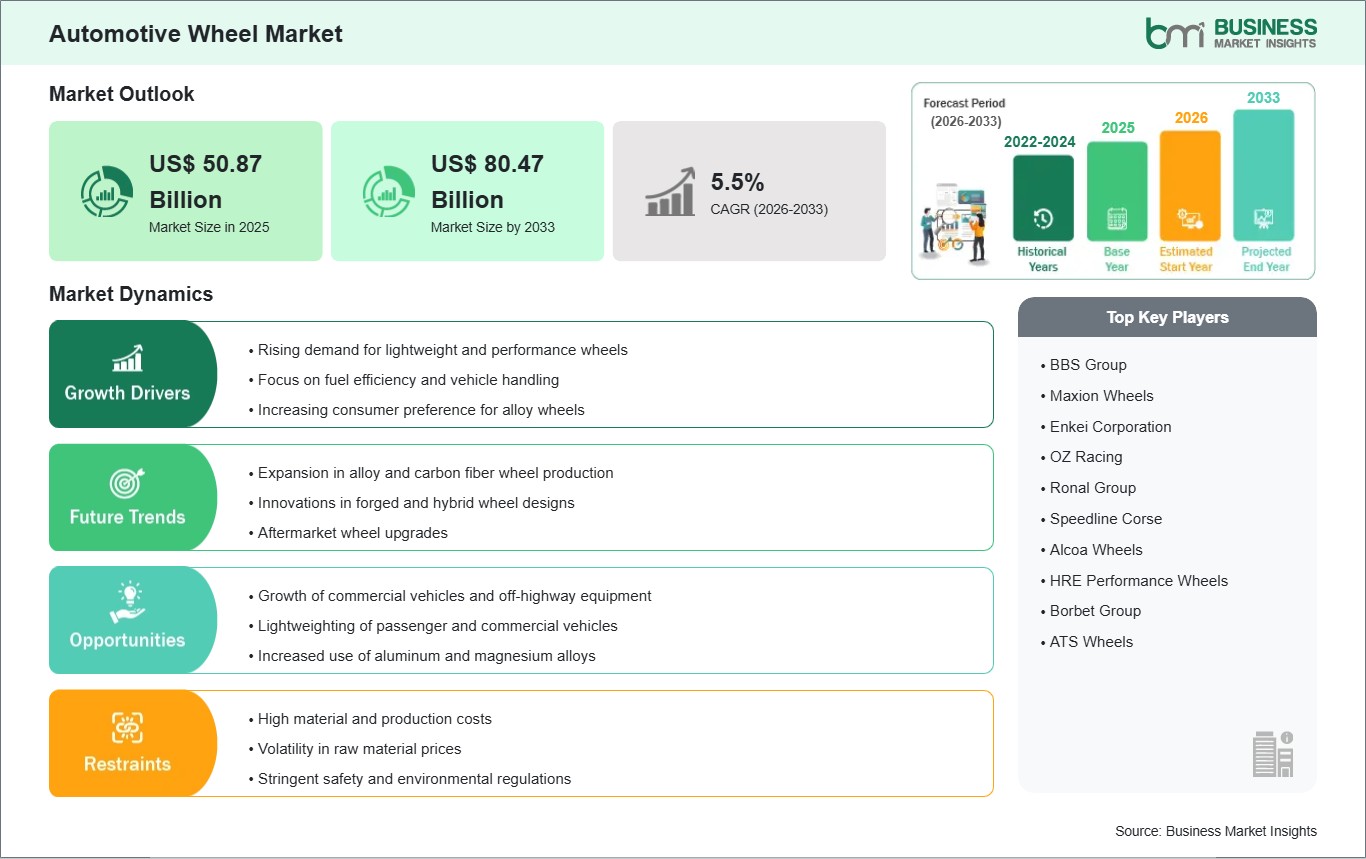
The Automotive Wheel Market size is expected to reach US$ 80.47 Billion by 2033 from US$ 50.87 Billion in 2025 .The market is estimated to record a CAGR of 5.5% from 2026 to 2033.
The global automotive wheel market is driven by the rising demand for lightweight, durable, and high-performance wheels that enhance vehicle safety, fuel efficiency, and aesthetics. Automotive wheels are critical for vehicle performance, influencing handling, braking, and overall ride quality. Innovations in materials and manufacturing processes, such as aluminum alloy and carbon fiber wheels, are reshaping the market by reducing weight while maintaining strength and durability.
The market growth is also supported by the increasing production of passenger and commercial vehicles worldwide. The growing preference for alloy wheels in premium segments and aftermarket upgrades is contributing to market expansion. In addition, regulations promoting fuel efficiency and reduced emissions are encouraging automakers to adopt lightweight wheel materials, such as aluminum and magnesium alloys, to decrease overall vehicle weight.
Competitive dynamics focus on innovation in wheel design, material technology, and manufacturing methods. Companies are introducing forged and hybrid wheels with improved strength-to-weight ratios. Strategic partnerships with OEMs and aftermarket distributors help expand market reach and increase brand visibility. Sustainability initiatives, such as recycled alloy usage and eco-friendly coatings, are becoming increasingly important for market players.

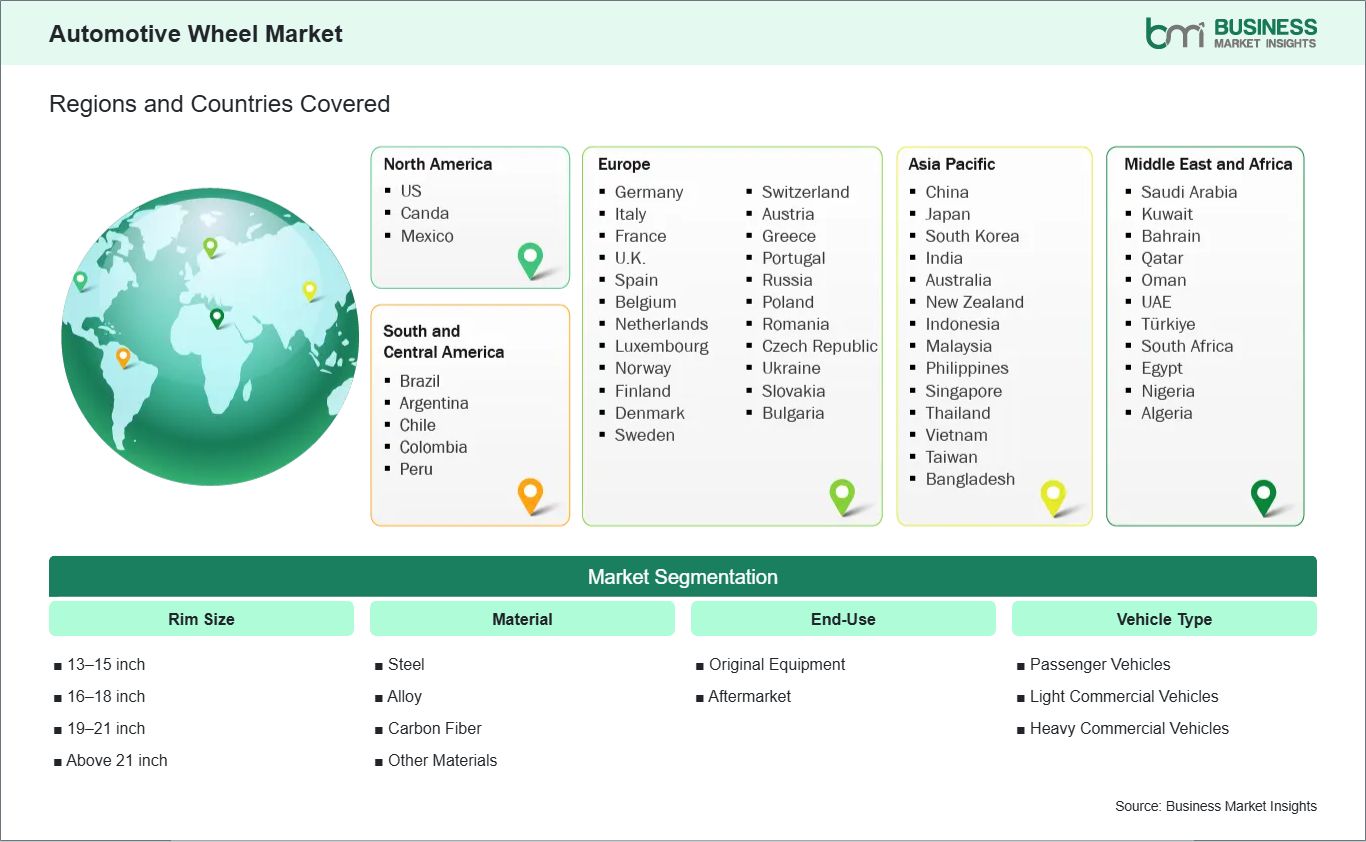
Key segments that contributed to the derivation of the automotive wheel market analysis are rim size, material, end-use, vehicle type, vehicle class, and off-highway applications.
The automotive wheel market is expanding due to the growing demand and focus towards developing lightweight yet high-performance wheels. Lightweight wheels such as those made from aluminum and magnesium alloys allow manufacturers to decrease the unsprung weight of a vehicle, which improves handling, acceleration, braking, and overall vehicle dynamics. Reducing the overall weight of a vehicle allows for greater fuel efficiency and results in lower carbon emissions, thus meeting sustainability objectives on a global level.
Another factor contributing to the growth of the automotive wheel market is the growing consumer preference for alloy wheels on passenger cars and aftermarket accessory upgrades. Alloy wheels have superior looks and offer better performance than their steel counterparts. Alloy wheels are generally lighter than steel wheels, are not susceptible to rust, provide enhanced braking system performance due to superior thermal conductivity, and the addition of advanced manufacturing processes such as forging and flow forming will allow manufacturers to produce even stronger and lighter wheels matching or exceeding the performance characteristics of existing designs.
In addition to lighter and more efficient alloy wheels, manufacturers are developing new manufacturing techniques that facilitate the production of carbon fiber and hybrid composite wheels which provide incredible weight savings while maintaining high structural strength. As OEMs continue to place importance on fuel efficiency and performance characteristics of vehicles, lightweight and technologically advanced wheels will continue to increase in market share in all vehicle categories.
The rise of commercial vehicle (CV) segments, including LCVs and HCVs, as well as off-highway applications including construction, mining, and farm equipment, has created a huge opportunity for the automotive wheel market. Wheels used by commercial and off-highway vehicles must be able to support high loads, be durable, and withstand tough operational conditions.
The latest innovations in material and design of alloy and steel wheels for heavy-duty vehicles will deliver increasingly better strength-to-weight performance, thus extending wheel life and reducing maintenance costs. In the construction and mining industries, wheels are built to be able to handle extreme load capabilities, rough terrains, and harsh environments.
The demand for high-performance, durable wheels for use in off-highway applications is also increasing because of the increase in urban infrastructure development, rapid urbanization, and increased use of mechanized agriculture in developing countries.
The aftermarket segment will also have more growth because vehicle owners are upgrading or replacing wheels to increase their vehicle's functionality or appearance. Partnerships between original equipment manufacturers (OEMs) and distributors will continue to expand the potential for manufacturers to reach new customers and generate additional revenues through these types of partnerships.
As global vehicle production continues to increase, we expect the automotive wheel market will experience continued growth as the use of off-highway equipment grows.

The Automotive Wheel Market demonstrates steady growth, with size and share analysis highlighting evolving trends and competitive dynamics among key players. The report examines subsegments categorized within rim size, material, end-use, vehicle type, vehicle class, and off-highway applications, offering insights into their contribution to overall market performance.
By rim size, the 16–18 inch subsegment dominated the market in 2025, driven by widespread use in mid-sized passenger vehicles.
Based on material, the alloy (aluminum & magnesium) subsegment dominated the market in 2025, driven by its lightweight and high-strength properties.
In terms of end-use, the original equipment (OE) subsegment dominated the market in 2025, driven by high integration of OEM wheels in vehicle production.
By vehicle type, the passenger vehicles subsegment dominated the market in 2025, driven by high global production.
Based on vehicle class, the mid-priced subsegment dominated the market in 2025, reflecting growing demand in mainstream consumer segments.
By off-highway applications, the construction & mining equipment subsegment dominated the market in 2025, driven by increasing industrial and infrastructure activities.
| Report Attribute | Details |
|---|---|
| Market size in 2025 | US$ 50.87 Billion |
| Market Size by 2033 | US$ 80.47 Billion |
| Global CAGR (2026 - 2033) | 5.5% |
| Historical Data | 2022-2024 |
| Forecast period | 2026-2033 |
| Segments Covered | By Rim Size
|
|
Regions and Countries Covered
| |
| North America | US, Canada, Mexico |
| Europe | Belgium, Austria, Finland, Denmark, Greece, Poland, Romania, Russia, Ukraine, Czech Republic, Slovakia, Bulgaria, Italy, Luxembourg, Germany, Switzerland, France, Netherlands, Norway, Portugal, Spain, Sweden, United Kingdom |
| Asia-Pacific | Australia, China, India, Japan, South Korea, Indonesia, Malaysia, Philippines, Singapore, Thailand, Vietnam, Bangladesh, New Zealand, Taiwan |
| South and Central America | Brazil, Argentina, Peru, Chile, Colombia |
| Middle East and Africa | Bahrain, Kuwait, Oman, Qatar, Saudi Arabia, United Arab Emirates, Turkiye, South Africa, Egypt, Algeria, Nigeria |
| Market leaders and key company profiles |
|
The "Automotive Wheel Market Size and Forecast (2022 - 2033)" report provides a detailed analysis of the market covering below areas:
The geographical scope of the Automotive Wheel Market report is divided into North America, Asia Pacific, Europe, Middle East & Africa, and South & Central America. North America held the largest share in 2025.
The adoption and demand for automotive wheels vary across regions, influenced by automotive production, vehicle ownership trends, and regulatory standards. In North America, the market is driven by advanced vehicle manufacturing, aftermarket penetration, and increasing demand for alloy wheels.
In Europe, stringent environmental and safety regulations encourage the adoption of lightweight and high-strength wheel solutions. Growth in luxury and mid-priced vehicle segments further supports market expansion.
Asia Pacific is the fastest-growing region, fueled by large-scale automotive production in China, India, and Japan, rising vehicle ownership, and increasing infrastructure development for off-highway applications.
The Middle East & Africa and South & Central America are experiencing moderate growth, driven by rising vehicle sales, commercial fleet expansion, and off-highway equipment adoption. Across all regions, technological innovation, sustainability goals, and regulatory requirements continue to shape market dynamics.

The Automotive Wheel Market is evaluated by gathering qualitative and quantitative data post primary and secondary research, which includes important corporate publications, association data, and databases. A few of the key developments in the automotive wheel market are:
The Automotive Wheel Market is valued at US$ 50.87 Billion in 2025, it is projected to reach US$ 80.47 Billion by 2033.
As per our report Automotive Wheel Market, the market size is valued at US$ 50.87 Billion in 2025, projecting it to reach US$ 80.47 Billion by 2033. This translates to a CAGR of approximately 5.5% during the forecast period.
The Automotive Wheel Market report typically cover these key segments-
The historic period, base year, and forecast period can vary slightly depending on the specific market research report. However, for the Automotive Wheel Market report:
The Automotive Wheel Market is populated by several key players, each contributing to its growth and innovation. Some of the major players include:
The Automotive Wheel Market report is valuable for diverse stakeholders, including:
Essentially, anyone involved in or considering involvement in the Automotive Wheel Market value chain can benefit from the information contained in a comprehensive market report.
Please tell us your area of interest
(Market Segments/ Regions and Countries/ Companies)