Market Summary
Executive Summary and Global Market Analysis
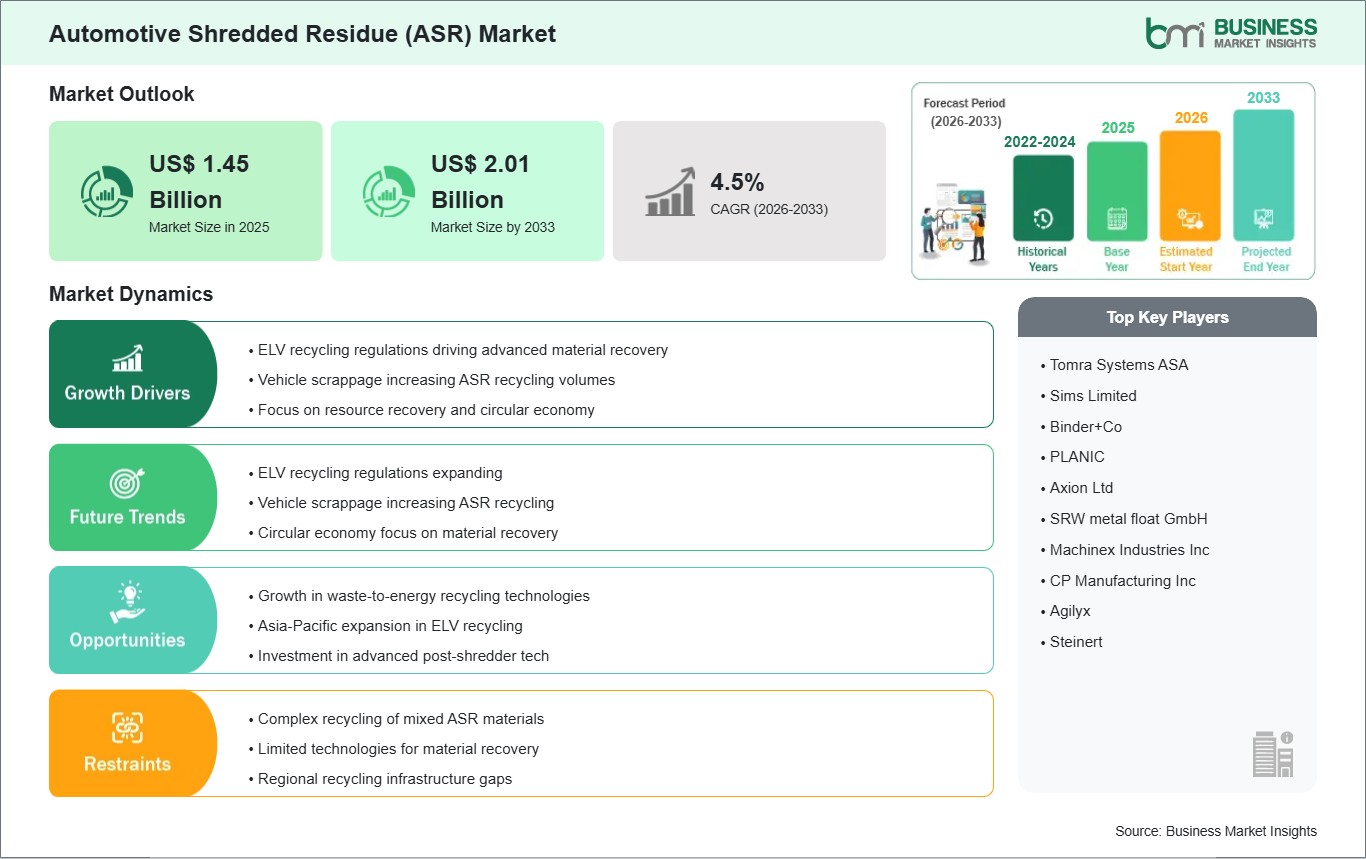
Automotive shredded residue (ASR) is an important byproduct of vehicle recycling. It contains mixed materials that remain after metals are taken from end-of-life vehicles. This complex stream includes plastics, rubber, foam, glass, fibers, and leftover metals. Managing ASR is key to improving recycling efficiency and reducing reliance on landfills. It presents both challenges and opportunities for recovering materials and generating energy. Improved separation technologies help extract reusable plastics and remaining metals, while some portions are turned into alternative fuels. Proper ASR treatment supports resource conservation, reduces environmental impact, and improves practices related to the circular economy. Market growth is mainly driven by increasing vehicle scrappage rates, strict environmental regulations, and a greater focus on sustainable waste management. Advances in sorting, pyrolysis, and material recovery systems also significantly aid market expansion.
However, the ASR market has notable challenges. The mixed makeup of shredded residue makes separation complicated and expensive. Changing recycling economics and different regulatory standards in various regions can create uncertainty for operators. High investment needs for advanced processing facilities may deter smaller recyclers from updating their systems. Ensuring the consistent quality of recovered materials also requires technical knowledge and ongoing innovation. Despite these challenges, there are significant opportunities due to rising circular economic initiatives, stricter landfill regulations, and a growing demand for recycled plastics and energy recovery solutions. Future market trends will depend on better recovery technologies, supportive environmental policies, and closer cooperation between automakers and recycling industries to promote material circularity.
Segment Analysis
Automotive Shredded Residue (ASR) Market Segmentation
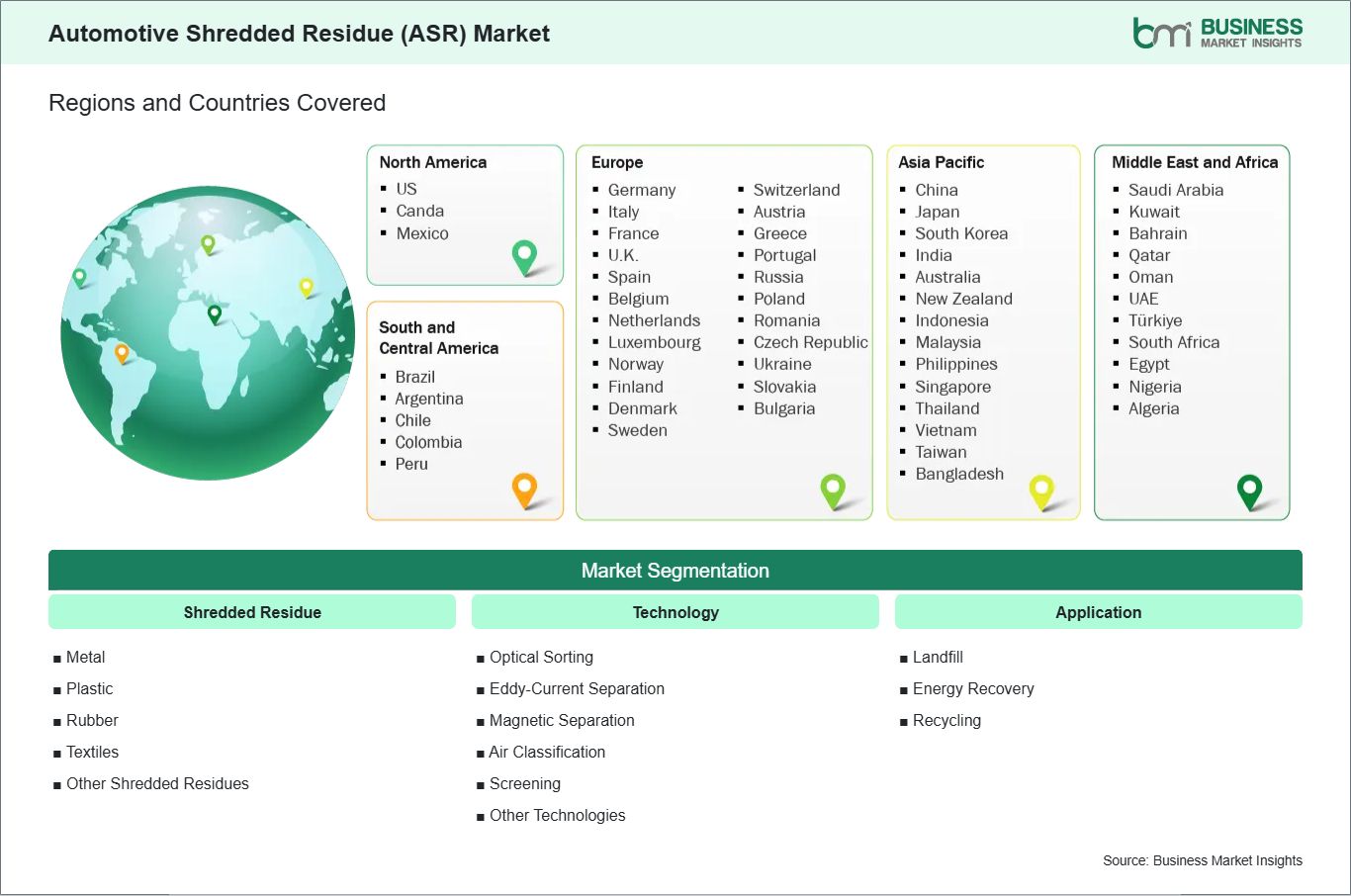
Key segments that contributed to the derivation of the automotive shredded residue (ASR) market analysis are shredded residue, technology, and application.
- By shredded residue, the automotive shredded residue (ASR) market is segmented into metal, plastic, rubber, textiles, and other shredded residues. The plastic segment dominated the market in 2025.
- By technology, the market is categorized into optical sorting, eddy-current separation, magnetic separation, air classification, screening, and other technologies. The magnetic separation segment dominated the market in 2025.
- By application, the market is categorized into landfill, energy recovery, and recycling. The landfill segment held the largest share of the market in 2025.
Market Forces
Automotive Shredded Residue (ASR) Market Drivers and Opportunities
Rising Demand for Advanced Recovery and Circular Economy Solutions
Recyclers and waste management companies are increasingly adopting automotive shredded residue (ASR) processing solutions to recover more materials and reduce reliance on landfills. ASR treatment technologies offer a cost-effective way to extract valuable plastics, rubber, and leftover metals without needing complete system changes. These solutions help meet today's sustainability goals by improving recovery rates, boosting operational efficiency, and ensuring better compliance with environmental standards. Their role in supporting circular economy models is becoming crucial as vehicle designs get more complex and material variety increases. The push for resource optimization and zero-waste strategies is speeding up innovation in separation and conversion technologies. Industry players are investing in research and tailored recovery systems to meet changing regulatory and performance needs. Rising vehicle scrappage rates, stricter recycling rules, and increased cooperation between automakers and recyclers also drive market growth. The ongoing need for effective material reuse is driving technological progress, leading to steady growth in the ASR market.
Transition Toward Sustainable and Regulated Waste Management Practices
There is a growing focus on environmentally friendly ASR management methods, including recycling, material recovery, and energy conversion technologies. This shift reflects increasing pressure to minimize landfill use and reduce environmental harm. Advanced processing systems help recover secondary raw materials and turn non-recyclable fractions into alternative fuels, which improves the sustainability of end-of-life vehicles. These methods boost resource efficiency by lowering reliance on virgin materials and cutting greenhouse gas emissions. Interest in innovative sorting, pyrolysis, and waste-to-energy technologies shows a strong commitment to balancing performance with environmental responsibility. Stricter regulations and global sustainability initiatives are speeding up the development of cleaner and more efficient recovery solutions. The industry is concentrating on processes that raise recovery yields while meeting strict safety and compliance standards. The drive for regulatory compliance, operational efficiency, and a smaller ecological footprint continues to encourage the global use of advanced ASR treatment technologies.
Size and Share Analysis
Automotive Shredded Residue (ASR) Market Size and Share Analysis
The automotive shredded residue (ASR) market demonstrates steady growth, with size and share analysis revealing evolving trends and competitive positioning among key players. The report further examines subsegments categorized within shredded residue, technology, and application, offering insights into their contribution to overall market performance.
Based on technology, the magnetic separation subsegment dominates the automotive shredded residue (ASR) market. Magnetic separation systems efficiently recover ferrous metals from complex shredded waste. They deliver reliable performance, low operating costs, and easy integration into current recycling lines. This technology is commonly used in the primary and secondary separation stages to extract valuable iron and steel before further processing. Its proven effectiveness, straightforward operation, and steady recovery rates make it the top choice for recyclers and plant operators looking for cost-effective metal recovery and better overall material value.
Report Coverage
Automotive Shredded Residue (ASR) Market Report Coverage and Deliverables
The " Automotive Shredded Residue (ASR) Market Size and Forecast (2022–2033)" report provides a detailed analysis of the market covering below areas:
- Automotive Shredded Residue (ASR) market size and forecast at global, regional, and country levels for all the key market segments covered under the scope
- Automotive Shredded Residue (ASR) market trends, as well as market dynamics such as drivers, restraints, and key opportunities
- Automotive Shredded Residue (ASR) market analysis covering key market trends, global and regional framework, major players, regulations, and recent market developments
- Industry landscape and competition analysis covering market concentration, heat map analysis, prominent players, and recent developments for the automotive shredded residue (ASR) market
- Detailed company profiles, including SWOT analysis
Geographic Insights
Automotive Shredded Residue (ASR) Market Geographic Insights
The geographical scope of the automotive shredded residue (ASR) market report is divided into five regions: North America, Asia Pacific, Europe, Middle East & Africa, and South & Central America. The Asia Pacific Automotive Shredded Residue (ASR) Market is segmented into China, Japan, South Korea, India, Australia, New Zealand, Indonesia, Malaysia, the Philippines, Singapore, Thailand, Vietnam, Taiwan, Bangladesh, and the Rest of Asia Pacific. Asia Pacific's fast industrial growth and expanding automotive recycling infrastructure make it a top region in the automotive shredded residue (ASR) market. More vehicle ownership, increasing numbers of end-of-life vehicles, and stricter waste management regulations support the growth of the market. Demand for efficient material recovery, less reliance on landfills, and better use of resources also drive growth.
Additionally, there is a rising interest in affordable and eco-friendly recycling technologies. The region's large automotive production base, growing population, and greater awareness of circular economy practices strengthen Asia Pacific's role as a key player in global ASR processing and recovery activities.
Industry Activity
Recent Developments
The Automotive Shredded Residue (ASR) market is evaluated by gathering qualitative and quantitative data post-primary and secondary research, which includes important corporate publications, association data, and databases. A few of the key developments in the automotive shredded residue (ASR) market are:
- In February 2024, MBA Polymers UK Ltd. initiated a program to recycle damaged or end-of-life car bumpers into polymers for the automotive sector. By collaborating with authorized treatment facilities, insurers, and garages, the initiative aims to reduce landfill waste, lower carbon emissions, aid car manufacturers in achieving recycling goals, and promote a circular economy in the industry.
- In August 2025, Sicon GmbH launched the EcoShred Wiretec system in Europe, designed to effectively recover nonferrous metals from shredded insulated copper wire (ICW) and enhance zorba fines sorting. This technology offers a cost-efficient solution for processing cables from auto shredder residue (ASR), addressing the challenges in separating materials from both light and heavy fractions. With over twenty years of experience, Sicon aims to improve the sorting and upgrading of metals from ASR streams.
Trust & Transparency
Research Methodology
The market analysis combines proprietary research with secondary data from government agencies, company disclosures, regulatory filings, industry databases and expert interviews. Market estimates are validated through data triangulation, cross-market benchmarking and analyst
review.
View Full Research Methodology
Key Sources Referred:
World Bank – Global Trade IndicatorsEuropean Chemicals AgencyInternational Council of Chemical AssociationsInternational Monetary Fund (IMF)World Trade Organization (WTO)International Trade Administration (ITA)Company WebsitesCompany Annual ReportsCompany Investor Presentations