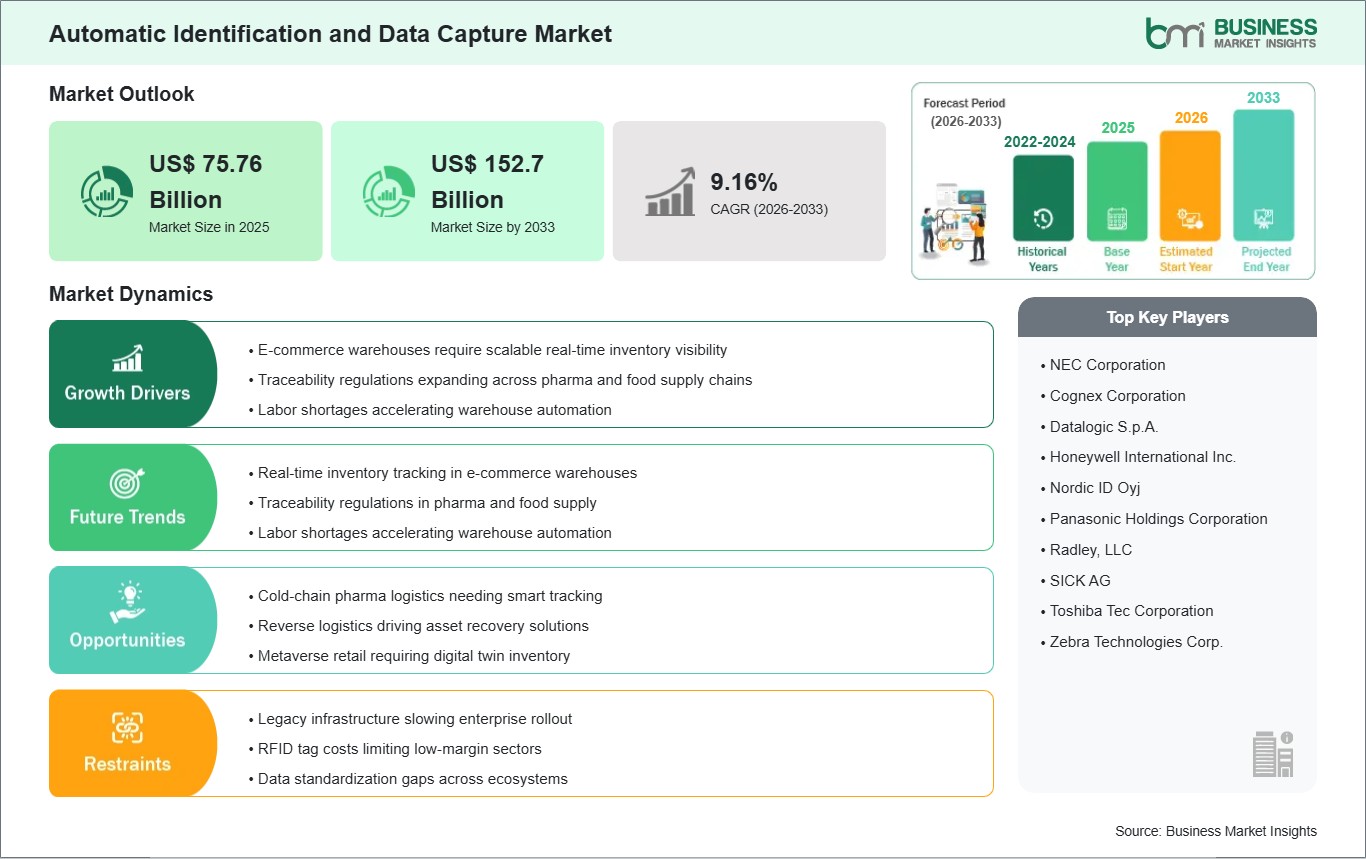
The Automatic Identification and Data Capture Market size is expected to reach US$ 152.7 Billion by 2033 from US$ 75.76 Billion in 2025. The market is estimated to record a CAGR of 9.16% from 2026 to 2033.
The global automatic identification and data capture market is using technologies like edge AI scanners, blockchain, secured RFID tags, and multimodal biometric fusion to provide real-time inventory visibility in supply chain ecosystems and contactless access control. These installations integrate 5G, enabled readers, predictive analytics algorithms, and zero-trust protocols, resulting in throughput gains of up to 85% when compared with the performance of legacy barcode-based systems. Thus, smart factories, omnichannel retail, and hospital asset tracking can fully operate at error-free data levels.
Besides the major benefits, features such as 60% lower power draw versus magnetic stripes, 45% reduction in weight due to polymer, embedded sensors, and zoning based on cloud dashboards are making AIDC a vital component of human-centric warehouses, edge AI vision systems, and sustainable logistics ecosystems. 6G, enabled IoT capture, regulatory mandates for traceability, and AR/VR picking interfaces will be accompanied by a massive surge of unstructured data from global trade. The market is being driven by green logistics certifications such as GS1 and EDGE, and the decrease in GaN RFID chip prices. However, on the other side, supply chain disruptions for rare earth antennas and Zigbee/Matter protocols interoperability are becoming the industry's pain points.

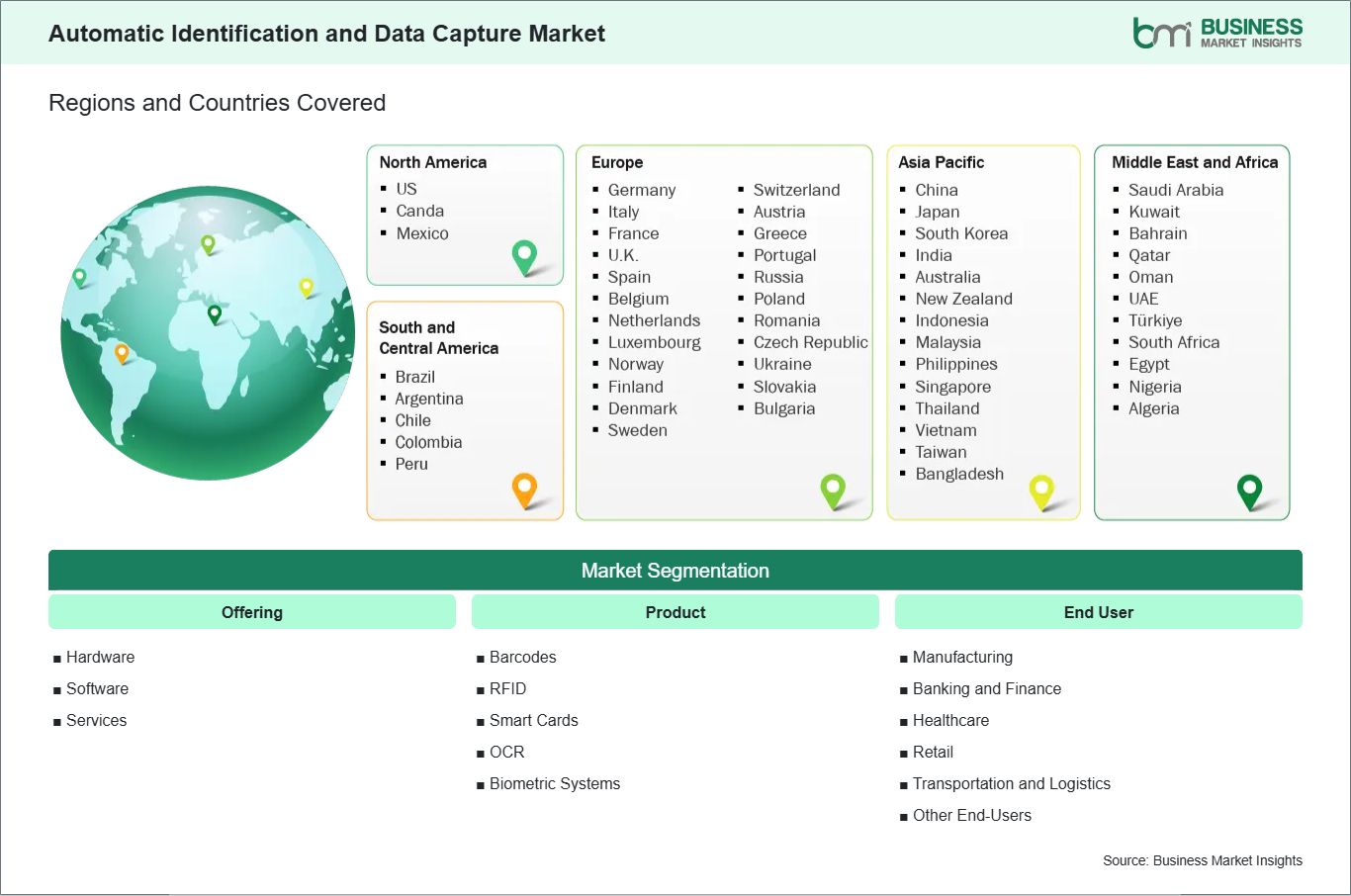
Key segments shaping the global automatic identification and data capture market include offering, product, and end user.
The automatic identification component was mainly characterized by large-scale retrofitting of old DCs with hyperscale and AI, optimized RFID portals, as operators were concentrating on low-latency, tunable 860, 960MHz interconnects. Zebra and Honeywell handheld scanners combined with Impinj controllers for dynamic slotting, the resulting 35% throughput enhancements have been realized through sub, 1% read errors throughout 100m zones, which is crucial for remote hybrid fulfillment.
In light of the EU Supply Chain Act rules, a 22% annual reader upgrade rate is creating a backlog of more than 45M units for 2030. US fabs are ramping quantum, dot tag production, antenna chain stressed e, comm FTL picking are blending OCR with biometrics, all thanks to IRA incentives. UHF RFID is at its best in, 20C cold chains, while DAC, to RFID swaps are opening the door for quick ROI; hence, AIDC systems will be the first step to zero-touch mesh networks that can handle petabytes, scale BIM models, liquid, cooled portals, and PUE levels below 1.15.
The energy shocks from Ukraine have drawn the attention of everyone to grid resilience, so hybrid sensor arrays that include lux, motion, and humidity monitors were created to avoid over-lighting in the adversary-threatened factories. GaN readers perform very well in the EMI, heavy EV production plants; therefore, the SNR is increased by more than 28% in comparison with the silicon competitors.
Barcodes/RFID will probably see a lot of benefits from both the omnichannel retail boom and factory 4.0 cockpits, thus clearing the way for biometric gloves and zonal robotics. Matter standards allow smart cards to be combined with Thread for remote monitoring, thus reducing the amount of venue wiring by 52% as compared to the use of legacy magstripes for CES/Expo streams. Consumer mandates like the EU Ecolabel push the unit costs under $12. Meanwhile, Industry 5.0 autonomy requires 400 reads/sec links for machine vision at a price of less than US$ 75/unit. Micro tags go as small as 0.5mm, therefore reducing the BOMs for edge gateways by half. Industrial verticals deploy biometric pendants in 48V DC grids according to UL 2054 standards. These developments prepare the ground for suppliers to make deals worth US$ 18 billion by 2034, with AIDC serving as the pluggable cores for disaggregated IoT and immersive environments.

By offering, the global automatic identification and data capture market segments into Hardware, Software, and Services. The Hardware segment dominated in 2025. Drives 68% installations: tunable frequency scalability boosts hyperscaler adoption in 915MHz fabrics.
By product, segments are Barcodes, RFID, Smart Cards, OCR, and Biometric Systems. The RFID segment led in 2025. Captures 58% volume; rebate programs demand rapid DC-to-retrofit scaling.
By end user, divisions include Manufacturing, Banking and Finance, Healthcare, Retail, Transportation and Logistics, and Others. The Retail segment held the largest share in 2025. Versatile 1-500m support enables seamless zone migrations globally.
| Report Attribute | Details |
|---|---|
| Market size in 2025 | US$ 75.76 Billion |
| Market Size by 2033 | US$ 152.7 Billion |
| Global CAGR (2026 - 2033) | 9.16% |
| Historical Data | 2022-2024 |
| Forecast period | 2026-2033 |
| Segments Covered | By Offering
|
|
Regions and Countries Covered
| |
| North America | US, Canada, Mexico |
| Europe | Belgium, Austria, Finland, Denmark, Greece, Poland, Romania, Russia, Ukraine, Czech Republic, Slovakia, Bulgaria, Italy, Luxembourg, Germany, Switzerland, France, Netherlands, Norway, Portugal, Spain, Sweden, United Kingdom |
| Asia-Pacific | Australia, China, India, Japan, South Korea, Indonesia, Malaysia, Philippines, Singapore, Thailand, Vietnam, Bangladesh, New Zealand, Taiwan |
| South and Central America | Brazil, Argentina, Peru, Chile, Colombia |
| Middle East and Africa | Bahrain, Kuwait, Oman, Qatar, Saudi Arabia, United Arab Emirates, Turkiye, South Africa, Egypt, Algeria, Nigeria |
| Market leaders and key company profiles |
|
The "Automatic Identification and Data Capture Market Size and Forecast (2022 - 2033)" report provides a detailed analysis of the market covering below areas:
The geographical scope of the automatic identification and data capture market report is divided into five regions: North America, Asia Pacific, Europe, the Middle East & Africa, and South & Central America. The automatic identification and data capture market in North America registered the highest market share in 2025.
North America is still leading the charge, boasting three mega DCs and smart labs sprinkled all over the US, Canada, and Mexico. There is a huge surge in deployment in the US, where 915MHz RFID portals are used, for example, at Amazon's Austin hubs and Walmart edge nodes for tactical AI picking. In Canada, operators such as Loblaws are installing 860MHz controls for their ML pipelines. The maquiladoras in Mexico are deploying OCR lights to the Tier 1 factory level.
Europe is still progressing by carrying out the EU Green Deal and net-zero mandates. Germany's Sick and Nedap are developing RFID for edge factories, the UK's Cove is getting adopted for BBC studios, and France's OVHcloud is emphasizing low-power readers for sovereign clouds. The Middle East is creating data havens, such as the Saudi NEOM's stc suspended grids and the UAE du's biometric track lights for 5G sites. Asia Pacific is rapidly growing with China's 14th Plan trials and chip objectives, Alibaba taking micro, RFID controls. One of the biggest advanced UHF dependencies is India's Reliance, which is putting up 400 reads/sec retrofits but is falling behind due to antenna gaps. South and Central America will experience growth during the forecast period.

The automatic identification and data capture market is evaluated by gathering qualitative and quantitative data post-primary and secondary research, which includes important corporate publications, association data, and databases. A few of the key developments in the automatic identification and data capture market are:
The Automatic Identification and Data Capture Market is valued at US$ 75.76 Billion in 2025, it is projected to reach US$ 152.7 Billion by 2033.
As per our report Automatic Identification and Data Capture Market, the market size is valued at US$ 75.76 Billion in 2025, projecting it to reach US$ 152.7 Billion by 2033. This translates to a CAGR of approximately 9.16% during the forecast period.
The Automatic Identification and Data Capture Market report typically cover these key segments-
The historic period, base year, and forecast period can vary slightly depending on the specific market research report. However, for the Automatic Identification and Data Capture Market report:
The Automatic Identification and Data Capture Market is populated by several key players, each contributing to its growth and innovation. Some of the major players include:
The Automatic Identification and Data Capture Market report is valuable for diverse stakeholders, including:
Essentially, anyone involved in or considering involvement in the Automatic Identification and Data Capture Market value chain can benefit from the information contained in a comprehensive market report.
Please tell us your area of interest
(Market Segments/ Regions and Countries/ Companies)