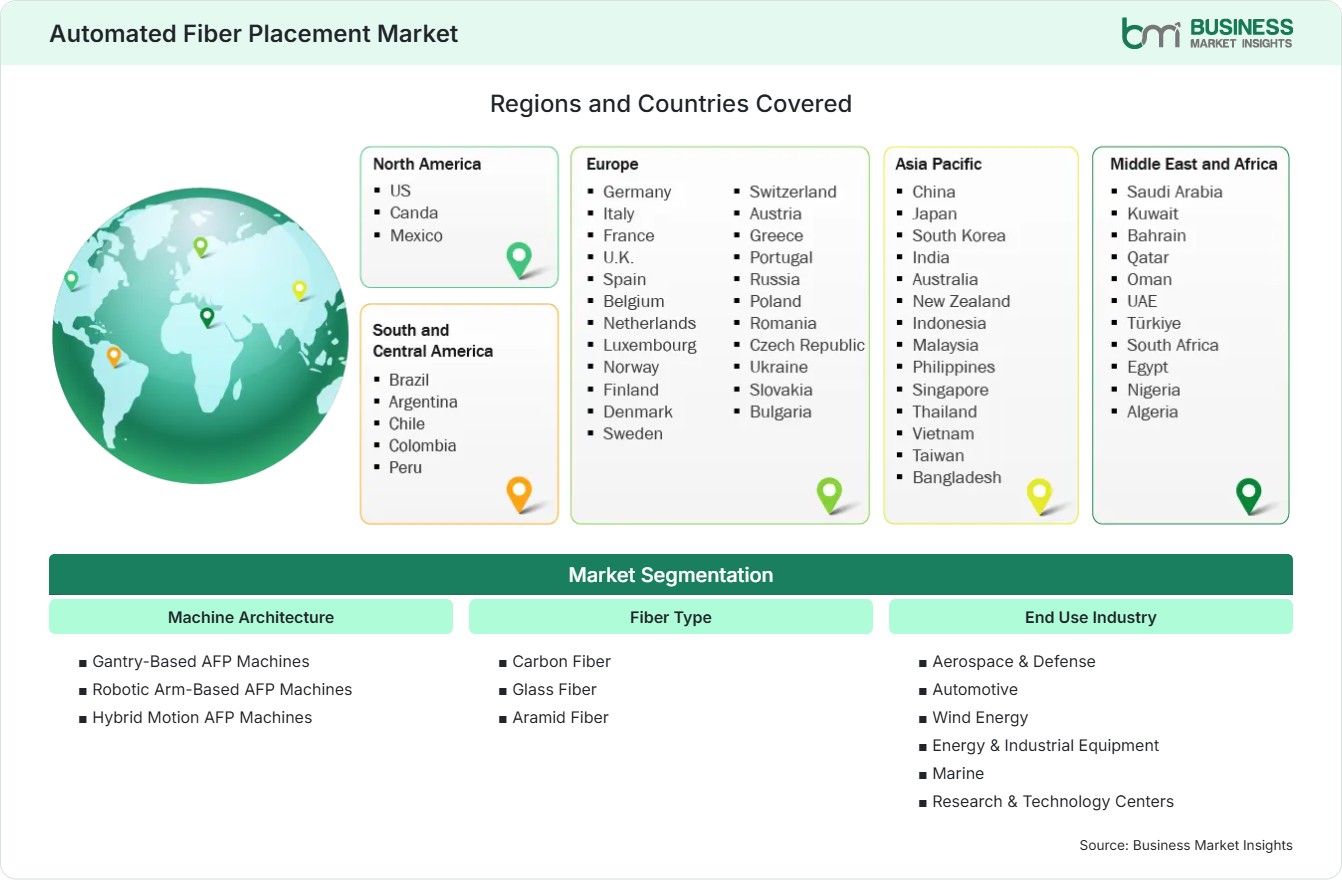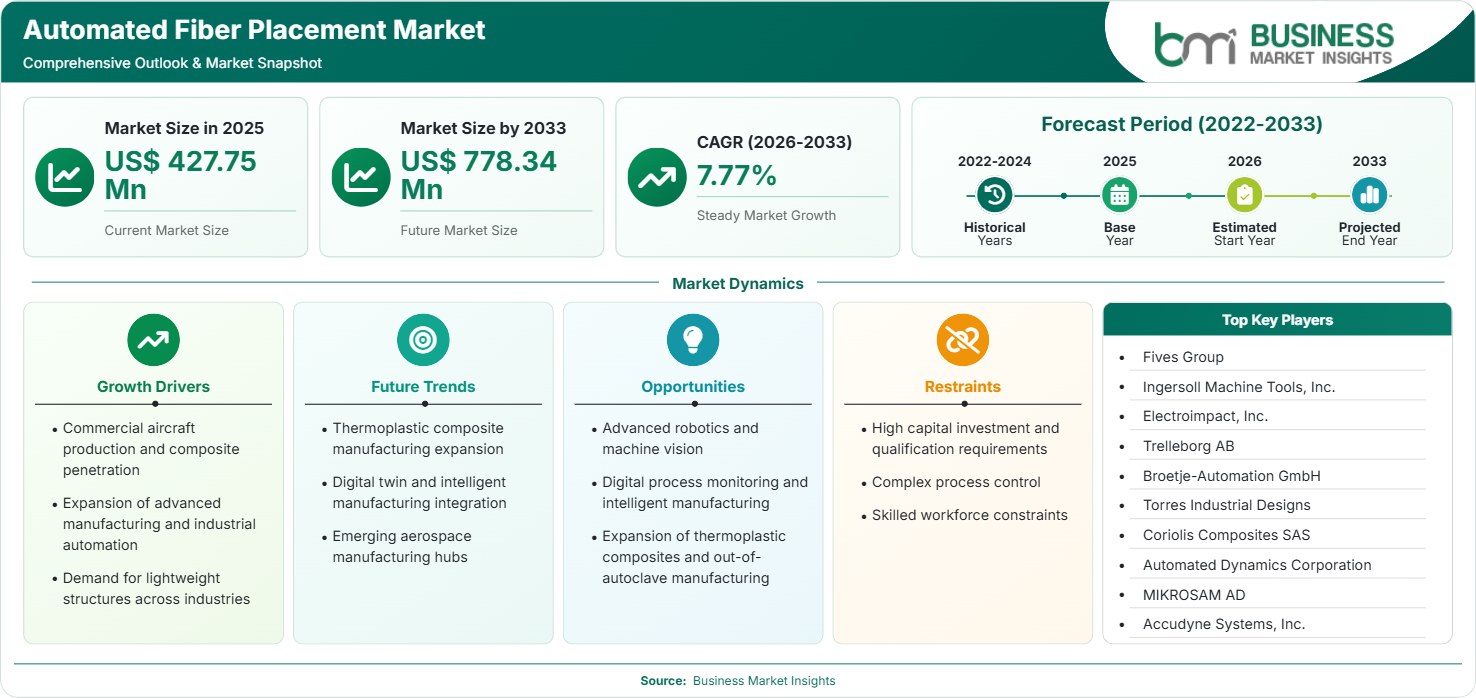
Automated Fiber Placement Market Regional Highlights
North America Automated Fiber Placement Market
The North American region contributes between 36% and 39% to global revenue, while the CAGR in North America between 2025 and 2033 is estimated at 6.9% to 7.3%. North America has the advantage of an efficient aerospace manufacturing sector, active defense procurement, sophisticated knowledge of composites, and ongoing investment in production automation. Automated Fiber Placement Market share depends on aircraft OEM requirements, defense platforms that use more composites, and research collaboration across industrial and government organizations. Capacity expansion programs continue to reinforce regional competitiveness in high-value composite manufacturing.
- Aircraft production backlogs at major aerospace manufacturers support continuous demand for automated composite fabrication systems and advanced fiber placement technologies across commercial and defense applications.
- NASA-supported advanced composite manufacturing initiatives encourage higher-rate production methods and accelerate technology validation for future aircraft structures and industrial applications.
- Defense modernization programs increasingly incorporate lightweight composite materials, supporting procurement of sophisticated manufacturing equipment capable of meeting strict performance requirements.
- Digital manufacturing adoption, including predictive analytics and inline inspection, enhances process efficiency and strengthens investment justification for advanced automation systems.
US Automated Fiber Placement Market
The U.S. accounts for 74%-78% of North America’s consumption and is projected to witness a CAGR of 7.0%-7.4% during 2026-2033. A robust aerospace manufacturing base, high defense expenditure, research activities in new materials, and investments in composite manufacturing are driving market growth. Leading OEMs and tier suppliers continue to invest in automated manufacturing operations to enhance efficiency. The U.S. continues to be an important center for innovation, qualification, and commercialization of next-generation technologies in composite manufacturing.
- Commercial aircraft programs require increasing volumes of composite structures, encouraging investment in automated manufacturing platforms capable of delivering repeatable production quality.
- Defense aerospace projects prioritize weight reduction and structural performance, expanding deployment of advanced fiber placement systems throughout supply chains.
- Research institutions actively collaborate with industry participants to improve automation efficiency, inspection technologies, and material utilization rates.
- Growth in industrial composite applications broadens equipment demand beyond traditional aerospace manufacturing environments.
Europe Automated Fiber Placement Market
Europe captures 28%–31% of global revenue in 2025 and is forecast to expand at 7.3%–7.8% of the Automated Fiber Placement Market CAGR through 2033. Strong aerospace manufacturing activity, sustainability-focused industrial policies, and advanced engineering capabilities support regional demand. Germany leads regional revenue generation, while Spain demonstrates one of the strongest growth trajectories near 8.0%–8.5% CAGR. Regional manufacturers increasingly invest in automation technologies to improve competitiveness, reduce production costs, and support growing composite adoption across aerospace, energy, and transportation sectors.
- Airbus supply-chain investments continue supporting deployment of advanced composite manufacturing technologies across multiple European countries.
- Sustainability initiatives encourage lightweight structures and efficient production methods, increasing automation requirements throughout industrial sectors.
- Strong engineering expertise supports development of advanced robotic placement systems and integrated manufacturing solutions.
- Research partnerships accelerate commercialization of thermoplastic composites and next-generation automated fabrication processes.
Asia Pacific Automated Fiber Placement Market
Asia Pacific accounts for 24%-27% of world revenue in 2025 and is expected to attain the highest CAGR of 9.2%-9.8% during 2023-2033. China is the market leader in the region, whereas India shows one of the highest CAGRs at 9.8%-10.4%. Growth in the aerospace, renewable energy, and industrial automation sectors will further contribute to adoption. Governments are investing in advanced materials capabilities and domestic production infrastructure, strengthening long-term prospects for automated composite manufacturing technologies.
- Domestic aircraft development programs create sustained demand for high-precision composite manufacturing equipment and related automation solutions.
- Wind energy expansion increases production requirements for composite-intensive structures and supports broader industrial adoption.
- Manufacturing modernization strategies encourage deployment of robotics, digital production systems, and advanced process control technologies.
- Increasing investments in research facilities support workforce development and technology qualification efforts across emerging economies.
Rest of World Automated Fiber Placement Market
Rest of World contributes 8%–10% of global revenue in 2025 and is projected to grow at 7.6%–8.2% CAGR of the Automated Fiber Placement Market through 2033. South and Central America benefit from expanding aerospace component manufacturing and industrial diversification strategies. Middle East and Africa markets are supported by aviation sector development, industrial modernization initiatives, and investments in advanced manufacturing capabilities. Brazil remains the leading regional contributor, while the United Arab Emirates demonstrates strong growth potential through technology-driven industrial programs.
- Aerospace component manufacturing expansion supports selective investment in composite automation capabilities across Latin America.
- Industrial diversification strategies encourage development of higher-value manufacturing ecosystems using advanced materials technologies.
- Aviation infrastructure investments strengthen demand for local manufacturing capabilities and supporting automation systems.
- Government-supported innovation programs help accelerate adoption of advanced production technologies and workforce training initiatives.