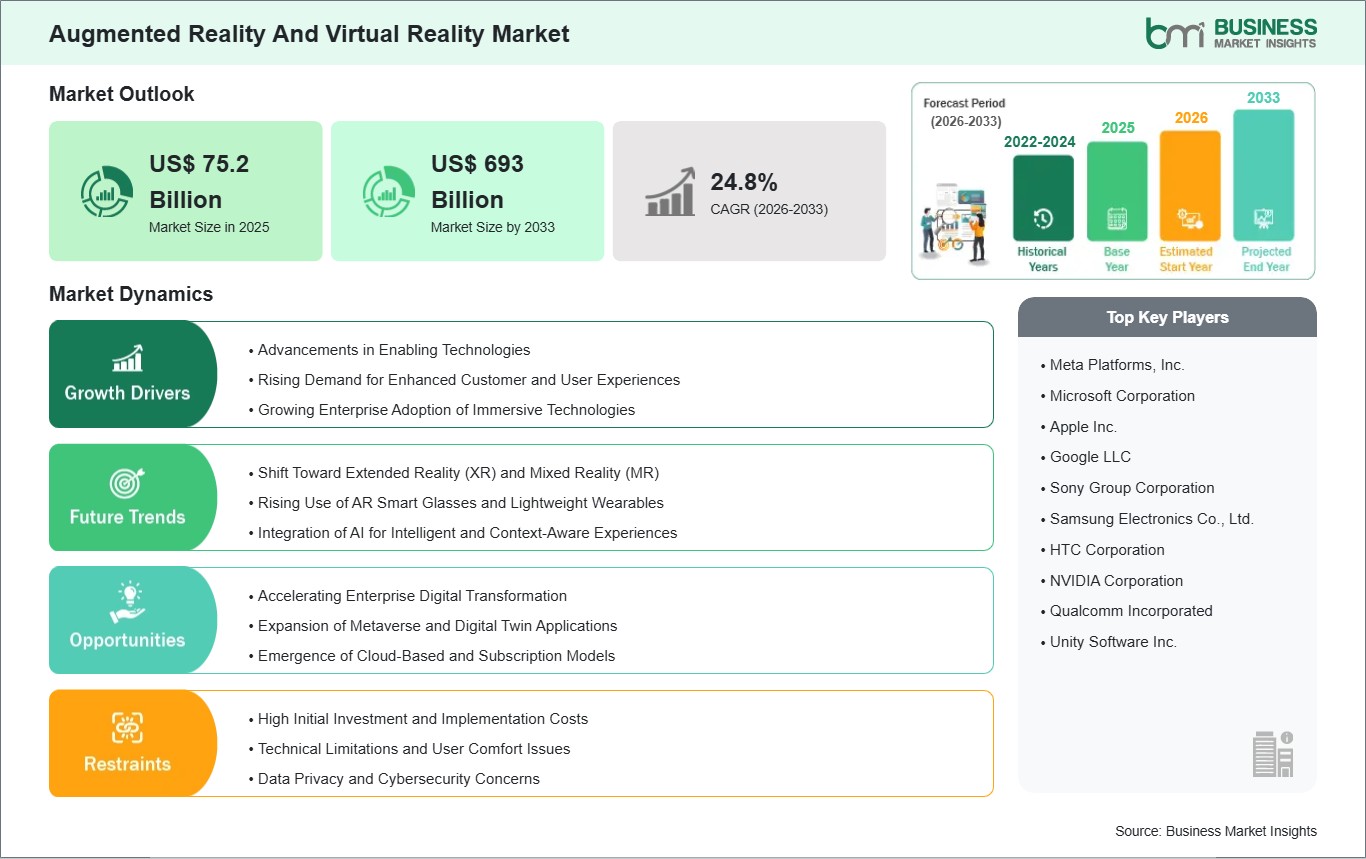
The Augmented Reality and Virtual Reality market size is expected to reach US$ 693.0 billion by 2033 from US$ 75.2 billion in 2025. The market is estimated to record a CAGR of 24.8% from 2026 to 2033.
The Augmented Reality and Virtual Reality (AR & VR) market is a critical enabler of digital transformation across multiple industries, including manufacturing, healthcare, education, retail, real estate, and enterprise services. AR and VR technologies are redefining how organizations visualize data, interact with digital content, and deliver immersive user experiences. By enabling real-time visualization, simulation, and interactive engagement, AR and VR solutions significantly enhance productivity, decision-making, training efficiency, and customer engagement across business environments. At the core of this transformation is the integration of AR and VR with enabling technologies such as Artificial Intelligence (AI), Internet of Things (IoT), cloud computing, and advanced analytics. These technologies allow businesses to deliver intelligent, data-driven, and context-aware immersive experiences. Enterprises are increasingly leveraging AR for remote assistance, maintenance, and operational guidance, while VR is gaining traction for virtual training, product design, simulations, and collaborative workspaces. Together, AR and VR support more efficient workflows, reduced operational costs, and faster time-to-market.
Several key factors are driving the expansion of the AR and VR market. These include the growing demand for immersive digital experiences, increasing enterprise adoption of virtual training and remote collaboration tools, and rapid advancements in hardware components such as head-mounted displays, sensors, and spatial computing devices. Additionally, the rise of the metaverse, digital twins, and extended reality (XR) platforms is accelerating investments across both consumer and enterprise segments. Organizations are also adopting AR and VR to improve safety, reduce errors, and enhance customer engagement in competitive markets.

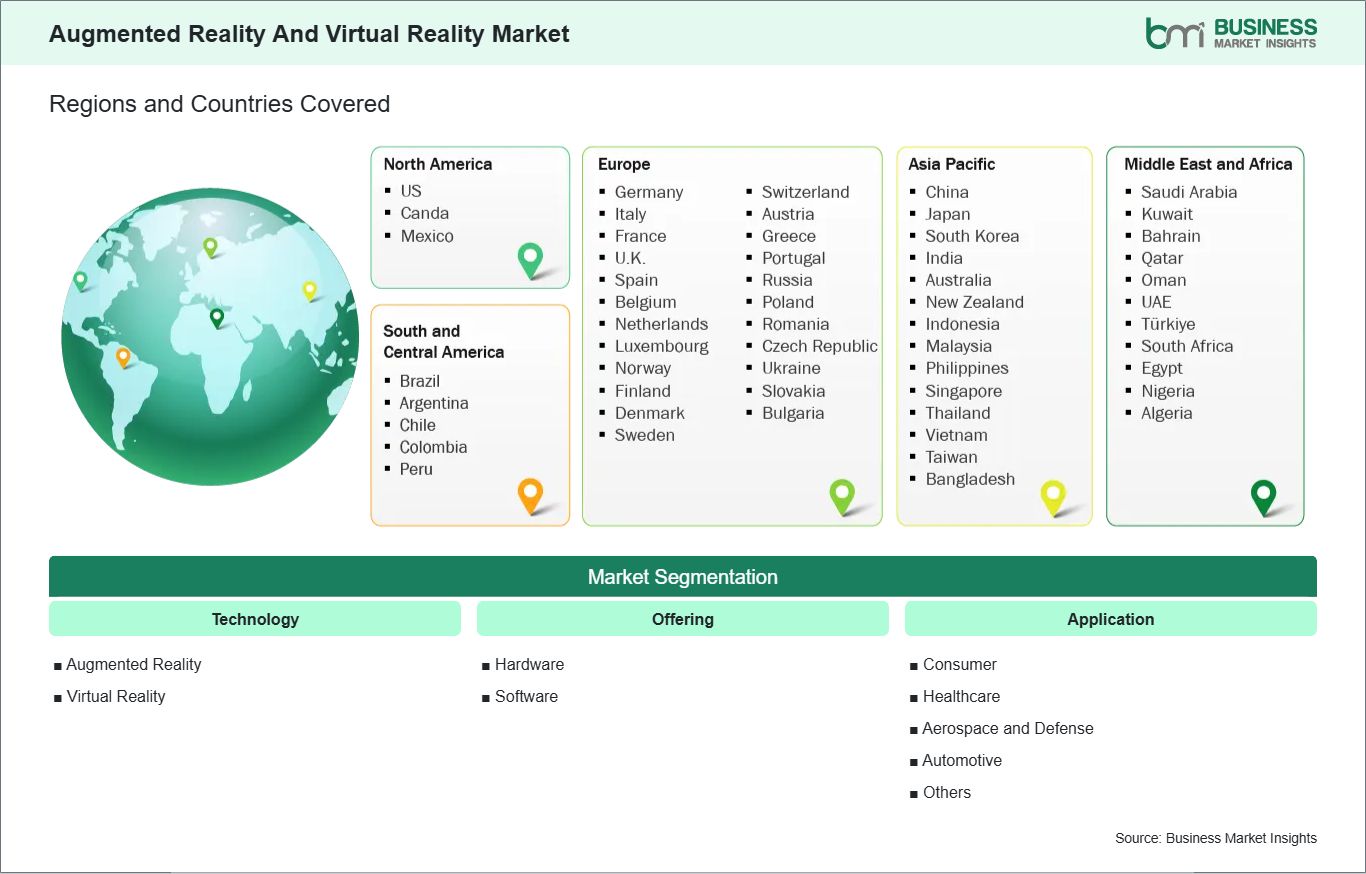
Key segments that contributed to the derivation of the Augmented Reality and Virtual Reality market analysis are technology, offering, and application.
Continuous advancements in enabling technologies such as Artificial Intelligence (AI), Internet of Things (IoT), cloud computing, and spatial computing are further driving the growth of the AR and VR market. These technologies enhance the intelligence, scalability, and performance of AR and VR platforms by enabling real-time data processing, analytics-driven insights, and seamless connectivity across devices.
AI-powered analytics improve object recognition, environment mapping, and user interaction, while IoT integration allows AR and VR systems to interface with real-world equipment and sensors. Automation and cloud-based deployment models reduce implementation complexity and support remote accessibility, making AR and VR solutions more viable for large-scale enterprise adoption. Together, these advancements are expanding the scope of AR and VR applications and increasing their value proposition for businesses.
One of the primary drivers of the Augmented Reality and Virtual Reality market is the accelerating pace of digital transformation across enterprises worldwide. Organizations are increasingly adopting AR and VR solutions to enhance operational efficiency, workforce productivity, and customer engagement. These technologies enable immersive visualization, real-time data interaction, and advanced simulation capabilities that traditional digital tools cannot provide. As businesses seek to modernize workflows, reduce operational costs, and improve decision-making, AR and VR are emerging as strategic enablers across manufacturing, healthcare, education, retail, and professional services.
AR solutions are particularly gaining traction in remote assistance, field service support, and maintenance operations, allowing employees to access contextual information and expert guidance in real time. VR, on the other hand, is being widely deployed for training, simulation, product design, and collaborative environments, offering risk-free and cost-effective alternatives to physical training and prototyping. This growing reliance on immersive technologies is significantly contributing to sustained market expansion.
By technology, the market is bifurcated into augmented reality and virtual reality. The augmented reality segment dominated the market in 2024. AR solutions overlay digital information onto the real-world environment, making them highly suitable for real-time operational use across industries such as retail, manufacturing, healthcare, automotive, and logistics.
By offering, the market is bifurcated into hardware and software. The hardware held the larger share in 2024. The rapid commercialization of advanced AR smart glasses and next-generation VR headsets by major technology players has significantly contributed to hardware revenue growth. Additionally, enterprise deployments often require upfront investments in specialized devices, further strengthening the dominance of the hardware segment.
By application, the market is segmented into Consumer, Healthcare, Aerospace and Defense, Automotive, Others. The consumer segment held the larger share in 2024. Consumer-focused applications such as immersive gaming experiences, virtual concerts and events, AR-based filters, and virtual try-on solutions have driven high user engagement and device sales. The growing influence of social platforms and the expansion of metaverse-related applications have further reinforced consumer dominance.
| Report Attribute | Details |
|---|---|
| Market size in 2025 | US$ 75.2 Billion |
| Market Size by 2033 | US$ 693 Billion |
| Global CAGR (2026 - 2033) | 24.8% |
| Historical Data | 2022-2024 |
| Forecast period | 2026-2033 |
| Segments Covered | By Technology
|
|
Regions and Countries Covered
| |
| North America | US, Canada, Mexico |
| Europe | Belgium, Austria, Finland, Denmark, Greece, Poland, Romania, Russia, Ukraine, Czech Republic, Slovakia, Bulgaria, Italy, Luxembourg, Germany, Switzerland, France, Netherlands, Norway, Portugal, Spain, Sweden, United Kingdom |
| Asia-Pacific | Australia, China, India, Japan, South Korea, Indonesia, Malaysia, Philippines, Singapore, Thailand, Vietnam, Bangladesh, New Zealand, Taiwan |
| South and Central America | Brazil, Argentina, Peru, Chile, Colombia |
| Middle East and Africa | Bahrain, Kuwait, Oman, Qatar, Saudi Arabia, United Arab Emirates, Turkiye, South Africa, Egypt, Algeria, Nigeria |
| Market leaders and key company profiles |
|
The Augmented Reality And Virtual Reality Market Size and Forecast (2022–2033) report provides a detailed analysis of the market covering below areas:
The geographical scope of the Augmented Reality And Virtual Reality market report is divided into five regions: North America, Asia Pacific, Europe, Middle East &; Africa, and South & Central America. The Augmented Reality And Virtual Reality market in Asia Pacific is expected to grow significantly during the forecast period.
The Asia Pacific AR and VR market encompasses China, Japan, South Korea, India, Australia, New Zealand, Indonesia, Malaysia, the Philippines, Singapore, Thailand, Vietnam, Taiwan, Bangladesh, and the Rest of Asia. Growth across the region is supported by strong demand from both consumer and enterprise segments, combined with significant investments in digital transformation initiatives, Industry 4.0 programs, and next-generation computing technologies. Major economies such as China, Japan, South Korea, and India are leading adoption by integrating AR and VR with AI, IoT, cloud platforms, robotics, and digital twin technologies to improve productivity, product quality, and operational efficiency.
In particular, China continues to be a dominant market due to its large consumer base, strong electronics manufacturing capabilities, and government support for emerging technologies. Japan and South Korea are at the forefront of innovation in hardware development, gaming, industrial automation, and immersive content creation, while India is rapidly emerging as a high-growth market supported by a strong software ecosystem, expanding startup landscape, and increasing enterprise adoption across education, healthcare, and manufacturing sectors.

The Augmented Reality And Virtual Reality market is evaluated by gathering qualitative and quantitative data post primary and secondary research, which includes important corporate publications, association data, and databases. A few of the key developments in the Augmented Reality And Virtual Reality market are:
The Augmented Reality And Virtual Reality Market is valued at US$ 75.2 Billion in 2025, it is projected to reach US$ 693 Billion by 2033.
As per our report Augmented Reality And Virtual Reality Market, the market size is valued at US$ 75.2 Billion in 2025, projecting it to reach US$ 693 Billion by 2033. This translates to a CAGR of approximately 24.8% during the forecast period.
The Augmented Reality And Virtual Reality Market report typically cover these key segments-
The historic period, base year, and forecast period can vary slightly depending on the specific market research report. However, for the Augmented Reality And Virtual Reality Market report:
The Augmented Reality And Virtual Reality Market is populated by several key players, each contributing to its growth and innovation. Some of the major players include:
The Augmented Reality And Virtual Reality Market report is valuable for diverse stakeholders, including:
Essentially, anyone involved in or considering involvement in the Augmented Reality And Virtual Reality Market value chain can benefit from the information contained in a comprehensive market report.
Please tell us your area of interest
(Market Segments/ Regions and Countries/ Companies)