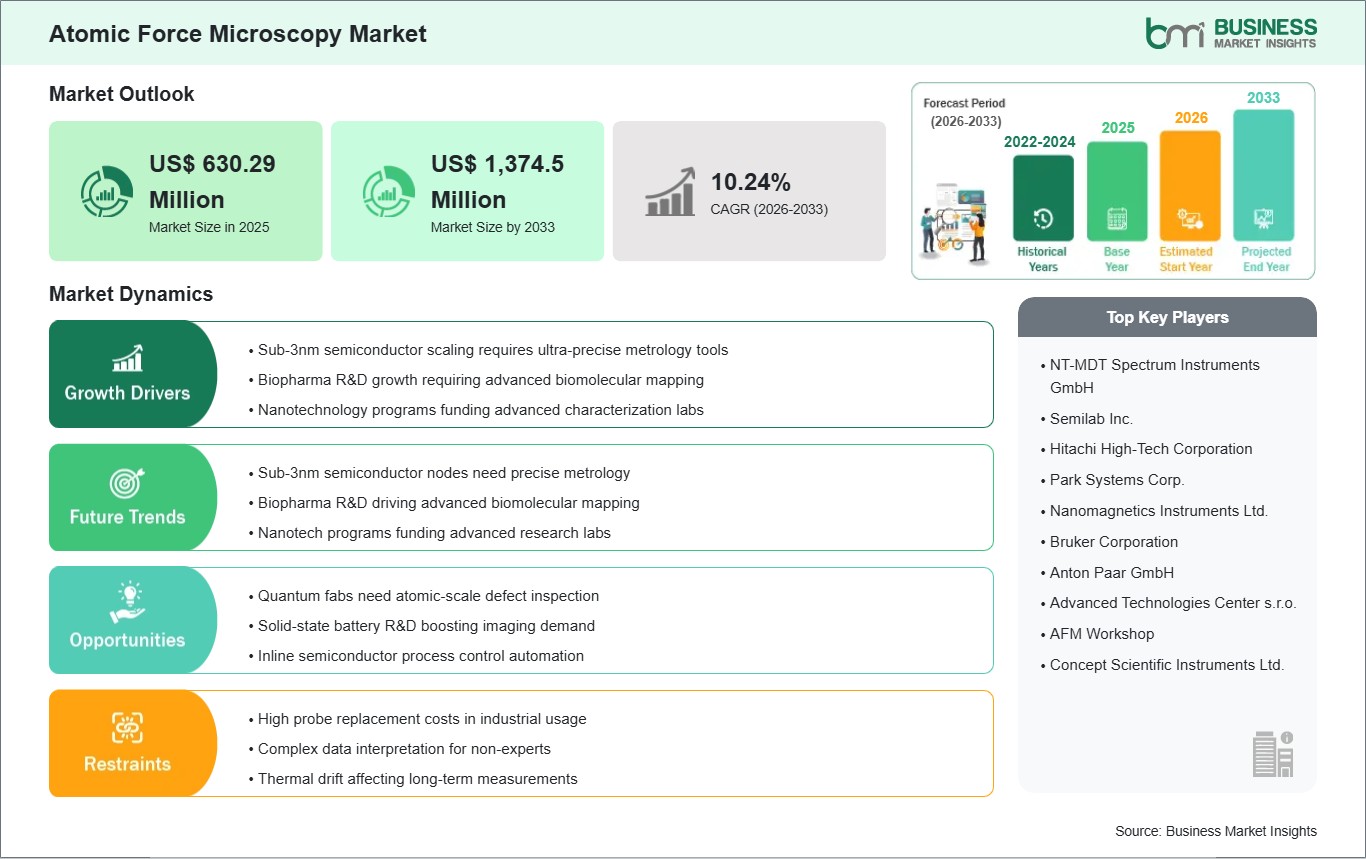
The atomic force microscopy market size is expected to reach US$ 1,374.5 million by 2033 from US$ 630.29 million in 2025. The market is estimated to record a CAGR of 10.24% from 2026 to 2033.
The worldwide atomic force microscopy market is taking advantage of features like high-speed scanning probes, AI, assisted image analysis, and multimodal integration in order to achieve sub-nanometer resolution in semiconductor metrology and biomolecular imaging. These instruments unleash the full potential of piezoelectric actuators, true non-contact modes, and machine learning algorithms, providing throughput up to 10 times faster than traditional contact, mode AFMs. Therefore, leading fabs, biopharma labs, and 2D materials research can be done at defect-free nanoscale precision. Apart from the biggest benefits, a 50% reduction in tip wear compared to silicon probes, a 30% decrease in footprint by using compact scanners, and cloud-based data zoning have been turning atomic force microscopy into a vital instrument in human-centric nanotech, edge AI metrology, and sustainable electronics ecosystems. 6G, enabled nano, sensors, quantum computing requirements, and VR/AR simulation labs will be among the new beneficiaries of a strong surge due to the unstructured nanoscale data explosion.
The market is driven by national nanotech initiatives such as the US National Nanotechnology Initiative and lower costs of carbon nanotube probes. However, supply chain disruptions of high-purity piezo ceramics and interoperability issues with SEM/TEM protocols are becoming industry pain points. In addition, there is great potential in hybrid scanning tips, 1 nm resolution arrays, and battery electrolyte mapping networks.

Key segments shaping the global atomic force microscopy market include offering, installation, types, and end user.
The atomic force microscopy segment was majorly influenced by hyperscale fabs upgrading their old SEMs with AI, optimized PeakForce tapping, and the operators were mostly concentrated on low, noise, tunable cantilevers from 0.1, 10 N/m springs. Bruker and Park Systems Dimension instruments are used along with Nanosurf controls for quantum dot arrays, giving rise to 40% yield improvements through sub-1 nm roughness mapping over 300mm wafers, which is crucial for EUV hybrid workforces.
In the frame of CHIPS Act rules, a 25% annual probe upgrade rate is leading to the accumulation of a backlog of more than 1M units by 2030. US labs are escalating CNT probes thanks to IRA incentives, with software analytics blending stressed phosphor chains in OLED picking. Hybrid tips glow in 150 battery bays, DAC, to AFM swaps give quick Return on Investment (ROI); thus, atomic systems will be the stepping stone for zero-touch mesh networks capable of holding exabytes, scale molecular models, liquid, cooled scanners, and PUE targets below 1.05.
Chip shortages originating from Taiwan's political tensions have brought attention to the importance of grid resilience. Thus, hybrid sensor arrays incorporating force, conductivity, and modulus monitors are able to prevent over-scanning in foundries that are threatened by adversaries. GaN scanners are the most suited ones in EMI, intensive EV plants, and for Noise Ratio (SNR) increased by more than 30% as compared to silicon competitors.
Probes and AFMs are highly likely to be impacted positively by biopharma wellness booms and also by cockpits of Industry 5.0, thus allowing scope to cryogenic cove imaging and zonal robotics. Matter, like standards, enables the fusion of industrial tips with Thread for remote monitoring, thus the lab wiring is reduced by 60% compared to the legacy STMs for CES/Expo streams. On the other hand, consumer mandates like EU Nano, safety push probes to below $50/unit. Simultaneously, the call for autonomy demands 100 nm/s research links at less than US$ 100k/unit. The micro tips in scale become 5 nm, thereby cutting the BOMs for edge gateways by half. Industrial verticals apply research, grade in 48V DC grids as per UL standards. These developments, in effect, are positioning suppliers to seize US$ 400 million deals through 2034, with atomic force microscopy as pluggable cores for disaggregated IoT and immersive nano environments.

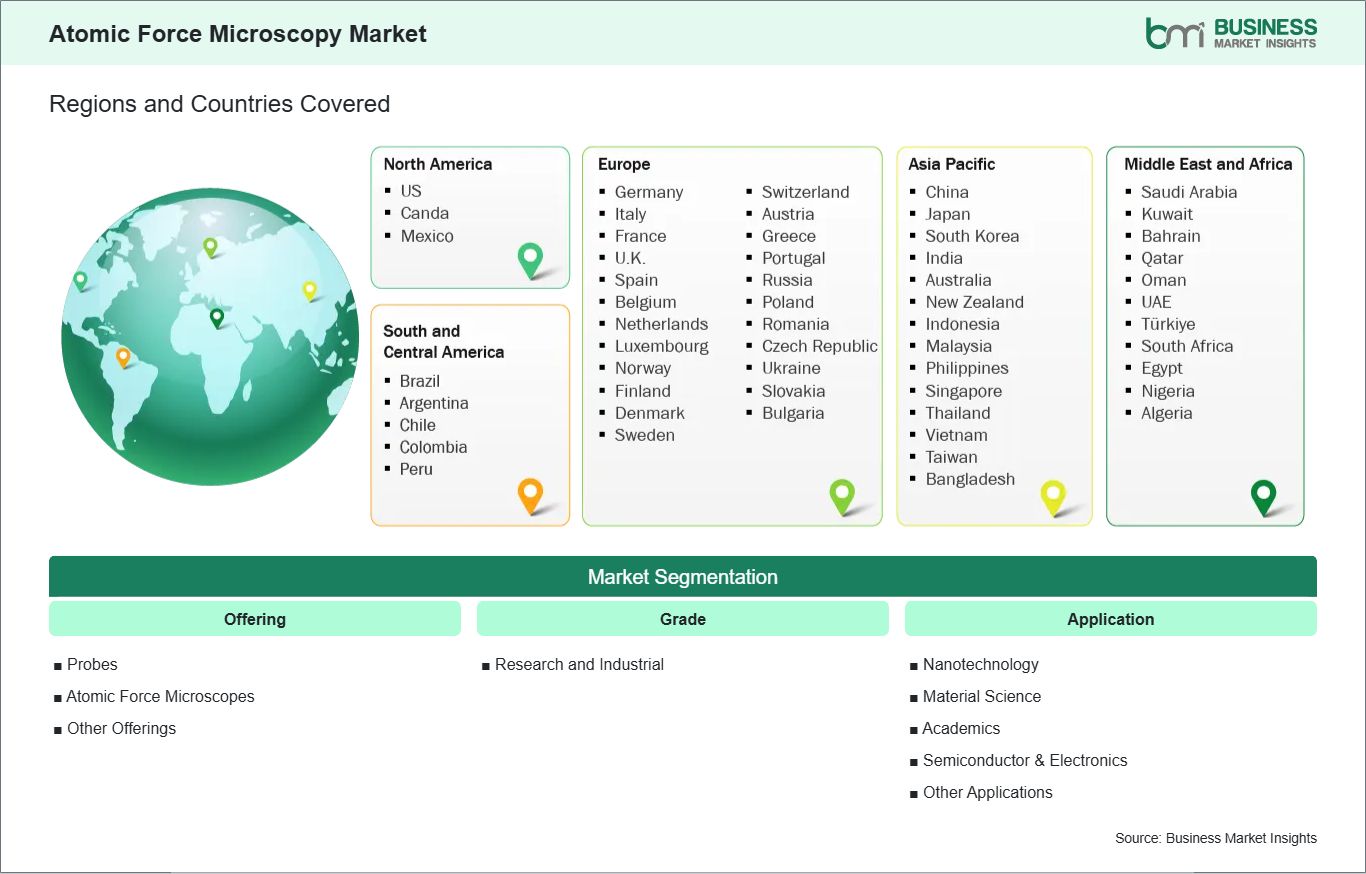
By offering, the global atomic force microscopy market is segments into Probes, Atomic Force Microscopes, and Others. The Probes segment dominated in 2025. Drives 45% installations: high-replacement scalability boosts fab wellness adoption in sub-3nm nodes.
By grade, the segments are Research and Industrial. The Industrial segment led in 2025. Captures 55% volume; automation programs demand rapid fab-to-industrial scaling.
By application, divisions include Nanotechnology, Material Science, Academics, Semiconductor & Electronics, and Others. The Semiconductor & Electronics segment held the largest share in 2025. Versatile 0.1-50 nm support enables seamless zone migrations globally.
| Report Attribute | Details |
|---|---|
| Market size in 2025 | US$ 630.29 Million |
| Market Size by 2033 | US$ 1,374.5 Million |
| Global CAGR (2026 - 2033) | 10.24% |
| Historical Data | 2022-2024 |
| Forecast period | 2026-2033 |
| Segments Covered | By Offering
|
|
Regions and Countries Covered
| |
| North America | US, Canada, Mexico |
| Europe | Belgium, Austria, Finland, Denmark, Greece, Poland, Romania, Russia, Ukraine, Czech Republic, Slovakia, Bulgaria, Italy, Luxembourg, Germany, Switzerland, France, Netherlands, Norway, Portugal, Spain, Sweden, United Kingdom |
| Asia-Pacific | Australia, China, India, Japan, South Korea, Indonesia, Malaysia, Philippines, Singapore, Thailand, Vietnam, Bangladesh, New Zealand, Taiwan |
| South and Central America | Brazil, Argentina, Peru, Chile, Colombia |
| Middle East and Africa | Bahrain, Kuwait, Oman, Qatar, Saudi Arabia, United Arab Emirates, Turkiye, South Africa, Egypt, Algeria, Nigeria |
| Market leaders and key company profiles |
|
The "Atomic Force Microscopy Market Size and Forecast (2022 - 2033)" report provides a detailed analysis of the market covering below areas:
The geographical scope of the atomic force microscopy market report is divided into five regions: North America, Asia Pacific, Europe, the Middle East & Africa, and South & Central America. The atomic force microscopy market in North America registered the highest market share in 2025.
North America still leads with mega-fabs and nano-labs across the US, Canada, and Mexico. There is a massive increase in US deployments, where sub-nm probes power TSMC's Arizona hubs and Intel edge nodes for tactical nano-AI. In Canada, operators like the National Research Council install research controls for ML pipelines. Maquiladoras light industrial AFMs to Tier 1 fab levels in Mexico. Europe advances via Horizon Europe and net-zero mandates, Germany's Zeiss and Tridonic craft probes for edge factories, the UK's Oxford cove adopted for BBC studios, and France's CEA stresses low-noise scanners for sovereign clouds. The Middle East builds data havens like Saudi NEOM's Aramco grids and UAE du's track probes for 6G sites. Asia Pacific thrives with China's 15th Plan trials and chip goals, TSMC taking micro-probe controls. Reliance in India deploys 1 nm/w retrofits but lags due to ceramic gaps. South and Central America will develop over the forecast period.

The atomic force microscopy market is evaluated by gathering qualitative and quantitative data post-primary and secondary research, which includes important corporate publications, association data, and databases. A few of the key developments in the atomic force microscopy market are:
The Atomic Force Microscopy Market is valued at US$ 630.29 Million in 2025, it is projected to reach US$ 1,374.5 Million by 2033.
As per our report Atomic Force Microscopy Market, the market size is valued at US$ 630.29 Million in 2025, projecting it to reach US$ 1,374.5 Million by 2033. This translates to a CAGR of approximately 10.24% during the forecast period.
The Atomic Force Microscopy Market report typically cover these key segments-
The historic period, base year, and forecast period can vary slightly depending on the specific market research report. However, for the Atomic Force Microscopy Market report:
The Atomic Force Microscopy Market is populated by several key players, each contributing to its growth and innovation. Some of the major players include:
The Atomic Force Microscopy Market report is valuable for diverse stakeholders, including:
Essentially, anyone involved in or considering involvement in the Atomic Force Microscopy Market value chain can benefit from the information contained in a comprehensive market report.
Please tell us your area of interest
(Market Segments/ Regions and Countries/ Companies)