Market Summary
Executive Summary and Global Market Analysis
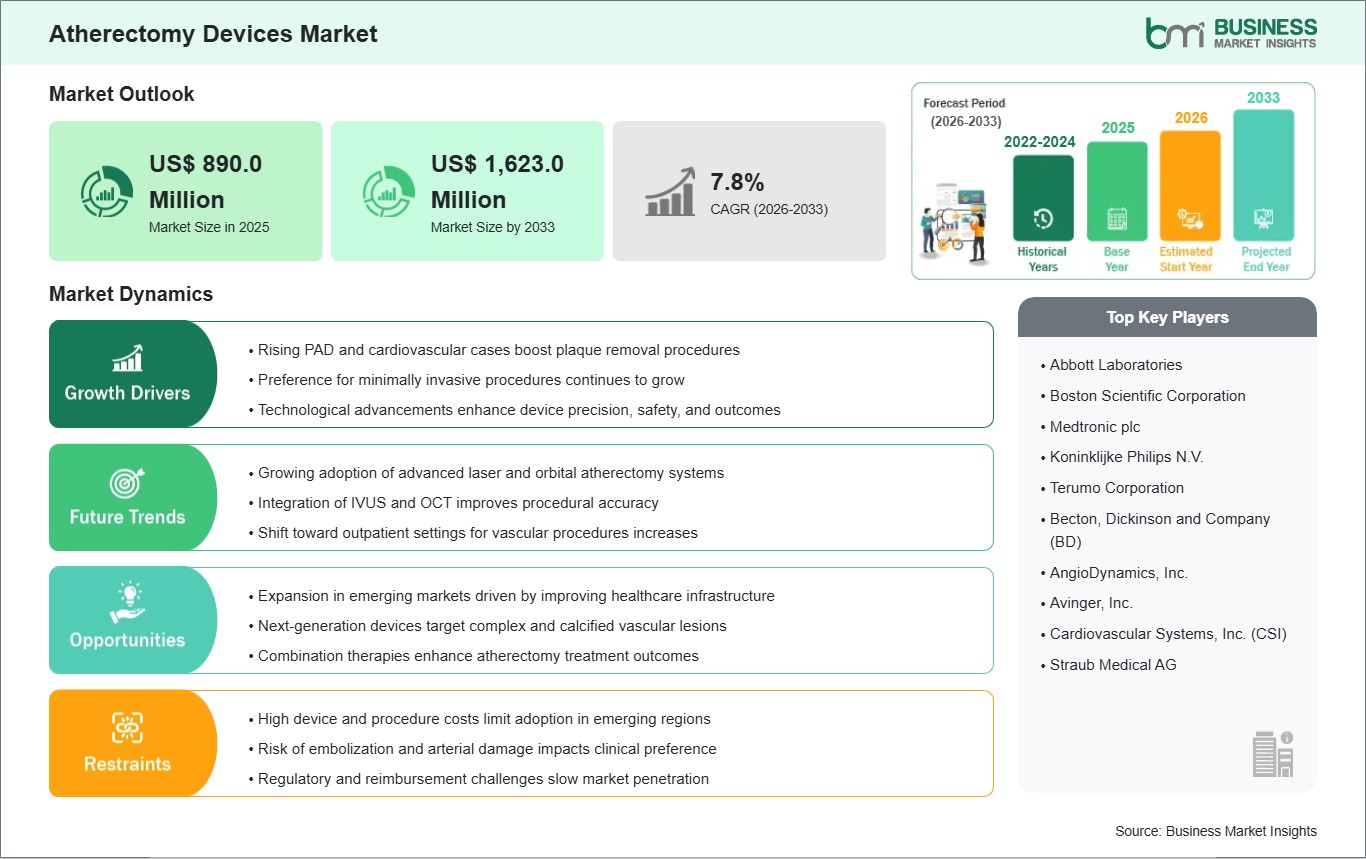
Atherectomy devices refer to a specialized category of minimally invasive surgical instruments designed to remove atherosclerotic plaque from the interior walls of blood vessels. Unlike balloon angioplasty, which compresses plaque against the vessel wall, or stenting, which scaffolds the artery open, atherectomy utilizes mechanical or thermal energy to debulk and physically eliminate obstructive material. Market expansion is fundamentally propelled by the rising global prevalence of atherosclerosis, exacerbated by sedentary lifestyles, high rates of diabetes, and a global aging population susceptible to vascular calcification. Furthermore, the shift toward minimally invasive endovascular procedures is accelerating the demand for tools that offer lower procedural trauma and shorter hospital stays compared to traditional open vascular surgery. The expansion of Office-Based Labs (OBLs) and Ambulatory Surgical Centers (ASCs), which prioritize outpatient revascularization, continues to serve as a primary catalyst for sustained demand.
However, several factors may restrain market progression. The high capital and per-procedure costs associated with sophisticated atherectomy systems can be prohibitive for healthcare facilities in emerging or resource-limited regions. Stringent regulatory and clinical trial requirements for Class III medical devices extend the timeline for commercialization and increase development costs. Additionally, the industry faces challenges related to reimbursement volatility, where periodic adjustments to outpatient payment levels can influence the adoption of premium technologies in private vascular practices.
Despite these hurdles, the market holds significant opportunities in the integration of intravascular imaging, such as IVUS or OCT, which allows for real-time visualization of plaque removal. The rise of combination therapies, such as atherectomy followed by drug-coated balloon (DCB) angioplasty, and the expansion of robotic-assisted catheterization are expected to support long-term development within the sector. Manufacturers are also finding growth potential in the development of specialized laser systems that minimize the risk of distal embolization during complex interventions.
Segment Analysis
Atherectomy Devices Market Segmentation
Key segments that contributed to the derivation of the Atherectomy Devices market analysis are product, application, and end user.
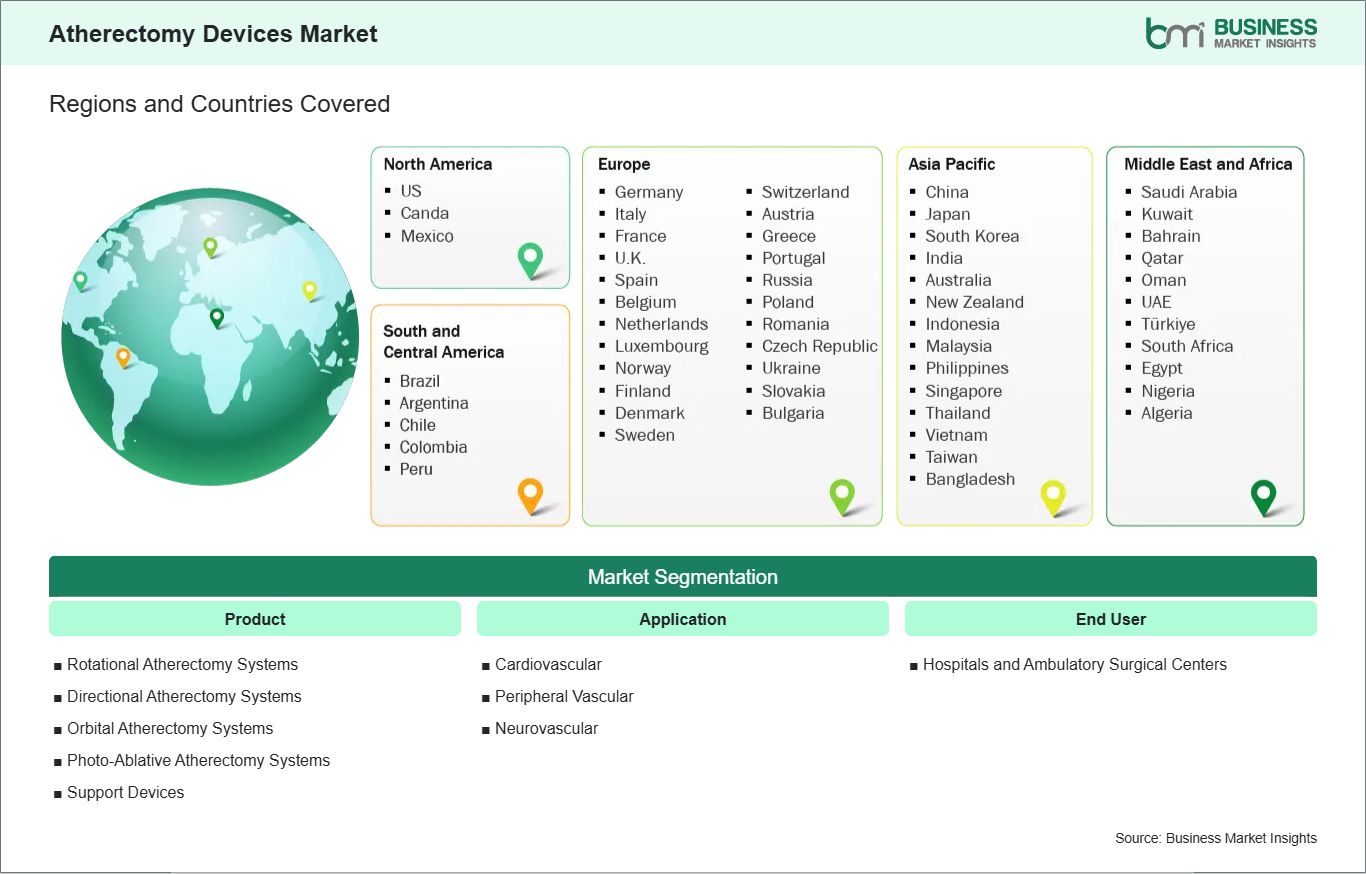
- By Product, the market is segmented into Rotational Atherectomy Systems, Directional Atherectomy Systems, Orbital Atherectomy Systems, Photo-Ablative Atherectomy Systems, and Support Devices.
- By Application, the market is divided into Cardiovascular, Peripheral Vascular, and Neurovascular.
- By End User, the market is categorized into Hospitals and Ambulatory Surgical Centers.
Market Forces
Atherectomy Devices Market Drivers and Opportunities
Demographic Vulnerability and Minimally Invasive Vascular Care
The primary driver for the Atherectomy Devices Market is the systemic global rise in the prevalence of peripheral artery disease (PAD) and coronary artery disease (CAD). The Increasing Incidence of Heavily Calcified Lesions acts as a foundational catalyst, as traditional angioplasty often fails to achieve adequate vessel expansion in these complex cases, necessitating mechanical plaque removal. This momentum is further propelled by the Growing Clinical Preference for Leave Nothing Behind Strategies; interventionalists are increasingly utilizing atherectomy to clear blockages without the permanent placement of metallic stents, thereby maintaining future surgical options and reducing foreign-body complications. In the technological sphere, the Integration of Real-Time Intravascular Imaging (IVUS/OCT) serves as a critical driver, allowing physicians to characterize plaque morphology and monitor debulking progress with sub-millimeter precision. Furthermore, the Expansion of Office-Based Labs (OBLs) and Ambulatory Surgical Centers (ASCs) is driving market growth by offering cost-effective, high-volume environments for outpatient vascular interventions. Together, these factors, disease complexity, stent-avoidance trends, and the shift toward outpatient care, ensure a robust and essential growth path for the global Atherectomy Devices Market.
AI-Guided Navigation and the Synergy of Combination Therapies
A significant high-value opportunity lies in the convergence of Atherectomy Platforms with Artificial Intelligence (AI) and Robotic-Assisted Surgery. Next-generation systems are being developed to utilize AI for automated lesion detection and real-time guidance, which reduces procedural variability and enhances safety by alerting clinicians to potential vessel dissections. There is also a major growth frontier in the development of Synergistic One-Device Solutions, where atherectomy is combined with other modalities, such as aspiration for embolic protection or intravascular lithotripsy for deep calcium modification, within a single catheter system. Furthermore, the expansion of Drug-Coated Balloon (DCB) Compatibility presents a lucrative opportunity, as evidence increasingly supports that thorough plaque excision significantly enhances the uptake of antiproliferative drugs into the vessel wall, leading to superior long-term patency. Beyond hardware, the rise of Precision-Designed Micro-Atherectomy for Neurovascular and Small-Vessel Applications offers a unique frontier, targeting previously unreachable blockages in the distal anatomy. Manufacturers who focus on Enhanced Crossing Profiles for Tortuous Anatomy and those pioneering Automated Smart Cutting Mechanisms are positioned to lead the global Atherectomy Devices Market.
Size and Share Analysis
Atherectomy Devices Market Size and Share Analysis
The Atherectomy Devices market demonstrates steady growth, with size and share analysis revealing evolving trends and competitive positioning among key players. The report examines subsegments categorized within product, application, and end user, offering insights into their contribution to overall market performance.
Based on the product, the Directional Atherectomy Systems subsegment holds the primary market presence, acting as the essential tool for targeted plaque removal in eccentric lesions. These systems are indispensable for the market, maintaining a significant position due to their ability to steer the cutting blade toward the plaque while protecting healthy arterial tissue. Rotational, Orbital, and Photo-Ablative (Laser) systems provide critical support for varied calcification levels. A notable trend is the surge in the Orbital Atherectomy and Laser Atherectomy subsegments, which are registering the highest pace of adoption. These technologies are becoming essential for Calcium Management and In-Stent Restenosis, as the move toward centrifugal sanding and ultraviolet photo-ablation allows for the safe treatment of severely hardened blockages and delicate neurovascular territories that were previously considered inaccessible or high-risk.
Report Coverage
Atherectomy Devices Market Report Coverage and Deliverables
The "Atherectomy Devices Market Size and Forecast (2022 - 2033)" report provides a detailed analysis of the market covering below areas:
- Market size and forecast at global, regional, and country levels for all market segments covered under the scope
- Market trends, as well as drivers, restraints, and opportunities
- Market analysis covering key trends, global and regional framework, major players, and recent developments
- Market concentration, heat map analysis, prominent players, and recent developments
- Detailed company profiles, including SWOT analysis
Geographic Insights
Atherectomy Devices Market Geographic Insights
The geographical scope of the Atherectomy Devices market report is divided into five regions: North America, Asia Pacific, Europe, Middle East & Africa, and South & Central America.
North America maintains a dominant market share, supported by a significant disease burden, advanced healthcare infrastructure, and the early adoption of interventional technologies such as AI-guided imaging. Europe represents a mature and technologically advanced market where growth is sustained by an aging population and a strong institutional focus on minimally invasive endovascular procedures. Asia Pacific is identified as the most rapidly advancing region, propelled by accelerating healthcare modernization, expanding clinical facilities, and substantial public investments to address the rising prevalence of cardiovascular mortality in emerging economies.
The Asia-Pacific Atherectomy Devices Market is segmented into China, Japan, South Korea, India, Australia, and the Rest of Asia Pacific. China serves as a central engine for regional expansion, driven by large-scale government programs to modernize vascular care and a growing demand for plaque-modification devices. India is witnessing a notable transition as private healthcare providers expand their interventional portfolios to address the high occurrence of peripheral and coronary artery diseases among the middle-class demographic. Japan continues to prioritize high-specification instrumentation, focusing on the integration of robotic catheter systems and advanced rotational atherectomy for its substantial geriatric population.
Industry Activity
Recent Developments
The Atherectomy Devices market is evaluated by gathering qualitative and quantitative data post primary and secondary research, which includes important corporate publications, association data, and databases. A few of the key developments in the Atherectomy Devices market are:
- In October 2025, BD launched the XTRACT™ Registry for the Rotarex™ Catheter System, enrolling the first patient in the U.S. The multi-center, post-market registry is designed to collect real-world evidence on the performance of BD`s atherectomy and thrombectomy device for peripheral artery disease (PAD). This initiative strengthens clinical validation, supports broader adoption, and highlights BD`s commitment to advancing evidence-based PAD care, positively impacting the atherectomy devices market.
- In November 2024, Philips launched the U.S. THOR IDE clinical trial for its innovative combined laser atherectomy and intravascular lithotripsy catheter. The first patient was successfully treated at the Cardiovascular Institute of the South, marking a milestone in peripheral artery disease (PAD) management. This first-of-its-kind device integrates two critical PAD treatments into a single procedure, simplifying workflows, reducing procedural complexity, and potentially improving patient outcomes. The launch underscores Philips’ in-house innovation capabilities and strengthens the pipeline of advanced atherectomy solutions, positively impacting market growth.
Trust & Transparency
Research Methodology
The market analysis combines proprietary research with secondary data from government agencies, company disclosures, regulatory filings, industry databases and expert interviews. Market estimates are validated through data triangulation, cross-market benchmarking and analyst
review.
View Full Research Methodology
Key Sources Referred:
World Bank & Global Trade IndicatorsWorld Trade Organization (WTO)(International Monetary Fund )IMFInternational Trade Administration (ITA)Company websiteCompany annual reportsCompany investor presentations