Market Summary
Executive Summary and Global Market Analysis
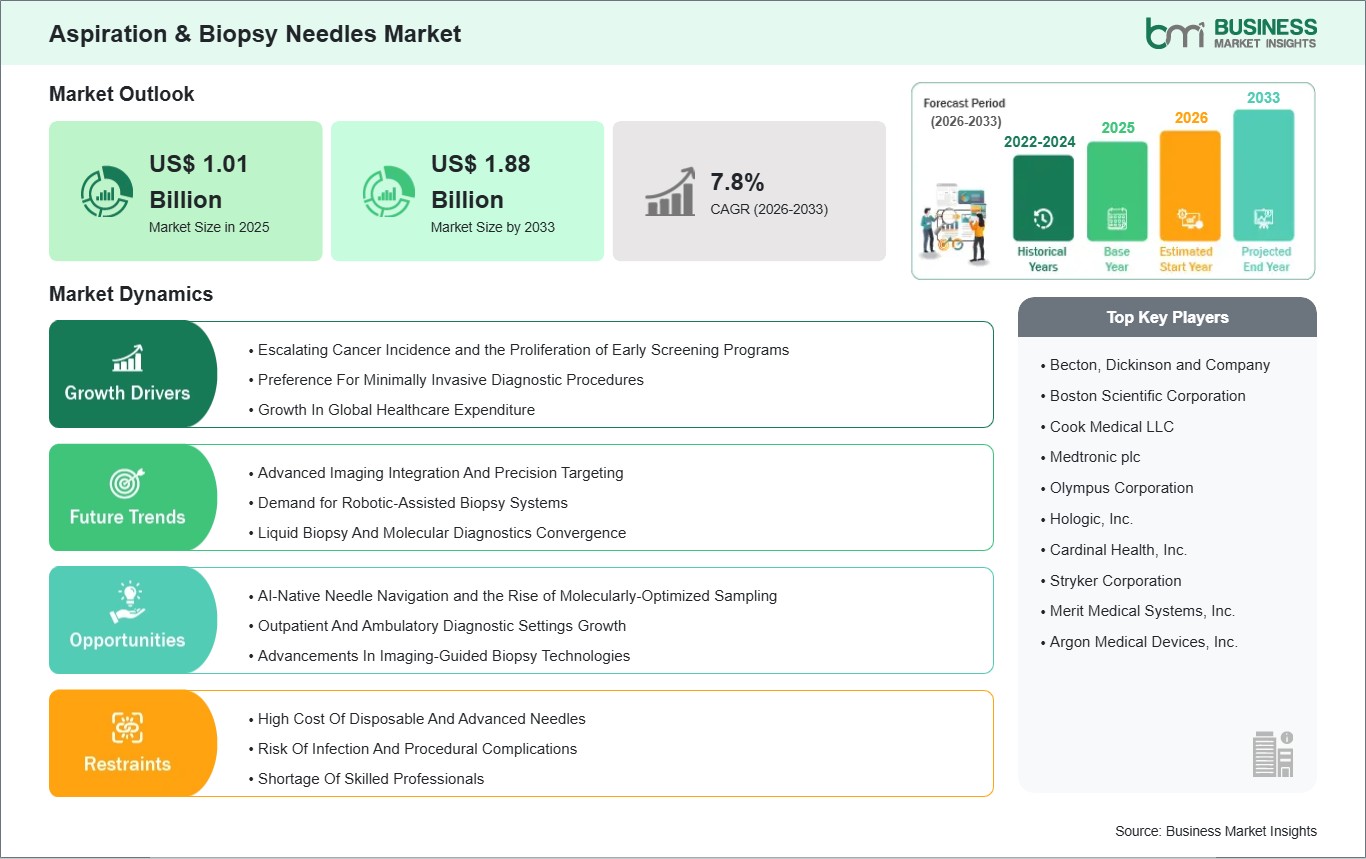
Aspiration biopsy needles refer to specialized, precision-engineered medical instruments designed to extract tissue or fluid samples from the body for diagnostic analysis. It is a critical pillar of modern oncology and pathology, providing the essential means for early disease detection and treatment monitoring. Market expansion is fundamentally propelled by the rising global incidence of cancer and autoimmune disorders, alongside an institutional shift toward minimally invasive diagnostics. These procedures offer significant clinical advantages, including reduced patient trauma, minimal scarring, and shorter recovery times compared to traditional surgical biopsies. Furthermore, a global aging population, characterized by a higher susceptibility to chronic conditions, continues to drive a sustained requirement for frequent and precise diagnostic sampling.
However, several factors may restrain market progression. The high cost of advanced imaging-guided systems and specialized vacuum-assisted devices can be prohibitive for healthcare facilities in resource-limited regions. Stringent regulatory mandates and quality standards for sterile medical devices necessitate substantial compliance investment and can extend product launch timelines. Additionally, the industry faces challenges related to the risk of procedural complications, such as localized infection or hemorrhage, and a global shortage of trained interventional radiologists and pathologists in certain developing markets.
Despite these hurdles, the market holds significant opportunities in the integration of artificial intelligence (AI) for real-time needle tracking and lesion targeting. The rise of robotic-assisted biopsy platforms, which enhance procedural stability and precision, and the expansion of healthcare infrastructure in emerging economies are expected to support long-term development. Manufacturers are also finding growth potential in the shift toward single-use, disposable needle systems to eliminate cross-contamination risks and streamline clinical workflows.
Segment Analysis
Aspiration & Biopsy Needles Market Segmentation
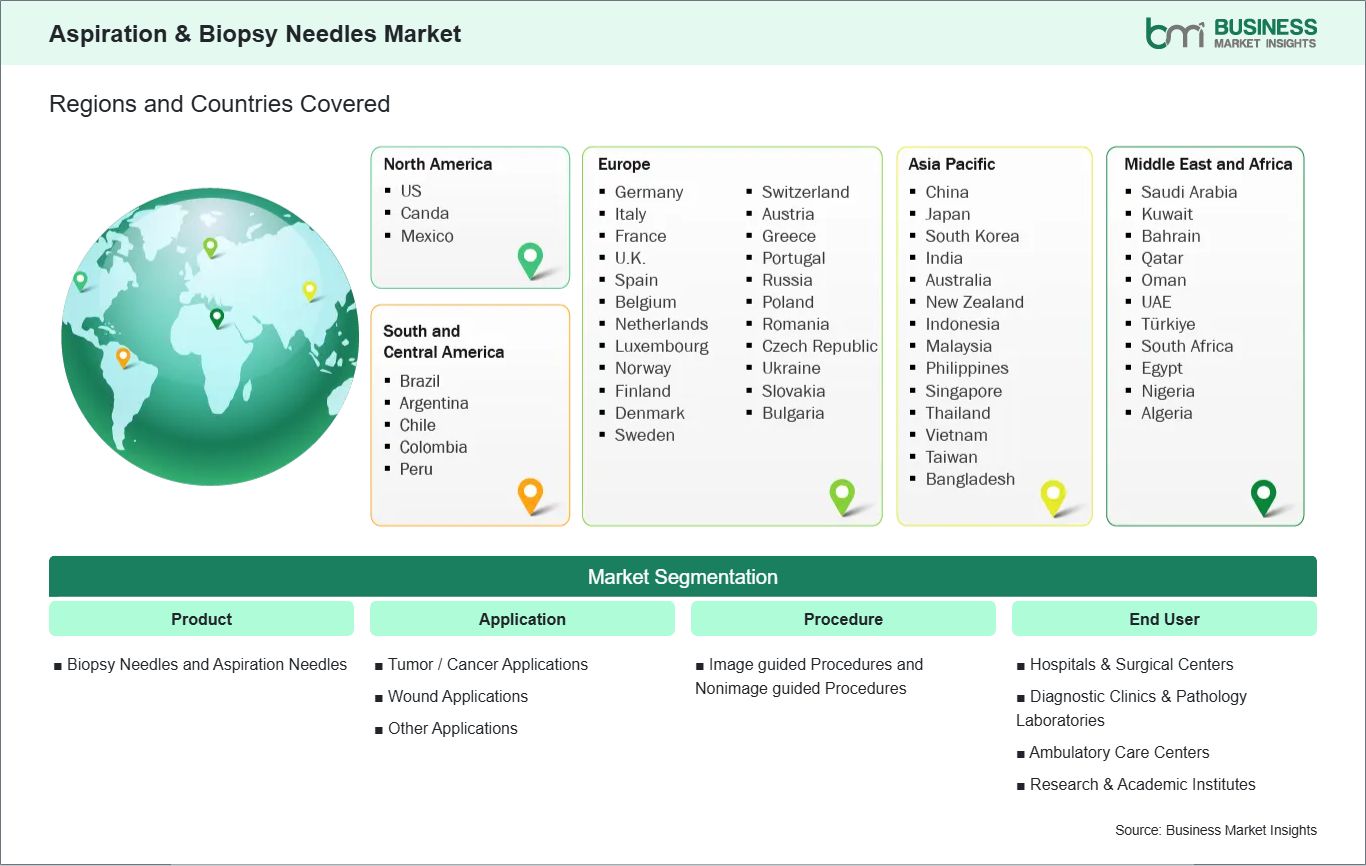
Key segments that contributed to the derivation of the Aspiration Biopsy Needles market analysis are product, application, procedure, and end user.
- By Product, the market is segmented into Biopsy Needles and Aspiration Needles.
- By Application, the market is divided into Tumor / Cancer Applications, Wound Applications, and Other Applications.
- By Procedure, the market is segmented into Image‑guided Procedures and Nonimage‑guided Procedures.
- By End User, the market is categorized into Hospitals & Surgical Centers, Diagnostic Clinics & Pathology Laboratories, Ambulatory Care Centers, Research & Academic Institutes.
Market Forces
Aspiration & Biopsy Needles Market Drivers and Opportunities
Escalating Cancer Incidence and the Proliferation of Early Screening Programs
The primary driver for the Aspiration Biopsy Needles Market is the systemic global rise in the prevalence of malignancies, particularly breast, lung, and gastrointestinal cancers. The Rising Demand for Early Cancer Detection and Staging acts as a foundational catalyst, as healthcare providers expand screening programs that necessitate accurate, minimally invasive tissue sampling. This momentum is further propelled by the Growing Clinical Preference for Fine Needle Biopsy (FNB) over Standard Aspiration; as personalized medicine requires intact tissue cores for genetic testing, the demand for needles with specialized menghini or forward-cutting tips is intensifying. In the technological sphere, the Widespread Integration of Endoscopic Ultrasound (EUS) and Image-Guided Platforms serves as a critical driver, enabling physicians to target deep-seated lesions, such as those in the pancreas or lymph nodes, with unparalleled accuracy. Furthermore, the Documented Reduction in Procedural Risks and Recovery Times associated with fine-needle techniques encourages their adoption over traditional surgical biopsies, especially in geriatric populations with multiple comorbidities. Together, these factors, demographic pressure, the precision medicine revolution, and imaging advancements, ensure a robust and essential growth path for the global Aspiration Biopsy Needles Market.
AI-Native Needle Navigation and the Rise of Molecularly-Optimized Sampling
A significant high-value opportunity lies in the convergence of Biopsy Needles with Artificial Intelligence (AI) and Robotic-Assisted Navigation. Next-generation smart biopsy systems are being developed to utilize AI for real-time needle tracking and automated trajectory planning, which significantly reduces the likelihood of non-diagnostic samples and minimizes accidental trauma to surrounding vascular structures. There is also a major growth frontier in the development of Advanced Surface Coatings and Echo-Enhanced Materials; by improving the visibility of ultra-fine needles under MRI or high-frequency ultrasound, manufacturers can facilitate the sampling of increasingly smaller and more complex lesions. Furthermore, the expansion of Single-Use, Fully Disposable Biopsy Kits presents a lucrative opportunity, as hospitals prioritize the elimination of cross-contamination and the reduction of overhead associated with instrument reprocessing. Beyond the hardware, the rise of Liquid Biopsy Synergy and Molecular-Ready Sampling offers a unique frontier, where needles are specifically designed to preserve the viability of cells for downstream genomic sequencing. Manufacturers who focus on Ergonomic, One-Handed Activation Devices and those pioneering Sustainable, Metal-Recyclable Needle Platforms are positioned to lead the most innovative and high-margin segments of the global Aspiration Biopsy Needles Market.
Size and Share Analysis
Aspiration & Biopsy Needles Market Size and Share Analysis
Based on the procedure, the Image-Guided Procedures subsegment holds the primary market presence, serving as the modern standard of care for most clinical biopsies. These procedures are indispensable for the market, maintaining a dominant influence as the integration of ultrasound, CT, and MRI guidance allows for the precise targeting of deep-seated or non-palpable lesions. A notable trend is the surge in the Ultrasound-Guided and MRI-Guided subsegments, which are registering significant traction. In these procedures, specialized needles are becoming essential for Real-Time Visual Verification, where the strategic requirement for echogenic coatings and non-ferromagnetic materials ensures optimal needle visibility and safety within the imaging field.
Report Coverage
Aspiration & Biopsy Needles Market Report Coverage and Deliverables
The "Aspiration Biopsy Needles Market Size and Forecast (2022–2033)" report provides a detailed analysis of the market covering below areas:
- Aspiration Biopsy Needles market size and forecast at global, regional, and country levels for all market segments covered under the scope
- Aspiration Biopsy Needles market trends, as well as drivers, restraints, and opportunities
- Aspiration Biopsy Needles market analysis covering key trends, global and regional framework, major players, regulations, and recent developments
- Industry landscape and competition analysis covering market concentration, heat map analysis, prominent players, and recent developments for the Aspiration Biopsy Needles market
- Detailed company profiles, including SWOT analysis
Geographic Insights
Aspiration & Biopsy Needles Market Geographic Insights
The geographical scope of the Aspiration Biopsy Needles market report is divided into five regions: North America, Asia Pacific, Europe, Middle East & Africa, and South & Central America.
North America maintains the primary market position, supported by a sophisticated healthcare infrastructure, high healthcare expenditure per capita, and the early clinical adoption of precision diagnostic tools such as vacuum-assisted biopsy systems. Europe represents a mature and highly regulated market where growth is sustained by strong government-funded healthcare programs, a rising geriatric demographic, and an increasing institutional focus on early cancer screening. Asia Pacific is identified as the most rapidly advancing region, propelled by accelerating healthcare modernization, the expansion of oncology centers in emerging economies, and substantial public investments to address the rising burden of chronic illnesses.
The Asia-Pacific Aspiration Biopsy Needles Market is segmented into China, Japan, South Korea, India, Australia, and the Rest of Asia Pacific. China serves as a central engine for regional expansion, driven by large-scale government initiatives to modernize diagnostic facilities and a significant domestic production capacity for high-quality, cost-effective medical consumables. India is witnessing a notable transition as private healthcare networks and diagnostic chains expand their biopsy services to meet the needs of a rising middle-class population. Japan continues to prioritize innovation in high-specification instrumentation, focusing on the integration of ultra-fine needles and automated sampling systems to support its advanced geriatric care frameworks.
Industry Activity
Recent Developments
The Aspiration Biopsy Needles market is evaluated by gathering qualitative and quantitative data post primary and secondary research, which includes important corporate publications, association data, and databases. A few of the key developments in the Aspiration Biopsy Needles market are:
- In January 2026, Olympus launched its SecureFlex™ single-use fine needle biopsy device in the U.S., designed for precise tissue sampling in challenging areas such as the pancreas. The device aims to improve diagnostic accuracy and procedural efficiency for gastroenterologists performing ultrasound-guided biopsies.
- In May 2024, Cook Medical launched the EchoTip ClearCore™ EUS Biopsy Needle in the U.S., designed for precise fine-needle biopsies of gastrointestinal and adjacent lesions. The needle`s flexible, cobalt-chromium Franseen tip allows physicians to access difficult anatomy with minimal force and improved tissue sampling accuracy.
Trust & Transparency
Research Methodology
The market analysis combines proprietary research with secondary data from government agencies, company disclosures, regulatory filings, industry databases and expert interviews. Market estimates are validated through data triangulation, cross-market benchmarking and analyst
review.
View Full Research Methodology
Key Sources Referred:
World Bank – Global Trade IndicatorsWorld Trade Organization (WTO)(International Monetary Fund )IMFInternational Trade Administration (ITA)Company websiteCompany annual reportsCompany investor presentations