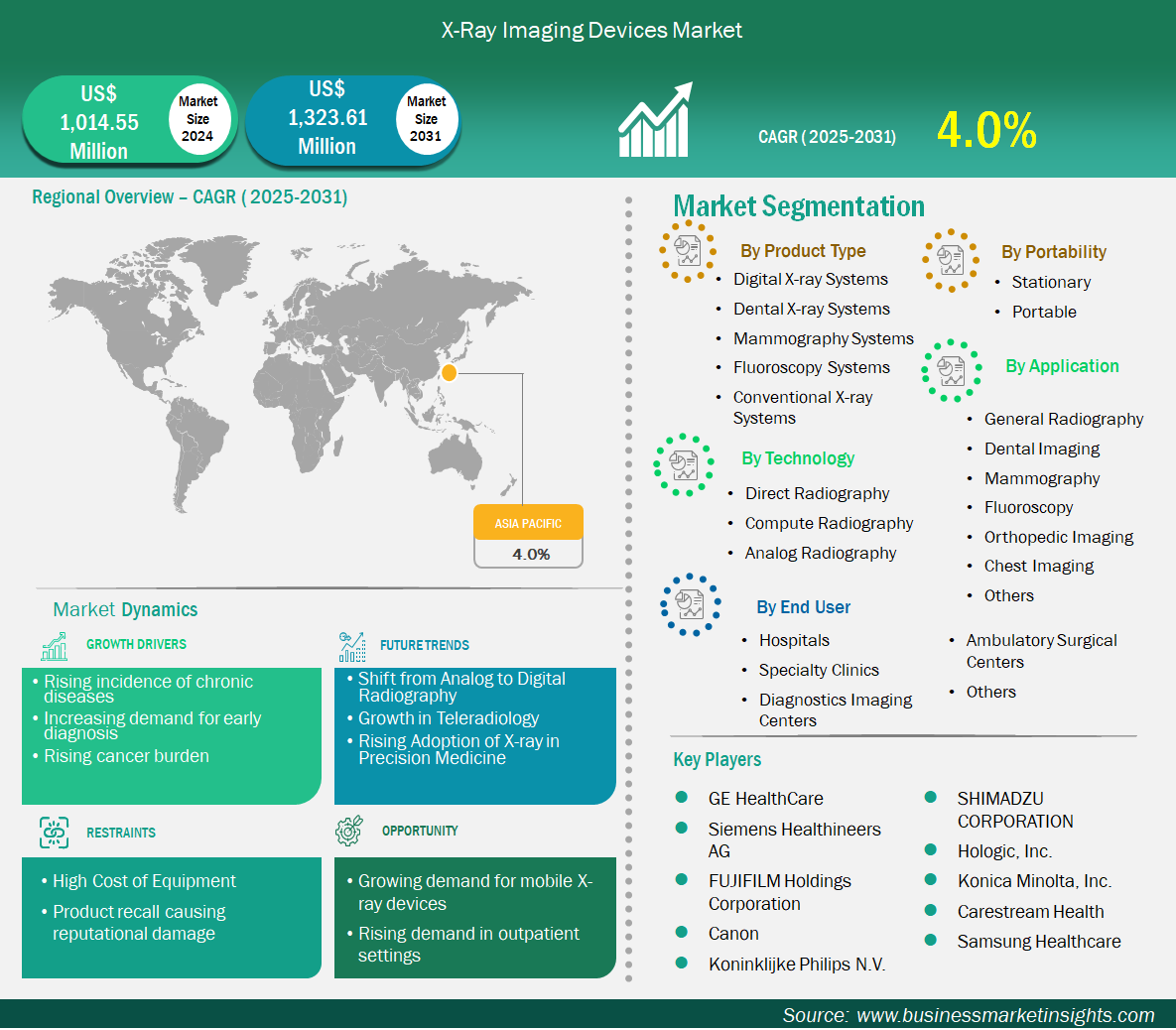
The Asia Pacific X-ray imaging devices market size is expected to reach US$ 1,323.61 million by 2031 from US$ 1,014.55 million in 2024. The market is estimated to record a CAGR of 4.0% from 2025 to 2031.
Executive Summary and Asia Pacific X-Ray Imaging Devices Market Analysis:
In the Asia Pacific region, the market for X-ray imaging devices is growing fast and shifting quickly. This growth is being driven by factors such as an aging population, rising cases of chronic illnesses like cardiovascular and orthopedic conditions, and steady improvements in technology. One big shift is the move from conventional film systems to newer digital options like DR and CR. These systems are faster, produce clearer images, and use lower radiation doses, which makes them more efficient and safer. New technologies, such as AI-assisted imaging and cloud storage, are making diagnostics easier and quicker. Overall, the Asia Pacific market is becoming very important in the global X-ray imaging industry.
Asia Pacific X-Ray Imaging Devices Market Segmentation Analysis:
Key segments that contributed to the derivation of the X-ray imaging devices market analysis are product type, portability, technology, application, and end user.
- By product type, the X-ray imaging devices market is segmented into digital X-ray systems, dental X-ray systems, mammography systems, fluoroscopy systems, and conventional X-ray systems. The digital X-ray systems segment dominated the market in 2024.
- By portability, the X-ray imaging devices market is segmented into stationary and portable. The stationary segment dominated the market in 2024.
- By technology, the X-ray imaging devices market is segmented into direct radiography, computed radiography, and analog radiography. The direct radiography segment dominated the market in 2024.
- By application, the X-ray imaging devices market is segmented into general radiography, dental imaging, mammography, fluoroscopy, orthopedic imaging, chest imaging, and others. The general radiography segment dominated the market in 2024.
- By end user, the market is segmented into hospitals, specialty clinics, diagnostics imaging centers, ambulatory surgical centers, and others. The hospitals segment held the largest share of the market in 2024.
Asia Pacific X-Ray Imaging Devices Market Outlook
One of the largest factors fueling growth of the Asia Pacific X-ray marketplace is that region's tendency to modernize healthcare facilities. This tendency is most pronounced in developing countries where local governments are implementing new programs and committing large budgets to upgrade hospitals and clinics. However, modernization isn't limited to simply replacing outdated machines, there has been a significant effort to introduce new technologies that improve both patient quality and operational efficiency. Digitalization is at the heart of these changes. Many policies now encourage healthcare providers to adopt advanced imaging tools, which is fueling steady demand for new X-ray equipment. From basic machines for local clinics to top-tier systems for specialized centers, the need spans all levels of care. With strong investment from both public and private sectors, the market is set up for long-term growth.
Asia Pacific X-Ray Imaging Devices Market Country Insights
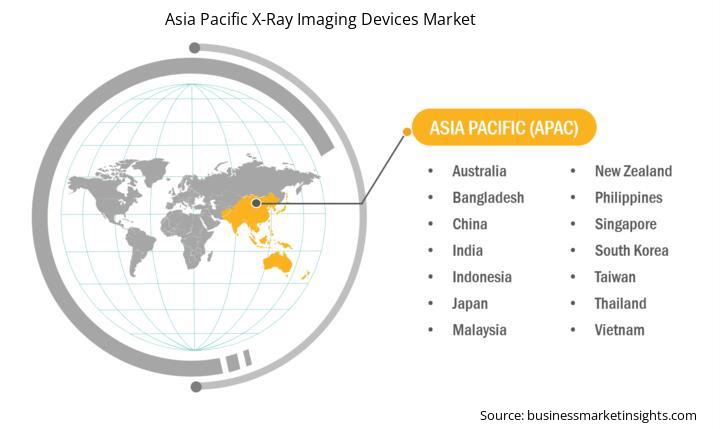
Based on country, the Asia Pacific X-ray imaging devices market is segmented into China, Japan, South Korea, India, Australia, New Zealand, Indonesia, Malaysia, the Philippines, Singapore, Thailand, Vietnam, Taiwan, Bangladesh, and the Rest of Asia. China held the largest share in 2024.
China leads the Asia Pacific X-ray imaging devices market, due to its large healthcare network, strong domestic manufacturing, and supportive government policies. X-Ray imaging is widely used in hospitals, specialty centers, and rural clinics for everything from maternal health to cancer, cardiovascular conditions, and emergency care. The country's focus on making healthcare more accessible has led to a major increase in the use of portable X-ray imaging devices systems, especially in areas that do not have enough medical services. Chinese manufacturers like Mindray and others are key to this effort. They create affordable, high-quality devices that meet the needs of the local market.
China's regulations also help new rapid adoption of new technologies, such as AI-powered imaging and teleradiology. The use of X-ray imaging devices in national health programs and the growth of private healthcare providers are also boosting the market. With its combination of a large market, new technology, and government support, China continues to be a leader in X-ray imaging devices in Asia Pacific.
Asia Pacific X-Ray Imaging Devices Market Company Profiles
GE HealthCare, Siemens Healthineers AG, FUJIFILM Holdings Corporation, Canon Inc., Koninklijke Philips N.V., SHIMADZU CORPORATION, Hologic, Inc., Konica Minolta, Inc., Carestream Health, and Samsung Healthcare are among the key players operating in the market. These players adopt strategies such as expansion, product innovation, and mergers and acquisitions to stay competitive in the market and offer innovative products to their consumers.
Asia Pacific X-Ray Imaging Devices Market Research Methodology:
The following methodology has been followed for the collection and analysis of data presented in this report:
- Secondary Research
The research process begins with comprehensive secondary research, utilizing both internal and external sources to gather qualitative and quantitative data for each market. Commonly referenced secondary research sources include, but are not limited to:
- Company websites, annual reports, financial statements, broker analyses, and investor presentations
- Industry trade journals and other relevant publications
- Government documents, statistical databases, and market reports
- News articles, press releases, and webcasts specific to companies operating in the market
Note: All financial data included in the Company Profiles section has been standardized to US$. For companies reporting in other currencies, figures have been converted to US$ using the relevant exchange rates for the corresponding year.
- Primary Research
Business Market Insights conducts a significant number of primary interviews each year with industry stakeholders and experts to validate and analyze the data and gain valuable insights. These research interviews are designed to:
- Refine findings from secondary research
- Enhance the expertise and market understanding of the analysis team
- Gain insights into market size, trends, growth patterns, competitive dynamics, and future prospects
Primary research is conducted via email interactions and telephone interviews with industry experts across various markets, categories, segments, and sub-segments in different regions. Participants typically include:
- Industry stakeholders: Vice Presidents, business development managers, market intelligence managers, and national sales managers
- External experts: Valuation specialists, research analysts, and key opinion leaders with industry-specific expertise
Key Sources Referred:
- The World Bank World Development Indicators
- World Health Organization (WHO)
- Center for Disease Control and Prevention (CDC)
- Radiological Society of North America
- American Society of Radiologic Technologists
- National Institutes of Health (NIH)
- Global Cancer Observatory
- Company website
- Company annual reports
- Company investor presentations
Asia Pacific X-Ray Imaging Devices Market Strategic Insights
Asia Pacific X-Ray Imaging DevicesMarket Report Highlights
| Report Attribute | Details |
| Market size in 2024 | US$ 1,014.55 Million |
| Market Size by 2031 | US$ 1,323.61 Million |
| CAGR (2025 - 2031) | 4.0% |
| Historical Data | 2021-2023 |
| Forecast period | 2025-2031 |
| Segments Covered |
By Product Type
|
|
Regions and Countries Covered
|
|
| Asia Pacific | China, Japan, South Korea, India, Australia, New Zealand, Indonesia, Malaysia, Philippines, Singapore, Thailand, Vietnam, Taiwan, Bangladesh |
| Market leaders and key company profiles |
|
Asia Pacific X-Ray Imaging Devices Market Country and Regional Insights