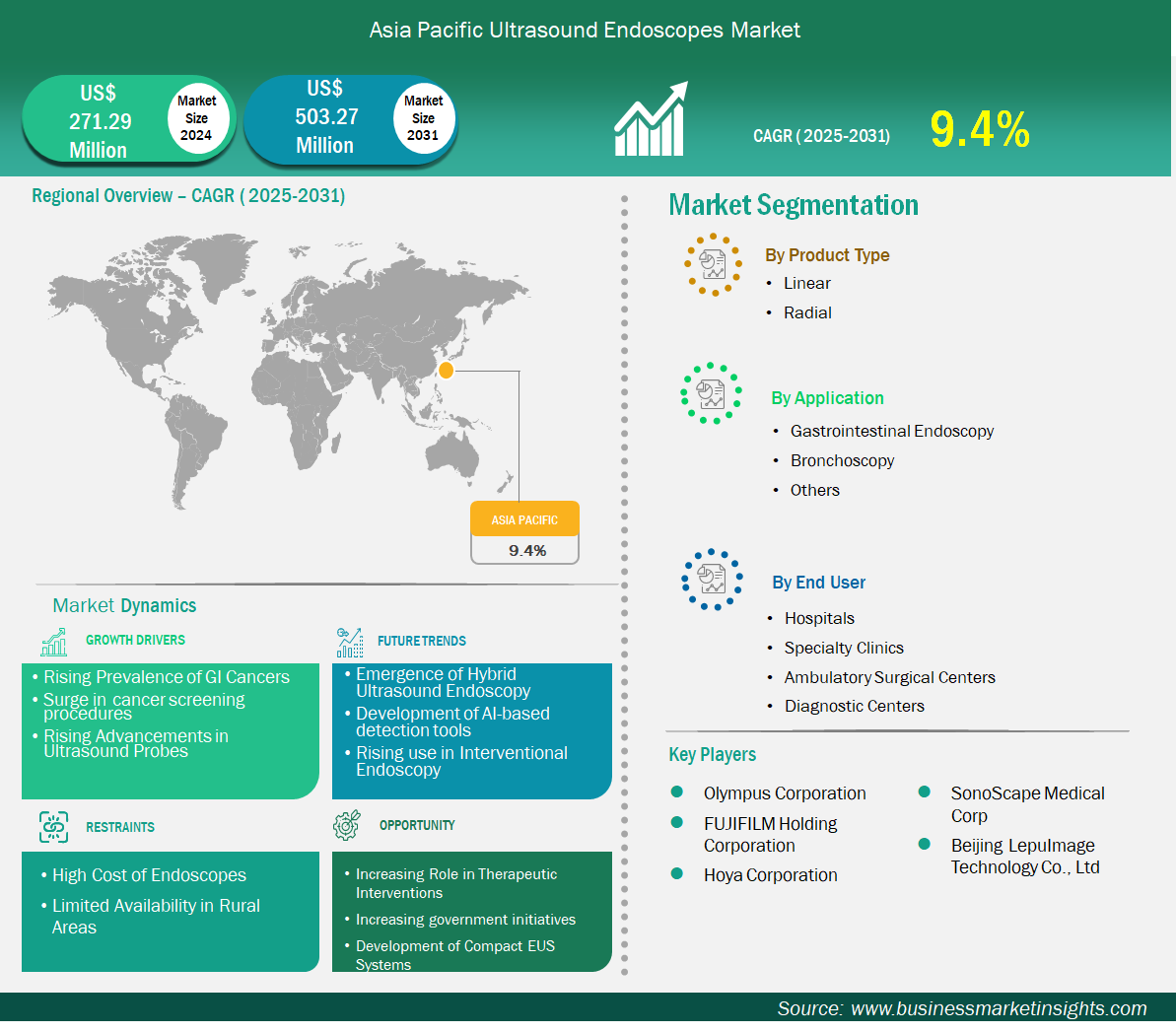
The Asia Pacific ultrasound endoscopes market size is expected to reach US$ 503.27 million by 2031 from US$ 271.29 million in 2024. The market is estimated to record a CAGR of 9.4% from 2025 to 2031.
Executive Summary and Asia Pacific Ultrasound Endoscopes Market Analysis:
The Asia Pacific region is emerging as the fastest-growing market for ultrasound endoscopes. This trend is mainly attributed to the modernizing healthcare infrastructure, increasing awareness of minimally invasive diagnostics, and the upsurge in disease screening programs. Presently, a major part of the demand is coming from the hospitals and specialty centers where healthcare providers need state-of-the-art imaging solutions for gastrointestinal and pancreatic disorders. The growing burden of chronic diseases and a strong shift toward precision-based diagnosis are further strengthening market growth. While technology adoption varies across countries, ongoing healthcare modernization and increasing physician training initiatives are fueling uptake. The region’s supportive government programs and growing investment in medical imaging innovation are also encouraging faster penetration of ultrasound endoscopes across both developed and developing economies.
Asia Pacific Ultrasound Endoscopes Market Segmentation Analysis:
Key segments that contributed to the derivation of the ultrasound endoscopes market analysis are product type, application, and end user.
- By product type, the ultrasound endoscope market is segmented into linear and radial. The linear segment dominated the market in 2024.
- By application, the ultrasound endoscope market is segmented into gastrointestinal endoscopy, bronchoscopy, and others. The gastrointestinal endoscopy segment dominated the market in 2024.
- By end user, the market is segmented into hospitals, specialty clinics, ambulatory surgical centers, and diagnostic centers. The hospitals segment held the largest share of the market in 2024.
Asia Pacific Ultrasound Endoscopes Market Outlook
The Asia Pacific ultrasound endoscopes market is influenced by a combination of highly clinical standards in the developed countries and the increasing healthcare access in the developing countries. To provide faster diagnostic solutions, urban hospitals are progressively bringing ultrasound endoscopy into their diagnostic processes with the rising focus on patient comfort. Nonetheless, the scarcity of trained professionals and the high device prices are still challenges that hinder the expansion of the market in disadvantaged areas. One of the key drivers is the increasing focus on early cancer detection, particularly gastrointestinal and pancreatic cancers. Governments and healthcare providers are emphasizing preventive screening, encouraging hospitals to adopt endoscopic ultrasound systems for better diagnostic precision and real-time visualization during procedures.
Asia Pacific Ultrasound Endoscopes Market Country Insights
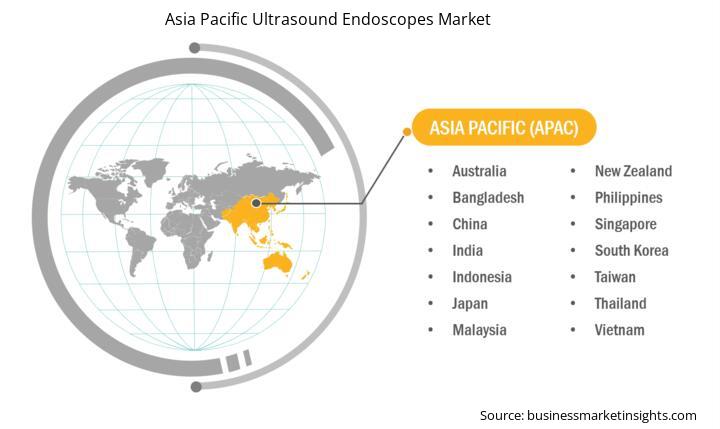
Based on country, the Asia Pacific ultrasound endoscopes market is segmented into China, Japan, South Korea, India, Australia, New Zealand, Indonesia, Malaysia, the Philippines, Singapore, Thailand, Vietnam, Taiwan, Bangladesh, and the Rest of Asia. China held the largest share in 2024.
China dominates the Asia Pacific ultrasound endoscopes market due to its huge patient base and extensive healthcare reforms. The government has been keen to encourage the use of advanced diagnostic imaging via the modulation of hospitals, and this has led to faster adoption in urban centers and provincial cities. Large domestic players are increasing production capabilities and investing heavily in R&D for better image quality, flexibility of the instruments, and affordability of their devices. Endoscopic ultrasound is being recognized by hospitals as a viable and reliable way to diagnose diseases related to pancreatic, biliary, and gastrointestinal diseases. Rising health expenditure combined with specialist gastroenterology centers will continue to support China as the leading market in this region. Moreover, government-supported physician training programs and collaborations with global imaging companies are fostering faster technology diffusion throughout the country.
Asia Pacific Ultrasound Endoscopes Market Company Profiles
Asia Pacific Ultrasound Endoscopes Market Research Methodology:
The following methodology has been followed for the collection and analysis of data presented in this report:
Secondary Research
The research process begins with comprehensive secondary research, utilizing both internal and external sources to gather qualitative and quantitative data for each market. Commonly referenced secondary research sources include, but are not limited to:
- Company websites, annual reports, financial statements, broker analyses, and investor presentations
- Industry trade journals and other relevant publications
- Government documents, statistical databases, and market reports
- News articles, press releases, and webcasts specific to companies operating in the market
Note: All financial data included in the Company Profiles section has been standardized to US$. For companies reporting in other currencies, figures have been converted to US$ using the relevant exchange rates for the corresponding year.
Primary Research
Business Market Insights conducts a significant number of primary interviews each year with industry stakeholders and experts to validate and analyze the data and gain valuable insights. These research interviews are designed to:
- Refine findings from secondary research
- Enhance the expertise and market understanding of the analysis team
- Gain insights into market size, trends, growth patterns, competitive dynamics, and future prospects
Primary research is conducted via email interactions and telephone interviews with industry experts across various markets, categories, segments, and sub-segments in different regions. Participants typically include:
- Industry stakeholders: Vice Presidents, business development managers, market intelligence managers, and national sales managers
- External experts: Valuation specialists, research analysts, and key opinion leaders with industry-specific expertise
Key Sources Referred:
- The World Bank
- World Health Organization (WHO)
- Center for Disease Control and Prevention (CDC)
- American Society for Gastrointestinal Endoscopy
- European Society of Gastrointestinal Endoscopy
- World Endoscopy Organization
- Society of American Gastrointestinal and Endoscopic Surgeons
- Global Cancer Observatory
- Company website
- Company annual reports
- Company investor presentations
Asia Pacific Ultrasound Endoscopes Market Strategic Insights
Asia Pacific Ultrasound EndoscopesMarket Report Highlights
| Report Attribute | Details |
| Market size in 2024 | US$ 271.29 Million |
| Market Size by 2031 | US$ 503.27 Million |
| CAGR (2025 - 2031) | 9.4 % |
| Historical Data | 2021-2023 |
| Forecast period | 2025-2031 |
| Segments Covered |
By Product Type
|
|
Regions and Countries Covered
|
|
| Asia Pacific | China, Japan, South Korea, India, Australia, New Zealand, Indonesia, Malaysia, Philippines, Singapore, Thailand, Vietnam, Taiwan, Bangladesh |
| Market leaders and key company profiles |
|
Asia Pacific Ultrasound Endoscopes Market Country and Regional Insights